Books🍂📚

Items in this hypelist
À lire

LA PESTE ECARLATE
LONDON JACK · 2020

La société du spectacle
Guy Debord · 1992

Les cendres de Gramsci
Pier Paolo Pasolini · 2025

Feu!!: Harlem 1926
Collectif · 2017

The Trial
Franz Kafka · 2020

La Perle et la coquille
Nadia HASHIMI · 2015

Entre deux mondes
Olivier Norek · 2024

La Nuit où les étoiles se sont éteintes - tome 1
Nine Gorman, Marie Alhinho · 2021

Incendies
Wajdi Mouawad
<p>Au début de l'histoire, la mort d'une femme qui, il y a longtemps déjà, a décidé de se taire. Elle adresse ses dernières volontés aux jumeaux Jeanne et Simon, ses enfants. Début d'un périple lourd de révélations sur leur identité. 4 hommes, 5 femmes / durée : 2 h 45</p>

Price of legacy
Anita Rigins · 2025

Tant que fleuriront les citronniers
Zoulfa Katouh · 2023

Un féminisme décolonial
Françoise Vergès · 2019

Le populisme, voilà l'ennemi !
Thomas Frank · 2021

Crime et Chatiment
Fyodor Dostoyevsky · 1975

Save Me An Orange
Hayley Grace · 2024
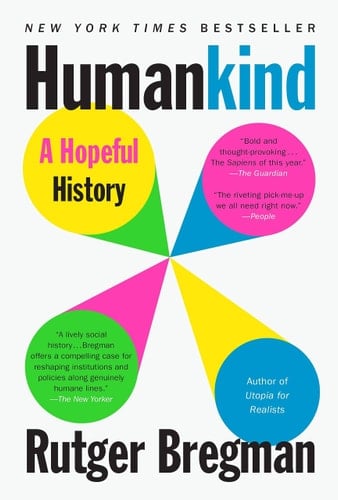
Humankind: A Hopeful History
Rutger Bregman · 2021
AN INSTANT NEW YORK TIMES BESTSELLER<br/><br/>The “lively” (The New Yorker), “convincing” (Forbes), and “riveting pick-me-up we all need right now” (People) that proves humanity thrives in a crisis and that our innate kindness and cooperation have been the greatest factors in our long-term success as a species.<br/><br/>If there is one belief that has united the left and the right, psychologists and philosophers, ancient thinkers and modern ones, it is the tacit assumption that humans are bad. It's a notion that drives newspaper headlines and guides the laws that shape our lives. From Machiavelli to Hobbes, Freud to Pinker, the roots of this belief have sunk deep into Western thought. Human beings, we're taught, are by nature selfish and governed primarily by self-interest.<br/><br/>But what if it isn't true? International bestseller Rutger Bregman provides new perspective on the past 200,000 years of human history, setting out to prove that we are hardwired for kindness, geared toward cooperation rather than competition, and more inclined to trust rather than distrust one another. In fact this instinct has a firm evolutionary basis going back to the beginning of Homo sapiens.<br/><br/>From the real-life Lord of the Flies to the solidarity in the aftermath of the Blitz, the hidden flaws in the Stanford prison experiment to the true story of twin brothers on opposite sides who helped Mandela end apartheid, Bregman shows us that believing in human generosity and collaboration isn't merely optimistic—it's realistic. Moreover, it has huge implications for how society functions. When we think the worst of people, it brings out the worst in our politics and economics. But if we believe in the reality of humanity's kindness and altruism, it will form the foundation for achieving true change in society, a case that Bregman makes convincingly with his signature wit, refreshing frankness, and memorable storytelling.<br/><br/>"The Sapiens of 2020." —The Guardian<br/><br/>"Humankind made me see humanity from a fresh perspective." —Yuval Noah Harari, author of the #1 bestseller Sapiens<br/><br/>Longlisted for the 2021 Andrew Carnegie Medal for Excellence in Nonfiction<br/><br/>One of the Washington Post's 50 Notable Nonfiction Works in 2020
Uncategorized

Les Silences des pères
Rachid Benzine
Un fils apprend au téléphone le décès de son père. Ils s’étaient éloignés : un malentendu, des drames puis des non-dits, et la distance désormais infranchissable. Maintenant que l’absence a remplacé le silence, le fils revient à Trappes, le quartier de son enfance, pour veiller avec ses soeurs la dépouille du défunt et trier ses affaires. Tandis qu’il débarrasse l’appartement, il découvre une enveloppe épaisse contenant quantité de cassettes audio, chacune datée et portant un nom de lieu. Il en écoute une et entend la voix de son père qui s’adresse à son propre père resté au Maroc. Il y raconte sa vie en France, année après année. Notre narrateur décide alors de partir sur les traces de ce taiseux dont la voix semble comme resurgir du passé. Le nord de la France, les mines de charbon des Trente Glorieuses, les usines d’Aubervilliers et de Besançon, les maraîchages et les camps de harkis en Camargue : le fils entend l’histoire de son père et le sens de ses silences.

L'origine du capitalisme
Ellen Meiksins Wood

Des masculinités: Hégémonie, inégalités, colonialité
Raewyn Connell · 2024

Sociologie de la police
Fabien Jobard, Jacques de Maillard · 2015