Items in this hypelist
To Read
Books test
Have you ever wondered why that 13-digit number on the back of a book costs $125 in the United States but is completely free in Canada and India? This book, The Global ISBN Handbook, is your 2025 guide to the International Standard Book Number. It explains everything about this global "fingerprint" for books. The ISBN is the most important cornerstone of the publishing industry. It started as a simple warehouse tool in the 1960s. Now, it is a complex digital identifier used in over 200 countries. This handbook deconstructs the entire system. It uses 15 distinct national case studies to do this. You will learn how the old 10-digit system changed to the new 13-digit one. We break down the five parts of the ISBN, from the "Bookland" prefix to the final check digit. The book explores the global governance framework, starting with the International ISBN Agency. Then, it dives deep into how different countries run their systems. You'll see the privatized, high-cost model in the United States. You'll compare it to Canada's free, government-run system. We explore the industry-led models in Brazil and Germany. We look at government-run systems in Mexico and India. We even cover the unique case of China, where the ISBN is not a simple identifier but a state-controlled publication license. The book also examines the systems in the UK , France , Russia , Japan , Australia , South Africa , Nigeria , and Egypt. Many books and websites can tell you how to get an ISBN. This handbook is the only resource that explains why the process is so different everywhere you look. It moves beyond a simple "how-to" and provides a true global analysis. It directly compares the privatized, for-profit models in the US and UK against the free, public-good systems in Canada and South Africa. You won't just learn the price; you will understand the cultural policies, market structures, and legal philosophies that shape that price. This book shows how the ISBN is a "global mirror". It reveals how a simple number can be a commercial product in one nation , a tool of cultural policy in another , and an instrument of state control in a third. This comparative insight is the missing piece for any author, publisher, or researcher trying to navigate the complex international publishing market. Disclaimer: This handbook is an independently produced resource for commentary and analysis. The author has no affiliation with the International ISBN Agency, R.R. Bowker, Library and Archives Canada, the National Press and Publication Administration, or any other national ISBN agency. This work is independently produced under the principle of nominative fair use.
Bangla thriller

Feluda Plus Feluda
Satyajit Ray • 2015
Another iconic Bengali detective series created by Satyajit Ray, following the adventures of Prodosh C. Mitter.
Uncategorized
TBR Blue: May 2025
The Brussels Review • 2025
The Brussels Review Poetry Appendix<br/>In an age where poetry is diluted into captions and algorithms, TBR Blue reclaims the page. As the poetry imprint of The Brussels Review, this May 2025 edition offers a powerful anthology of poetic voices from across the globe—writers who dare to confront, console, and complicate.<br/>Curated with care, the collection spans lyrical, experimental, and narrative modes, unified by a belief in poetry’s enduring resonance when printed, held, and revisited. This issue reminds readers that poetry is not content—it is language with consequence.<br/>Featuring work by: Adam Penna, Andrew P. Dillon, Anna Kiggins, Bruce Parker, Claudia Wysocky, Daniel Bliss, Charles Mines, Denise O’Hagan, Eric Lawson, Eugene Stevenson, Eve Lyon, Genevieve Chornenki, Joseph E. Arechavala, Kate Lewington, Kevin Cahill, Lynn White, Malachy Moran, Michael Okafor, Nethra Venkatakrishna, Philip Miller, Portia D. Lulgjuraj, Robert Miner, Robert Rinehart, Sarah Samarbaf, Suphil Lee Park, and Vaishnavi Pusapati.<br/><br/>Cover Art: Unthinker by Santa Zukker (2024)<br/><br/>This is a book for those who believe poetry should outlast the moment.
TBR Journal
Kate Johnston • 2021
The ideal planner and journal for your to be read (TBR) list. Use this journal to plan the next bunch of books on your list based on mood, author, and summary. This tracker is perfect for all book lovers, general readers, writers, and students.<br/><br/>We all have that daunting pile of books we want to read stacked in the corner of our room or in a folder on our kindle, teasing us, all the while triggering some variation of ADHD keeping us distracted enough to…Where was I going with this?<br/><br/>It’s overwhelming. Fun, but overwhelming.<br/><br/>You need a tracker. Something to keep you hyped for all the new books you add to your collection but is also easy to sift through to find just the right read for the mood you’re in. Something with a little more umph than GoodReads to eventually get you to GoodReads.<br/><br/>This TBR (to be read) journal will give you that umph and excitement to get you to that next read until you’re able to finish your TBR pile. Now’s a good time to point out that your TBR pile shouldn’t be your entire library. Of course, that’s the ultimate TBR, but just like any goal, you need milestones to get to the finish line. Your current TBR should be books that you want to read now instead of later. The ones you have the most excitement for now.<br/><br/>Of course, this is just one person’s advice. Do what you want. I can barely handle my own life, let alone someone else’s. But this Journal has helped me stay on track and get out of reading slumps. I want to share some of my tricks with you to help you stay on track and keep that motivation, too.<br/><br/>Here’s how I use the journal, but feel free to be creative and customize it to your own needs. Building your list:<br/>Book Title: I mean, duh.<br/>Author: Another duh. But will also help you track if you liked that author’s writing style.<br/>Order #: Gives you flexibility to keep your list organized.<br/>Read: Check this box when you complete your read! A little token of accomplishment.<br/>Star Rating: This will for sure help you remember which reads are worth revisiting or sharing with your friends when they ask for recommendations.<br/>Reading Mood: What kind of mood is the book? Or better yet, what kind of mood are you looking for when choosing a book from your TBR pile?<br/>Date Started/Finished: Compare this to your star rating to help you determine if the read was worth it or not. Will help you build your next TBR pile.<br/>Main Theme: To help you understand reading impact.<br/>Summary: Overview of the read. Compare with the reading mood to help you decide when to read the book.<br/><br/> When you finish the book:<br/>Favorite Quote: Helps you remember why this read was fun or important.<br/>Review: Your overall thoughts of the book. Adds an element of critical thinking.<br/>Impact on Me: Why was this an important read? Did it have some wonderful dialogue on society? Or was it brain candy -- an easy read that you needed after a long day at work?<br/><br/>enjoy!
TBR Blue: May 2025
The Brussels Review • 2025
The Brussels Review Poetry Appendix<br/>In an age where poetry is diluted into captions and algorithms, TBR Blue reclaims the page. As the poetry imprint of The Brussels Review, this May 2025 edition offers a powerful anthology of poetic voices from across the globe—writers who dare to confront, console, and complicate.<br/>Curated with care, the collection spans lyrical, experimental, and narrative modes, unified by a belief in poetry’s enduring resonance when printed, held, and revisited. This issue reminds readers that poetry is not content—it is language with consequence.<br/>Featuring work by: Adam Penna, Andrew P. Dillon, Anna Kiggins, Bruce Parker, Claudia Wysocky, Daniel Bliss, Charles Mines, Denise O’Hagan, Eric Lawson, Eugene Stevenson, Eve Lyon, Genevieve Chornenki, Joseph E. Arechavala, Kate Lewington, Kevin Cahill, Lynn White, Malachy Moran, Michael Okafor, Nethra Venkatakrishna, Philip Miller, Portia D. Lulgjuraj, Robert Miner, Robert Rinehart, Sarah Samarbaf, Suphil Lee Park, and Vaishnavi Pusapati.<br/><br/>Cover Art: Unthinker by Santa Zukker (2024)<br/><br/>This is a book for those who believe poetry should outlast the moment.
TBR Dark: 5/2025
The Brussels Review • 2025 afford
TBR Dark is a curated anthology of fiction that peers into the uncanny, the speculative, and the psychologically charged. Conceived as an appendix to The Brussels Review, this volume gathers authors whose work resists boundaries—stories that explore altered consciousness, post-human dilemmas, technological intrusions, existential dread, and the fragile architectures of memory and belief. These are not simply genre tales; they are literary incursions into the unstable territories where identity, morality, and perception begin to unravel.<br/>At the heart of this collection is a concern with transformation—not just of bodies, societies, or technologies, but of thought itself. In Christopher Miguel Flakus’s “A True Good Man,” a man’s fear of mechanized medicine leads him to a confrontation with prejudice, vulnerability, and the last remnants of a fading war between humans and sentient machines. The story challenges notions of trust, repair, and inter-species inheritance, asking whether memory or function defines a person—or a machine.<br/>Ed Meek’s “Doggie.com” shifts the narrative to the domestic realm, where a robotic pet becomes more companion than tool, more confidant than product. What begins as satire becomes unsettlingly intimate, raising questions about attachment, autonomy, and the slow blurring of boundaries between affection and programming. It is a story that holds up a mirror not to the future, but to our present tendency to outsource intimacy.<br/>“Retro Racers” by Mord McGhee takes the reader into the adrenaline-soaked world of AI-manipulated racing, where a washed-up human driver contends with the commodification of talent and the erasure of agency. Speed becomes a metaphor for obsolescence and resistance, and in its wake lies a deeper commentary on what is retained when machines outperform the bodies that built them.<br/>Time fractures in Camellia Paul’s “Pearls of the Planets,” where a teenager on the beaches of Puri, India, touches something that shouldn’t exist—a floating celestial body—and is pulled backward into their own pre-existence. This speculative reverie folds memory, heritage, and time-travel into an atmospheric narrative of awe and reconciliation, where personal mythologies bend the laws of physics.<br/>In “Rubicon” by Nathan Poole Shannon, a space station on the edge of collapse becomes the site of impossible choices. Life support dwindles, evacuation is partial, and a mother must decide who survives. Told with eerie calm and escalating dread, it is a meditation on sacrifice, hallucination, and maternal devotion in the face of cosmic indifference.<br/>Elsewhere in the volume, readers will find Dionyssios Kalamvrezos’s surreal childhood mystery “The Blue Dice,” where media, memory, and imagination collide; Alexis Ames’s haunting parable “Fortunate One,” examining the metaphysical residue of human trauma; and tales from A.D. Capili, Edward St Boniface, Jake Stein, Mark Connelly, and others, each contributing a distinct note to the dissonant symphony of TBR Dark.<br/>What binds these stories is not their setting or genre but their willingness to traverse uncertainty. Whether through alien technologies, sentient algorithms, or dreamlike recursions of the past, each piece asks what it means to be human in environments that resist human comprehension. The horror is not in monsters but in perception stretched to its limit. The science is not speculative but diagnostic.<br/>TBR Dark is for readers who crave fiction that disturbs gently, questions persistently, and lingers like a low frequency heard in the bones. It is a book not about darkness as a theme, but as a condition of knowledge—what we cannot fully illuminate, what we choose not to see, and what watches back from the void.
TBR Journal
Kate Johnston • 2021
The ideal planner and journal for your to be read (TBR) list. Use this journal to plan the next bunch of books on your list based on mood, author, and summary. This tracker is perfect for all book lovers, general readers, writers, and students.<br/><br/>We all have that daunting pile of books we want to read stacked in the corner of our room or in a folder on our kindle, teasing us, all the while triggering some variation of ADHD keeping us distracted enough to…Where was I going with this?<br/><br/>It’s overwhelming. Fun, but overwhelming.<br/><br/>You need a tracker. Something to keep you hyped for all the new books you add to your collection but is also easy to sift through to find just the right read for the mood you’re in. Something with a little more umph than GoodReads to eventually get you to GoodReads.<br/><br/>This TBR (to be read) journal will give you that umph and excitement to get you to that next read until you’re able to finish your TBR pile. Now’s a good time to point out that your TBR pile shouldn’t be your entire library. Of course, that’s the ultimate TBR, but just like any goal, you need milestones to get to the finish line. Your current TBR should be books that you want to read now instead of later. The ones you have the most excitement for now.<br/><br/>Of course, this is just one person’s advice. Do what you want. I can barely handle my own life, let alone someone else’s. But this Journal has helped me stay on track and get out of reading slumps. I want to share some of my tricks with you to help you stay on track and keep that motivation, too.<br/><br/>Here’s how I use the journal, but feel free to be creative and customize it to your own needs. Building your list:<br/>Book Title: I mean, duh.<br/>Author: Another duh. But will also help you track if you liked that author’s writing style.<br/>Order #: Gives you flexibility to keep your list organized.<br/>Read: Check this box when you complete your read! A little token of accomplishment.<br/>Star Rating: This will for sure help you remember which reads are worth revisiting or sharing with your friends when they ask for recommendations.<br/>Reading Mood: What kind of mood is the book? Or better yet, what kind of mood are you looking for when choosing a book from your TBR pile?<br/>Date Started/Finished: Compare this to your star rating to help you determine if the read was worth it or not. Will help you build your next TBR pile.<br/>Main Theme: To help you understand reading impact.<br/>Summary: Overview of the read. Compare with the reading mood to help you decide when to read the book.<br/><br/> When you finish the book:<br/>Favorite Quote: Helps you remember why this read was fun or important.<br/>Review: Your overall thoughts of the book. Adds an element of critical thinking.<br/>Impact on Me: Why was this an important read? Did it have some wonderful dialogue on society? Or was it brain candy -- an easy read that you needed after a long day at work?<br/><br/>enjoy!
Boo
Rosa Von Feder • 2017
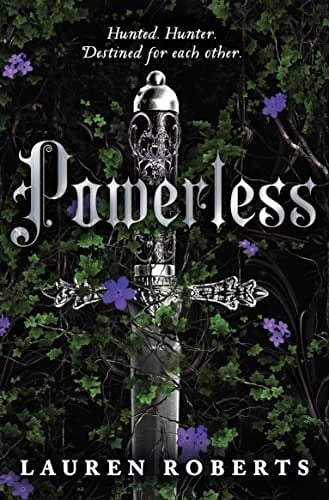
Powerless
Lauren Roberts · 2023
