capstone sources

Items in this hypelist
secondaries
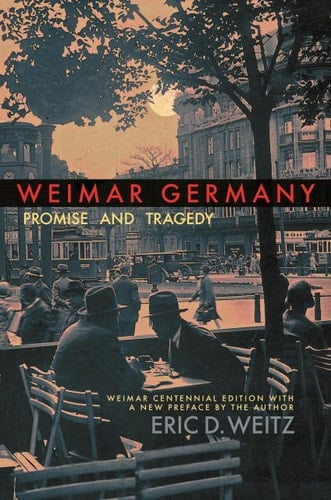
Weimar Germany Promise and Tragedy, Weimar Centennial Edition
Eric D. Weitz · 2018
<p><b>The definitive history of Weimar politics, culture, and society<br>A <i>New York Times Book Review </i>Editor’s Choice<br>A <i>Financial Times</i> Best Book of the Year</b><br><br>Thoroughly up-to-date, skillfully written, and strikingly illustrated, <i>Weimar Germany</i> brings to life an era of unmatched creativity in the twentieth century—one whose influence and inspiration still resonate today. Eric Weitz has written the authoritative history that this fascinating and complex period deserves, and he illuminates the uniquely progressive achievements and even greater promise of the Weimar Republic. Weitz reveals how Germans rose from the turbulence and defeat of World War I and revolution to forge democratic institutions and make Berlin a world capital of avant-garde art. He explores the period’s groundbreaking cultural creativity, from architecture and theater, to the new field of "sexology"—and presents richly detailed portraits of some of the Weimar’s greatest figures. <i>Weimar Germany</i> also shows that beneath this glossy veneer lay political turmoil that ultimately led to the demise of the republic and the rise of the radical Right. Yet for decades after, the Weimar period continued to powerfully influence contemporary art, urban design, and intellectual life—from Tokyo to Ankara, and Brasilia to New York. Featuring a new preface, this comprehensive and compelling book demonstrates why Weimar is an example of all that is liberating and all that can go wrong in a democracy.</p>
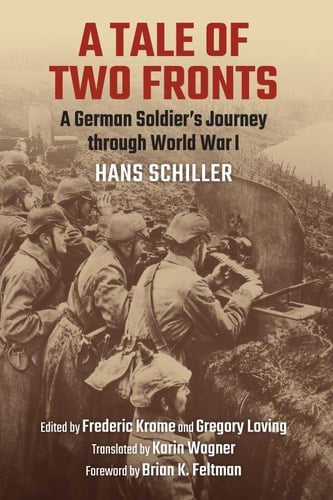
A Tale of Two Fronts
Hans Schiller · 2024
<p>In 2013, while helping her mother, Ingrid, comb through family possessions, Karin Wagner came across a large folio handwritten in German in the back of a dresser drawer. When Karin asked her mother what the document was, Ingrid replied, “Oh, that is your grandfather’s Great War memoir.”</p><p>Schiller was a seventeen-year-old student in Bromberg, Prussia, when World War I broke out in August 1914. He enlisted in the German army and was assigned to an artillery unit on the Eastern Front. From 1915 to 1917, Schiller saw action in what is now Latvia, Lithuania, and Poland. After the Bolshevik Revolution in October 1917 and Russia’s withdrawal from the war, Schiller was transferred to the Western Front. He arrived in time for Germany’s last great offensive in the west, where the attempt to break the Allied lines included what is believed to be the single greatest artillery bombardment in human history up to that point. After the German retreat and Armistice, Schiller reentered military service in the Freikorps, German mercenary groups fighting in former German territory in Eastern Europe, where the conflict dragged on even after the Treaty of Versailles. Schiller left military service in May 1920.</p><p>Hans Schiller’s <i>Kriegserinnerungen</i> (literally, “memories of war”) was written in 1928 and based on diaries, since lost, that Schiller kept during the war. <i>A Tale of Two Fronts</i>, an edition of the memoir with historical context and explanatory notes, provides a vivid first-person account of German army life during World War I. It is a valuable resource for anyone interested in the experiences of common soldiers in World War I.</p>
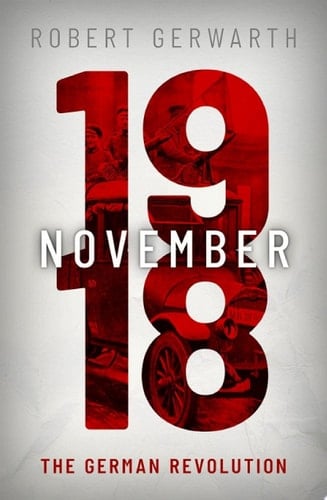
November 1918
Robert Gerwarth · 2020
The German Revolution of November 1918 is nowadays largely forgotten outside Germany. It is generally regarded as a failure even by those who have heard of it, a missed opportunity which paved the way for the rise of the Nazis and the catastrophe to come. Robert Gerwarth argues here that to view the German Revolution in this way is a serious misjudgement. Not only did it bring down the authoritarian monarchy of the Hohenzollern, it also brought into being the first ever German democracy in an amazingly bloodless way. Focusing on the dramatic events between the last months of the First World War in 1918 and Hitler's Munich Putsch of 1923, Robert Gerwarth illuminates the fundamental and deep-seated ways in which the November Revolution changed Germany. In doing so, he reminds us that, while it is easy with the benefit of hindsight to write off the 1918 Revolution as a 'failure', this failure was not somehow pre-ordained. In 1918, the fate of the German Revolution remained very much an open book.
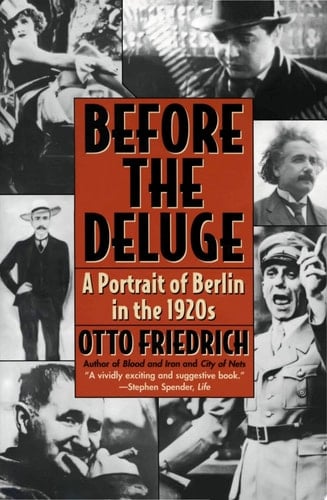
Before the Deluge Portrait of Berlin in the 1920s, A
Otto Friedrich · 1995
A fascinating portrait of the turbulent political, social, and cultural life of the city of Berlin in the 1920s.

When Money Dies The Nightmare of Deficit Spending, Devaluation, and Hyperinflation in Weimar Germany
Adam Fergusson · 2010
<b>The classic history of the political and economic devastation wrought by runaway inflation in Weimar Germany—“</b><b>brilliant” (<i>Guardian</i>)</b><br><b> </b><br> In 1923, with its currency effectively worthless (the exchange rate in December of that year was one dollar to 4,200,000,000,000 marks), the German republic was all but reduced to a barter economy. Expensive cigars, artworks, and jewels were routinely exchanged for staples such as bread; a cinema ticket could be bought for a lump of coal; and a bottle of paraffin for a silk shirt. People watched helplessly as their life savings disappeared and their loved ones starved. Germany's finances descended into chaos, with severe social unrest in its wake.<br> <br> Money may no longer be physically printed and distributed in the voluminous quantities of 1923. However, "quantitative easing," that modern euphemism for surreptitious deficit financing in an electronic era, can no less become an assault on monetary discipline. Whatever the reason for a country's deficit—<br> necessity or profligacy, unwillingness to tax or blindness to expenditure—it is beguiling to suppose that if the day of reckoning is postponed economic recovery will come in time to prevent higher unemployment or deeper recession. What if it does not? Germany in 1923 provides a vivid, compelling, sobering moral tale.
diaries/memoirs

Berlin Stories
Robert Walser · 2012
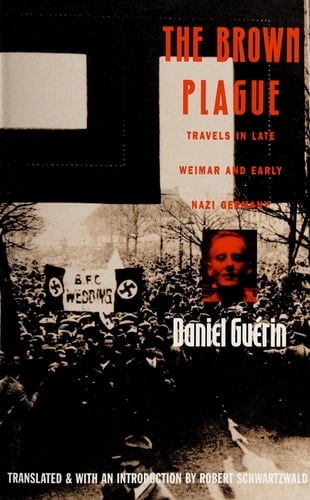
The Brown Plague Travels in Late Weimar & Early Nazi Germany
Daniel Guérin · 1994
In 1932 and 1933, during the months surrounding the Nazi seizure of power, Daniel Guérin, then a young French journalist, made two trips through Germany. <i>The Brown Plague</i>, translated here into English for the first time, is Guérin's eyewitness account of the fall of the Weimar Republic and the first months of the Third Reich. Originally written for the popular French left press and then revised by the author into book form, <i>The Brown Plague</i> delivers a passionate warning to French workers about the terror and horror of fascism. Guérin chronicles the collapse of the German workers' movement and reports on the beginnings of clandestine resistance to the Nazis. He also describes the Socialist and Communist leaderships' inability to recognize the danger that led to their demise. Through vivid dialogs, interviews, and revealing descriptions of everyday life among the German people, he offers insight into the tragedy that was beginning to unfold. <br>Guérin's travels took him across the countryside and into the cities of Germany. He describes with extraordinary clarity, for example, his encounters with large groups of unemployed workers in Berlin and the spectacle of Goering presiding over the Reichstag. Staying in youth hostels, Guérin met individuals representing a range of various groups and movements, including the Wandervögel, leftist brigades, Hitler Youth, and the strange, semicriminal sexual underground of the Wild-frei. Devoting particular attention to the cultural politics of fascism and the lure of Nazism for Germany's disaffected youth, he describes the seductive rituals by which the Nazis were able to win over much of the population. As Robert Schwartzwald makes clear in his introduction, Guérin's interest in Germany at this time was driven, in part, by a homoerotic component that could not be stated explicitly in his published material. This excellent companion essay also places <i>The Brown Plague</i> within a broad historical and literary context while drawing connections between fascism, aesthetics, and sexuality. <br>Informed by an epic view of class struggle and an admiration for German culture, <i>The Brown Plague</i>, a notable primary source in the literature of modern Europe, provides a unique view onto the rise of Nazism.
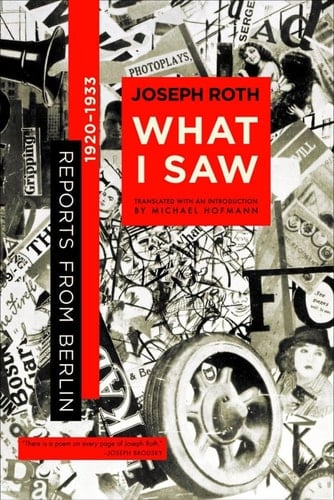
What I Saw Reports From Berlin 1920 To 1933
Joseph Roth · 2004
<b>"[Joseph Roth] is now recognized as one of the twentieth century's great writers."—Anthony Heilbut, <i>Los Angeles Times Book Review</i> </b><br><br>The Joseph Roth revival has finally gone mainstream with the thunderous reception for <i>What I Saw</i>, a book that has become a classic with five hardcover printings. Glowingly reviewed, <i>What I Saw</i> introduces a new generation to the genius of this tortured author with its "nonstop brilliance, irresistible charm and continuing relevance" (Jeffrey Eugenides, <i>New York Times Book Review</i>). As if anticipating Christopher Isherwood, the book re-creates the tragicomic world of 1920s Berlin as seen by its greatest journalistic eyewitness. In 1920, Joseph Roth, the most renowned German correspondent of his age, arrived in Berlin, the capital of the Weimar Republic. He produced a series of impressionistic and political essays that influenced an entire generation of writers, including Thomas Mann and the young Christopher Isherwood. Translated and collected here for the first time, these pieces record the violent social and political paroxysms that constantly threatened to undo the fragile democracy that was the Weimar Republic. Roth, like no other German writer of his time, ventured beyond Berlin's official veneer to the heart of the city, chronicling the lives of its forgotten inhabitants: the war cripples, the Jewish immigrants from the Pale, the criminals, the bathhouse denizens, and the nameless dead who filled the morgues. Warning early on of the dangers posed by the Nazis, Roth evoked a landscape of moral bankruptcy and debauched beauty—a memorable portrait of a city and a time of commingled hope and chaos. <i>What I Saw</i>, like no other existing work, records the violent social and political paroxysms that compromised and ultimately destroyed the precarious democracy that was the Weimar Republic.
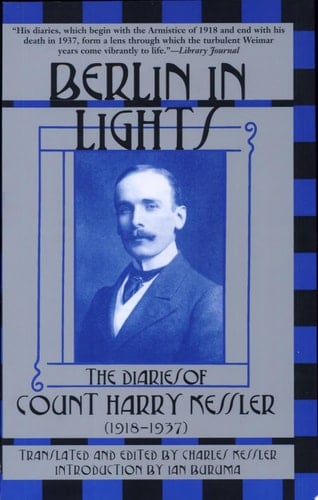
Berlin in Lights The Diaries of Count Harry Kessler, 1918-1937
Graf Harry Kessler · 1999
Berlin in Lights, chosen as a New York Times Notable Book, is the collection of German aristocrat Harry Kessler's diaries between the two world wars. Count Harry Kessler (1868-1937), the son of a German banker and an Irish beauty, was a diplomat and publisher who moved easily among the worlds of art, politics, and society. He lived in Berlin but traveled throughout Europe, always with a keen eye to the political climate of the times. His diaries encompass an extraordinary variety of people: Einstein engages him in long discussions on his theories, and Josephine Baker dances naked in Kessler's drawing room. Kessler had lunch with Bertolt Brecht, Kurt Weill, and Erik Satie, and dinner with Max Reinhardt, George Grosz, Virginia Woolf, Jean Cocteau, and Andre Gide, to name a few. His diaries encapsulate this tumultuous time frame, recording at first hand the agonizing collapse and death of Weimar Germany and the arrival of the Nazis. Beautifully written, the diaries provide rare insight into the frenetic, constantly changing mood and give us a brilliant portrait of Germany and Europe between the wars. "What distinguishes his diary is Kessler's distanziert tone -- its elegance, precision and shrewdness." -- Iain Bamforth, The New York Times Book Review
