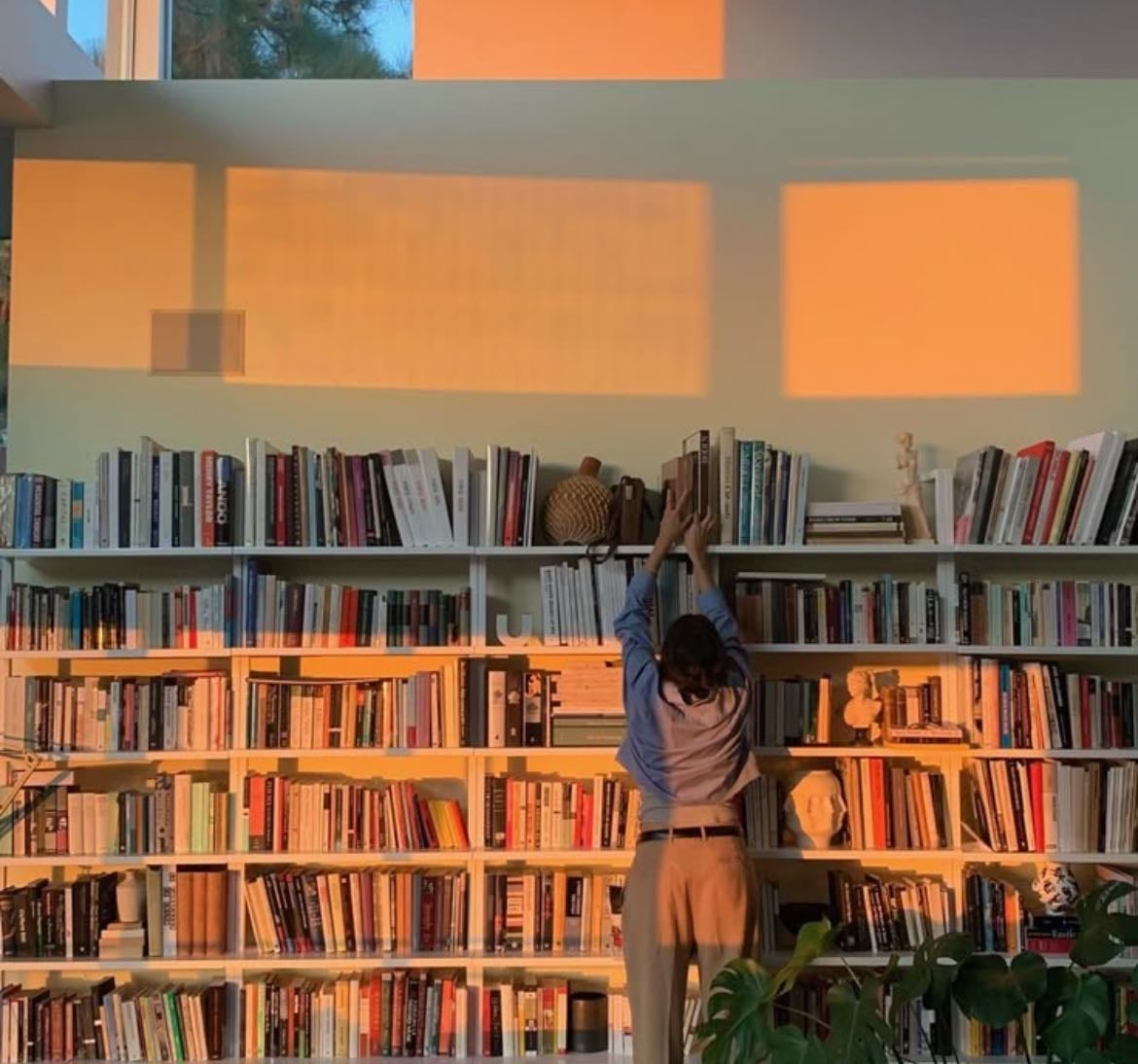
David Lynch's library
Julien’s auction house announced that David Lynch’s personal items, including his library, were to be auctioned. We cannot calculate the value of this small universe that this director created in his home, but we can admire it with respect. Thank you so much.
Items in this hypelist
Fiction
The Ring of the Nibelung (Penguin Clothbound Classics)
Richard Wagner • 2018
A superb new translation of one of the greatest nineteenth century poems: the libretto to Wagner’s Ring Cycle, in a Penguin Classics hardcover designed by Coralie Bickford-Smith<br/><br/>The scale and grandeur of Wagner’s The Ring of the Nibelung has no precedent and no successor. It preoccupied Wagner for much of his adult life and revolutionized the nature of opera, the orchestra, the demands on singers and on the audience itself. The four operas—The Rhinegold, The Valkyrie, Siegfried,and Twilight of the Gods—are complete worlds, conjuring up extraordinary mythological landscapes through sound as much as staging. Wagner wrote the entire libretto before embarking on the music. Discarding the grand choruses and bravura duets central to most operas, he used the largest musical forces in the context often of only a handful of singers on stage. The words were essential: he was telling a story and making an argument in a way that required absolute attention to what was said. The libretto for The Ring lies at the heart of nineteenth century culture. It is in itself a work of power and grandeur, and it had an incalculable effect on European and specifically German culture. John Deathridge’s superb new translation, with notes and a fascinating introduction, is essential for anyone who wishes to fully engage with one of the great musical experiences.<br/><br/>For more than seventy years, Penguin has been the leading publisher of classic literature in the English-speaking world. With more than 1,800 titles, Penguin Classics represents a global bookshelf of the best works throughout history and across genres and disciplines. Readers trust the series to provide authoritative texts enhanced by introductions and notes by distinguished scholars and contemporary authors, as well as up-to-date translations by award-winning translators.
Bad Dirt
Annie Proulx • 2005
Now Watch Him Die
Henry Rollins Rollins • 1993
Book by Henry Rollins
See a Grown Man Cry
Rollins; Henry • 1992
Book by Rollins, Henry Rollins
The Oresteia of Aeschylus
Jeffrey Scott Bernstein • 2020
The stories are familiar: family disharmony, mourning the loss of a loved one, vengeance, national tyranny, international war, a desire for justice. This new translation by Jeffrey Scott Bernstein, an independent scholar and novelist, preserves the artistry of the original while deploying a clear speech that directly addresses a twenty-first century temperament. The Oresteia, first performed in Greece in 458 bce, has been celebrated as an example of the highest literary art. The murder of King Agamemnon by his wife Clytemnestra, the bloody vengeance their son Orestes wreaks upon his mother, and the appearance of the goddess Athena to sort matters out, tells a foundation narrative of world drama. The trilogy traces a progression from personal blood feud to institutionalised justice, and in doing so celebrates, by the end, the triumph of democracy among the citizenry.
The Enlightened Heart
Stephen Mitchell • 2011
From Stephen Mitchell comes an anthology of poetry chosen from the world's great religious and literary traditions--the perfect companion to Mitchel's bestselling translation of Tao Te Ching • The Upanishads • The Book of Psalms • Lao-tzu • The Bhagavad Gita • Chuang-tzu • The Odes of Solomon • Seng-ts'an • Han-shan • Li Po • Tu Fu • Layman P'ang • Kukai • Tung-shan • Symeon the New Theologian • Izumi Shikibu • Su Tung-p'o • Hildegard of Bingen • Francis of Assisi • Wu-men • Dõgen • Rumi • Mechthild of Magdeburg • Dante • Kabir Mirabai • William Shakespeare • George Herbert • Bunan • Gensei • Angelus Silesius • Thomas Traherne • Basho • William Blake • Ryõkan • Issa • Ghalib • Bibi Hayati • Wait Whitman • Emily Dickinson • Gerard Manley Hopkins • Uvavnuk • Anonymous Navaho • W. B. Yeats • Antonio Machado • Rainer Maria Rilke • Wallace Stevens • D.H. Lawrence • Robinson Jeffers
The Cry of the Owl
Patricia Highsmith • 2011
A man’s obsession with a beautiful woman leads to danger in this psychological thriller by the author of The Talented Mr. Ripley and The Price of Salt. In a small Pennsylvania town, Robert Forrester is recuperating from a nasty divorce and a bout of psychological trouble. One evening, while driving home, he sees a pretty, young woman framed by her bright kitchen window. Soon, he can’t keep himself away. But when Robert is inevitably discovered, obsession is turned on its head, and he finds himself unable to shake the young woman, nor entirely sure whether he should. From Patricia Highsmith, once called “the balladeer of stalking” by The New Yorker, The Cry of the Owl is a modern classic ready to be reborn. Praise for The Cry of the Owl “Kafka with a vengeance.” —The Spectator (London) “Highsmith generates suspense out of a different sort of fear: not the fear of death, which drives most crime-centered entertainment, but the pettier, more intimate dread of humiliation, of being caught on the street with nothing on. . . . There’s something else here, hard to identify, pulling us along relentlessly, as thrillers do—an undertow, a surge of third-rail current.” —The New Yorker “The Cry of the Owl is a deceptively easy stroll toward personal chaos and destruction. It is thoroughly chilling because nothing seems farfetched. Odd, yes, but believable. . . . The Cry of the Owl is creepy and unsettling, a taut psychological thriller.” —Linnea Lannon, Detroit Free Press “One of her lesser-known works . . . and one of her most unsettling. Which is saying plenty. . . . The crime writer Elmore Leonard has written a host of novels with the same basic plot: Plans go wrong. The story message driving all of Highsmith’s work is similarly simple and clear: We live on thin ice. Highsmith revolts some readers, yet hypnotizes many others. She’s sui generis, a writer of almost occult power.” —Richard Rayner, Los Angeles Times
Writers
Barry Gifford • 2015
In Writers, great American storyteller Barry Gifford paints portraits of famous writers caught in imaginary vulnerable moments in their lives. In prose that is funny, grotesque, and a touch brutal, Gifford shows these writers at their most human, which is to say at their worst: they are liars, frauds, lousy lovers, and drunks. This is a world in which Ernest Hemingway drunkenly sets explosive trip wires outside his home in Cuba, Marcel Proust implores the angel of death as a delirious Arthur Rimbaud lies dying in a hospital bed, and Albert Camus converses with a young prostitute while staring at himself in the mirror of a New York City hotel room. In Gifford's house of mirrors, we are offered a unique perspective on this group of literary greats. We see their obsessions loom large, and none more than a shared needling preoccupation with mortality. And yet these stories, which are meant to be performed as plays, are also tender and thoughtful exercises in empathy. Gifford asks: What does it means to devote oneself entirely to art? And as an artist, what defines success and failure?
The Up-Down: A Novel
Barry Gifford • 2016
A novel of violence, of love, and introspection, The Up-Down follows a man who leaves home and all that’s familiar, finds true love, loses it, and finds it again. Pace’s voyage is outward, among strangers, and inward into the fifth direction that is the up-down, in a sweeping, voracious human tale that takes no prisoners, witnesses extreme brutalities and expresses a childlike amazement. Here the route goes from New Orleans, to Chicago to Wyoming to Bay St. Clement, North Carolina, but the geography he is charting is always first and foremost unchartable.
The Metamorphosis, the Penal Colony, and Other Stories (Schocken Classics)
Franz Kafka • 1988
Text: English, German (translation)
Elephant Bangs Train.
William Kotzwinkle • 1971
A clean, unmarked and unclipped copy.
The Lady in the Lake
Raymond Chandler • 2025
The Lady in the Lake by Raymond Chandler is a hard-boiled detective novel featuring Philip Marlowe, Chandler's iconic private investigator. The story begins when Marlowe is hired by a wealthy man named Derace Kingsley to find his missing wife, Mrs. Mildred Kingsley. The case seems straightforward, but soon it becomes complicated when Marlowe uncovers that there may be more than one missing woman involved.<br/>As Marlowe digs deeper, he discovers connections between the missing women, a mysterious lake, and a series of dark secrets hidden in the shadows of Los Angeles. Throughout the novel, Marlowe faces deception, betrayal, and violence, all while navigating the morally murky waters of the city’s underworld.<br/>The novel is notable for Chandler’s signature style of sharp dialogue, atmospheric setting, and its exploration of moral ambiguity. The deeper Marlowe delves into the case, the more tangled and dangerous it becomes, making for a tense and gripping narrative. The story touches on themes of illusion vs. reality and the dark side of human nature.
Port Tropique
Barry Gifford • 2011
Revolution is simmering in the heat of battered Central American town Port Tropique, where protagonist Franz Hall is an "intellectual Meursault in a paranoid Hemingway landscape, a self-conscious Conradian adventurer, a Lord Jim in the earliest stages of selfwilled failure" (New York Times). The ineffectual hero spends his days drinking and observing people in the zócalo, and occasional nights involved in an ivory-smuggling operation threatened by impending government siege. Always persistent are memories of Marie and what was lost. In this sinuous narrative of dislocation and remorse, Barry Gifford details Franz’s mundanity and the bizarre cast of characters swirling around him.
Forgiving the Angel: Four Stories for Franz Kafka
Jay Cantor • 2014
Product Description <br/><br/>In four stories that are a deft amalgam of fact and fiction, Jay Cantor captures the reverberations of Kafka's influences on the lives of some of the friends and lovers who survived him. Here is Kafka's last lover, Dora Diamant: their love opening out with both passion and pathos as he succumbs to tuberculosis...Max Brod, his friend and literary executor, struggling with Kafka's instructions to burn all his unpublished stories upon his death...the militant German Communist Lusk Lask, whom Dora - still enraptured by the memory of Kafka - marries and loses to a Soviet Gulag...a Nazi concentration camp prisoner whose survival will depend on her love for Milena Jesenska, who once survived on her own love for Kafka.<br/><br/> About the Author <br/><br/>Jay Cantor is the author of three novels, The Death of Che Guevara, Krazy Kat, and Great Neck, and two books of essays, The Space Between, and On Giving Birth to One's Own Mother. A MacArthur Fellow, Cantor teaches at Tufts University and lives in Cambridge, Massachusetts, with his wife and daughter.<br/><br/><br/>READER BIO<br/> Qarie has narrated over 30 series for the Discovery, Learning Channels & The BBC, as well as providing the inflight programming for Virgin Atlantic Airlines & BBC radio plays. He has voiced over 80 video games for the Playstation & Xbox, and was a guest voice on Comedy Central's Drawn Together. He was made an Associate Artist of The Purple Rose Theatre in 2007.
Metamorphoses
Ovid • 1955
"Ovid is, after Homer, the single most important source for classical mythology. The Metamorphoses, which he wrote over the six-year period leading up to his exile from Rome in 8 a.d. , is the primary source for over two hundred classical legends that survived to the twenty-first century. Many of the most familiar classical myths, including the stories of Apollo and Daphne and Pyramus and Thisbe, come directly from Ovid. The Metamorphoses is a twelve-thousand-line poem, written in dactylic hexameters and arranged loosely in chronological order from the beginning of the universe's creation to the Augustan Rome of Ovid's own time. The major theme of the Metamorphoses, as the title suggests, is metamorphosis, or change. Throughout the fifteen books making up the Metamorphoses, the idea of change is pervasive. Gods are continually transforming their own selves and shapes, as well as the shapes and beings of humans. The theme of power is also ever-present in Ovid's work. The gods as depicted by the Roman poets are wrathful, vengeful, capricious creatures who are forever turning their powers against weaker mortals and half-mortals, especially females. Ovid's own situation as a poet who was exiled because of Augustus's capriciousness is thought by many to be reflected in his depictions of the relationships between the gods and humans." -- from http://www.enotes.com/metamorphoses-of-ovid (Jan. 24, 2011.)
The Trial - Franz Kafka: Annotated
Franz Kafka • 2020
The narrative emerges from the book’s opening sentence: “Somebody must have slandered Joseph K., for one morning, without having done anything wrong, he was arrested.” It is K.’s 30th birthday, and a pair of guards have arrived at his boardinghouse to inform him that he is under arrest. He is shortly summoned before the inspector, who is in the bedroom of another tenant. The inspector does not know what the charges are but tells K. that he is free to continue living his life as usual. K. goes to the bank where he works and is later told that a series of hearings will be taking place on Sundays.K. is not informed of the time that he is expected to appear, but he goes on Sunday morning to the address he was given, which proves to be that of a large tenement building. Eventually a washerwoman directs him to a crowded meeting hall, where the examining magistrate scolds K. for being late. K. energetically protests his treatment and denounces the corruption of the system. As he is leaving, the magistrate tells him that he has damaged his case by declining to participate in the hearing. No further summonses arrive, so K. returns to the building the following Sunday morning only to be told by the washerwoman that court is not in session. Her husband is the court usher, and he offers to show K. the law court offices. While there K. begins to feel extremely fatigued, but after two officials help him outside, he immediately recovers.A few days later, as he is leaving work, K. hears a sound coming from a storeroom, and inside it he finds the guards who arrested him being flogged because of his complaints about them to the magistrate. An uncle of K.’s later takes him to the defense lawyer Dr. Huld. Although Huld is in bed because of a heart condition, he is very interested in taking on K. as a client. The chief clerk of the court emerges from a dark corner of the room, and he and Huld discuss the case. Huld’s caretaker, Leni, lures K. from the room and seduces him. She also tells him that he is being too stubborn and that he must confess his guilt. K.’s uncle is furious over his inattention to his case.Weeks pass, during which K. finds it increasingly difficult to focus on work and also becomes increasingly dissatisfied with his lawyer’s largely invisible work on his behalf. One day a bank client suggests that he seek help from the court painter, Titorelli. In light of K.’s innocence, Titorelli says that he can help K., though he reveals that, in his experience, no one has ever been acquitted. However, he believes that K. can obtain an ostensible acquittal, which is provisional and hence carries the risk that charges might be reinstated, or an indefinite postponement, which requires regular filings and appearances. Either may prevent the case from reaching the sentencing phase.When K. goes to fire Huld, he meets Block, a merchant who is another client of Huld’s. Block’s case has been going on for five years, and he has secretly engaged other lawyers and tried to represent himself. Huld exhibits his power over Block in an attempt to dissuade K. from dismissing him. Later at work, K. is asked to show an Italian client a local cathedral, but the client fails to arrive at the appointed time. A priest appears at a side pulpit and reveals that he is the prison chaplain. He informs K. that his case is going badly, as he is by now considered to be guilty. The chaplain then tells him a baffling parable.On the eve of K.’s 31st birthday, two men in frock coats and top hats come to his home. He goes with them, and they hold his arms. Although it seems that they are going where K. leads them, they take him to an abandoned quarry and have him sit with his head on a stone. They pass a knife back and forth to each other, and then one of them pushes it into K.’s heart and twists it twice...
The Painted Bird
Jerzy Kosinski • 1983
Many writers have portrayed the cruelty people inflict upon each other in the name of war or ideology or garden-variety hate, but few books will surpass Kosinski's first novel, The Painted Bird, for the sheer creepiness of its savagery. The story follows an abandoned young boy who wanders alone through the frozen bogs and broken towns of Eastern Europe during and after World War II, trying to survive. His experiences and actions occur at and beyond the limits of what might be called humanity, but Kosinski never averts his eyes, nor allows us to.
Juve in the Dock: A Fantomas Detective Novel
Marcel Allain • 2017
Fantomas having just escaped into the sewers of Paris, Juve and Fandor find themselves with few clues to go on until the great detective is approached by a Committee of Insurance Companies against Theft with a mission—to protect a secret document which details the precise location of the jewels of Empress Eugenie, wife of Napoleon III. Knowing Fantomas will try to steal this priceless treasure map, Juve sets a trap for the Arch-Criminal in the pleasure resorts of the Parisian suburbs in this, the thirty-fourth book of the series.
The Catcher in the Rye
J. D. Salinger • 2001
Cinematographic references
Production Design and Art Direction
Peter Ettedgui • 1999
In Production Design and Art Direction sixteen of the world's greatest production designers discuss their craft, revealing the creative process which led to the look of the most memorable films of our time. Contributors include Dean Tavoularis (Godfather Trilogy), Dante Ferretti (whose work with Fellini, Pasolini and Scorsese covers the span of the best of Italian cinema) and Anna Asp (Fanny and Alexander). As aesthetically appealing as any art book, Production Design and Art Direction is densely illustrated with drawings, scripts, storyboards and models, as well as stills from the films. This book is part of the Screencraft series, which includes the enormously successful Cinematography, also by Peter Ettedgui and published by Focal Press in the US.<br/><br/>The text is based on the words of 16 masters of the craft<br/>Beautifully produced and lavishly illustrated with drawings, scripts, storyboards, models and stills from memorable films<br/>Part of the Screencraft series, the first books to explore the crafts of filmmaking by tracing the entire creative process through the eyes of leading practitioners
Cinematography (Screencraft Series)
Peter Ettedgui • 1999
Cinematography is the first title in the Screencraft Series, a unique venture which aims to unravel for the first time the multi-layered language of film-making, by exploring the fusion of crafts which combine to create the most important art form of the 20th century. Although the cinematographer or director of photography rarely receives the kind of attention reserved for directors and actors, there is little doubt that this is the key technical role in the process of revealing a story through images. The cinematographers featured in this book encompass three generations of filmmaking and represent a diversity of film cultures. What they have in common is the contribution they have made to a universal cinema heritage and the fact that their work has helped to expand -- if not revolutionize -- the language of film. This book, featuring the world's finest cinematographers, will inspire practicing professionals, students, and movie buffs alike. This beautifully designed and illustrated book speaks in the voices of these cinematographers and through the powerful images they have created for the screen.<br/><br/>The cinematographers featured in this book encompass three generations of filmmaking and represent a diversity of film cultures, from "African Queen" to "Delicatessen."<br/>Highly illustrated -- over 500 color pictures and 300 black and white photos -- and written entirely based on each cinematographer's own words from interviews<br/>This book, featuring the world's finest cinematographers, will inspire practicing professionals, students, and movie buffs alike.<br/><br/>Features three generations of cinematographers representing many diverse film cultures<br/>Highly illustrated with over 500 color pictures and 300 black and white photos<br/>Written entirely based on each cinematographer's own words from interviews
Los proverbios chinos de F.W. Murnau (Filmoteca española) (Spanish Edition)
Luciano Berriatúa • 1990
Woody et moi
Allen, Woody, Björkman, Stig • 1993
La Dolce Vita - L'Album
Federico Fellini • 2009
¿Buñuel! La mirada del siglo
Museo Reina Sofia
Future Details of Architecture
Mark Garcia • 2014
<p>Despite the exaggerated news of the untimely 'death of the detail' by Greg Lynn, the architectural detail is now more lifelike and active than ever before. In this era of digital design and production technologies, new materials, parametrics, building information modeling (BIM), augmented realities and the nano-bio-information-computation consilience, the detail is now an increasingly vital force in architecture. Though such digitally designed and produced details are diminishing in size to the molecular and nano levels, they are increasingly becoming more complex, multi-functional, high performance and self-replicating. Far from being a non-essential and final finish, this new type of highly evolved high-tech detail is rapidly becoming the indispensable and critical core, the (sometimes iconic) DNA of an innovative new species of built environmental form that is spawning in scale and prominence, across product, interior, urban and landscape design. This issue of AD re-examines the history, theories and design of the world's most significant spatial details, and explores their innovative potentials and possibilities for the future of architecture.<br></p><p>Contributors include: Rachel Armstrong, Nic Clear, Edward Ford, Dennis Shelden, Skylar Tibbits.<br></p><p>Featured architects: Ben van Berkel, Hernan Diaz Alonso, Peter Macapia, Carlo Ratti, Philippe Rahm, Patrik Schumacher, Neil Spiller.<br></p>
Brando
Manso • 1995
This book reveals the story Brando wished to keep secret.Manso spent seven yearsresearching this book of a"living legend"!
Ladro di sguardi: Fotografie di fotografie, 1945-1949 (Italian Edition)
Stanley Kubrick • 1994
Conversations with Wilder
Cameron Crowe • 2001
In Conversations with Wilder, Hollywood's legendary and famously elusive director Billy Wilder agrees for the first time to talk extensively about his life and work.<br/><br/>Here, in an extraordinary book with more than 650 black-and-white photographs -- including film posters, stills, grabs, and never-before-seen pictures from Wilder's own collection -- the ninety-three-year-old icon talks to Cameron Crowe, one of today's best-known writer-directors, about thirty years at the very heart of Hollywood, and about screenwriting and camera work, set design and stars, his peers and their movies, the studio system and films today. In his distinct voice we hear Wilder's inside view on his collaborations with such stars as Barbara Stanwyck, Gary Cooper, Marilyn Monroe, Jack Lemmon, Tony Curtis, William Holden, Audrey Hepburn, and Greta Garbo (he was a writer at MGM during the making of Ninotchka. Here are Wilder's sharp and funny behind-the-scenes stories about the making of A Foreign Affair, Double Indemnity, Sunset Boulevard, Love in the Afternoon, Some Like It Hot, The Apartment, and Ace in the Hole, among many others. Wilder is ever mysterious, but Crowe gets him to speak candidly on Stanwyck: "She knew the script, everybody's lines, never a fault, never a mistake"; on Cary Grant: "I had Cary Grant in mind for four of my pictures . . . slipped through my net every time"; on the "Lubitsch Touch": "It was the elegant use of the super-joke." Wilder also remembers his early years in Vienna, working as a journalist in Berlin, rooming with Peter Lorre at the Chateau Marmont -- always with the same dry wit, tough-minded romanticism, and elegance that are the hallmarks of Wilder's films. This book is a classic of Hollywood history and lore.
Maya Deren - Choreographed for Camera
Mark Alice Durant • 2022
Advance Praise for Maya Deren, Choreographed for Camera<br/><br/>A brilliant book. Durant tells the story of the radical and multi-dimensional life of Maya Deren in ways that are as engrossing and inspiring as Deren's art. Every artist should read this. — Paul Chan<br/><br/>Drawing from a treasure trove of archival materials, Mark Alice Durant gives a vivid account of the swath Maya Deren cut through the modernist century. Durant’s gorgeous writing captures how, in Deren’s hands, cinema is a devotion to life itself. — Laura U. Marks<br/><br/>A vibrant cultural history of one of art's most exciting eras, Mark Alice Durant’s Maya Deren, Choreographed for Camera is a feast of life and art. — Lynne Tillman<br/><br/>In Mark Alice Durant, the legendary Maya Deren has found her ideal biographer, at the right time, when the world desperately needs her, and his, uncanny insights into the mysteries of the image. — David Levi Strauss<br/><br/>Maya Deren was not only a legend, but a flesh-and-blood individual, as is made amply apparent in Mark Alice Durant’s illuminating, loving and long-overdue biography. — J. Hoberman<br/><br/>Drama and myth frame the life and death of Maya Deren. Born in Kiev in 1917, at the start of the Russian Revolution, she died forty-four years later in New York City. In her brief life, she established herself as a pioneering experimental filmmaker, prolific writer, accomplished photographer, and crusader for a personal and poetic cinema. With its dreamy circular narrative and enigmatic imagery, her first film, Meshes of the Afternoon (1943), has inspired generations of artists, filmmakers, and poets. Deren worked and collaborated with numerous mid-century cultural luminaries, including Katherine Dunham, Marcel Duchamp, John Cage, Anais Nin, Gregory Bateson, Jonas Mekas, and Joseph Campbell.<br/><br/>Deren received the first Guggenheim Fellowship ever awarded for creative filmmaking, using the funding to travel to Haiti where she became a devotee of Vodou. In 1953, she pubished Divine Horsemen, a ground-breaking ethnographic study of Haitian religious culture. Although Deren completed only six short films in her lifetime, her impact on the history of cinema is immeasurable. She has become the patron saint of 20th century experimental film. The aura that suffuses Deren’s legend emanates from the power of her films, magnified by her bohemian glamour and visionary intelligence.<br/><br/>This is the first full biography of Deren. Based on years of research, interviews with some of Deren’s closest collaborators, and generously illustrated with film stills and photographs, author Mark Alice Durant creates a vivid and accessible narrative exploring the complexities and contradictions in the life and work of this remarkable and charismatic artist.
Photography books
Hauts Fourneaux
Bernd y Hilla Becher
Life Dances On: Robert Frank in Dialogue
Robert Frank • 2024
An in-depth exploration of the last six decades of work from the iconic photographer and filmmaker, with a special focus on his ceaseless experimentation and artistic collaborations<br/>This volume, published in conjunction with the artist’s first solo exhibition at the Museum of Modern Art, New York, provides new insights into the interdisciplinary and lesser-known aspects of Robert Frank’s expansive career. The exhibition explores the six decades that followed his landmark photobook The Americans, a period in which Frank maintained an extraordinarily multifaceted practice characterized by perpetual experimentation across mediums and artistic and personal dialogues with other artists and with his communities. Coinciding with the centennial of his birth, this catalog takes its name from the artist’s poignant 1980 film, Life Dances On, in which Frank reflects on the individuals who have shaped his outlook.<br/>The lushly illustrated publication features photographs, films, books and archival materials, layered with quotes from Frank on his influences and process. Three scholarly essays, excerpts from previously unpublished video footage and a rich visual chronology together explore Frank’s ceaseless creative exploration and observation of life.<br/>Robert Frank was a Swiss American photographer and filmmaker best known for his groundbreaking monograph The Americans (1958). Over his decades-long career, Frank captured the complexities of contemporary life with a distinct style and poetic insight. He lived between New York City and Nova Scotia, Canada.
I'm the most normal person i know
Chris Anthony