environmental sociology & socio-ecological metabolism
This folder tracks how modern capitalism reorganizes the physical planet and drives structural inequality. This folder focuses on the metabolic rifts of contemporary production systems, analyzing how class, race, and geography dictate who profits from natural resource extraction and who bears the brunt of environmental degradation. It bridges macro-level theories with the specific bureaucratic metrics, paperwork, and state systems that hide environmental harm and make marginalized communities invisible. The literature mapped here explores how state administrative structures, regulatory metrics, and institutional risk governance manage public exposure to toxicity and harm. Special emphasis is placed on how these bureaucratic frameworks define safety and risk, often rendering localized environmental degradation and the vulnerabilities of marginalized communities structurally invisible to the state. The scope of this log traces these dynamics from their foundational disciplinary baselines, through the socio-spatial sorting of industrial and resource-extractive hazards along class and racial lines, to the discursive and ideological contestations over green capitalism, climate denial, and the structural paths toward ecosocialist and degrowth transitions.
Items in this hypelist
The Tactical Baselines

The Treadmill of Production Injustice and Unsustainability in the Global Economy
Kenneth Alan Gould · 2008
Schnaiberg's concept of the treadmill of production is arguably the most visible and enduring theory to emerge in three decades of environmental sociology. Elaborated and tested, it has been found to be an accurate predictor of political-economic changes in the global economy. In the global South, it has figures prominently in the work of structural environmental analysts and has been used by many political-economic movements. Building new extensions and applications of the treadmill theory, this new book shows how and why northern analysts and governments have failed to protect our environment and secure our future. Using an empirically based political-economic perspective, the authors outline the causes of environmental degradation, the limits of environmental protection policies, and the failures of institutional decision-makers to protect human well-being.
The Environment in Anthropology A Reader in Ecology, Culture, and Sustainable Living
Nora Haenn · 2006
<p><b>The Environment in Anthropology</b> presents ecology and current environmental studies from an anthropological point of view. From the classics to the most current scholarship, this book connects the theory and practice in environment and anthropology, giving readers a strong intellectual foundation as well as offering practical tools for solving environmental problems.<br>Haenn and Wilk pose the most urgent questions of environmental protection: How are environmental problems mediated by cultural values? What are the environmental effects of urbanization? When do environmentalists get in conflict with indigenous peoples? How can we assess the impact of “environmentally correct” businesses such as the Body Shop? They also cover the fundamental topics of population growth, large scale development, biodiversity conservation, sustainable environmental management, indigenous groups, consumption, and globalization.<br>Balancing landmark essays with cutting-edge scholarship, bridging theory and practice, and offering suggestions for further reading and new directions for research, <b>The Environment in Anthropology</b> is the ideal introduction to a burgeoning field.<br><b>Contributors include:</b> J. Peter Brosius, Billie DeWalt, Arturo Escobar, Akhil Gupta, Caren Kaplan, Conrad Kottak, David Maybury-Lewis, B.J. McCay, Kay Milton, Virginia Nazarea, Robert Netting, Vandana Shiva, Julian Steward, and Susan C. Stonich.</p>
Research Handbook on Environmental Sociology
Axel Franzen · 2021
This <i>Research Handbook</i> presents the state of the art of empirical sociological research on the causes of, and solutions to, pressing environmental problems. It provides cutting-edge insights into some of the most urgent challenges facing humanity, including anthropogenic climate change and environmental pollution. The contributors argue that profound collective efforts to protect the environment are vital for sustainable development and offer practical solutions to specific contemporary issues.<br><p><br>Wide ranging and insightful, this <i>Research Handbook</i> encompasses the causes and consequences of environmental deterioration, the measurement, development and precedents of environmental concern, the determinants of pro-environmental behavior, and the acceptance of environmental policies. Key topics include the development of global CO2 emissions, prices, income and energy demand, climate change knowledge, meta-knowledge and beliefs, the collective risk social dilemma and support for city road tolls. <br><p><br>Scholars and students in the environmental social sciences will find this innovative <i>Research Handbook</i> invaluable. Critical case studies also provide important insights and recommendations for environmental decision makers.

Green Development Environment and Sustainability in a Developing World
William Mark Adams · 2019
<p>The concept of sustainability lies at the core of the challenge of environment and development, and the way governments, business and environmental groups respond to it. <i>Green Development </i>provides a clear and coherent analysis of sustainable development in both theory and practice. </p> <p></p><i> <p>Green Development</i> explores the origins and evolution of mainstream thinking about sustainable development and offers a critique of the ideas behind them. It draws a link between theory and practice by discussing the nature of the environmental degradation and the impacts of development. It argues that, ultimately, 'green' development has to be about political economy, about the distribution of power, and not about environmental quality. Its focus is strongly on the developing world.</p> <p></p> <p>The fourth edition retains the broad structure of previous editions, but has been updated to reflect advances in ideas and changes in international policy. Greater attention has been given to the political ecology of development, market-based and neoliberal environmentalism, and degrowth. This fully revised edition discusses: </p> <ul> <p> <li>the origins of thinking about sustainability and sustainable development, and its evolution to the present day;</li> <p></p> <p> <li>the ideas that dominate mainstream sustainable development (including natural capital, the green economy, market environmentalism and ecological modernisation);</li> <p></p> <p> <li>critiques of mainstream ideas and of neoliberal framings of sustainability, and alternative ideas about sustainability that challenge 'business as usual' thinking, such as arguments about limits to growth and calls for degrowth;</li> <p></p> <p> <li>the dilemmas of sustainability in the context of forests, desertification, food and farming, biodiversity conservation and dam construction;</li> <p></p> <p> <li>the challenge of policy choices about sustainability, particularly between reformist and radical responses to the contemporary global dilemmas.</li> <p></p></ul> <p></p><i> <p>Green Development </i>offers clear insights into the challenges of environmental sustainability, and social and economic development. It is unique in offering a synthesis of theoretical ideas on sustainability and in its coverage of the extensive literature on environment and development around the world. The book has proved its value to generations of students as an authoritative, thought-provoking and readable guide to the field of sustainable development.</p>

The Cambridge Handbook of Environmental Sociology: Volume 2
Katharine Legun · 2020
The Cambridge Handbook of Environmental Sociology is a go-to resource for cutting-edge research in the field. This two-volume work covers the rich theoretic foundations of the sub-discipline, as well as novel approaches and emerging areas of research that add vitality and momentum to the discipline. Over the course of sixty chapters, the authors featured in this work reach new levels of theoretical depth, incorporating a global scope and diversity of cases. This book explores the broad scope of crucial disciplinary ideas and areas of research, extending its investigation to the trajectories of thought that led to their unfolding. This unique work serves as an invaluable tool for all those working in the nexus of environment and society.

The Cambridge Handbook of Environmental Sociology: Volume 1
Katharine Legun · 2020
The Cambridge Handbook of Environmental Sociology is a go-to resource for cutting-edge research in the field. This two-volume work covers the rich theoretic foundations of the sub-discipline, as well as novel approaches and emerging areas of research that add vitality and momentum to the discipline. Over the course of sixty chapters, the authors featured in this work reach new levels of theoretical depth, incorporating a global scope and diversity of cases. This book explores the broad scope of crucial disciplinary ideas and areas of research, extending its investigation to the trajectories of thought that led to their unfolding. This unique work serves as an invaluable tool for all those working in the nexus of environment and society.
Eco-Marxism & The Socio-Ecological Metabolism
After the Death of Nature Carolyn Merchant and the Future of Human-nature Relations
Kenneth Worthy · 2019
<p>Carolyn Merchant¿s foundational 1980 book <i>The Death of Nature: Women, Ecology, and the Scientific Revolution</i> established her as a pioneering researcher of human-nature relations. Her subsequent groundbreaking writing in a dozen books and over one hundred peer-reviewed articles have only fortified her position as one of the most influential scholars of the environment. This book examines and builds upon her decades-long legacy of innovative environmental thought and her critical responses to modern mechanistic and patriarchal conceptions of nature and women as well as her systematic taxonomies of environmental thought and action. Seventeen scholars and activists assess, praise, criticize, and extend Merchant¿s work to arrive at a better and more complete understanding of the human place in nature today and the potential for healthier and more just relations with nature and among people in the future. Their contributions offer personal observations of Merchant¿s influence on the teaching, research, and careers of other environmentalists.</p>

Environmental Harm: An Eco-Justice Perspective (Studies in Social Harm)
Rob White · 2015
This unique study of social harm offers a systematic and critical discussion of the nature of environmental harm from an eco-justice perspective, challenging conventional criminological definitions of environmental harm. The book evaluates three interconnected justice-related approaches to environmental harm: environmental justice (humans), ecological justice (the environment) and species justice (non-human animals). It provides a critical assessment of environmental harm by interrogating key concepts and exploring how activists and social movements engage in the pursuit of justice. It concludes by describing the tensions between the different approaches and the importance of developing an eco-justice framework that to some extent can reconcile these differences. Using empirical evidence built on theoretical foundations with examples and illustrations from many national contexts, ‘Environmental harm’ will be of interest to students and academics in criminology, sociology, law, geography, environmental studies, philosophy and social policy all over the world.
Capitalism in the Web of Life Ecology and the Accumulation of Capital
Jason W. Moore · 2025
<b>Integrating both social and historical factors, this radical analysis of the development of capitalism reveals the ever-deepening relationship between capital and ecology</b><br> <br>Finance. Climate. Food. Work. How are the crises of the twenty-first century connected? In <i>Capitalism in the Web of Life</i>, Jason W. Moore argues that the sources of today’s global turbulence have a common cause: capitalism as a way of organizing nature, including human nature. Drawing on environmentalist, feminist, and Marxist thought, Moore offers a groundbreaking new synthesis: capitalism as a “world-ecology” of wealth, power, and nature. Capitalism’s greatest strength—and the source of its problems—is its capacity to create Cheap Natures: labor, food, energy, and raw materials. That capacity is now in question. <br><br>Rethinking capitalism through the pulsing and renewing dialectic of humanity-in-nature, Moore takes readers on a journey from the rise of capitalism to the modern mosaic of crisis. <i>Capitalism in the Web of Life</i> shows how the critique of capitalism-in-nature—rather than capitalism <i>and</i> nature—is key to understanding our predicament, and to pursuing the politics of liberation in the century ahead.

Metabolic Rifts - Capitalism's Assault on the Earth System
Ian Angus · 2026
<p>Like an autoimmune disease that attacks the body it dwells in, capitalism is tearing apart the very planet that feeds it. Metabolic Rifts: Capitalism’s Assault on the Earth System, builds on Karl Marx’s insight that while capitalism is dependent on the natural world, it is also waging war on the natural systems that sustain life on Earth.<br><br>Focusing on deadly rifts in two of the most important natural systems—the carbon and nitrogen cycles—Ian Angus explains and elaborates on the Marxist view that capitalism is massively disrupting essential exchanges of matter and energy between society and the rest of nature, putting the entire Earth System in danger. After tracing the long-neglected history of metabolic rift theory in scientific and socialist writing, Angus draws on a wealth of modern research to extend and deepen the natural science basis of Marxist ecology. In clear, non-technical language, Metabolic Rifts offers a scientific basis for understanding the deep causes of today’s environmental crises, and a program for action to prevent catastrophe in our time.</p>

Ecology Against Capitalism
John Bellamy Foster · 2002
In recent years John Bellamy Foster has emerged as a leading theorist of the Marxist perspective on ecology. His seminal book Marx's Ecology (Monthly Review Press, 2000) discusses the place of ecological issues within the intellectual history of Marxism and on the philosophical foundations of a Marxist ecology, and has become a major point of reference in ecological debates. This historical and philosophical focus is now supplemented by more directly political engagement in his new book, Ecology against Capitalism. In a broad-ranging treatment of contemporary ecological politics, Foster deals with such issues as pollution, sustainable development, technological responses to environmental crisis, population growth, soil fertility, the preservation of ancient forests, and the "new economy" of the Internet age. Foster's introduction sets out the unifying themes of these essays enabling the reader to draw from them a consolidated approach to a rapidly-expanding field of debate which is of critical importance in our times. Within these debates on the politics of ecology, Foster's work develops an important and distinctive perspective. Where many of these debates assume a basic divergence of "red" and "green" issues, and are concerned with the exact terms of a trade-off between them, Foster argues that Marxismproperly understoodalready provides the framework within which ecological questions are best approached. This perspective is advanced here in accessible and concrete form, taking account of the major positions in contemporary ecological debate.
Facing the Anthropocene:: Fossil Capitalism and the Crisis of the Earth System
Ian Angus · 2017
Product Description <br/>Science tells us that a new and dangerous stage in planetary evolution has begun the Anthropocene, a time of rising temperatures, extreme weather, rising oceans, and mass species extinctions. Humanity faces not just more pollution or warmer weather,<br/>but a crisis of the Earth System. If business as usual continues, this century will be marked by rapid deterioration of our physical, social, and economic environment. Large parts of Earth will become uninhabitable, and civilization itself will be threatened.<br/>Facing the Anthropocene shows what has caused this planetary emergency, and what we must do to meet the challenge. Bridging the gap between Earth System science and ecological Marxism, Ian Angus examines not only the latest scientific findings about the physical causes and consequences of the Anthropocene transition, but also the social and economic trends that underlie the crisis. Cogent and compellingly written,<br/>Facing the Anthropocene offers a unique synthesis of natural and social science that illustrates how capitalism's inexorable drive for growth, powered by the rapid burning of fossil fuels that took millions of years to form, has driven our world to the brink of disaster. Survival in the Anthropocene, Angus argues, requires radical social change, replacing fossil capitalism with a new, ecosocialist civilization. <br/> Review <br/>"A crisp, eloquent and deeply informed call to arms by a leading eco-socialist." -Mike Davis --Mike Davis<br/> About the Author <br/>Ian Angus is editor of the online ecosocialist journal Climate and Capitalism. He is also the author of Facing the Anthropocene.

Karl Marx’s Ecosocialism Capital, Nature, and the Unfinished Critique of Political Economy
Kohei Saito · 2017
<p><b>Reveals the ideal of a sustainable ecosocialist world in Marx’s writings <br></b><br>Karl Marx, author of what is perhaps the world’s most resounding and significant critique of bourgeois political economy, has frequently been described as a “Promethean.” According to critics, Marx held an inherent belief in the necessity of humans to dominate the natural world, in order to end material want and create a new world of fulfillment and abundance—a world where nature is mastered, not by anarchic capitalism, but by a planned socialist economy. Understandably, this perspective has come under sharp attack, not only from mainstream environmentalists but also from ecosocialists, many of whom reject Marx outright. <br><br>Kohei Saito’s Karl Marx’s Ecosocialism lays waste to accusations of Marx’s ecological shortcomings. Delving into Karl Marx’s central works, as well as his natural scientific notebooks—published only recently and still being translated—Saito also builds on the works of scholars such as John Bellamy Foster and Paul Burkett, to argue that Karl Marx actually saw the environmental crisis embedded in capitalism. “It is not possible to comprehend the full scope of [Marx’s] critique of political economy,” Saito writes, “if one ignores its ecological dimension.” <br><br>Saito’s book is crucial today, as we face unprecedented ecological catastrophes—crises that cannot be adequately addressed without a sound theoretical framework. Karl Marx’s Ecosocialism shows us that Marx has given us more than we once thought, that we can now come closer to finishing Marx’s critique, and to building a sustainable ecosocialist world.</p>
Questioning Collapse Human Resilience, Ecological Vulnerability, and the Aftermath of Empire
Patricia A. McAnany · 2010
Questioning Collapse challenges those scholars and popular writers who advance the thesis that societies - past and present - collapse because of behavior that destroyed their environments or because of overpopulation. In a series of highly accessible and closely argued essays, a team of internationally recognized scholars bring history and context to bear in their radically different analyses of iconic events, such as the deforestation of Easter Island, the cessation of the Norse colony in Greenland, the faltering of nineteenth-century China, the migration of ancestral peoples away from Chaco Canyon in the American southwest, the crisis and resilience of Lowland Maya kingship, and other societies that purportedly "collapsed." Collectively, these essays demonstrate that resilience in the face of societal crises, rather than collapse, is the leitmotif of the human story from the earliest civilizations to the present. Scrutinizing the notion that Euro-American colonial triumphs were an accident of geography, Questioning Collapse also critically examines the complex historical relationship between race and political labels of societal "success" and "failure."

Underground Leviathan Corporate Sovereignty and Mining in the Americas
Israel G. Solares · 2024
<i>Underground Leviathan</i> explores the emergence, dynamics, and lasting impacts of a mining firm, the United States Company. Through its exercise of sovereign power across the borders of North America in the early twentieth century, the transnational US Company shaped the business, environmental, political, and scientific landscape. Between its initial incorporation in Maine in 1906 and its final demise in the 1980s, the mining company held properties in Utah, Colorado, California, Nevada, Alaska, Mexico, and Canada. The firm was a prototypical management-ruled corporation, which strategically planned and manipulated the technological, production, economic, urban, environmental, political, and cultural activities wherever it operated, all while shaping social actors internationally, including managers, engineers, workers, neighbors, and farmers.<br> <br> Author Israel G. Solares examines how the twentieth century multinational firm established and articulated multinational corporate sovereignty in ways that reflect other multinational titans, like the East Asian Trade companies, and presages the digital giants and space corporations of the twenty-first century. Bridging the domineering practices used during the colonization of Southern Asia with the futuristic colonies on the Moon, <i>Underground Leviathan</i> documents the cost of a corporation's unyielding desire to consume the secrets at the center of the Earth.
Subterranean Estates
Hannah Appel · 2015
<p>"Oil is a fairy tale, and, like every fairy tale, is a bit of a lie."—Ryzard Kapuscinski, <i>Shah of Shahs</i></p><p><b>The scale and reach of the global oil and gas industry, valued at several trillions of dollars, is almost impossible to grasp</b>. Despite its vast technical expertise and scientific sophistication, the industry betrays a startling degree of inexactitude and empirical disagreement about foundational questions of quantity, output, and price. As an industry typified by concentrated economic and political power, its operations are obscured by secrecy and security. Perhaps it is not surprising, then, that the social sciences typically approach oil as a metonym—of modernity, money, geopolitics, violence, corruption, curse, ur-commodity—rather than considering the daily life of the industry itself and of the hydrocarbons around which it is built.</p><p><i>Subterranean Estates</i> gathers an interdisciplinary group of scholars and experts to instead provide a critical topography of the hydrocarbon industry, understood not solely as an assemblage of corporate forms but rather as an expansive and porous network of laborers and technologies, representation and expertise, and the ways of life oil and gas produce at points of extraction, production, marketing, consumption, and combustion. By accounting for oil as empirical and experiential, the contributors begin to demystify a commodity too often given almost demiurgic power. </p><p><i>Subterranean Estates</i> shifts critical attention away from an exclusive focus on global oil firms toward often overlooked aspects of the industry, including insurance, finance, law, and the role of consultants and community organizations. Based on ethnographic research from around the world (Equatorial Guinea, Nigeria, Oman, the United States, Ecuador, Chad, the United Kingdom, Kazakhstan, Canada, Iran, and Russia), and featuring a photoessay on the lived experiences of those who inhabit a universe populated by oil rigs, pipelines, and gas flares, this innovative volume provides a new perspective on the material, symbolic, cultural, and social meanings of this multidimensional world.</p>

Carbon Democracy: Political Power in the Age of Oil
Timothy Mitchell · 2011
“A brilliant, revisionist argument that places oil companies at the heart of 20th-century history—and of the political and environmental crises we now face.” —Guardian “A sweeping overview of the relationship between fossil fuels and political institutions from the industrial revolution to the Arab Spring.” —Financial Times Oil is a curse, it is often said, that condemns the countries producing it to an existence defined by war, corruption and enormous inequality. Carbon Democracy tells a more complex story, arguing that no nation escapes the political consequences of our collective dependence on oil. It shapes the body politic both in regions such as the Middle East, which rely upon revenues from oil production, and in the places that have the greatest demand for energy. Timothy Mitchell begins with the history of coal power to tell a radical new story about the rise of democracy. Coal was a source of energy so open to disruption that oligarchies in the West became vulnerable for the first time to mass demands for democracy. In the mid-twentieth century, however, the development of cheap and abundant energy from oil, most notably from the Middle East, offered a means to reduce this vulnerability to democratic pressures. The abundance of oil made it possible for the first time in history to reorganize political life around the management of something now called “the economy” and the promise of its infinite growth. The politics of the West became dependent on an undemocratic Middle East. In the twenty-first century, the oil-based forms of modern democratic politics have become unsustainable. Foreign intervention and military rule are faltering in the Middle East, while governments everywhere appear incapable of addressing the crises that threaten to end the age of carbon democracy—the disappearance of cheap energy and the carbon-fuelled collapse of the ecological order. In making the production of energy the central force shaping the democratic age, Carbon Democracy rethinks the history of energy, the politics of nature, the theory of democracy, and the place of the Middle East in our common world.
The Waste of the World Consumption, Economies and the Making of the Global Waste Problem
Nicky Gregson · 2023
<p>Despite frequent claims that waste is being reduced, consumer-reliant economies, everyday consumption and the waste industry continue to produce and demand more waste.</p><p> Combining a lucid style with robust empirical and theoretical research, this book examines the root causes of the global waste problem, rather than simply the symptoms. It challenges existing waste policies, highlighting what needs to change if we are to get serious in tackling this global problem. It concludes with policy implications for shifting waste from an ‘end-of-pipe’ concern to being at the heart of the debate over decarbonization.</p>

From the Cult of Waste to the Trash Heap of History The Politics of Waste in Socialist and Postsocialist Hungary
Zsuzsa Gille · 2007
<p>Zsuzsa Gille combines social history, cultural analysis, and environmental sociology to advance a long overdue social theory of waste in this study of waste management, Hungarian state socialism, and post--Cold War capitalism. From 1948 to the end of the Soviet period, Hungary developed a cult of waste that valued reuse and recycling. With privatization the old environmentally beneficial, though not flawless, waste regime was eliminated, and dumping and waste incineration were again promoted. Gille's analysis focuses on the struggle between a Budapest-based chemical company and the small rural village that became its toxic dump site.</p>

A History of the World in Seven Cheap Things A Guide to Capitalism, Nature, and the Future of the Planet
Raj Patel · 2020
"Nature, money, work, care, food, energy, and lives: these are the seven things that have made our world and will shape its future. In making these things cheap, modern commerce has transformed, governed, and devastated Earth. In A History of the World in Seven Cheap Things, Raj Patel and Jason W. Moore present a new approach to analyzing today's planetary emergencies. Bringing the latest ecological research together with histories of colonialism, indigenous struggles, slave revolts, and other rebellions and uprisings, Patel and Moore demonstrate that throughout history, crises have always prompted fresh strategies to make the world cheap and safe for capitalism. At a time of crisis in all seven cheap things, innovative and systemic thinking is urgently required. This book proposes a radical new way of understanding--and reclaiming--the planet in the turbulent twenty-first century"--Provided by publisher.

Uneven Development Nature, Capital, and the Production of Space
Neil Smith · 2010
<p>In Uneven Development, a classic in its field, Neil Smith offers the first full theory of uneven geographical development, entwining theories of space and nature with a critique of capitalist development. Featuring pathbreaking analyses of the production of nature and the politics of scale, Smith's work anticipated many of the uneven contours that now mark neoliberal globalization. This third edition features an afterword updating the analysis for the present day.<br></p>

Free Gifts Capitalism and the Politics of Nature
Alyssa Battistoni · 2025
<p><b>A timely new critique of capitalism’s persistent failure to value nature</b><br><br>Capitalism is typically treated as a force for relentless commodification. Yet it consistently fails to place value on vital aspects of the nonhuman world, whether carbon emissions or entire ecosystems. In <i>Free Gifts</i>, Alyssa Battistoni explores capitalism’s persistent failure to value nature, arguing that the key question is not the moral issue of why some kinds of nature <i>shouldn’t </i>be commodified, but the economic puzzle of why they <i>haven’t</i> been. To understand contemporary ecological problems from biodiversity collapse to climate change, she contends, we have to understand how some things come to have value under capitalism—and how others do not. To help us do so, Battistoni recovers and reinterprets the idea of the free gift of nature used by classical economic thinkers to describe what we gratuitously obtain from the natural world, and builds on Karl Marx’s critique of political economy to show how capitalism fundamentally treats nature as free for the taking. This novel theory of capitalism’s relationship to nature not only helps us understand contemporary ecological breakdown, but also casts capitalism’s own core dynamics in a new light.<br><br>Battistoni addresses four different instances of the free gift in political economic thought, each in a specific domain: natural agents in industry, pollution in the environment, reproductive labor in the household, and natural capital in the biosphere. In so doing, she offers new readings of major twentieth-century thinkers, including Friedrich Hayek, Simone de Beauvoir, Garrett Hardin, Silvia Federici, and Ronald Coase. Ultimately, she offers a novel account of freedom for our ecologically troubled present, developing a materialist existentialism to argue that capitalism limits our ability to be responsible for our relationships to the natural world, and imagining how we might live freely while valuing nature’s gifts.</p>
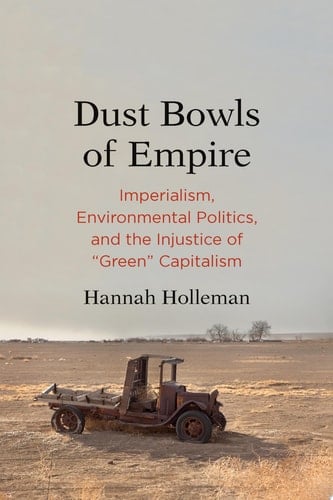
Dust Bowls of Empire
Hannah Holleman · 2018
<B>A profound reinterpretation of both the Dust Bowl on the U.S. southern plains and its relevance for today</B><BR /><BR /> The 1930s witnessed a harrowing social and ecological disaster, defined by the severe nexus of drought, erosion, and economic depression that ravaged the U.S. southern plains. Known as the Dust Bowl, this crisis has become a major referent of the climate change era, and has long served as a warning of the dire consequences of unchecked environmental despoliation.<BR /> <BR /> Through innovative research and a fresh theoretical lens, Hannah Holleman reexamines the global socioecological and economic forces of settler colonialism and imperialism precipitating this disaster, explaining critical antecedents to the acceleration of ecological degradation in our time. Holleman draws lessons from this period that point a way forward for environmental politics as we confront the growing global crises of climate change, freshwater scarcity, extreme energy, and soil degradation.
Ecologies of Gender Contemporary Nature Relations and the Nonhuman Turn
Susanne Lettow · 2022
<p>Ecologies of Gender: Contemporary Nature Relations and the Nonhuman Turn examines the role of gender in recent debates about the nonhuman turn in the humanities, and critically explores the implications for a contemporary theory of gender and nature relations.</p> <p></p> <p>The interdisciplinary contributions in this volume each provides theoretical reflections based on an analysis of specific naturecultural processes. They reveal how "ecologies of gender" are constructed through aesthetic, epistemological, political, technological and economic practices that shape multispecies and material interrelations as well as spatial and temporal orderings. The volume includes contributions from cultural anthropology, cultural studies, film studies, literary studies, media studies, philosophy and theatre studies. The essays are organized around four key dimensions of an "ecological" understanding of gender: "creatures", "materials", "spaces" and "temporalities". </p> <p>The overall aim of the volume Ecologies of Gender: Contemporary Nature Relations and the Nonhuman Turn is to explore the potentialities and limitations of the nonhuman turn for a critical analysis and theory of ecologies of gender, and thereby make an original contribution to both the environmental humanities and gender studies. </p> <p></p> <p>This book will be of great interest to scholars and students from the interdisciplinary field of the environmental humanities and environmental studies more broadly, as well as from gender studies and cultural theory. </p>
Creating an Ecological Society:: Toward a Revolutionary Transformation
Fred Magdoff · 2017
Sickened by the contamination of their water, their air, of the Earth itself, more and more people are coming to realize that it is capitalism that is, quite literally, killing them. It is now clearer than ever that capitalism is also degrading the Earth s ability to support other forms of life. Capitalism s imperative to make profit at all costs and expand without end is destabilizing Earth s climate, while increasing human misery and inequality on a planetary scale. Already, hundreds of millions of people are facing poverty in the midst of untold wealth, perpetual war, growing racism, and gender oppression. The need to organize for social and environmental reforms has never been greater. But crucial as reforms are, they cannot solve our intertwined ecological and social crises. Creating an Ecological Society reveals an overwhelmingly simple truth: Fighting for reforms is vital, but revolution is essential.<br/>Because it aims squarely at replacing capitalism with an ecologically sound and socially just society, Creating an Ecological Society is filled with revolutionary hope. Fred Magdoff and Chris Williams, who have devoted their lives to activism, Marxist analysis, and ecological science, provide informed, fascinating accounts of how a new world can be created from the ashes of the old. Their book shows that it is possible to envision and create a society that is genuinely democratic, equitable, and ecologically sustainable. And possible not one moment too soon for society to change fundamentally and be brought into harmony with nature.

Marx and Nature A Red and Green Perspective
Paul Burkett · 2014
<p>Though infrequently viewed as an environmental thinker, Karl Marx insisted that production as a social and material process is shaped and constrained by both historically developed relations among producers <i>and</i> natural conditions. Paul Burkett shows that it is Marx's overriding concern with human emancipation that impels him to approach nature from the standpoint of materialist history, sociology, and critical political economy.</p> <p><b>Paul Burkett, PhD</b> , who earned his doctorate in economics from Syracuse University, is a professor of economics at Indiana State University, Terre Haute. His publications include <i>Marxism and Ecological Economics</i> and many articles in scholarly journals.</p> <p><b>John Bellamy Foster</b> is a professor of sociology at the University of Oregon and also editor of <i>Monthly Review</i>.</p> <br>
Capitalism in the Anthropocene Ecological Ruin Or Ecological Revolution
John Bellamy Foster · 2022
<p>Over the last 11,700 years, during which human civilization developed, the earth has existed within what geologists refer to as the Holocene Epoch. Now science is telling us that the Holocene Epoch in the geological time scale ended, replaced by the onset of a new, more dangerous Anthropocene Epoch, which began around 1950. The Anthropocene Epoch is characterized by an “anthropogenic rift” in the biological cycles of the Earth System, marking a changed reality in which human activities are now the main geological force impacting the earth as a whole, generating at the same time an existential crisis for the world’s population.<br>What caused this massive shift in the history of the earth? In this comprehensive study, John Bellamy Foster tells us that a globalized system of capital accumulation has induced humanity to foul its own nest. The result is a planetary emergency that threatens all present and future generations, throwing into question the continuation of civilization and ultimately the very survival of humanity itself. Only by addressing the social aspects of the current planetary emergency, exploring the theoretical, historical, and practical dimensions of the capitalism’s alteration of the planetary environment, is it possible to develop the ecological and social resources for a new journey of hope.</p>
The Robbery of Nature Capitalism and the Ecological Rift
John Bellamy Foster · 2020
<p><b>Bridges the gap between social and environmental critiques of capitalism</b><br><br>In the nineteenth century, Karl Marx, inspired by the German chemist Justus von Liebig, argued that capitalism’s relation to its natural environment was that of a <i>robbery</i> system, leading to an irreparable <i>rift</i> in the metabolism between humanity and nature. In the twenty-first century, these classical insights into capitalism’s degradation of the earth have become the basis of extraordinary advances in critical theory and practice associated with contemporary ecosocialism. In <i>The Robbery of Nature</i>, John Bellamy Foster and Brett Clark, working within this historical tradition, examine capitalism’s plundering of nature via commodity production, and how it has led to the current anthropogenic rift in the Earth System.<br><br>Departing from much previous scholarship, Foster and Clark adopt a materialist and dialectical approach, bridging the gap between social and environmental critiques of capitalism. The ecological crisis, they explain, extends beyond questions of traditional class struggle to a corporeal rift in the physical organization of living beings themselves, raising critical issues of social reproduction, racial capitalism, alienated speciesism, and ecological imperialism. No one, they conclude, following Marx, owns the earth. Instead we must maintain it for future generations and the innumerable, diverse inhabitants of the planet as part of a process of sustainable human development.</p>

The Power of the Machine: Global Inequalities of Economy, Technology, and Environment (Volume 1) (Globalization and the Environment, 1)
Alf Hornborg · 2001
Hornborg argues that we are caught in a collective illusion about the nature of modern technology that prevents us from imagining solutions to our economic and environmental crises other than technocratic fixes. He demonstrates how the power of the machine generates increasingly asymmetrical exchanges and distribution of resources and risks between distant populations and ecosystems, and thus an increasingly polarized world order. The author challenges us to reconceptualize the machine―'industrial technomass'―as a species of power and a problem of culture. He shows how economic anthropology has the tools to deconstruct the concepts of production, money capital, and market exchange, and to analyze capital accumulation as a problem at the very interface of the natural and social sciences. His analysis provides an alternative understanding of economic growth and technological development. Hornborg's work is essential for researchers in anthropology, human ecology, economics, political economy, world-systems theory, environmental justice, and science and technology studies. Find out more about the author at the Lund University, Sweden web site.
The Tragedy of the Commodity Oceans, Fisheries, and Aquaculture
Stefano Longo · 2015
<b>Winner of the 2017 Paul Sweezy Marxist Sociology Book Award from the American Sociological Association</b><br> <br> <br> <br> Although humans have long depended on oceans and aquatic ecosystems for sustenance and trade, only recently has human influence on these resources dramatically increased, transforming and undermining oceanic environments throughout the world. Marine ecosystems are in a crisis that is global in scope, rapid in pace, and colossal in scale. In <i>The Tragedy of the Commodity</i>, sociologists Stefano B. Longo, Rebecca Clausen, and Brett Clark explore the role human influence plays in this crisis, highlighting the social and economic forces that are at the heart of this looming ecological problem. In a critique of the classic theory "the tragedy of the commons" by ecologist Garrett Hardin, the authors move beyond simplistic explanations--such as unrestrained self-interest or population growth--to argue that it is the commodification of aquatic resources that leads to the depletion of fisheries and the development of environmentally suspect means of aquaculture. To illustrate this argument, the book features two fascinating case studies--the thousand-year history of the bluefin tuna fishery in the Mediterranean and the massive Pacific salmon fishery. Longo, Clausen, and Clark describe how new fishing technologies, transformations in ships and storage capacities, and the expansion of seafood markets combined to alter radically and permanently these crucial ecosystems. In doing so, the authors underscore how the particular organization of social production contributes to ecological degradation and an increase in the pressures placed upon the ocean. The authors highlight the historical, political, economic, and cultural forces that shape how we interact with the larger biophysical world. A path-breaking analysis of overfishing, <i>The Tragedy of the Commodity</i> yields insight into issues such as deforestation, biodiversity loss, pollution, and climate change.
Dirt The Erosion of Civilizations
David R. Montgomery · 2012
Dirt, soil, call it what you want—it's everywhere we go. It is the root of our existence, supporting our feet, our farms, our cities. This fascinating yet disquieting book finds, however, that we are running out of dirt, and it's no laughing matter. An engaging natural and cultural history of soil that sweeps from ancient civilizations to modern times, <i>Dirt: The Erosion of Civilizations </i>explores the compelling idea that we are—and have long been—using up Earth's soil. Once bare of protective vegetation and exposed to wind and rain, cultivated soils erode bit by bit, slowly enough to be ignored in a single lifetime but fast enough over centuries to limit the lifespan of civilizations. A rich mix of history, archaeology and geology, <i>Dirt </i>traces the role of soil use and abuse in the history of Mesopotamia, Ancient Greece, the Roman Empire, China, European colonialism, Central America, and the American push westward. We see how soil has shaped us and we have shaped soil—as society after society has risen, prospered, and plowed through a natural endowment of fertile dirt. David R. Montgomery sees in the recent rise of organic and no-till farming the hope for a new agricultural revolution that might help us avoid the fate of previous civilizations.

The Dialectics of Ecology Socalism and Nature
John Bellamy Foster · 2024
<p>Explores ecological socialism's potential against capitalist environmental degradation <br><br>Today the fate of the earth as a home for humanity is in question—and yet, contends John Bellamy Foster, the reunification of humanity and the earth remains possible if we are prepared to make revolutionary changes. As with his prior books, <i>The Dialectics of Ecology</i> is grounded in the contention that we are now faced with a concrete choice between ecological socialism and capitalist exterminism, and rooted in insights drawn from the classical historical materialist tradition. In this latest work, Foster explores the complex theoretical debates that have arisen historically with respect to the dialectics of nature and society. He then goes on to examine the current contradictions associated with the confrontation between capitalist extractivism and the financialization of nature, on the one hand, and the radical challenges to these represented by emergent visions of ecological civilization and planned degrowth, on the other.<br><br>The product of contemporary ecosocialist debates, <i>The Dialectics of Ecology</i> builds on earlier works by Foster, including <i>Marx’s Ecology</i> and <i>The Return of Nature</i>, aimed at the development of a dialectical naturalism and the formation of a path to sustainable human development.</p>

The Return of Nature Socialism and Ecology
John Bellamy Foster · 2020
<p><b><i>Winner, 2020 Isaac and Tamara Deutscher Memorial Prize</i><br><br>A fascinating reinterpretation of the radical and socialist origins of ecology</b><br><br>Twenty years ago, John Bellamy Foster’s <i>Marx’s Ecology: Materialism and Nature</i> introduced a new understanding of Karl Marx’s revolutionary ecological materialism. More than simply a study of Marx, it commenced an intellectual and social history, en-compassing thinkers from Epicurus to Darwin, who developed materialist and ecological ideas. Now, with <i>The Return of Nature: Socialism and Ecology,</i> Foster continues this narrative. In so doing, he uncovers a long history of the efforts to unite questions of social justice and environmental sustainability, and helps us comprehend and counter today’s unprecedented planetary emergencies.<br><br><i>The Return of Nature</i> begins with the deaths of Darwin (1882) and Marx (1883) and moves on until the rise of the ecological age in the 1960s and 1970s. Foster explores how socialist analysts and materialist scientists of various stamps, first in Britain, then the United States, from William Morris and Frederick Engels, to Joseph Needham, Rachel Carson, and Stephen J. Gould, sought to develop a dialectical naturalism, rooted in a critique of capitalism. In the process, he delivers a far-reaching and fascinating reinterpretation of the radical and socialist origins of ecology. Ultimately, what this book asks for is nothing short of revolution: a long, ecological revolution, aimed at making peace with the planet while meeting collective human needs.</p>
Environmental Racism, Spatial Justice & Global Inequalities

From the Ground Up
Luke W. Cole · 2000
A critical look at the movement for environmental justice When Bill Clinton signed an Executive Order on Environmental Justice in 1994, the phenomenon of environmental racism—the disproportionate impact of environmental hazards, particularly toxic waste dumps and polluting factories, on people of color and low-income communities—gained unprecedented recognition. Behind that momentous signature, however, lies a remarkable tale of grassroots activism and political mobilization. Today, thousands of activists in hundreds of locales are fighting for their children, their communities, their quality of life, and their health. From the Ground Up critically examines one of the fastest growing social movements in the United States—the movement for environmental justice. Tracing the movement's roots, Luke Cole and Sheila Foster combine long-time activism with powerful storytelling to provide gripping case studies of communities across the US—towns like Kettleman City, California; Chester, Pennsylvania; and Dilkon, Arizona—and their struggles against corporate polluters. The authors use social, economic and legal analysis to reveal the historical and contemporary causes for environmental racism. Environmental justice struggles, they demonstrate, transform individuals, communities, institutions and the nation as a whole.
Environmental Justice Creating Equality, Reclaiming Democracy
Kristin Sharon Shrader-Frechette · 2005
Shrader-Frechette offers a rigorous philosophical discussion of environmental justice. Explaining fundamental ethical concepts such as equality, property rights, procedural justice, free informed consent, intergenerational equity, and just compensation--and then bringing them to bear on real-world social issues--she shows how many of these core concepts have been compromised for a large segment of the global population, including Appalachians, African-Americans, workers in hazardous jobs, and indigenous people in developing nations. She argues that burdens like pollution and resource depletion need to be apportioned more equally, and that there are compelling ethical grounds for remedying our environmental problems. She also argues that those affected by environmental problems must be included in the process of remedying those problems; that all citizens have a duty to engage in activism on behalf of environmental justice; and that in a democracy it is the people, not the government, that are ultimately responsible for fair use of the environment.<br>

What is Critical Environmental Justice?
David Naguib Pellow · 2017
<p><b>Human societies have always been deeply interconnected with our ecosystems, but today those relationships are witnessing greater frictions, tensions, and harms than ever before. These harms mirror those experienced by marginalized groups across the planet.</b></p> <p>In this novel book, David Naguib Pellow introduces a new framework for critically analyzing Environmental Justice scholarship and activism. In doing so he extends the field's focus to topics not usually associated with environmental justice, including the Israel/Palestine conflict and the Black Lives Matter movement in the United States. In doing so he reveals that ecological violence is first and foremost a form of social violence, driven by and legitimated by social structures and discourses. Those already familiar with the discipline will find themselves invited to think about the subject in a new way.</p> <p>This book will be a vital resource for students, scholars, and policy makers interested in transformative approaches to one of the greatest challenges facing humanity and the planet.</p>
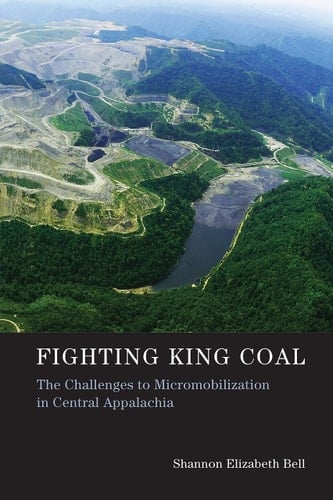
Fighting King Coal The Challenges to Micromobilization in Central Appalachia
Shannon Elizabeth Bell · 2016
<p><b>An examination of why so few people suffering from environmental hazards and pollution choose to participate in environmental justice movements. </b></p><p>In the coal-mining region of Central Appalachia, mountaintop-removal mining and coal-industry-related flooding, water contamination, and illness have led to the emergence of a grassroots, women-driven environmental justice movement. But the number of local activists is small relative to the affected population, and recruiting movement participants from within the region is an ongoing challenge. </p><p>In <i>Fighting King Coal</i>, Shannon Elizabeth Bell examines an understudied puzzle within social movement theory: why so few of the many people who suffer from industry-produced environmental hazards and pollution rise up to participate in social movements aimed at bringing about social justice and industry accountability. Using the coal-mining region of Central Appalachia as a case study, Bell investigates the challenges of micromobilization through in-depth interviews, participant observation, content analysis, geospatial viewshed analysis, and an eight-month “Photovoice” project—an innovative means of studying, in real time, the social dynamics affecting activist involvement in the region. Although the Photovoice participants took striking photographs and wrote movingly about the environmental destruction caused by coal production, only a few became activists. Bell reveals the importance of local identities to the success or failure of local recruitment efforts in social movement struggles, ultimately arguing that, if the local identities of environmental justice movements are lost, the movements may also lose their power. </p>

Coal, Cages, Crisis The Rise of the Prison Economy in Central Appalachia
Judah Schept · 2022
<p><b>How prisons became economic development strategies for rural Appalachian communities</b><br><br>As the United States began the project of mass incarceration, rural communities turned to building prisons as a strategy for economic development. More than 350 prisons have been built in the U.S. since 1980, with certain regions of the country accounting for large shares of this dramatic growth. Central Appalachia is one such region; there are eight prisons alone in Eastern Kentucky. If Kentucky were its own country, it would have the seventh highest incarceration rate in the world. In <i>Coal, Cages, Crisis, </i>Judah Schept takes a closer look at this stunning phenomenon, providing insight into prison growth, jail expansion and rising incarceration rates in America’s hinterlands. <br><br>Drawing on interviews, site visits, and archival research, Schept traces recent prison growth in the region to the rapid decline of its coal industry. He takes us inside this startling transformation occurring in the coalfields, where prisons are often built on top of old coalmines, including mountaintop removal sites, and built into community planning approaches to crises of unemployment, population loss, and declining revenues. By linking prison growth to other sites in this landscape—coal mines, coal waste, landfills, and incinerators—Schept shows that the prison boom has less to do with crime and punishment and much more with the overall extraction, depletion, and waste disposal processes that characterize dominant development strategies for the region.<br><br>Schept argues that the future of this area now hangs in the balance, detailing recent efforts to oppose its carceral growth. <i>Coal, Cages, Crisis </i>offers invaluable insight into the complex dynamics of mass incarceration that continue to shape Appalachia and the broader United States.</p>
Toxic Safety Flame Retardants, Chemical Controversies, and Environmental Health
Alissa. Cordner · 2019
Initially marketed as a life-saving advancement, flame retardants are now mired in controversy. Some argue that data show the chemicals are unsafe while others continue to support their use. The tactics of each side have far-reaching consequences for how we interpret new scientific discoveries.<br> <br> An experienced environmental sociologist, Alissa Cordner conducts more than a hundred interviews with activists, scientists, regulators, and industry professionals to isolate the social, scientific, economic, and political forces influencing environmental health policy today. Introducing "strategic science translation," she describes how stakeholders use scientific evidence to support nonscientific goals and construct "conceptual risk formulas" to shape risk assessment and the interpretation of empirical evidence. A revelatory text for public-health advocates, <i>Toxic Safety</i> demonstrates that while all parties interested in health issues use science to support their claims, they do not compete on a level playing field and even good intentions can have deleterious effects.

Residual Governance
Gabrielle Hecht · 2023
In Residual Governance, Gabrielle Hecht dives into the wastes of gold and uranium mining in South Africa to explore how communities, experts, and artists fight for infrastructural and environmental justice. Hecht outlines how mining in South Africa is a prime example of what she theorizes as residual governance—the governance of waste and discard, governance that is purposefully inefficient, and governance that treats people and places as waste and wastelands. She centers the voices of people who resist residual governance and the harms of toxic mining waste to highlight how mining’s centrality to South African history reveals the links between race, capitalism, the state, and the environment. In this way, Hecht shows how the history of mining in South Africa and the resistance to residual governance and environmental degradation is a planetary story: the underlying logic of residual governance lies at the heart of contemporary global racial capitalism and is a major accelerant of the Anthropocene.

Form and Flow The Spatial Politics of Urban Resilience and Climate Justice
Kian Goh · 2021
<b>An examination of urban climate change response strategies and the resistance to them by grassroots activists and social movements.</b><br><br>Cities around the world are formulating plans to respond to climate change and adapt to its impact. Often, marginalized urban residents resist these plans, offering “counterplans” to protest unjust and exclusionary actions. In this book, Kian Goh examines climate change response strategies in three cities—New York, Jakarta, and Rotterdam—and the mobilization of community groups to fight the perceived injustices and oversights of these plans. Looking through the lenses of urban design and socioecological spatial politics, Goh reveals how contested visions of the future city are produced and gain power.<br> <br>Goh describes, on the one hand, a growing global network of urban environmental planning organizations intertwined with capitalist urban development, and, on the other, social movements that themselves often harness the power of networks. She explores such initiatives as Rebuild By Design in New York, the Giant Sea Wall plan in Jakarta, and Rotterdam Climate Proof, and discovers competing narratives, including community resiliency in Brooklyn and grassroots activism in the informal “kampungs” of Jakarta. Drawing on participatory fieldwork and her own background in architecture and urban design, Goh offers both theoretical explanations and practical planning and design strategies. She reframes the critical concerns of urban climate change responses, presenting a sociospatial typology of urban adaptation and considering the notion of a “just” resilience. Finally, she proposes a theoretical framework for designing equitable and just urban climate futures.

Climate Justice in the Majority World Vulnerability, Resistance and Diverse Knowledges
Neil James Wilson Crawford · 2024
"This edited collection explores a diverse range of climate (in)justice case studies from the Majority World - where most of humans and non-humans live. It is also the site of the most severe impacts of climate change and home to some of the key solutions for the climate crisis. The collection brings together twelve chapters featuring the work of over thirty authors from around the globe. The impacts of climate change are disproportionately affecting individuals, communities, and countries in the Majority World who historically have contributed little to rising global temperatures. The twelve chapters focus on a range of cross-cutting themes, demonstrating both individual and collective experiences of climate change and struggles for achieving climate justice from the Majority World. This includes activism, resistance, and social movement organising in India and Brazil, lived experiences and understandings of frontline communities in Bangladesh and South Africa, consequences of and responses to disasters in Mozambique and Puerto Rico, and contested accounts, narratives, and futures in the Maldives and Pakistan, among other topics. By adopting a decolonial lens, this book provides rich empirical content, insightful comparisons, and novel conceptual interventions. It foregrounds climate justice from an intersectional perspective and contributes to the ongoing efforts by scholars and activists to address epistemic injustice in climate change research, policy and practice. It will appeal to undergraduate and graduate-level students, academics, activists, policymakers, and members of the public concerned with the impacts and inequalities of climate change in the Majority World. Neil J. W. Crawford is a Research Fellow in Climate Action and member of the Priestley International Centre for Climate, University of Leeds, UK. Their research focuses on forced migration and displacement, refugee rights, climate justice and the inequalities of climate change, gender and sexuality, and cities"--

Seeking Spatial Justice
Edward W. Soja · 2010
In 1996, the Los Angeles Bus Riders Union, a grassroots advocacy organization, won a historic legal victory against the city's Metropolitan Transit Authority. The resulting consent decree forced the MTA for a period of ten years to essentially reorient the mass transit system to better serve the city's poorest residents. A stunning reversal of conventional governance and planning in urban America, which almost always favors wealthier residents, this decision is also, for renowned urban theorist Edward W. Soja, a concrete example of spatial justice in action. <i>In Seeking Spatial Justice</i>, Soja argues that justice has a geography and that the equitable distribution of resources, services, and access is a basic human right. Building on current concerns in critical geography and the new spatial consciousness, Soja interweaves theory and practice, offering new ways of understanding and changing the unjust geographies in which we live. After tracing the evolution of spatial justice and the closely related notion of the right to the city in the influential work of Henri Lefebvre, David Harvey, and others, he demonstrates how these ideas are now being applied through a series of case studies in Los Angeles, the city at the forefront of this movement. Soja focuses on such innovative labor–community coalitions as Justice for Janitors, the Los Angeles Alliance for a New Economy, and the Right to the City Alliance; on struggles for rent control and environmental justice; and on the role that faculty and students in the UCLA Department of Urban Planning have played in both developing the theory of spatial justice and putting it into practice. Effectively locating spatial justice as a theoretical concept, a mode of empirical analysis, and a strategy for social and political action, this book makes a significant contribution to the contemporary debates about justice, space, and the city.
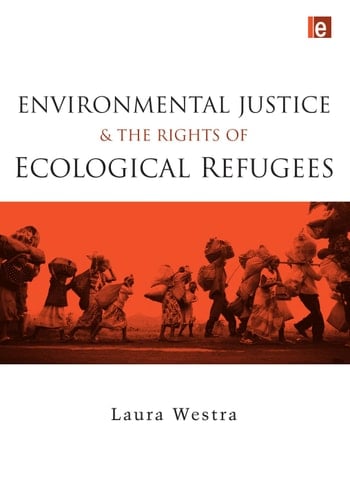
Environmental Justice and the Rights of Ecological Refugees
Laura Westra · 2009
<p>Climate change and other environmental problems are increasingly leading to the displacement of populations from their homelands, whether through drought, flooding, famine or other causes. Worse, there is currently no protection in international law for people made refugees by such means. </p><p>Following on from her previous explorations of environmental justice as it relates to future generations and indigenous peoples, Laura Westra now turns her attention to the plight of ecological refugees. In Part I, Westra provides an overview of what defines an ecological refugee and their present legal status. Part II goes into greater depth as to who the vulnerable are and what protection they have in international law. Part III looks to the future, advocating a comprehensive approach to the problem. With extensive examples and analysis, this is a compelling treatment that will be indispensable for legal professionals, government and business leaders, academics and students of the role of law in the protection of the rights of refugees. </p>
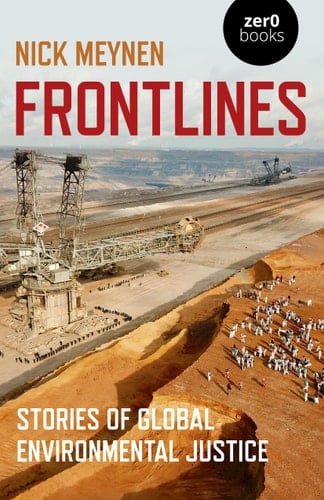
Frontlines Stories of Global Environmental Justice
Nick Meynen · 2020
Every unpacked frontline is one cutting edge of an economic system and political ideology that is destroying life on earth. Revealing our ecosystems to be under a sustained attack, Nick Meynen finds causes for hope in unconventional places.
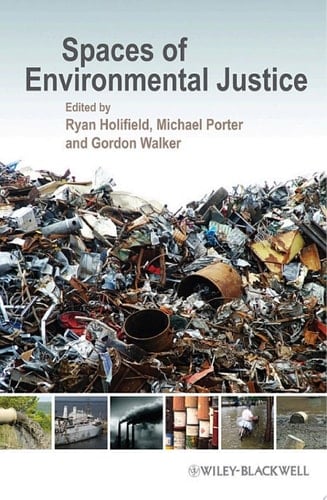
Spaces of Environmental Justice
Ryan Holifield · 2011
<p>In this cutting-edge volume, leading scholars examine a diverse range of environmental inequalities from around the world.<br></p><ul> <li>Shows how far the field has moved beyond its original focus on uneven distributions of pollution in the USA </li> <li>Considers the influence of critical geographical and social theory on environmental justice studies </li> <li>Examines a range of possibilities for future research directions </li> <li>Explores the challenges of investigating and pursuing environmental justice at a time of rapid economic and environmental change </li></ul>

Environmental Justice and Environmentalism The Social Justice Challenge to the Environmental Movement
Ronald D. Sandler · 2007
<p><b>Analysis and case studies from interdisciplinary perspectives explore the possibility and desirability of collaboration between the grassroots-oriented environmental justice movement and mainstream environmental organizations. </b></p><p>Although the environmental movement and the environmental justice movement would seem to be natural allies, their relationship over the years has often been characterized by conflict and division. The environmental justice movement has charged the mainstream environmental movement with racism and elitism and has criticized its activist agenda on the grounds that it values wilderness over people. Environmental justice advocates have called upon environmental organizations to act on environmental injustice and address racism and classism in their own hiring and organizational practices, lobbying agenda, and political platforms. This book examines the current relationship between the two movements in both conceptual and practical terms and explores the possibilities for future collaboration. In ten original essays, contributors from a variety of disciplines consider such topics as the relationship between the two movements' ethical commitments and activist goals, instances of successful cooperation in U.S. contexts, and the challenges posed to both movements by globalization and climate change. They examine the possibility and desirability of one unified movement as opposed to two complementary ones by means of analyses and case studies; these include a story of asbestos hazards that begins in a Montana mine and ends with the release of asbestos insulation into the air of Manhattan after the collapse of the World Trade Center. This book, part of a necessary rethinking of the relationship between the two movements, shows that effective, mutually beneficial alliances can advance the missions of both.</p><p><b>Contributors</b><br>Kim Allen, J. Robert Cox, Vinci Daro, Kevin DeLuca, Giovanna Di Chiro, Daniel Faber, Dorothy Holland, Dale Jamieson, M. Nils Peterson, Markus John Peterson, Tarla Rai Peterson, Phaedra C. Pezzullo, J. Timmons Roberts, Ronald Sandler, Steve Schwarze, Peter Wenz</p>

There’s Something In The Water: Environmental Racism in Indigenous & Black Communities
Ingrid R. G. Waldron · 2018

Toxic Communities: Environmental Racism, Industrial Pollution, and Residential Mobility
Dorceta E. Taylor · 2021

A Climate of Injustice: Global Inequality, North-South Politics, and Climate Policy (Global Environmental Accord: Strategies for Sustainability and Institutional Innovation)
J. Timmons Roberts · 2006
The global debate over who should take action to address climate change is extremely precarious, as diametrically opposed perceptions of climate justice threaten the prospects for any long-term agreement. Poor nations fear limits on their efforts to grow economically and meet the needs of their own people, while powerful industrial nations, including the United States, refuse to curtail their own excesses unless developing countries make similar sacrifices. Meanwhile, although industrialized countries are responsible for 60 percent of the greenhouse gas emissions that contribute to climate change, developing countries suffer the "worst and first" effects of climate-related disasters, including droughts, floods, and storms, because of their geographical locations. In A Climate of Injustice, J. Timmons Roberts and Bradley Parks analyze the role that inequality between rich and poor nations plays in the negotiation of global climate agreements.<br/>Roberts and Parks argue that global inequality dampens cooperative efforts by reinforcing the "structuralist" worldviews and causal beliefs of many poor nations, eroding conditions of generalized trust, and promoting particularistic notions of "fair" solutions. They develop new measures of climate-related inequality, analyzing fatality and homelessness rates from hydrometeorological disasters, patterns of "emissions inequality," and participation in international environmental regimes. Until we recognize that reaching a North-South global climate pact requires addressing larger issues of inequality and striking a global bargain on environment and development, Roberts and Parks argue, the current policy gridlock will remain unresolved.

Environmental Inequalities Beyond Borders Local Perspectives on Global Injustices
JoAnn Carmin · 2011
<p><b> Case studies demonstrate the spatial disconnect between global consumption and production and its effects on local environmental quality and human rights.</b></p><p>Multinational corporations often exploit natural resources or locate factories in poor countries far from the demand for the products and profits that result. Developed countries also routinely dump hazardous materials and produce greenhouse gas emissions that have a disproportionate impact on developing countries. This book investigates how these and other globalized practices exact high social and environmental costs as poor, local communities are forced to cope with depleted resources, pollution, health problems, and social and cultural disruption. Case studies drawn from Africa, Asia, the Pacific Rim, and Latin America critically assess how diverse types of global inequalities play out on local terrains. These range from an assessment of the pros and cons of foreign investment in Fiji to an account of the work of transnational activists combating toxic waste disposal in Mozambique. Taken together, the chapters demonstrate the spatial disconnect between global consumption and production on the one hand and local environmental quality and human rights on the other. The result is a rich perspective not only on the ways industries, governments, and consumption patterns may further entrench existing inequalities but also on how emerging networks and movements can foster institutional change and promote social equality and environmental justice.</p>
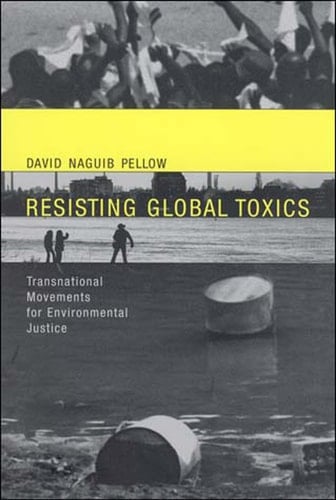
Resisting Global Toxics Transnational Movements for Environmental Justice
David Naguib Pellow · 2007
<b>Examines the export of hazardous wastes to poor communities of color around the world and charts the global social movements that challenge them.</b><p>Every year, nations and corporations in the “global North” produce millions of tons of toxic waste. Too often this hazardous material—inked to high rates of illness and death and widespread ecosystem damage—is exported to poor communities of color around the world. In <i>Resisting Global Toxics</i>, David Naguib Pellow examines this practice and charts the emergence of transnational environmental justice movements to challenge and reverse it. Pellow argues that waste dumping across national boundaries from rich to poor communities is a form of transnational environmental inequality that reflects North/South divisions in a globalized world, and that it must be theorized in the context of race, class, nation, and environment. Building on environmental justice studies, environmental sociology, social movement theory, and race theory, and drawing on his own research, interviews, and participant observations, Pellow investigates the phenomenon of global environmental inequality and considers the work of activists, organizations, and networks resisting it. He traces the transnational waste trade from its beginnings in the 1980s to the present day, examining global garbage dumping, the toxic pesticides that are the legacy of the Green Revolution in agriculture, and today's scourge of dumping and remanufacturing high tech and electronics products. The rise of the transnational environmental movements described in <i>Resisting Global Toxics</i> charts a pragmatic path toward environmental justice, human rights, and sustainability.</p>

Environmental Justice in the Anthropocene From (un)just Presents to Just Futures
Stacia Ryder · 2021
<p>Through various international case studies presented by both practitioners and scholars, <i>Environmental Justice in the Anthropocene</i> explores how an environmental justice approach is necessary for reflections on inequality in the Anthropocene and for forging societal transitions toward a more just and sustainable future.</p>

Confronting Environmental Racism Voices from the Grassroots
Robert D. Bullard · 1993
The connection between racism and environmental quality is increasingly visible. People of color in urban and rural areas are the most likely victims of industrial dumping, toxic landfills, uranium mining, and dangerous waste incinerators. This groundbreaking anthology grows out of the National People of Color Environmental Leadership Summit and brings together leading scholars, environmental leaders, and social justice activists of the emerging environmental justice movement.
Ecosocialism, Degrowth, & Climate Ideologies
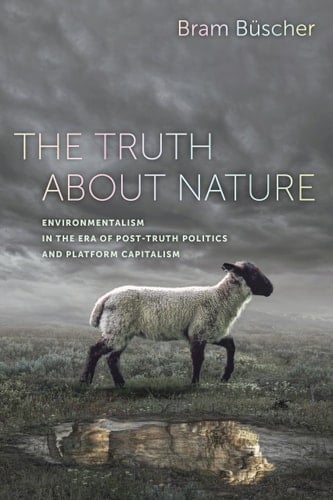
The Truth about Nature Environmentalism in the Era of Post-truth Politics and Platform Capitalism
Bram Büscher · 2020
How should we share the truth about the environmental crisis? At a moment when even the most basic facts about ecology and the climate face contestation and contempt, environmental advocates are at an impasse. Many have turned to social media and digital technologies to shift the tide. But what if their strategy is not only flawed, but dangerous?<br><br><i>The Truth about Nature</i> follows environmental actors as they turn to the internet to save nature. It documents how conservation efforts are transformed through the political economy of platforms and the algorithmic feeds that have been instrumental to the rise of post-truth politics. Developing a novel account of post-truth as an expression of power under platform capitalism, Bram Büscher shows how environmental actors attempt to mediate between structural forms of platform power and the contingent histories and contexts of particular environmental issues. Bringing efforts at wildlife protection in Southern Africa into dialogue with a sweeping analysis of truth and power in the twenty-first century, Büscher makes the case for a new environmental politics that radically reignites the art of speaking truth to power.

Ending Fossil Fuels Why Net Zero is Not Enough
Holly Jean Buck · 2021
<b>Ending the fossil fuel industry is the only credible path for climate policy</b><br><br>Around the world, countries and companies are setting net-zero carbon emissions targets. But what will it mean if those targets are achieved? One possibility is that fossil fuel companies will continue to produce billions of tons of atmospheric CO2 while relying on a symbiotic industry to scrub the air clean. Focusing on emissions draws our attention away from the real problem: the point of production.<br><br>The fossil fuel industry must come to an end but will not depart willingly; governments must intervene. By embracing a politics of rural-urban coalitions and platform governance, climate advocates can build the political power needed to nationalize the fossil fuel industry and use its resources to draw carbon out of the atmosphere.
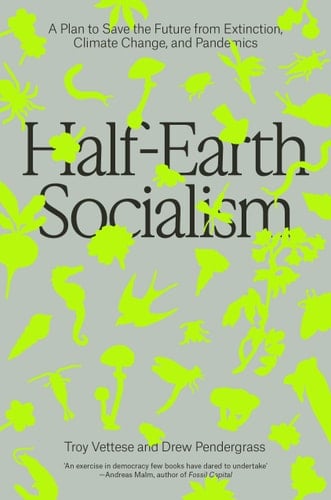
Half-Earth Socialism A Plan to Save the Future from Extinction, Climate Change and Pandemics
Troy Vettese · 2022
<b>A plan to save the earth and bring the good life to all </b><br><br>In this thrilling and capacious book, Troy Vettese and Drew Pendergrass challenge the inertia of capitalism and the left alike and propose a radical plan to address climate disaster and guarantee the good life for all. Consumption in the Global North can’t continue unabated, and we must give up the idea that humans can fully control the Earth through technological “fixes” which only wreak further havoc.<br><br> Rather than allow the forces of the free market to destroy the planet, we must strive for a post-capitalist society able to guarantee the good life the entire planet. This plan, which they call Half-Earth Socialism, means we must:<br><br> • rewild half the Earth to absorb carbon emissions and restore biodiversity<br> • pursue a rapid transition to renewable energy, paired with drastic cuts in consumption by the world’s wealthiest populations<br> • enact global veganism to cut down on energy and land use<br> • inaugurate worldwide socialist planning to efficiently and equitably manage production<br> • welcome the participation of everyone—even you!<br><br> Accompanied by a climate-modelling website inviting readers to design their own “half earth,” Vettese and Pendergrass offer us a visionary way forward—and our only hope for a future.
The Rise of Ecofascism Climate Change and the Far Right
Sam Moore · 2022
<p>The world faces a climate crisis and an ascendant far right. Are these trends related? How does the far right think about the environment, and what openings does the coming crisis present for them?</p> <p>This incisive new book traces the long history of far-right environmentalism and explores how it is adapting to the contemporary world. It argues that the extreme right, after years of denying the reality of climate change, are now showing serious signs of reversing their strategy. A new generation of far-right activists has realized that impending environmental catastrophe represents their best chance yet for a return to relevance. In reality, however, their noxious blend of conspiracy, hatred and violence is no solution at all: it is the ‘eco-socialism of fools’. Only a real commitment to climate justice can save us and stop the far right in its tracks.</p> <p>No-one interested in the struggle against right-wing extremism and the crusade for climate justice can afford to miss this trenchant critique of burgeoning ecofascism.</p>
Petrocultures Oil, Politics, Culture
Sheena L. Wilson · 2017
Contemporary life is founded on oil - a cheap, accessible, and rich source of energy that has shaped cities and manufacturing economies at the same time that it has increased mobility, global trade, and environmental devastation. Despite oil's essential role, full recognition of its social and cultural significance has only become a prominent feature of everyday debate and discussion in the early twenty-first century. Presenting a multifaceted analysis of the cultural, social, and political claims and assumptions that guide how we think and talk about oil, Petrocultures maps the complex and often contradictory ways in which oil has influenced the public's imagination around the world. This collection of essays shows that oil's vast network of social and historical narratives and the processes that enable its extraction are what characterize its importance, and that its circulation through this immense web of relations forms worldwide experiences and expectations. Contributors' essays investigate the discourses surrounding oil in contemporary culture while advancing and configuring new ways to discuss the cultural ecosystem that it has created. A window into the social role of oil, Petrocultures also contemplates what it would mean if human life were no longer deeply shaped by the consumption of fossil fuels.
The Exhausted of the Earth Politics in a Burning World
Ajay Singh Chaudhary · 2024
<b><b>Marrying the scientific and political sides of the climate crisis issue, this is a hopeful call to arms about how we can overcome climate change.</b><br><br>Climate change is not only about the exhaustion of the planet, it's about the exhaustion of so many of us, our lives, our worlds, even our minds. So, what is to be done?</b><br><br>To answer this question, Ajay Singh Chaudhary brings together both the science and the politics of climate change. He shows how a new politics particular to the climate catastrophe demands a bitter struggle between those attached to the power, wealth, and security of "business-as-usual" and all of us, those exhausted, in every sense of the word, by the status quo.<br><br>Replacing Promethean, romantic, and apocalyptic fairytales with a new story for every exhausted inhabitant of this exhausted world, <i>The Exhausted of the Earth </i>outlines the politics and the power needed to alter the course of our burning world far beyond, far better than, mere survival.
Overshoot How the World Surrendered to Climate Breakdown
Andreas Malm · 2024
<b>A scathing critique of proposals to geoengineer our way out of climate disaster by the bestselling author of <i>How to Blow Up a Pipeline</i></b><br><br>It might soon be far too hot on this planet. What do we do then? In the era of "overshoot," schemes abound for turning down the heat–not now, but a few decades down the road. We’re being told that we can return to liveable temperatures by means of technologies for removing CO2 from the air or blocking incoming sunlight.If they even exist, such technologies are not safe.<br><br>They come with immense uncertainties and risks. Worse, like magical promises of future redemption, they might provide reasons for continuing to emit in the present. But do they also hold some potentials? In <i>Overshoot</i> two leading climate scholars subject the plans for saving the planet after it’s been wrecked to critical study. Carbon dioxide removal is already having effects, as an excuse for continuing business as usual, while geoengineering promises to bail out humanity if the heat reaches critical levels.<br><br>Both distract from the one urgent task: to slash emissions <i>now</i>. There can be no further delay. The climate revolution is long overdue, and in the end, no technology can absolve us of its tasks.
The Conservation Revolution Radical Ideas for Saving Nature Beyond the Anthropocene
Bram Buscher · 2020
<b>A post-capitalist manifesto for conservation</b><br><br>Conservation needs a revolution. This is the only way it can contribute to the drastic transformations needed to come to a truly sustainable model of development. The good news is that conservation is ready for revolution. Heated debates about the rise of the Anthropocene and the current ‘sixth extinction’ crisis demonstrate an urgent need and desire to move beyond mainstream approaches. Yet the conservation community is deeply divided over where to go from here. Some want to place ‘half earth’ into protected areas. Others want to move away from parks to focus on unexpected and ‘new’ natures. Many believe conservation requires full integration into capitalist production processes.<br><br> Building a razor-sharp critique of current conservation proposals and their contradictions, Büscher and Fletcher argue that the Anthropocene challenge demands something bigger, better and bolder. Something truly revolutionary. They propose convivial conservation as the way forward. This approach goes beyond protected areas and faith in markets to incorporate the needs of humans and nonhumans within integrated and just landscapes. Theoretically astute and practically relevant, <i>The Conservation Revolution</i> offers a manifesto for conservation in the twenty-first century—a clarion call that cannot be ignored.

After Nature A Politics for the Anthropocene
Jedediah Purdy · 2018
<p><b>An <i>Artforum</i> Best Book of the Year<br>A <i>Legal Theory Bookworm</i> Book of the Year</b><br><br><b>“<i>After Nature</i> argues that we will deserve the future only because it will be the one we made. We will live, or die, by our mistakes.” —Christine Smallwood, <i>Harper’s</i></b><br><br>Nature no longer exists apart from humanity. Henceforth, the world we will inhabit is the one we have made. Geologists have called this new planetary epoch the Anthropocene, the Age of Humans. The geological strata we are now creating record industrial emissions, industrial-scale crop pollens, and the disappearance of species driven to extinction. Climate change is planetary engineering without design. These facts of the Anthropocene are scientific, but its shape and meaning are questions for politics—a politics that does not yet exist. <i>After Nature</i> develops a politics for this post-natural world.<br><br>“Dazzling...Purdy hopes that climate change might spur yet another change in how we think about the natural world, but he insists that such a shift will be inescapably political...For a relatively slim volume, this book distills an incredible amount of scholarship—about Americans’ changing attitudes toward the natural world, and about how those attitudes might change in the future.”<br>—Ross Andersen, <i>The Atlantic</i></p>

Post-Apocalyptic Environmentalism The Green Movement in Times of Catastrophe
Carl Cassegård · 2022
<p>This book analyses how the environmental movement has developed three overarching narratives that co-exist and compete within it. The first is the narrative of green progress, which has been prominent from the start in environmentalist thought and which is today expressed in the idea of sustainable development and in eco-modernism. The second is the apocalyptic narrative, which urges us to act in order to avert a future catastrophe and which rose to prominence with Rachel Carson and other classics of post-war environmentalism and experienced a renaissance with the climate activism of the 2000s. The third is the postapocalyptic narrative according to which catastrophe is already an unavoidable fact. The centrepiece of the book is its discussion of the postapocalyptic narrative, which has become influential in the recent decade, especially in the wake of the disillusionment following the failed climate summit in Copenhagen 2009. </p><p>Climate change, resource exhaustion, pollution and species extinction signal that catastrophes have already become realities here and now for an enormous number of people and other lifeforms. The book probes the possibilities and limitations of the environmental movement in grappling with these issues and turning them into relevant action. </p><br>

Rare Earth Frontiers From Terrestrial Subsoils to Lunar Landscapes
Julie Michelle Klinger · 2017
<p><i>Rare Earth Frontiers</i> is a work of human geography that serves to demystify the powerful elements that make possible the miniaturization of electronics, green energy and medical technologies, and essential telecommunications and defense systems. Julie Michelle Klinger draws attention to the fact that the rare earths we rely on most are as common as copper or lead, and this means the implications of their extraction are global. Klinger excavates the rich historical origins and ongoing ramifications of the quest to mine rare earths in ever more impossible places.</p><p>Klinger writes about the devastating damage to lives and the environment caused by the exploitation of rare earths. She demonstrates in human terms how scarcity myths have been conscripted into diverse geopolitical campaigns that use rare earth mining as a pretext to capture spaces that have historically fallen beyond the grasp of centralized power. These include legally and logistically forbidding locations in the Amazon, Greenland, and Afghanistan, and on the Moon. Drawing on ethnographic, archival, and interview data gathered in local languages and offering possible solutions to the problems it documents, this book examines the production of the rare earth frontier as a place, a concept, and a zone of contestation, sacrifice, and transformation.</p>
The Afterlives of Extraction Alternatives and Sustainable Futures
Filipe Calvão · 2023
The frontiers of extraction are expanding rapidly, driven by a growing demand for minerals and metals that is often motivated by sustainability considerations. Two volumes of International Development Policy are dedicated to the paradoxes and futures of green extractivism, with analyses of experiences from five continents. In this, the second of the two volumes, the 22 authors, using different conceptual approaches and in different empirical contexts, demonstrate the alarming obduracy of the logic of extractivism, even - and perhaps especially - in the growing support for the so-called green transition. The authors highlight the complex and enduring legacies of resource extraction and the urgent need to move beyond extractive models of development towards alternative pathways that prioritise social justice, environmental sustainability, democratic governance and the well-being of both humans and non-humans. They also caution us against the assumption that anti-extraction is anti-extractivist, that post-extraction is post-extractivism, and they critically attune us to the systemic nature of extractivism in ways that both connect and transcend any particular site or scale. <br><br> This volume accompanies IDP 15, <i>The Lives of Extraction: Identities, Communities, and the Politics of Place</i>.
The Rare Metals War The Dark Side of Clean Energy and Digital Technologies
Guillaume Pitron · 2020
<p><b>Is the shift to renewable energy and digital devices going to free us from severe pollution, material shortages, and military tensions?</b></p> <p>Rare metals are essential to electric vehicles, fighter jets, wind turbines, and solar panels, and also to our smartphones, computers, tablets, and other everyday connected objects. But consumers know very little about how they are mined and traded, or the environmental, economic, and geopolitical costs of this dependence.</p> <p>This book reveals the dark side of the world that awaits us. It is an undercover tale of a technological odyssey that has promised much, and a look behind the scenes. Behind it all lurks China, which has captured the lion's share of the ownership and processing of rare metals we now can't do without. Drawing on six years of research across a dozen countries, this book shows that by breaking free of fossil fuels, we are in fact setting ourselves up for a new dependence--on rare metals that have become vital to our new ecological and digital society.</p>

Living Minerals
Javiera Barandiaran · 2026
A sobering investigation of the rush for lithium for electric vehicles, the problematic history of lithium mining, and the consequences for sustainability. Consumers today are buying electric vehicles with lithium-ion batteries motivated by the belief that they are doing good and decarbonizing society. But is sustainable lithium extraction possible? In Living Minerals, Javiera Barandiarán examines the history of lithium mining and uses during the twentieth century, with a specific focus on the two oldest brine-lithium mines: Silver Peak, Nevada, and Salar de Atacama, Chile, where lithium is found as one more element in a liquid mix of salts, minerals, and organisms. For six decades, mining experts have failed to ask about water usage, about waste or brine leakage, and about the ecosystem impacts in delicate deserts. Instead, they have relied on various fictions about the size of reserves, the fate of leaked brine, or the value of waste in facilitating mine development. These fictions, rooted in brine-lithium’s material qualities, could be sustained thanks to powerful mining memories that celebrated resource nationalism. Unique in its historical and multidimensional approach to minerals and mining, based on the novel Rights of Nature paradigm, and using new archival materials from both Chile and the US, the book argues that decarbonizing society requires that we reckon with these realities—or risk deepening our dependency on an unsustainable mining industry.
The Great Green Grab - Climate Extractivism and the New Resource Imperialism
Philippe Le Billon · 2026

The Rise of Green Extractivism Extractivism, Rural Livelihoods and Accumulation in a Climate-smart World
Natacha Bruna · 2023
<p>The Rise of Green Extractivism tackles the understudied interconnections between extractivism and climate-smart policies and their implications for rural livelihoods, both theoretically and empirically.</p>

Overheated
Kate Aronoff · 2021
This damning account of the forces that have hijacked progress on climate change shares a bold vision of what it will take, politically and economically, to face the existential threat of global warming head-on. In the past few years, it has become impossible (for most) to deny the effects of climate change and that the planet is warming, and to acknowledge that we must act. But a new kind of denialism is taking root in the halls of power, shaped by a quarter-century of neoliberal policies, that threatens to doom us before we've grasped the full extent of the crisis. As Kate Aronoff argues, since the 1980s and 1990s, economists, pro-business Democrats and Republicans in the US, and global organizations like the UN and the World Economic Forum have all made concessions to the oil and gas industry that they have no intention of reversing. What's more, they believe that climate change can be solved through the market, capitalism can be a force for good, and all of us, corporations included, are fighting the good fight together. These assumptions, Aronoff makes abundantly clear, will not save the planet. Drawing on years of reporting and rigorous economic analysis, Aronoff lays out a robust vision for what will, detailing how to constrain the fossil fuel industry; transform the economy into a sustainable, democratic one; mobilize political support; create effective public-private partnerships; enact climate reparations; and adapt to inevitable warming in a way that is just and equitable. Our future, Overheated makes clear, will require a radical reimagining of our politics and our economies, but if done right, it will save the world.
The Rise of the Green Left: A Global Introduction to Ecosocialism
Derek Wall · 2010
Drawing on the work of key thinkers such as Joel Kovel and John Bellamy Foster, Derek Wall provides an unique insider view of how ecosocialism has developed and a practical guide to focused ecosocialist action.<br/>Climate change and other ecological ills are driving the creation of a grassroots global movement for change. From Latin America to Europe, Australia and China a militant movement merging red and green is taking shape. Ecosocialists argue that capitalism threatens the future of humanity and the rest of nature. From indigenous protest in the Peruvian Amazon to the green transition in Cuba to the creation of red-green parties in Europe, ecosocialism is defining the future of left and green politics globally. Latin American leaders such as Morales and Chavez are increasingly calling for an ecosocialist transition. This is an important handbook for activists and engaged students of politics.
Less is More How Degrowth Will Save the World
Jason Hickel · 2021
<b>______________________</b><br><b>'A powerfully disruptive book for disrupted times ...</b> <b>If you're looking for transformative ideas, this book is for you.' </b>KATE RAWORTH, economist and author of <i>Doughnut Economics</i><br><br><i>Featured in </i><b>FT Best Books of the Year 2020</b><br><b>______________________</b><br><b>The world has finally awoken to the reality of climate breakdown and ecological collapse. Now we must face up to its primary cause. Capitalism demands perpetual expansion, which is devastating the living world. There is only one solution that will lead to meaningful and immediate change: DEGROWTH.</b><br><br>If we want to have a shot at halting the crisis, we need to restore the balance. We need to change how we see nature and our place in it, shifting from a philosophy of domination and extraction to one that's rooted in reciprocity and regeneration. We need to evolve beyond the dogmas of capitalism to a new system that is fit for the twenty-first century. But what does such a society look like? What about jobs? What about health? What about progress?<br><br>This book tackles these questions and traces a clear pathway to a post-capitalist economy. An economy that's more just, more caring, and more fun. An economy that enables human flourishing while reversing ecological breakdown. An economy that will not only lift us out of our current crisis, but restore our sense of connection to a world that's brimming with life. By taking less, we can become more.<br><b>______________________</b><br>'A masterpiece... <i>Less is More </i>covers centuries and continents, spans academic disciplines, and connects contemporary and ancient events in a way which cannot be put down until it's finished.' <b>DANNY DORLING, Professor of Geography, University of Oxford</b><br><br>'Jason is able to personalise the global and swarm the mind in the way that insects used to in abundance but soon shan't unless we are able to heed his beautifully rendered warning.' <b>RUSSELL BRAND</b><br><br>'Jason Hickel shows that recovering the commons and decolonizing nature, cultures, and humanity are necessary conditions for hope of a common future in our common home.' <b>VANDANA SHIVA, author of <i>Making Peace With the Earth</i></b><br><br>'This is a book we have all been waiting for. Jason Hickel dispels ecomodernist fantasies of "green growth". Only degrowth can avoid climate breakdown. The facts are indisputable and they are in this book.' <b>GIORGIS KALLIS, author of <i>Degrowth</i></b><br><br>'Capitalism has robbed us of our ability to even imagine something different; <i>Less is More</i> gives us the ability to not only dream of another world, but also the tools by which we can make that vision real.' <b>ASAD REHMAN, director of War on Want</b><br><br>'One of the most important books I have read ... does something extremely rare: it outlines a clear path to a sustainable future for all.' <b>RAOUL MARTINEZ, author of <i>Creating Freedom</i></b><br><br>'Jason Hickel takes us on a profound journey through the last 500 years of capitalism and into the current crisis of ecological collapse. <i>Less is More </i>is required reading for anyone interested in what it means to live in the Anthropocene, and what we can do about it.' <b>ALNOOR LADHA, co-founder of The Rules</b>

Ecosocialism A Radical Alternative to Capitalist Catastrophe
Michael Lšwy · 2015
Revolutionary ideas and strategies to save the planet.

Disaster Nationalism The Downfall of Liberal Civilization
Richard Seymour · 2024
<b>Liberal civilisation is in crisis - now is a time of monsters.</b><br><br>The rise of the new far right has left the world grappling with a profound misunderstanding. While the spotlight often shines on the actions of charismatic leaders such as Donald Trump and Jair Bolsonaro, the true peril lies elsewhere. Defeating these people will not stem the tide driving them forward. They are merely the embodiment of profound forces that are rarely understood. Propelled through the vast networks of social media and fueled by far-right influencers, enthralled by images of disaster and fantasies of doom, they have emerged from a reservoir of societal despair, fear, and isolation. Within this seething cauldron, we witness not only the surge of far-right political movements but also the sparks of individual and collective violence against perceived enemies, from ‘lone wolf’ killers to terrifying pogroms. Should a new fascism emerge, it will coalesce from these very elements. This is disaster nationalism.<br><br>Richard Seymour delves deep into this alarming development in world politics, dissecting its roots, its influencers, and the threats it poses. With meticulous analysis and compelling storytelling, Seymour offers a stark warning. The battle against disaster nationalism is not just political; it is a struggle for our collective soul and the future of civilization itself. Unless we understand the deeper forces propelling the far-right resurgence, we have little chance of stopping it.

Future of Denial The Ideologies of Climate Change
Tad Delay · 2024
<b>"Tad DeLay is one of the most important and disquieting theorists of consciousness and politics writing today. His work is indispensable."<br>—China Miéville, author of <i>October</i><br><br>Capitalism is an ecocidal engine constantly regenerating climate change denial</b><br><br>The age of denial is over, we are told. Yet emissions continue to rise while gimmicks, graft, and green- washing distract the public from the climate violence suffered by the vulnerable. This timely, interdisciplinary contribution to the environmental humanities draws on the latest climatology, the first shoots of an energy transition, critical theory, Earth’s paleoclimate history, and trends in border violence to answer the most pressing question of our age: Why do we continue to squander the short time we have left?<br><br>The symptoms suggest society’s inability to adjust is profound. Near Portland, militias incapable of accepting that the world is warming respond to a wildfire by hunting for imaginary left-wing arsonists. Europe erects nets in the Aegean Sea to capture migrants fleeing drought and war. An airline claims to be carbon neutral thanks to bogus cheap offsets. Drone strikes hit people living along the aridity line. Yes, Exxon knew as early as the 1970s, but the fundamental physics of carbon dioxide warming the Earth was already understood before the American Civil War.<br><br>Will capitalists ever voluntarily walk away from hundreds of trillions of dollars in fossil fuels unless they are forced to do so? And, if not, who will apply the necessary pressure?
Epistemology & Environmental Humanities
Environmental Justice as Decolonization
Julia Miller Cantzler · 2020
This book corrects the tendency in scholarly work to leave Indigenous peoples on the margins of discussions of environmental inequality by situating them as central activists in struggles to achieve environmental justice. Drawing from archival and interview data, it examines and compares the historical and contemporary processes through which Indigenous fishing rights have been negotiated in the United States, Australia and New Zealand, where three unique patterns have emerged and persist. It thus reveals the agential dynamics and the structural constraints that have resulted in varying degrees of success for Indigenous communities who are struggling to define the terms of their rights to access traditionally harvested fisheries, while also gaining economic stability through commercial fishing enterprises. Presenting rich narratives of conquest and resistance, domination and resilience, and marginalization and revitalization, the author uncovers the fundamentally cultural, political and ecological dynamics of colonization and explores the key mechanisms through which Indigenous assertions of rights to natural resources can systematically transform enduring political and cultural vestiges of colonization. A study of environmental justice as a fundamental ingredient in broader processes of decolonization, Environmental Justice as Decolonization will appeal to scholars of sociology, anthropology, environmental studies, law and Indigenous studies.

Ecocriticism on the Edge The Anthropocene as a Threshold Concept
Timothy Clark · 2015
<p>The twenty-first century has seen an increased awareness of the forms of environmental destruction that cannot immediately be seen, localised or, by some, even acknowledged.</p><p><i>Ecocriticism on the Edge</i> explores the possibility of a new mode of critical practice, one fully engaged with the destructive force of the planetary environmental crisis. Timothy Clark argues that, in literary and cultural criticism, the “Anthropocene”, which names the epoch in which human impacts on the planet's ecological systems reach a dangerous limit, also represents a threshold at which modes of interpretation that once seemed sufficient or progressive become, in this new counterintuitive context, inadequate or even latently destructive. The book includes analyses of literary works, including texts by Paule Marshall, Gary Snyder, Ben Okri, Henry Lawson, Lorrie Moore and Raymond Carver.</p>

The Climate of History in a Planetary Age
Dipesh Chakrabarty · 2021
For the past decade, historian Dipesh Chakrabarty has been one of the most influential scholars addressing the meaning of climate change. Climate change, he argues, upends long-standing ideas of history, modernity, and globalization. The burden of The Climate of History in a Planetary Age is to grapple with what this means and to confront humanities scholars with ideas they have been reluctant to reconsider—from the changed nature of human agency to a new acceptance of universals. Chakrabarty argues that we must see ourselves from two perspectives at once: the planetary and the global. This distinction is central to Chakrabarty’s work—the globe is a human-centric construction, while a planetary perspective intentionally decenters the human. Featuring wide-ranging excursions into historical and philosophical literatures, The Climate of History in a Planetary Age boldly considers how to frame the human condition in troubled times. As we open ourselves to the implications of the Anthropocene, few writers are as likely as Chakrabarty to shape our understanding of the best way forward.

Indigenous Environmental Justice
Karen Jarratt-Snider · 2020
This volume clearly distinguishes Indigenous environmental justice (IEJ) from the broader idea of environmental justice (EJ) while offering detailed examples from recent history of environmental injustices that have occurred in Indian Country. With connections to traditional homelands being at the heart of Native identity, environmental justice is of heightened importance to Indigenous communities. Not only do irresponsible and exploitative environmental policies harm the physical and financial health of Indigenous communities, they also cause spiritual harm by destroying land held in a place of exceptional reverence for Indigenous peoples.<br> <br> With focused essays on important topics such as the uranium mining on Navajo and Hopi lands, the Dakota Access Pipeline dispute on the Standing Rock Indian Reservation, environmental cleanup efforts in Alaska, and many other pertinent examples, this volume offers a timely view of the environmental devastation that occurs in Indian Country. It also serves to emphasize the importance of self-determination and sovereignty in victories of Indigenous environmental justice.<br> <br> The book explores the ongoing effects of colonization and emphasizes Native American tribes as governments rather than ethnic minorities. Combining elements of legal issues, human rights issues, and sovereignty issues, <i>Indigenous Environmental Justice</i> creates a clear example of community resilience in the face of corporate greed and state indifference.<br>

On the Swamp Fighting for Indigenous Environmental Justice
Ryan Emanuel · 2024
"Despite centuries of colonialism, Indigenous peoples still occupy parts of their ancestral homelands in what is now Eastern North Carolina-a patchwork quilt of forested swamps, sandy plains, and blackwater streams that spreads across the Coastal Plain between the Fall Line and the Atlantic Ocean. In these backwaters, Lumbees and other American Indians have adapted to a radically transformed world while maintaining vibrant cultures and powerful connections to land and water. This reality is paralleled in Indigenous communities worldwide as Indigenous people continue to assert their rights to self-determination by resisting legacies of colonialism and the continued transformation of their homelands through pollution, unsustainable development, and climate change. Environmental scientist Ryan Emanuel, a member of the Lumbee tribe, shares stories from North Carolina about Indigenous survival and resilience in the face of radical environmental changes. Addressing issues from the loss of wetlands to the arrival of gas pipelines, these stories connect the dots between historic patterns of Indigenous oppression and present-day efforts to promote environmental justice and Indigenous rights on the swamp. Emanuel's scientific insight and deeply personal connections to his home blend together in a book that is both a heartfelt and an analytical call to acknowledge and protect sacred places"--
As Long as Grass Grows The Indigenous Fight for Environmental Justice, from Colonization to Standing Rock
Dina Gilio-Whitaker · 2020
<b>The story of Native peoples’ resistance to environmental injustice and land incursions, and a call for environmentalists to learn from the Indigenous community’s rich history of activism</b><br><br>Through the unique lens of “Indigenized environmental justice,” Indigenous researcher and activist Dina Gilio-Whitaker explores the fraught history of treaty violations, struggles for food and water security, and protection of sacred sites, while highlighting the important leadership of Indigenous women in this centuries-long struggle. <i>As Long As Grass Grows</i> gives readers an accessible history of Indigenous resistance to government and corporate incursions on their lands and offers new approaches to environmental justice activism and policy.<br><br>Throughout 2016, the Standing Rock protest put a national spotlight on Indigenous activists, but it also underscored how little Americans know about the longtime historical tensions between Native peoples and the mainstream environmental movement. Ultimately, she argues, modern environmentalists must look to the history of Indigenous resistance for wisdom and inspiration in our common fight for a just and sustainable future.

Fresh Banana Leaves Healing Indigenous Landscapes through Indigenous Science
Jessica Hernandez, Ph.D. · 2022
<b>An Indigenous environmental scientist breaks down why western conservationism isn't working--and offers Indigenous models informed by case studies, personal stories, and family histories that center the voices of Latin American women and land protectors.</b><br><br>Despite the undeniable fact that Indigenous communities are among the most affected by climate devastation, Indigenous science is nowhere to be found in mainstream environmental policy or discourse. And while holistic land, water, and forest management practices born from millennia of Indigenous knowledge systems have much to teach <i>all</i> of us, Indigenous science has long been ignored, otherized, or perceived as "soft"--the product of a systematic, centuries-long campaign of racism, colonialism, extractive capitalism, and delegitimization. <br><br>Here, Jessica Hernandez--Maya Ch'orti' and Zapotec environmental scientist and founder of environmental agency Piña Soul--introduces and contextualizes Indigenous environmental knowledge and proposes a vision of land stewardship that heals rather than displaces, that generates rather than destroys. She breaks down the failures of western-defined conservatism and shares alternatives, citing the restoration work of urban Indigenous people in Seattle; her family's fight against ecoterrorism in Latin America; and holistic land management approaches of Indigenous groups across the continent. <br><br>Through case studies, historical overviews, and stories that center the voices and lived experiences of Indigenous Latin American women and land protectors, Hernandez makes the case that if we're to recover the health of our planet--for everyone--we need to stop the eco-colonialism ravaging Indigenous lands and restore our relationship with Earth to one of harmony and respect.

Salmon and Acorns Feed Our People Colonialism, Nature, and Social Action
Kari Marie Norgaard · 2019
<b>Finalist for the 2020 C. Wright Mills Award from the Society for the Study of Social Problems</b><br> <br> Since time before memory, large numbers of salmon have made their way up and down the Klamath River. Indigenous management enabled the ecological abundance that formed the basis of capitalist wealth across North America. These activities on the landscape continue today, although they are often the site of intense political struggle. Not only has the magnitude of Native American genocide been of remarkable little sociological focus, the fact that this genocide has been coupled with a reorganization of the natural world represents a substantial theoretical void. Whereas much attention has (rightfully) focused on the structuring of capitalism, racism and patriarchy, few sociologists have attended to the ongoing process of North American colonialism. <i>Salmon and Acorns Feed Our People</i> draws upon nearly two decades of examples and insight from Karuk experiences on the Klamath River to illustrate how the ecological dynamics of settler-colonialism are essential for theorizing gender, race and social power today.

Pollution Is Colonialism
Max Liboiron · 2021
In Pollution Is Colonialism Max Liboiron presents a framework for understanding scientific research methods as practices that can align with or against colonialism. They point out that even when researchers are working toward benevolent goals, environmental science and activism are often premised on a colonial worldview and access to land. Focusing on plastic pollution, the book models an anticolonial scientific practice aligned with Indigenous, particularly Métis, concepts of land, ethics, and relations. Liboiron draws on their work in the Civic Laboratory for Environmental Action Research (CLEAR)—an anticolonial science laboratory in Newfoundland, Canada—to illuminate how pollution is not a symptom of capitalism but a violent enactment of colonial land relations that claim access to Indigenous land. Liboiron's creative, lively, and passionate text refuses theories of pollution that make Indigenous land available for settler and colonial goals. In this way, their methodology demonstrates that anticolonial science is not only possible but is currently being practiced in ways that enact more ethical modes of being in the world.

The Anthropocene and the Humanities From Climate Change to a New Age of Sustainability
Carolyn Merchant · 2020
<p>A wide-ranging and original introduction to the Anthropocene (the Age of Humanity) that offers fresh, theoretical insights bridging the sciences and the humanities</p><p>From noted environmental historian Carolyn Merchant, this book focuses on the original concept of the Anthropocene first proposed by Paul Crutzen and Eugene Stoermer in their foundational 2000 paper. It undertakes a broad investigation into the ways in which science, technology, and the humanities can create a new and compelling awareness of human impacts on the environment.</p><p>Using history, art, literature, religion, philosophy, ethics, and justice as the focal points, Merchant traces key figures and developments in the humanities throughout the Anthropocene era and explores how these disciplines might influence sustainability in the next century. Wide-ranging and accessible, this book from an eminent scholar in environmental history and philosophy argues for replacing the Age of the Anthropocene with a new Age of Sustainability.</p>

The Mushroom at the End of the World On the Possibility of Life in Capitalist Ruins
Anna Lowenhaupt Tsing · 2017
<p><b>What a rare mushroom can teach us about sustaining life on a fragile planet</b><br><br>Matsutake is the most valuable mushroom in the world—and a weed that grows in human-disturbed forests across the northern hemisphere. Through its ability to nurture trees, matsutake helps forests to grow in daunting places. It is also an edible delicacy in Japan, where it sometimes commands astronomical prices. In all its contradictions, matsutake offers insights into areas far beyond just mushrooms and addresses a crucial question: what manages to live in the ruins we have made? <br><br>A tale of diversity within our damaged landscapes, <i>The Mushroom at the End of the World</i> follows one of the strangest commodity chains of our times to explore the unexpected corners of capitalism. Here, we witness the varied and peculiar worlds of matsutake commerce: the worlds of Japanese gourmets, capitalist traders, Hmong jungle fighters, industrial forests, Yi Chinese goat herders, Finnish nature guides, and more. These companions also lead us into fungal ecologies and forest histories to better understand the promise of cohabitation in a time of massive human destruction.<br><br>By investigating one of the world's most sought-after fungi, <i>The Mushroom at the End of the World</i> presents an original examination into the relation between capitalist destruction and collaborative survival within multispecies landscapes, the prerequisite for continuing life on earth.</p>

The Unconstructable Earth An Ecology of Separation
Frédéric Neyrat · 2019
<p><b>Winner, Grand Prize, French Voices Award for Excellence in Publication and Translation</b><br> <br> The Space Age is over? Not at all! A new planet has appeared: Earth. In the age of the Anthropocene, the Earth is a post-natural planet that can be remade at will, controlled and managed thanks to the prowess of geoengineering. This new imaginary is also accompanied by a new kind of power--geopower--that takes the entire Earth, in its social, biological and geophysical dimensions, as an object of knowledge, intervention, and governmentality. In short, our rising awareness that we have destroyed our planet has simultaneously provided us not with remorse or resolve but with a new fantasy: that the Anthropocene delivers an opportunity to remake our terrestrial environment thanks to the power of technology.<br> <br> Such is the position we find ourselves in, when proposals for reengineering the earth's ecosystems and geosystems are taken as the only politically feasible answer to ecological catastrophe. Yet far from being merely the fruit of geo-capitalism, this new grand narrative of geopower has also been activated by theorists of the constructivist turn--ecomodernist, postenvironmentalist, accelerationist--who have likewise called into question the great divide between nature and culture. With the collapse of this divide, a cyborg, hybrid, flexible nature has been built, an impoverished nature that does not exist without being performed by technologies that proliferate within the space of human needs and capitalist imperatives. Underneath this performative vision resides a hidden anaturalism denying all otherness to nature and the Earth, no longer by externalizing it as a thing to be dominated, but by radically internalizing it as something to be digested. Constructivist ecology thus finds itself in no position to confront the geoconstructivist project, with its claim that there is no nature and its aim to replace Earth with Earth 2.0.<br> <br> Against both positions, Neyrat stakes out the importance of the unconstructable Earth. Against the fusional myth of technology over nature, but without returning to the division between nature and culture, he proposes an "ecology of separation" that acknowledges the wild, subtractive capacity of nature. Against the capitalist, technocratic delusion of earth as a constructible object, but equally against an organicism marked by unacknowledged traces of racism and sexism, Neyrat shows what it means to appreciate Earth as an unsubstitutable becoming: a traject that cannot be replicated in a laboratory. Underway for billions of years, withdrawing into the most distant past and the most inaccessible future, Earth escapes the hubris of all who would remake and master it.<br> <br> This remarkable book, which will be of interest to those across the humanities, natural sciences, and social sciences, from theorists to shapers of policy, recasts the earth as a singular trajectory that invites humans to turn political ecology into a geopolitics.</p>
Uncategorized

Dumping In Dixie: Race, Class, And Environmental Quality, Third Edition
Robert D. Bullard · 2000
This book provides the major economic, social, and psychological impacts associated with the siting of noxious facilities and their significance in mobilizing the African American community. It explores the barriers to environmental and social justice experienced by African Americans.
The Promise of Infrastructure
Nikhil Anand, Akhil Gupta, and Hannah Appel, editors · 2018
From U.S.-Mexico border walls to Flint's poisoned pipes, there is a new urgency to the politics of infrastructure. Roads, electricity lines, water pipes, and oil installations promise to distribute the resources necessary for everyday life. Yet an attention to their ongoing processes also reveals how infrastructures are made with fragile and often violent relations among people, materials, and institutions. While infrastructures promise modernity and development, their breakdowns and absences reveal the underbelly of progress, liberal equality, and economic growth. This tension, between aspiration and failure, makes infrastructure a productive location for social theory. Contributing to the everyday lives of infrastructure across four continents, some of the leading anthropologists of infrastructure demonstrate in The Promise of Infrastructure how these more-than-human assemblages made over more-than-human lifetimes offer new opportunities to theorize time, politics, and promise in the contemporary moment. A School for Advanced Research Advanced Seminar Contributors. Nikhil Anand, Hannah Appel, Geoffrey C. Bowker, Dominic Boyer, Akhil Gupta, Penny Harvey, Brian Larkin, Christina Schwenkel, Antina von Schnitzler
Water and Development Good Governance After Neoliberalism
Ronaldo Munck · 2015
Of Limits and Growth The Rise of Global Sustainable Development in the Twentieth Century
Stephen Macekura · 2016
Of Limits and Growth connects three of the most important aspects of the twentieth century: decolonization, the rise of environmentalism, and the United States' support for economic development and modernization in the Third World. It links these trends by revealing how environmental NGOs challenged and reformed development approaches of the U.S. government, World Bank, and United Nations from the 1960s through the 1990s. The book shows how NGOs promoted the use of "appropriate" technologies, environmental reviews in the lending process, development plans based on ecological principles, and international cooperation on global issues such as climate change. It also reveals that the "sustainable development" concept emerged from transnational negotiations in which environmentalists accommodated the developmental aspirations of Third World intellectuals and leaders. In sum, Of Limits and Growth offers a new history of sustainability by elucidating the global origins of environmental activism, the ways in which environmental activists challenged development approaches worldwide, and how environmental non-state actors reshaped the United States' and World Bank's development policies.

China's Environmental Crisis: An Enquiry into the Limits of National Development
Vaclav Smil · 2016
In 1982, Vaclav Smil turned upside down traditional perceptions of China as a green paradise in "The Bad Earth", a disturbing book. This new volume, drawn on a much broader canvas, updates and expands on the basic arguments and perceptions of "The Bad Earth". This book is not a systematic litany of what went wrong and how much - but rather an inquiry into the fundamental factors, needs, prospects, and limits of modern Chinese society, all seen through the critical environmental constraints and impacts.