
indigeneity, citizenship, & post-empowerment regimes
Items in this hypelist
Postcolonial Foundations & Subaltern Subjectivities

Mohawk Interruptus: Political Life Across the Borders of Settler States
Audra Simpson · 2022
Mohawk Interruptus is a bold challenge to dominant thinking in the fields of Native studies and anthropology. Combining political theory with ethnographic research among the Mohawks of Kahnawà:ke, a reserve community in what is now Southwestern Quebec, Audra Simpson examines their struggles to articulate and maintain political sovereignty through centuries of settler colonialism. The Kahnawà:ke Mohawks are part of the Haudenosaunee or Iroquois Confederacy. Like many Iroquois peoples, they insist on the integrity of Haudenosaunee governance and refuse American or Canadian citizenship. Audra Simpson thinks through this politics of refusal, which stands in stark contrast to the politics of cultural recognition. Tracing the implications of refusal, Simpson argues that one sovereign political order can exist nested within a sovereign state, albeit with enormous tension around issues of jurisdiction and legitimacy. Finally, Simpson critiques anthropologists and political scientists, whom, she argues, have too readily accepted the assumption that the colonial project is complete. Belying that notion, Mohawk Interruptus calls for and demonstrates more robust and evenhanded forms of inquiry into indigenous politics in the teeth of settler governance.
Dipesh Chakrabarty and the Global South Subaltern Studies, Postcolonial Perspectives, and the Anthropocene
Saurabh Dube · 2021
Over the last four decades, Dipesh Chakrabarty's astonishingly wide-ranging scholarship has elaborated a range of important issues, especially those of modernity, identity, and politics - in dialogue with postcolonial theory and critical historiography - on global and planetary scales. All of this makes Chakrabarty among the most significant (and most cited) scholars working in the humanities and social sciences today. The present text comprises substantive yet short, academic yet accessible essays that are crafted in conversation with the critical questions raised by Chakrabarty's writings. Now, Chakrabarty holds the singular distinction of making key contributions to some of the most salient shifts in understandings of the Global South that have come about in wake of subaltern studies and postcolonial perspectives, critiques of Eurocentrism together with elaborations of public pasts, and articulations of climatic histories alongside problems of the Anthropocene. Rather than exegeses and commentaries, these original, commissioned, pieces - written by a stellar cast of contributors from four continents - imaginatively engage Chakrabarty's insights and arguments, in order to incisively explore important issues of the politics of knowledge in contemporary worlds. This book will be of interest to scholars and graduate students interested in a wide variety of interdisciplinary issues across the humanities and social sciences, especially the interplay between postcolonial perspectives and subaltern studies, between man-made climate change and the human sciences, between history and theory, and between modernity and globalization. -- publisher's website.
![To Be Cared For: The Power of Conversion and Foreignness of Belonging in an Indian Slum [Paperback] - Nathaniel Roberts](/_next/image?url=https%3A%2F%2Fassets.hypelist.com%2FuserAssets%252Fn66CebZFnIexbHgFoRgtKodyRDH3%252Fhypelists%252Fitems%252Ffe739b01-5abd-469c-a97d-a87450ec76ca.jpg&w=3840&q=85)
To Be Cared For: The Power of Conversion and Foreignness of Belonging in an Indian Slum [Paperback]
Nathaniel Roberts
BRAND NEW, Exactly same ISBN as listed, Please double check ISBN carefully before ordering.

The Location of Culture
Homi K. Bhabha · 2004
<p>'Homi Bhabha is one of that small group occupying the front ranks of cultural theoretical thought. Any serious discussion of post-colonial/postmodern scholarship is inconceivable without referencing Mr. Bhabha.' -- Toni Morrison</p> <p>Rethinking questions of identity, social agency and national affiliation, Bhabha provides a working, if controversial, theory of cultural hybridity -- one that goes far beyond previous attempts by others. In The Location of Culture, he uses concepts such as mimicry, interstice, hybridity, and liminality to argue that cultural production is always most productive where it is most ambivalent. Speaking in a voice that combines intellectual ease with the belief that theory itself can contribute to practical political change, Bhabha has become one of the leading post-colonial theorists of this era.</p>
Mas Que Un Indio (More Than An Indian): Racial Ambivalence And The Paradox Of Neoliberal Multiculturalism in Guatemala
Charles R. Hale · 2006
Más que un indio: "More than an Indian." Two decades ago, the phrase expressed a common-sense prescription for upward mobility in a racist society: to better themselves, Indians had to abandon their culture and identity. Ironically, today it captures the predicament of ladinos, members of Guatemala's dominant culture. In the 1990s, Maya people organized in diverse ways to challenge racism and achieve basic rights. They achieved a broad recognition of their cultural rights during the same time that neoliberal economic reforms carried the day. The resulting "neoliberal multiculturalism" has opened important spaces for indigenous empowerment while recreating Guatemala's racial hierarchy. The author examines this paradox through the eyes of provincial ladinos, who show growing respect for indigenous culture and support for equality while harboring deep anxieties about the prospect of Maya ascendancy. Their racial ambivalence embodies a desire to be free of racism without ceasing to benefit from ingrained racial privilege, epitomized by the belief that ladinos are "más que un indio." This deeply researched and sensitively rendered study raises troubling questions about the contradictions of anti-racist politics and the limits of multiculturalism in Guatemala and, by implication, other countries in the midst of similar reform projects.
Bureaucratic Violence, Ontological Erasure, & Local Capture

Being Malay in Indonesia Histories, Hopes and Citizenship in the Riau Archipelago
Nicholas J. Long · 2013
In 1999, the people of Indonesia's Riau Archipelago were angry. Resentful of decades of "internal colonialism" by Mainland Sumatra, and concerned that they lacked the education and skills to flourish in a globalised world, they dreamed of inhabiting a province of their own. When the post-authoritarian state committed itself to democracy and local autonomy, they lobbied vigorously and successfully for the region to be returned to its "native" Malay residents. Riau Islands Province was born in 2004. This book explores what happened next.

Purity and Exile Violence, Memory, and National Cosmology among Hutu Refugees in Tanzania
Liisa H. Malkki · 1995
In this study of Hutu refugees from Burundi, driven into exile in Tanzania after their 1972 insurrection against the dominant Tutsi was brutally quashed, Liisa Malkki shows how experiences of dispossession and violence are remembered and turned into narratives, and how this process helps to construct identities such as "Hutu" and "Tutsi."<br> <br> Through extensive fieldwork in two refugee communities, Malkki finds that the refugees' current circumstances significantly influence these constructions. Those living in organized camps created an elaborate "mythico-history" of the Hutu people, which gave significance to exile, and envisioned a collective return to the homeland of Burundi. Other refugees, who had assimilated in a more urban setting, crafted identities in response to the practical circumstances of their day to day lives. Malkki reveals how such things as national identity, historical consciousness, and the social imagination of "enemies" get constructed in the process of everyday life. The book closes with an epilogue looking at the recent violence between Hutu and Tutsi in Rwanda and Burundi, and showing how the movement of large refugee populations across national borders has shaped patterns of violence in the region.

Land & Development in Indonesia Searching for the People's Sovereignty
John Fitzgerald McCarthy · 2016
Indonesia was founded on the ideal of the "Sovereignty of the People", which suggests the pre-eminence of people's rights to access, use and control land to support their livelihoods. Yet, many questions remain unresolved. The contributors to this volume presents case studies from across the archipelago.

The Empty Seashell Witchcraft and Doubt on an Indonesian Island
Nils Bubandt · 2014
<p> The Empty Seashell explores what it is like to live in a world where cannibal witches are undeniably real, yet too ephemeral and contradictory to be an object of belief. In a book based on more than three years of fieldwork between 1991 and 2011, Nils Bubandt argues that cannibal witches for people in the coastal, and predominantly Christian, community of Buli in the Indonesian province of North Maluku are both corporeally real and fundamentally unknowable.</p> <p> Witches (known as gua in the Buli language or as suanggi in regional Malay) appear to be ordinary humans but sometimes, especially at night, they take other forms and attack people in order to kill them and eat their livers. They are seemingly everywhere and nowhere at the same time. The reality of gua, therefore, can never be pinned down. The title of the book comes from the empty nautilus shells that regularly drift ashore around Buli village. Convention has it that if you find a live nautilus, you are a gua. Like the empty shells, witchcraft always seems to recede from experience.</p> <p> Bubandt begins the book by recounting his own confusion and frustration in coming to terms with the contradictory and inaccessible nature of witchcraft realities in Buli. A detailed ethnography of the encompassing inaccessibility of Buli witchcraft leads him to the conclusion that much of the anthropological literature, which views witchcraft as a system of beliefs with genuine explanatory power, is off the mark. Witchcraft for the Buli people doesn't explain anything. In fact, it does the opposite: it confuses, obfuscates, and frustrates. Drawing upon Jacques Derrida’s concept of aporia—an interminable experience that remains continuously in doubt—Bubandt suggests the need to take seriously people’s experiential and epistemological doubts about witchcraft, and outlines, by extension, a novel way of thinking about witchcraft and its relation to modernity.</p>

Freedom in Entangled Worlds West Papua and the Architecture of Global Power
Eben Kirksey · 2012
Eben Kirksey first went to West Papua, the Indonesian-controlled half of New Guinea, as an exchange student in 1998. His later study of West Papua's resistance to the Indonesian occupiers and the forces of globalization morphed as he discovered that collaboration, rather than resistance, was the primary strategy of this dynamic social movement. Accompanying indigenous activists to Washington, London, and the offices of the oil giant BP, Kirksey saw the revolutionaries' knack for getting inside institutions of power and building coalitions with unlikely allies, including many Indonesians. He discovered that the West Papuans' pragmatic activism was based on visions of dramatic transformations on coming horizons, of a future in which they would give away their natural resources in grand humanitarian gestures, rather than watch their homeland be drained of timber, gold, copper, and natural gas. During a lengthy, brutal occupation, West Papuans have harbored a messianic spirit and channeled it in surprising directions. Kirksey studied West Papua's movement for freedom while a broad-based popular uprising gained traction from 1998 until 2008. Blending ethnographic research with indigenous parables, historical accounts, and narratives of his own experiences, he argues that seeking freedom in entangled worlds requires negotiating complex interdependencies.
UMA Politics: An Ethnography of Democratization in West Sumba, Indonesia, 1986-2006
Jacqueline A C Vel · 2008
Democracy cannot be implemented overnight. Democratization is an often unpredictable process. This book concentrates on that political transformation in one of Indonesia’s most ‘traditional’ islands, Sumba. Why does democratization create such great opportunities for local politicians with their private agenda’s? Why does regional autonomy, as part of the national democratization program, promote socio-economic inequality in West Sumba?

Christian Moderns Freedom and Fetish in the Mission Encounter
Webb Keane · 2007
"Webb Keane's book demonstrates, once again, that nothing illuminates the puzzles of modernity as effectively as cross-cultural studies of colonial encounters. His careful, interdisciplinary, and penetrating analysis of the semiotics of conversion to Dutch Calvinism in the Indonesian island of Sumba and his skillful blending of theological and anthropological issues will make this book a model for studies of religious conversion. It truly deserves a wide readership."—Dipesh Chakrabarty, author of <i>Provincializing Europe: Postcolonial Thought and Historical Difference</i><br><br>“<i>Christian Moderns</i> is a wonderful exploration of the boundaries between material things, words, and agents, and the implications of their separation and interconnection for the master trope of modernity. In a rich and challenging analysis, . . . the book shows how a Christian modernity was negotiated and inhabited. The elaborate care with which Keane argues this thesis is truly impressive. I do not know of any other anthropological book on the same theme that can compare with it.”—Talal Asad, author of <i>Genealogies of Religion: Discipline and Reasons of Power in Christianity and Islam</i><br><br>“<i>Christian Moderns</i> is the kind of book every anthropologist would like to have written. Keane moves easily between the large and small picture: modernism, purification, and Protestantism; a religious conversion or the changing value of meat on the Indonesian island of Sumba. In developing a semiotic ideology, he is able to address at once verbal and material culture, ritual speech and exchange, innerness and sincerity, agency, intentionality and fetishism, and the mutual misrecognitions of the missionary and the ‘pagan.’ I know of no book that is as sensitive to the embedded, the spiritual, conundra, of religious contact and conversion and yet remains rigorous in argument.”—Vincent Crapanzano, author of <i>Serving the Word: Literalism in America from the Pulpit to the Bench</i><br><br>“In this remarkable work, Webb Keane juxtaposes European religious disputes with an ethnographic account of Christian conversion in Indonesia. Abiding dilemmas of western social science—he argues—have their source in language ideologies that anthropologists share with the Protestant missionaries who preceded them. Anxieties about objectification, agency, and the erasure of materiality have been crucial to Calvinism. They are no less central to colonial modernization projects and our own logics of inquiry. In lucid prose, Keane builds a powerful argument about semiosis and material life that is sure to stimulate important debate.”—Susan Gal, co-author of <i>The Politics of Gender After Socialism</i>
In the Shadow of the Palms More-Than-Human Becomings in West Papua
Sophie Chao · 2022
With <i>In the Shadow of the Palms</i>, Sophie Chao examines the multispecies entanglements of oil palm plantations in West Papua, Indonesia, showing how Indigenous Marind communities understand and navigate the social, political, and environmental demands of the oil palm plant. As Chao notes, it is no secret that the palm oil sector has destructive environmental impacts: it greatly contributes to tropical deforestation and is a major driver of global warming. Situating the plant and the transformations it has brought within the context of West Papua’s volatile history of colonization, ethnic domination, and capitalist incursion, Chao traces how Marind attribute environmental destruction not just to humans, technologies, and capitalism but also to the volition and actions of the oil palm plant itself. By approaching cash crops as both drivers of destruction and subjects of human exploitation, Chao rethinks capitalist violence as a multispecies act. In the process, Chao centers how Marind fashion their own changing worlds and foreground Indigenous creativity and decolonial approaches to anthropology.<br><br>Duke University Press Scholars of Color First Book Award recipient
In the Shadow of the Palms More-Than-Human Becomings in West Papua
Sophie Chao · 2022
With <i>In the Shadow of the Palms</i>, Sophie Chao examines the multispecies entanglements of oil palm plantations in West Papua, Indonesia, showing how Indigenous Marind communities understand and navigate the social, political, and environmental demands of the oil palm plant. As Chao notes, it is no secret that the palm oil sector has destructive environmental impacts: it greatly contributes to tropical deforestation and is a major driver of global warming. Situating the plant and the transformations it has brought within the context of West Papua’s volatile history of colonization, ethnic domination, and capitalist incursion, Chao traces how Marind attribute environmental destruction not just to humans, technologies, and capitalism but also to the volition and actions of the oil palm plant itself. By approaching cash crops as both drivers of destruction and subjects of human exploitation, Chao rethinks capitalist violence as a multispecies act. In the process, Chao centers how Marind fashion their own changing worlds and foreground Indigenous creativity and decolonial approaches to anthropology.<br><br>Duke University Press Scholars of Color First Book Award recipient
The Cunning of Recognition Indigenous Alterities and the Making of Australian Multiculturalism
Elizabeth A. Povinelli · 2002
<i>The Cunning of Recognition</i> is an exploration of liberal multiculturalism from the perspective of Australian indigenous social life. Elizabeth A. Povinelli argues that the multicultural legacy of colonialism perpetuates unequal systems of power, not by demanding that colonized subjects identify with their colonizers but by demanding that they identify with an impossible standard of authentic traditional culture.<br>Povinelli draws on seventeen years of ethnographic research among northwest coast indigenous people and her own experience participating in land claims, as well as on public records, legal debates, and anthropological archives to examine how multicultural forms of recognition work to reinforce liberal regimes rather than to open them up to a true cultural democracy. <i>The Cunning of Recognition</i> argues that the inequity of liberal forms of multiculturalism arises not from its weak ethical commitment to difference but from its strongest vision of a new national cohesion. In the end, Australia is revealed as an exemplary site for studying the social effects of the liberal multicultural imaginary: much earlier than the United States and in response to very different geopolitical conditions, Australian nationalism renounced the ideal of a unitary European tradition and embraced cultural and social diversity.<br>While addressing larger theoretical debates in critical anthropology, political theory, cultural studies, and liberal theory, <i>The Cunning of Recognition</i> demonstrates that the impact of the globalization of liberal forms of government can only be truly understood by examining its concrete—and not just philosophical—effects on the world.
The Politics of Adat & Legislative Legibility
The Revival of Tradition in Indonesian Politics The Deployment of Adat from Colonialism to Indigenism
Jamie Davidson · 2012
<p>The Indonesian term adatmeans ‘custom’ or ‘tradition’, and carries connotations of sedate order and harmony. Yet in recent years it has suddenly become associated with activism, protest and violence. This book investigates the revival of adatin Indonesian politics, identifying its origins, the historical factors that have conditioned it and the reasons behind its recent blossoming. </p><p>It considers whether the adatrevival is a constructive contribution to Indonesia’s new political pluralism or a divisive, dangerous and reactionary force, and examines the implications for the development of democracy, human rights, civility and political stability. </p><p>The Revival of Tradition in Indonesian Politicsprovides detailed coverage of the growing significance of adatin Indonesian politics. It is an important resource for anyone seeking to understand the contemporary Indonesian political landscape.</p>

Adat and Indigeneity in Indonesia Culture and Entitlements between Heteronomy and Self-Ascription
Hauser-Schäublin, Brigitta · 2013
<p>A number of UN conventions and declarations (on the Rights of Indigenous<br/> Peoples, the Protection and Promotion of the Diversity of Cultural <br/>Expressions and the World Heritage Conventions) can be understood as <br/>instruments of international governance to promote democracy and social <br/>justice worldwide. In Indonesia (as in many other countries), these <br/>international agreements have encouraged the self-assertion of <br/>communities that had been oppressed and deprived of their land, <br/>especially during the New Order regime (1966-1998). More than 2,000 <br/>communities in Indonesia who define themselves as masyarakat adat or <br/>“indigenous peoples” had already joined the Indigenous Peoples’ Alliance<br/> of the Archipelago” (AMAN) by 2013. In their efforts to gain <br/>recognition and selfdetermination, these communities are supported by <br/>international donors and international as well as national NGOs by means<br/> of development programmes. In the definition of masyarakat adat, <br/>“culture” or adat plays an important role in the communities’ <br/>self-definition. Based on particular characteristics of their adat, the <br/>asset of their culture, they try to distinguish themselves from others <br/>in order to substantiate their claims for the restitution of their <br/>traditional rights and property (namely land and other natural <br/>resources) from the state. The authors of this volume investigate how <br/>differently structured communities - socially, politically and <br/>religiously - and associations reposition themselves vis-à-vis others, <br/>especially the state, not only by drawing on adat for achieving <br/>particular goals, but also dignity and a better future. <br></p>

Adat, kelas, dan indigenitas - gerakan masyarakat adat di Indonesia
R. Yando Zakaria · 2024
On Indigenous peoples' movement as a struggle rooted in social injustice and class-based inequalities viewed from socio-anthropological and political perspectives in Indonesia.
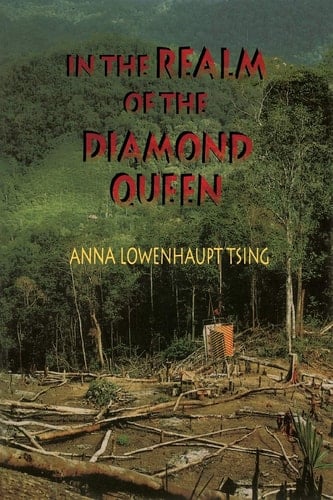
In the Realm of the Diamond Queen Marginality in an Out-of-the-way Place
Anna Lowenhaupt Tsing · 1993
<p>In this highly original and much-anticipated ethnography, Anna Tsing challenges not only anthropologists and feminists but all those who study culture to reconsider some of their dearest assumptions. By choosing to locate her study among Meratus Dayaks, a marginal and marginalized group in the deep rainforest of South Kalimantan, Indonesia, Tsing deliberately sets into motion the familiar and stubborn urban fantasies of self and other. Unusual encounters with her remarkably creative and unconventional Meratus friends and teachers, however, provide the opportunity to rethink notions of tradition, community, culture, power, and gender--and the doing of anthropology. Tsing's masterful weaving of ethnography and theory, as well as her humor and lucidity, allow for an extraordinary reading experience for students, scholars, and anyone interested in the complexities of culture.</p><p>Engaging Meratus in wider conversations involving Indonesian bureaucrats, family planners, experts in international development, Javanese soldiers, American and French feminists, Asian-Americans, right-to-life advocates, and Western intellectuals, Tsing looks not for consensus and coherence in Meratus culture but rather allows individual Meratus men and women to return our gaze. Bearing the fruit from the lively contemporary conversations between anthropology and cultural studies, <i>In the Realm of the Diamond Queen</i> will prove to be a model for thinking and writing about gender, power, and the politics of identity.</p>
Development Governmentality & Frontier Enclosure
Oil Palm Expansion in South East Asia Trends and Implications for Local Communities and Indigenous Peoples
Marcus Colchester · 2011

The Will to Improve: Governmentality, Development, and the Practice of Politics
Tania Murray Li · 2007
The Will to Improve is a remarkable account of development in action. Focusing on attempts to improve landscapes and livelihoods in Indonesia, Tania Murray Li carefully exposes the practices that enable experts to diagnose problems and devise interventions, and the agency of people whose conduct is targeted for reform. Deftly integrating theory, ethnography, and history, she illuminates the work of colonial officials and missionaries; specialists in agriculture, hygiene, and credit; and political activists with their own schemes for guiding villagers toward better ways of life. She examines donor-funded initiatives that seek to integrate conservation with development through the participation of communities, and a one-billion-dollar program designed by the World Bank to optimize the social capital of villagers, inculcate new habits of competition and choice, and remake society from the bottom up.<br/>Demonstrating that the “will to improve” has a long and troubled history, Li identifies enduring continuities from the colonial period to the present. She explores the tools experts have used to set the conditions for reform—tools that combine the reshaping of desires with applications of force. Attending in detail to the highlands of Sulawesi, she shows how a series of interventions entangled with one another and tracks their results, ranging from wealth to famine, from compliance to political mobilization, and from new solidarities to oppositional identities and violent attack. The Will to Improve is an engaging read—conceptually innovative, empirically rich, and alive with the actions and reflections of the targets of improvement, people with their own critical analyses of the problems that beset them.

Seeing like a State: How Certain Schemes to Improve the Human Condition Have Failed
James C. Scott · 1999
Biopolitics, Development, & Subaltern Citizenship
A Critique of Postcolonial Reason Toward a History of the Vanishing Present
Gayatri Chakravorty Spivak · 1999
<p>Are the “culture wars” over? When did they begin? What is their relationship to gender struggle and the dynamics of class? In her first full treatment of postcolonial studies, a field that she helped define, Gayatri Chakravorty Spivak, one of the world’s foremost literary theorists, poses these questions from within the postcolonial enclave.<br><br>“We cannot merely continue to act out the part of Caliban,” Spivak writes; and her book is an attempt to understand and describe a more responsible role for the postcolonial critic. <i>A Critique of Postcolonial Reason</i> tracks the figure of the “native informant” through various cultural practices—philosophy, history, literature—to suggest that it emerges as the metropolitan hybrid. The book addresses feminists, philosophers, critics, and interventionist intellectuals, as they unite and divide. It ranges from Kant’s analytic of the sublime to child labor in Bangladesh. Throughout, the notion of a Third World interloper as the pure victim of a colonialist oppressor emerges as sharply suspect: the mud we sling at certain seemingly overbearing ancestors such as Marx and Kant may be the very ground we stand on.<br><br>A major critical work, Spivak’s book redefines and repositions the postcolonial critic, leading her through transnational cultural studies into considerations of globality.</p>

Homo Sacer Sovereign Power and Bare Life
Giorgio Agamben · 1998
The work of Giorgio Agamben, one of Italy's most important and original philosophers, has been based on an uncommon erudition in classical traditions of philosophy and rhetoric, the grammarians of late antiquity, Christian theology, and modern philosophy. Recently, Agamben has begun to direct his thinking to the constitution of the social and to some concrete, ethico-political conclusions concerning the state of society today, and the place of the individual within it.<br> <br> In <i>Homo Sacer,</i> Agamben aims to connect the problem of pure possibility, potentiality, and power with the problem of political and social ethics in a context where the latter has lost its previous religious, metaphysical, and cultural grounding. Taking his cue from Foucault's fragmentary analysis of biopolitics, Agamben probes with great breadth, intensity, and acuteness the covert or implicit presence of an idea of biopolitics in the history of traditional political theory. He argues that from the earliest treatises of political theory, notably in Aristotle's notion of man as a political animal, and throughout the history of Western thinking about sovereignty (whether of the king or the state), a notion of sovereignty as power over "life" is implicit.<br> <br> The reason it remains merely implicit has to do, according to Agamben, with the way the sacred, or the idea of sacrality, becomes indissociable from the idea of sovereignty. Drawing upon Carl Schmitt's idea of the sovereign's status as the exception to the rules he safeguards, and on anthropological research that reveals the close interlinking of the sacred and the taboo, Agamben defines the sacred person as one who can be killed and yet not sacrificed—a paradox he sees as operative in the status of the modern individual living in a system that exerts control over the collective "naked life" of all individuals.<br> <br>
The Politics of the Governed Reflections on Popular Politics in Most of the World
Partha Chatterjee · 2004
<p>Often dismissed as the rumblings of "the street," popular politics is where political modernity is being formed today, according to Partha Chatterjee. The rise of mass politics all over the world in the twentieth century led to the development of new techniques of governing population groups. On the one hand, the idea of popular sovereignty has gained wide acceptance. On the other hand, the proliferation of security and welfare technologies has created modern governmental bodies that administer populations, but do not provide citizens with an arena for democratic deliberation. Under these conditions, democracy is no longer government of, by, and for the people. Rather, it has become a world of power whose startling dimensions and unwritten rules of engagement Chatterjee provocatively lays bare.</p><p>This book argues that the rise of ethnic or identity politics -- particularly in the postcolonial world -- is a consequence of new techniques of governmental administration. Using contemporary examples from India, the book examines the different forms taken by the politics of the governed. Many of these operate outside of the traditionally defined arena of civil society and the formal legal institutions of the state. This book considers the global conditions within which such local forms of popular politics have appeared and shows us how both community and global society have been transformed. Chatterjee's analysis explores the strategic as well as the ethical dimensions of the new democratic politics of rights, claims, and entitlements of population groups and permits a new understanding of the dynamics of world politics both before and after the events of September 11, 2001.</p><p> <i>The Politics of the Governed</i> consists of three essays, originally given as the Leonard Hastings Schoff Lectures at Columbia University in November 2001, and four additional essays that complement and extend the analyses presented there. By combining these essays between the covers of a single volume, Chatterjee has given us a major and urgent work that provides a full perspective on the possibilities and limits of democracy in the postcolonial world.</p>

The Anti-politics Machine "development," Depoliticization, and Bureaucratic Power in Lesotho
James Ferguson · 1994
Development, it is generally assumed, is good and necessary, and in its name the West has intervened, implementing all manner of projects in the impoverished regions of the world. When these projects fail, as they do with astonishing regularity, they nonetheless produce a host of regular and unacknowledged effects, including the expansion of bureaucratic state power and the translation of the political realities of poverty and powerlessness into "technical" problems awaiting solution by "development" agencies and experts. It is the political intelligibility of these effects, along with the process that produces them, that this book seeks to illuminate through a detailed case study of the workings of the "development" industry in one country, Lesotho, and in one "development" project. Using an anthropological approach grounded in the work of Foucault, James Ferguson analyzes the institutional framework within which such projects are crafted and the nature of "development discourse," revealing how it is that, despite all the "expertise" that goes into formulating development projects, they nonetheless often demonstrate a startling ignorance of the historical and political realities of the locale they are intended to help. In a close examination of the attempted implementation of the Thaba-Tseka project in Lesotho, Ferguson shows how such a misguided approach plays out, how, in fact, the "development" apparatus in Lesotho acts as an "anti-politics machine," everywhere whisking political realities out of sight and all the while performing, almost unnoticed, its own pre-eminently political operation of strengthening the state presence in the local region.James Ferguson is an associate professor of anthropology at the University of California at Irvine.
