introspective modern classics
A curated list of modern classics that explore alienation, identity, absurdity, and the darker sides of human existence. I hope you like it ( ^ω^ )
Items in this hypelist
To Read
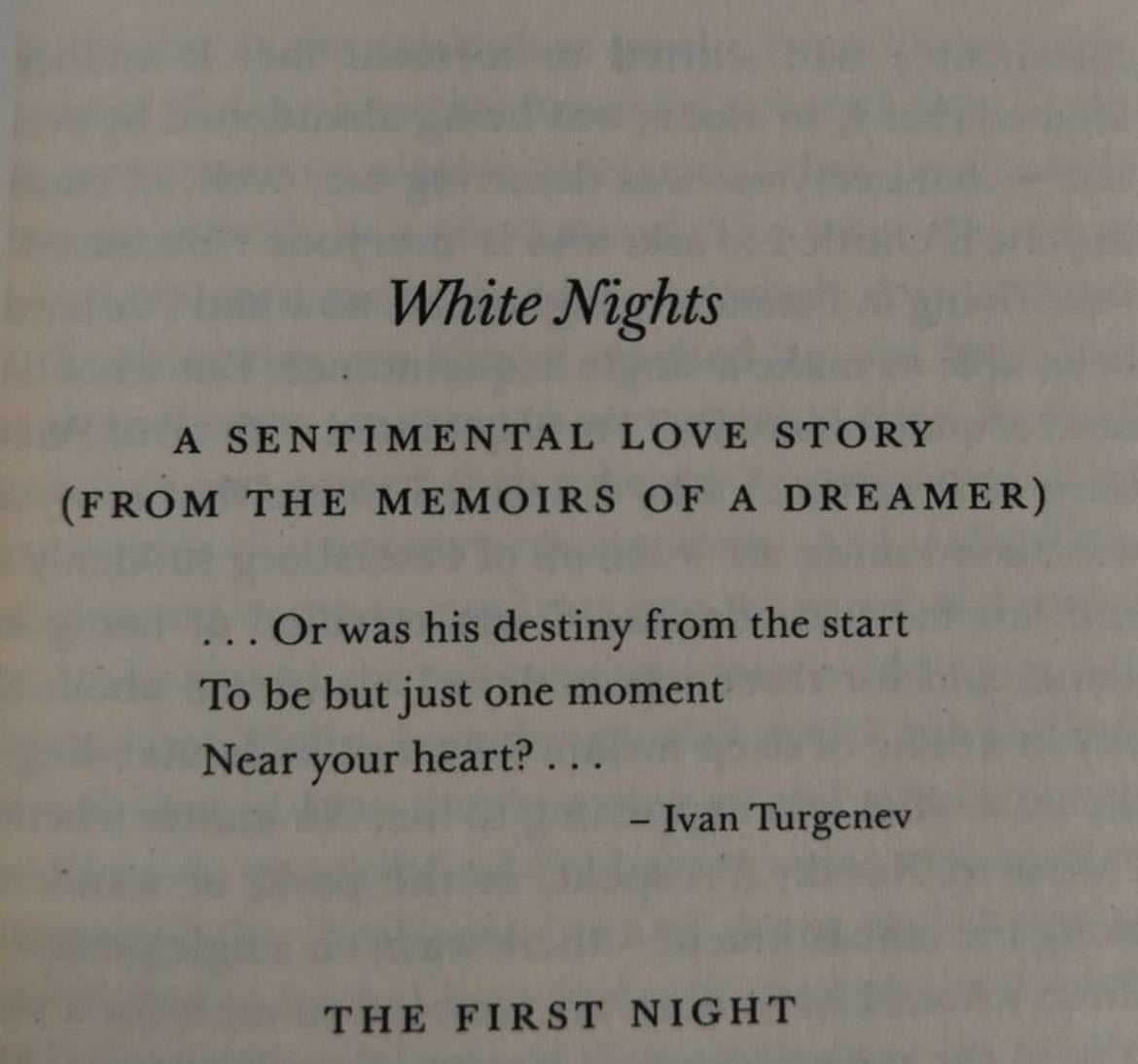
White nights
Fiodor Dostoievski
Have you ever wondered why that 13-digit number on the back of a book costs $125 in the United States but is completely free in Canada and India? This book, The Global ISBN Handbook, is your 2025 guide to the International Standard Book Number. It explains everything about this global "fingerprint" for books. The ISBN is the most important cornerstone of the publishing industry. It started as a simple warehouse tool in the 1960s. Now, it is a complex digital identifier used in over 200 countries. This handbook deconstructs the entire system. It uses 15 distinct national case studies to do this. You will learn how the old 10-digit system changed to the new 13-digit one. We break down the five parts of the ISBN, from the "Bookland" prefix to the final check digit. The book explores the global governance framework, starting with the International ISBN Agency. Then, it dives deep into how different countries run their systems. You'll see the privatized, high-cost model in the United States. You'll compare it to Canada's free, government-run system. We explore the industry-led models in Brazil and Germany. We look at government-run systems in Mexico and India. We even cover the unique case of China, where the ISBN is not a simple identifier but a state-controlled publication license. The book also examines the systems in the UK , France , Russia , Japan , Australia , South Africa , Nigeria , and Egypt. Many books and websites can tell you how to get an ISBN. This handbook is the only resource that explains why the process is so different everywhere you look. It moves beyond a simple "how-to" and provides a true global analysis. It directly compares the privatized, for-profit models in the US and UK against the free, public-good systems in Canada and South Africa. You won't just learn the price; you will understand the cultural policies, market structures, and legal philosophies that shape that price. This book shows how the ISBN is a "global mirror". It reveals how a simple number can be a commercial product in one nation , a tool of cultural policy in another , and an instrument of state control in a third. This comparative insight is the missing piece for any author, publisher, or researcher trying to navigate the complex international publishing market. Disclaimer: This handbook is an independently produced resource for commentary and analysis. The author has no affiliation with the International ISBN Agency, R.R. Bowker, Library and Archives Canada, the National Press and Publication Administration, or any other national ISBN agency. This work is independently produced under the principle of nominative fair use.
Never Let Me Go
Kazuo Ishiguro • 2006
The Fall
Albert Camus • 1991
The Trial Franz Kafka
Franz Kafka • 2024
1984
George Orwell • 1950
<b>Written more than 70 years ago, <i>1984</i> was George Orwell’s chilling prophecy about the future. And while 1984 has come and gone, his dystopian vision of a government that will do anything to control the narrative is timelier than ever...<br><br><b>• Nominated as one of America’s best-loved novels by PBS’s <i>The Great American Read •</i></b><br></b><br>“<i>The Party told you to reject the evidence of your eyes and ears. It was their final, most essential command.</i>”<br><br>Winston Smith toes the Party line, rewriting history to satisfy the demands of the Ministry of Truth. With each lie he writes, Winston grows to hate the Party that seeks power for its own sake and persecutes those who dare to commit thoughtcrimes. But as he starts to think for himself, Winston can’t escape the fact that Big Brother is always watching...<br><br>A startling and haunting novel, <i>1984</i> creates an imaginary world that is completely convincing from start to finish. No one can deny the novel’s hold on the imaginations of whole generations, or the power of its admonitions—a power that seems to grow, not lessen, with the passage of time.
Crime and Punishment
Fyodor Dostoevsky • 1993
<b>Hailed by <i>Washington Post Book World</i> as “the best [translation] currently available" when it was first published, this second edition of <i>Crime and Punishment </i>has been updated in honor of the 200th anniversary of Dostoevsky’s birth. • <b>ONE OF <i>TIME MAGAZINE</i>'S 100 BEST MYSTERY AND THRILLER BOOKS OF ALL TIME</b></b><br><br>With the same suppleness, energy, and range of voices that won their translation of <i>The Brothers Karamazov</i> the PEN/Book-of-the-Month Club Prize, Richard Pevear and Larissa Volokhonsky offer a brilliant translation of <i>Crime and Punishment, </i>Dostoevsky's astounding pyschological thriller, newly revised for his bicentenniel. <br><br>In <i>Crime and Punishment</i>, when Raskolnikov, an impoverished student living in the St. Petersburg of the tsars, commits an act of murder and theft, he sets into motion a story that is almost unequalled in world literature for its excruciating suspense, its atmospheric vividness, and its depth of characterization and vision. Dostoevsky’s drama of sin, guilt, and redemption transforms the sordid story of an old woman’s murder into the nineteenth century’s profoundest and most compelling philosophical novel.
The Vegetarian A Novel
Han Kang • 2016
<b>FROM HAN KANG, WINNER OF THE 2024 NOBEL PRIZE IN LITERATURE</b><br><br><b>“[Han Kang’s] intense poetic prose . . . exposes the fragility of human life.”—The Nobel Committee for Literature, in the citation for the Nobel Prize</b><br><br><b><i>A NEW YORK TIMES</i> BESTSELLER</b><br><b>WINNER OF THE INTERNATIONAL BOOKER PRIZE </b><br><b>ONE OF THE NEW YORK TIMES’S 100 BEST BOOKS OF THE 21ST CENTURY<br>A <i>KIRKUS REVIEWS </i>BEST FICTION BOOK OF THE CENTURY</b><br><br><b>“Ferocious.”—<i>The New York Times Book Review</i> (Ten Best Books of the Year)</b><br><b>“Both terrifying and terrific.”—Lauren Groff</b><br><b>“Provocative [and] shocking.”—<i>The Washington Post</i></b><br><br>Before the nightmares began, Yeong-hye and her husband lived an ordinary, controlled life. But the dreams—invasive images of blood and brutality—torture her, driving Yeong-hye to purge her mind and renounce eating meat altogether. It’s a small act of independence, but it interrupts her marriage and sets into motion an increasingly grotesque chain of events at home. As her husband, her brother-in-law and sister each fight to reassert their control, Yeong-hye obsessively defends the choice that’s become sacred to her. Soon their attempts turn desperate, subjecting first her mind, and then her body, to ever more intrusive and perverse violations, sending Yeong-hye spiraling into a dangerous, bizarre estrangement, not only from those closest to her, but also from herself. <br><br>Celebrated by critics around the world, <i>The Vegetarian</i> is a darkly allegorical, Kafka-esque tale of power, obsession, and one woman’s struggle to break free from the violence both without and within her.<br><b><br>A Best Book of the Year: <i>BuzzFeed, Entertainment Weekly, Wall Street Journal, Time, Elle, The Economist, HuffPost, Slate, Bustle, The St. Louis Dispatch, Electric Literature, Publishers Weekly</i></b>
No Longer Human
太宰治 • 1958
<p> Mine has been a life of much shame. I can't even guess myself what it must be to live the life of a human being. </p><p>Portraying himself as a failure, the protagonist of Osamu Dazai's No Longer Human narrates a seemingly normal life even while he feels himself incapable of understanding human beings. His attempts to reconcile himself to the world around him begin in early childhood, continue through high school, where he becomes a "clown" to mask his alienation, and eventually lead to a failed suicide attempt as an adult. Without sentimentality, he records the casual cruelties of life and its fleeting moments of human connection and tenderness.</p><p>Still one of the ten bestselling books in Japan, No Longer Human is an important and unforgettable modern classic: "The struggle of the individual to fit into a normalizing society remains just as relevant today as it was at the time of writing." (The Japan Times)</p>
The Stranger
Albert Camus • 1989
The Metamorphosis
Franz Kafka • 2009