LIBROS DE ARTE 🎨
Soy estudiante de Bellas artes. Aquí econtrarás hallazgos e intereses propios y recomendaciones de mis profesores.
Items in this hypelist
Art

Aprende a promocionar tu trabajo: 10 recursos para artistas, diseñadores y creativos (Spanish Edition)
Aprende a promocionar tu trabajo: 10 recursos para artistas, diseñadores y creativos (Spanish Edition)

BRUJAS EN EL ARTE, LAS: MITOS Y LEYENDAS SOBRE LAS BRUJAS
ALIX PARE · 2025

Van Gogh. The Complete Paintings
Rainer Metzger • 2015

El tiburón de 12 millones de dólares: La curiosa economía del arte contemporáneo y las casas de subastas
Don Thompson • 2022
Art The Definitive Visual Guide
Andrew Graham Dixon • 2018
El Arte De La Fantasia
Elisabeth • unde
Diseño: La historia visual definitiva
DK • 2024
Historia de la fealdad
Umberto Eco • 2016
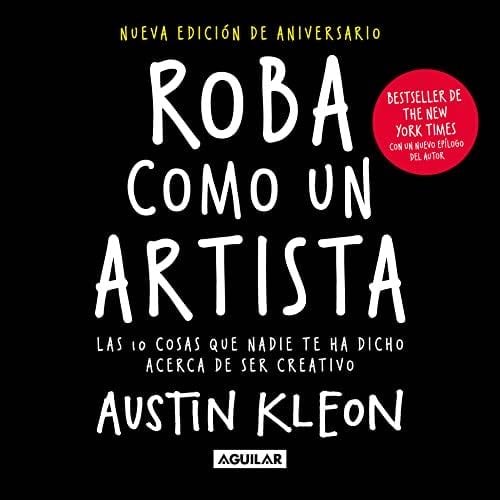
Roba Como Un Artista

El camino del artista / The Artist's Way (Spanish Edition)
Julia Cameron · 2018

El diseño como storytelling
Ellen Lupton, Álvaro Marcos Lantero · 2019
El libro de las sombras
Alix Paré • 2025
Teoría de color 🎨
Teoría del color para artistas
Ian Goldsmith • 2025
Psicología del color
Eva Heller · 2012
Este libro aborda la relación de los colores con nuestros sentimientos y demuestra cómo ambos no se combinan de manera accidental, pues sus asociaciones no son meras cuestiones de gusto, sino experiencias universales que están profundamente enraizadas en nuestro lenguaje y en nuestro pensamiento. Organizado en 13 capítulos que corresponden a 13 colores distintos, el volumen poporciona una gran cantidad y variedad de información sobre los colores: desde dichos y saberes populares, hasta su utilización en el diseño de productos, los diferentes tests que se basan en colores, la curación por medio de ellos, la manipulación de las personas, los nombres y apellidos relacionados con colores, etc. La diversidad de este enfoque convierte a la obra de Eva Heller en una herramienta fundamental para todas aquellas personas que trabajan con colores: artistas, terapeutas, diseñadores gráficos e industriales, interioristas, arquitectos, diseñadores de moda, publicistas, entre otros.
Iconografía e Historia del arte
Los símbolos en el arte
Matthew Wilson
Have you ever wondered why that 13-digit number on the back of a book costs $125 in the United States but is completely free in Canada and India? This book, The Global ISBN Handbook, is your 2025 guide to the International Standard Book Number. It explains everything about this global "fingerprint" for books. The ISBN is the most important cornerstone of the publishing industry. It started as a simple warehouse tool in the 1960s. Now, it is a complex digital identifier used in over 200 countries. This handbook deconstructs the entire system. It uses 15 distinct national case studies to do this. You will learn how the old 10-digit system changed to the new 13-digit one. We break down the five parts of the ISBN, from the "Bookland" prefix to the final check digit. The book explores the global governance framework, starting with the International ISBN Agency. Then, it dives deep into how different countries run their systems. You'll see the privatized, high-cost model in the United States. You'll compare it to Canada's free, government-run system. We explore the industry-led models in Brazil and Germany. We look at government-run systems in Mexico and India. We even cover the unique case of China, where the ISBN is not a simple identifier but a state-controlled publication license. The book also examines the systems in the UK , France , Russia , Japan , Australia , South Africa , Nigeria , and Egypt. Many books and websites can tell you how to get an ISBN. This handbook is the only resource that explains why the process is so different everywhere you look. It moves beyond a simple "how-to" and provides a true global analysis. It directly compares the privatized, for-profit models in the US and UK against the free, public-good systems in Canada and South Africa. You won't just learn the price; you will understand the cultural policies, market structures, and legal philosophies that shape that price. This book shows how the ISBN is a "global mirror". It reveals how a simple number can be a commercial product in one nation , a tool of cultural policy in another , and an instrument of state control in a third. This comparative insight is the missing piece for any author, publisher, or researcher trying to navigate the complex international publishing market. Disclaimer: This handbook is an independently produced resource for commentary and analysis. The author has no affiliation with the International ISBN Agency, R.R. Bowker, Library and Archives Canada, the National Press and Publication Administration, or any other national ISBN agency. This work is independently produced under the principle of nominative fair use.
Lo que los libros de historia del arte no quieren que sepas
Blanca Guilera
Have you ever wondered why that 13-digit number on the back of a book costs $125 in the United States but is completely free in Canada and India? This book, The Global ISBN Handbook, is your 2025 guide to the International Standard Book Number. It explains everything about this global "fingerprint" for books. The ISBN is the most important cornerstone of the publishing industry. It started as a simple warehouse tool in the 1960s. Now, it is a complex digital identifier used in over 200 countries. This handbook deconstructs the entire system. It uses 15 distinct national case studies to do this. You will learn how the old 10-digit system changed to the new 13-digit one. We break down the five parts of the ISBN, from the "Bookland" prefix to the final check digit. The book explores the global governance framework, starting with the International ISBN Agency. Then, it dives deep into how different countries run their systems. You'll see the privatized, high-cost model in the United States. You'll compare it to Canada's free, government-run system. We explore the industry-led models in Brazil and Germany. We look at government-run systems in Mexico and India. We even cover the unique case of China, where the ISBN is not a simple identifier but a state-controlled publication license. The book also examines the systems in the UK , France , Russia , Japan , Australia , South Africa , Nigeria , and Egypt. Many books and websites can tell you how to get an ISBN. This handbook is the only resource that explains why the process is so different everywhere you look. It moves beyond a simple "how-to" and provides a true global analysis. It directly compares the privatized, for-profit models in the US and UK against the free, public-good systems in Canada and South Africa. You won't just learn the price; you will understand the cultural policies, market structures, and legal philosophies that shape that price. This book shows how the ISBN is a "global mirror". It reveals how a simple number can be a commercial product in one nation , a tool of cultural policy in another , and an instrument of state control in a third. This comparative insight is the missing piece for any author, publisher, or researcher trying to navigate the complex international publishing market. Disclaimer: This handbook is an independently produced resource for commentary and analysis. The author has no affiliation with the International ISBN Agency, R.R. Bowker, Library and Archives Canada, the National Press and Publication Administration, or any other national ISBN agency. This work is independently produced under the principle of nominative fair use.
Iconografía e iconología introducción al significado de la obra artística
Fernando Moreno Cuadro • 2022
Historia del arte
E. H. Gombrich • 1997
Guía para identificar los personajes de la mitología clásica
Lorenzo de la Plaza Escudero • 2016
Recomendación profesores BBAA
Perspectiva. Ciencia y magia de la representación
Inmaculada López Vílchez - 2009
Have you ever wondered why that 13-digit number on the back of a book costs $125 in the United States but is completely free in Canada and India? This book, The Global ISBN Handbook, is your 2025 guide to the International Standard Book Number. It explains everything about this global "fingerprint" for books. The ISBN is the most important cornerstone of the publishing industry. It started as a simple warehouse tool in the 1960s. Now, it is a complex digital identifier used in over 200 countries. This handbook deconstructs the entire system. It uses 15 distinct national case studies to do this. You will learn how the old 10-digit system changed to the new 13-digit one. We break down the five parts of the ISBN, from the "Bookland" prefix to the final check digit. The book explores the global governance framework, starting with the International ISBN Agency. Then, it dives deep into how different countries run their systems. You'll see the privatized, high-cost model in the United States. You'll compare it to Canada's free, government-run system. We explore the industry-led models in Brazil and Germany. We look at government-run systems in Mexico and India. We even cover the unique case of China, where the ISBN is not a simple identifier but a state-controlled publication license. The book also examines the systems in the UK , France , Russia , Japan , Australia , South Africa , Nigeria , and Egypt. Many books and websites can tell you how to get an ISBN. This handbook is the only resource that explains why the process is so different everywhere you look. It moves beyond a simple "how-to" and provides a true global analysis. It directly compares the privatized, for-profit models in the US and UK against the free, public-good systems in Canada and South Africa. You won't just learn the price; you will understand the cultural policies, market structures, and legal philosophies that shape that price. This book shows how the ISBN is a "global mirror". It reveals how a simple number can be a commercial product in one nation , a tool of cultural policy in another , and an instrument of state control in a third. This comparative insight is the missing piece for any author, publisher, or researcher trying to navigate the complex international publishing market. Disclaimer: This handbook is an independently produced resource for commentary and analysis. The author has no affiliation with the International ISBN Agency, R.R. Bowker, Library and Archives Canada, the National Press and Publication Administration, or any other national ISBN agency. This work is independently produced under the principle of nominative fair use.
Seguir siendo bárbaro
Louisa Yousfi • 2024
Elsa von Freytag-Loringhoven la artista que dio cuerpo a la vanguardia
Joana Masó • 2024

Real-virtual en la estética y la teoría de las artes
Simón Marchán Fiz • 2006
Arte e identidad en Internet
Gemma San Cornelio Esquerdo • 2008
Cincuenta Y Tantos Consejos Sobre Tipografía
Enric • 2021
Sistemas de retículas un manual para diseñadores gráficos
Josef Müller-Brockmann • 1982
La psicología de los objetos cotidianos
Donald A. Norman • 2018
Las leyes de la simplicidad: Diseño, tecnología, negocios, vida
John Maeda • 2026
Es mi tipo: Un libro sobre fuentes tipográficas
Simon Garfield • 2023
Diccionario de edición, tipografía y artes gráficas
José Martínez de Sousa • 2001
Brand Las marcas según Wally Olins
Wally Olins • 2004
¿Por qué nadie sabe qué es el diseño?
Eugenio Vega • 2023
ESP La Historia del Arte Ed Lujo (the Story of Art Luxury Edition Spanish Edition)
E. H. Gombrich • 2024
Historia de los museos en España. 2.ª edición, revisada y ampliada (Biblioteconomía y administración cultural / Library Science and Cultural Management) (Spanish Edition)
María Bolaños • 2008
Tratado de iconografía
Juan Francisco Esteban Lorente • 1990
Goya y el gusto moderno
Valeriano Bozal Fernández • 1994
La mujer y la pintura del XIX español (Ensayos arte catedra/ Art Chair Essays) (Spanish Edition)
Estrella de Diego • 2009
Arte y archivo, 1920-2010 Genealogías, tipologías y discontinuidades
Anna María Guasch • 2011
Manual de historia de la museología
Jesús Pedro Lorente • 2012
Maestras antiguas Mujeres, arte e ideología
Griselda Pollock • 2022
Mujeres artistas
Linda Nochlin • 2021
Artista y designer
Bruno Munari • 1974
Typoésie
Jérôme Peignot • 2005
Maestros del diseño español identidad y diversidad
Juan Arias • 1996
Del Diseño
Yves Zimmermann • 2013
Veintidós consejos sobre tipografía (Spanish Edition)
Enric Jardí • 2007
De lo bello de las cosas. Materiales para una estética del diseño
Anna Calvera • 2007
Sistemas de retículas Un manual para diseñadores gráficos
Josef Müller-Brockmann - (1981)
Have you ever wondered why that 13-digit number on the back of a book costs $125 in the United States but is completely free in Canada and India? This book, The Global ISBN Handbook, is your 2025 guide to the International Standard Book Number. It explains everything about this global "fingerprint" for books. The ISBN is the most important cornerstone of the publishing industry. It started as a simple warehouse tool in the 1960s. Now, it is a complex digital identifier used in over 200 countries. This handbook deconstructs the entire system. It uses 15 distinct national case studies to do this. You will learn how the old 10-digit system changed to the new 13-digit one. We break down the five parts of the ISBN, from the "Bookland" prefix to the final check digit. The book explores the global governance framework, starting with the International ISBN Agency. Then, it dives deep into how different countries run their systems. You'll see the privatized, high-cost model in the United States. You'll compare it to Canada's free, government-run system. We explore the industry-led models in Brazil and Germany. We look at government-run systems in Mexico and India. We even cover the unique case of China, where the ISBN is not a simple identifier but a state-controlled publication license. The book also examines the systems in the UK , France , Russia , Japan , Australia , South Africa , Nigeria , and Egypt. Many books and websites can tell you how to get an ISBN. This handbook is the only resource that explains why the process is so different everywhere you look. It moves beyond a simple "how-to" and provides a true global analysis. It directly compares the privatized, for-profit models in the US and UK against the free, public-good systems in Canada and South Africa. You won't just learn the price; you will understand the cultural policies, market structures, and legal philosophies that shape that price. This book shows how the ISBN is a "global mirror". It reveals how a simple number can be a commercial product in one nation , a tool of cultural policy in another , and an instrument of state control in a third. This comparative insight is the missing piece for any author, publisher, or researcher trying to navigate the complex international publishing market. Disclaimer: This handbook is an independently produced resource for commentary and analysis. The author has no affiliation with the International ISBN Agency, R.R. Bowker, Library and Archives Canada, the National Press and Publication Administration, or any other national ISBN agency. This work is independently produced under the principle of nominative fair use.
Diseñador/Ciudadano
Milton Glaser • 2015
Pensar Con Tipos Una Guía Clave Para Estudiantes, Diseñadores, Editores Y Escritores
Ellen Lupton • 2012
Milton Glaser. Conversaciones con Peter Mayer
Milton Glaser • 2017
Paula Scher Twenty-Five Years at the Public, A Love Story
Paula Scher • 2020
Psicología del color Cómo actúan los colores sobre los sentimientos y la razón
Eva Heller • 2012
Este libro aborda la relación de los colores con nuestros sentimientos y demuestra cómo ambos no se combinan de manera accidental, pues sus asociaciones no son meras cuestiones de gusto, sino experiencias universales que están profundamente enraizadas en nuestro lenguaje y en nuestro pensamiento. Organizado en 13 capítulos que corresponden a 13 colores distintos, el volumen poporciona una gran cantidad y variedad de información sobre los colores: desde dichos y saberes populares, hasta su utilización en el diseño de productos, los diferentes tests que se basan en colores, la curación por medio de ellos, la manipulación de las personas, los nombres y apellidos relacionados con colores, etc. La diversidad de este enfoque convierte a la obra de Eva Heller en una herramienta fundamental para todas aquellas personas que trabajan con colores: artistas, terapeutas, diseñadores gráficos e industriales, interioristas, arquitectos, diseñadores de moda, publicistas, entre otros.
Modos de Ver
John Berger • 2016
Las técnicas artísticas
Corrado Maltese • 1997
El Dibujo Tecnica y Utilidad
Susan Lambert • 1996
Las lecciones del dibujo
Juan José Gómez Molina • 1995
COLLAGE FIRMADO POR MUJERES
Rebeka Elizegi • 2019
Aprender a Dibujar Con el Lado Derecho Del Cerebro
Betty Edwards • 1985
Las bases del dibujo
Gabriel Martín i Roig • 2022
The Natural Way to Draw A Working Plan for Art Study
Kimon Nicolaïdes • 1969
Keys to Drawing
Bert Dodson • 1990
El Triángulo Más de 100 Ejemplos Ilustrados Sobre el Triángulo Equilátero
Bruno Munari • 1999
El conocimiento secreto el redescubrimiento de las técnicas perdidas de los grandes maestros
David Hockney • 2001
Cómo dibujar guía completa de sus técnicas e interpretaciones
Cynthia Maris Dantzic • 2004
Drawing and Perceiving Life Drawing for Students of Architecture and Design
Douglas Cooper • 2000
Dibujo Y Proyecto
Francis D. K. Ching • 2006
Drawing Essentials A Guide to Drawing from Observation
Deborah A. Rockman • 2012
Nuevo aprender a dibujar con el lado derecho del cerebro un curso que potencia la creatividad y la confianza creativa
Betty Edwards • 2000
El sueño imperativo fragmentos sobre arte, naturaleza y sociedad
John Ruskin • 2014
Sobre el dibujo
John Berger • 2013
Arte y percepción visual: Psicología del ojo creador (Spanish Edition)
Rudolf Arnheim • 2002
El número de oro ritos y ritmos pitagóricos en el desarrollo de la civilización occidental
Matila Costiescu Ghyka • 1992
La interacción del color
Josef Albers • 2005
Materiales y técnicas del arte
Ralph Mayer • 2005
Vision and Difference
Griselda Pollock • 2015
The Optical Unconscious
Rosalind E. Krauss • 1994
Matisse on art
Jack D. Flam • 1973
Cómo se lee una obra de arte (Signo E Imagen) (Spanish Edition)
Omar Calabrese • 1993
Correspondencia
Camille Claudel • 2006
Introducción al color
María del Mar Cuevas Riaño • 2005
I Paint What I Want to See
Philip Guston • 2022