
peripherality, spatial politics, & state margins
Collection of foundational theoretical and empirical engine for analyzing the dissonance of administrative success, programmatic exit strategies, and the structural production of invisibility at the margins of the post-colonial state. Rejecting mainstream, technocratic policy frameworks that treat the state as a neutral administrator or development as a linear path to inclusion, this folder approaches space as an active, contested instrument of coercion, capital accumulation, and sovereign enclosure. The curated monographs and field ethnographies collected here are organized to track a deliberate analytical arc, from the macro-blueprints of state legibility and mapping violence, through the hidden regulatory mechanics of infrastructure networks and global logistics, down to the datafied, algorithmic, and aesthetic parameters that quietly erase marginal subjects from the state’s developmental ledger.
Items in this hypelist
Theoretical Framework
The Production of Space
Henri Lefebvre · 1992
Henri Lefebvre has considerable claims to be the greatest living philosopher. His work spans some sixty years and includes original work on a diverse range of subjects, from dialectical materialism to architecture, urbanism and the experience of everyday life. The Production of Space is his major philosophical work and its translation has been long awaited by scholars in many different fields.<br><br>The book is a search for a reconciliation between mental space (the space of the philosophers) and real space (the physical and social spheres in which we all live). In the course of his exploration, Henri Lefebvre moves from metaphysical and ideological considerations of the meaning of space to its experience in the everyday life of home and city. He seeks, in other words, to bridge the gap between the realms of theory and practice, between the mental and the social, and between philosophy and reality. In doing so, he ranges through art, literature, architecture and economics, and further provides a powerful antidote to the sterile and obfuscatory methods and theories characteristic of much recent continental philosophy.<br><br>This is a work of great vision and incisiveness. It is also characterized by its author's wit and by anecdote, as well as by a deftness of style which Donald Nicholson-Smith's sensitive translation precisely captures.
Uneven Development Nature, Capital, and the Production of Space
Neil Smith · 2008
In <i>Uneven Development</i>, a classic in its field, Neil Smith offers the first full theory of uneven geographical development, entwining theories of space and nature with a critique of capitalist development. Featuring pathbreaking analyses of the production of nature and the politics of scale, Smith's work anticipated many of the uneven contours that now mark neoliberal globalization. This third edition features an afterword updating the analysis for the present day.
Spaces of Global Capitalism A Theory of Uneven Geographical Development
David Harvey · 2019
Fiscal crises have cascaded across much of the developing world with devastating results, from Mexico to Indonesia, Russia and Argentina. The extreme volatility in contemporary political economic fortunes seems to mock our best efforts to understand the forces that drive development in the world economy.<br><br>David Harvey is the single most important geographer writing today and a leading social theorist of our age, offering a comprehensive critique of contemporary capitalism. In this fascinating book, he shows the way forward for just such an understanding, enlarging upon the key themes in his recent work: the development of neoliberalism, the spread of inequalities across the globe, and ‘space’ as a key theoretical concept.<br><br>Both a major declaration of a new research programme and a concise introduction to David Harvey’s central concerns, this book will be essential reading for scholars and students across the humanities and social sciences.

Implosions/explosions Towards a Study of Planetary Urbanization
Neil Brenner · 2014
In 1970, the influential French Marxist philosopher and sociologist Henri Lefebvre published a book titled <i>The Urban Revolution</i>, in which he advanced the hypothesis that "society has been completely urbanized." By this, Lefebvre meant that the process of urbanization creates the conditions for capitalism--rather than urbanization being an outcome of the circulation of capital--and that the consequences of this process therefore extended far beyond actual cities. Compiling both classic and contemporary essays on the "urbanization question," this book explores the various theoretical, epistemological and political implications of Lefebvre's claim, with a series of analytical and cartographic interventions that reach beyond the conventional binaries of the topic (urban/rural, city/non-city, society/nature) in order to investigate the uneven implosions and explosions of capitalist urbanization across the globe--and what Lefebvre famously termed (in his book of the same name) "the production of space."
Rebel Cities From the Right to the City to the Urban Revolution
David Harvey · 2013
Long before Occupy, cities were the subject of much utopian thinking. They are the centers of capital accumulation as well as of revolutionary politics, where deeper currents of social and political change rise to the surface. Do the financiers and developers control access to urban resources or do the people? Who dictates the quality and organization of daily life?<br><br><i>Rebel Cities</i> places the city at the heart of both capital and class struggles, looking at locations ranging from Johannesburg to Mumbai, from New York City to São Paulo. Drawing on the Paris Commune as well as Occupy Wall Street and the London Riots, Harvey asks how cities might be reorganized in more socially just and ecologically sane ways—and how they can become the focus for anti-capitalist resistance.
Rethinking the Region Spaces of Neo-Liberalism
John Allen · 2012
Rethinking the Region argues that regions are not simply bounded spaces on a map. This book uses unique research of England during the 1980s to show how regions are made and unmade by social processes. The book examines how new lines of division both social and geographical were laid down as free-market growth and reconstructed this are as a `neo-liberal' region. <br> The authors argue that a more balanced form of growth is possible - within and between regions as well as between social groups. This book shows that to grasp the complexities of growth we must rethink `the region' in time as well as in space.
Seeking Spatial Justice
Edward W. Soja · 2010
In 1996, the Los Angeles Bus Riders Union, a grassroots advocacy organization, won a historic legal victory against the city's Metropolitan Transit Authority. The resulting consent decree forced the MTA for a period of ten years to essentially reorient the mass transit system to better serve the city's poorest residents. A stunning reversal of conventional governance and planning in urban America, which almost always favors wealthier residents, this decision is also, for renowned urban theorist Edward W. Soja, a concrete example of spatial justice in action. <i>In Seeking Spatial Justice</i>, Soja argues that justice has a geography and that the equitable distribution of resources, services, and access is a basic human right. Building on current concerns in critical geography and the new spatial consciousness, Soja interweaves theory and practice, offering new ways of understanding and changing the unjust geographies in which we live. After tracing the evolution of spatial justice and the closely related notion of the right to the city in the influential work of Henri Lefebvre, David Harvey, and others, he demonstrates how these ideas are now being applied through a series of case studies in Los Angeles, the city at the forefront of this movement. Soja focuses on such innovative labor–community coalitions as Justice for Janitors, the Los Angeles Alliance for a New Economy, and the Right to the City Alliance; on struggles for rent control and environmental justice; and on the role that faculty and students in the UCLA Department of Urban Planning have played in both developing the theory of spatial justice and putting it into practice. Effectively locating spatial justice as a theoretical concept, a mode of empirical analysis, and a strategy for social and political action, this book makes a significant contribution to the contemporary debates about justice, space, and the city.

The Politics of the Encounter Urban Theory and Protest under Planetary Urbanization
Andy Merrifield · 2013
<p>The Politics of the Encounter is a spirited interrogation of the city as a site of both theoretical inquiry and global social struggle. The city, writes Andy Merrifield, remains "important, virtually and materially, for progressive politics." And yet, he notes, more than forty years have passed since Henri Lefebvre advanced the powerful ideas that still undergird much of our thinking about urbanization and urban society. Merrifield rethinks the city in light of the vast changes to our planet since 1970, when Lefebvre's seminal Urban Revolution was first published. At the same time, he expands on Lefebvre's notion of "the right to the city," which was first conceived in the wake of the 1968 student uprising in Paris.<br></p><p>We need to think less of cities as "entities with borders and clear demarcations between what's inside and what's outside" and emphasize instead the effects of "planetary urbanization," a concept of Lefebvre's that Merrifield makes relevant for the ways we now experience the urban. The city—from Tahrir Square to Occupy Wall Street—seems to be the critical zone in which a new social protest is unfolding, yet dissenters' aspirations are transcending the scale of the city physically and philosophically. Consequently, we must shift our perspective from "the right to the city" to "the politics of the encounter," says Merrifield. We must ask how revolutionary crowds form, where they draw their energies from, what kind of spaces they occur in—and what kind of new spaces they produce.<br></p>
State Legibility, Coercion, & Sovereign Enclosure

Siam Mapped A History of the Geo-Body of a Nation
Thongchai Winichakul · 1997
This unusual and intriguing study of nationhood explores the 19th-century confrontation of ideas that transformed the kingdom of Siam into the modern conception of a nation. <i>Siam Mapped</i> challenges much that has been written on Thai history because it demonstrates convincingly that the physical and political definition of Thailand on which other works are based is anachronistic.

The Political Ecology of Forestry in Burma, 1824-1994
Raymond L. Bryant · 1997
The author examines how the Burmese state has sought to control the country's forest activities, and the ways in which groups relying on the forest for their livelihood (loggers, transnational corporations, cultivators, peasants) have fought such control.
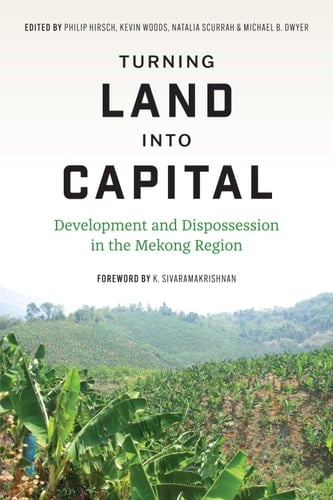
Turning Land into Capital
Philip Hirsch, Kevin Woods, Natalia Scurrah, and Michael B. Dwyer · 2022
In Southeast Asia reversals of earlier agrarian reforms have rolled back "land-to-the-tiller" policies created in the wake of Cold War–era revolutions. This trend, marked by increased land concentration and the promotion of export-oriented agribusiness at the expense of smallholder farmers, exposes the convergence of capitalist relations and state agendas that expand territorial control within and across national borders. Turning Land into Capital examines the contradictions produced by superimposing twenty-first-century neoliberal projects onto diverse landscapes etched by decades of war and state socialism. Chapters in the book explore geopolitics, legacies of colonialism, ideologies of development, and strategies to achieve land justice in Cambodia, Laos, Myanmar, Thailand, and Vietnam. The resulting picture reveals the place-specific interactions of state and market ideologies, regional geopolitics, and local elites in concentrating control over land.
When the State Meets the Street Public Service and Moral Agency
Bernardo Zacka · 2017
Bernardo Zacka probes the complex moral lives of street-level bureaucratsÑthe frontline social and welfare workers, police officers, and educators who represent governmentÕs human face to ordinary citizens. Too often dismissed as soulless operators, these workers wield significant discretion and make decisions that profoundly affect peopleÕs lives.
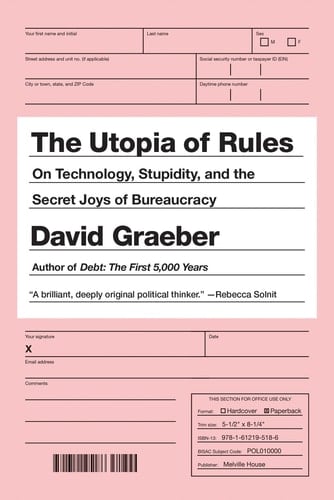
The Utopia of Rules On Technology, Stupidity, and the Secret Joys of Bureaucracy
David Graeber · 2016
<b>From the author of the international bestseller <i>Debt: The First 5,000 Years</i> comes a revelatory account of the way bureaucracy rules our lives</b> <br><br> Where does the desire for endless rules, regulations, and bureaucracy come from? How did we come to spend so much of our time filling out forms? And is it really a cipher for state violence?<br> <br> To answer these questions, the anthropologist David Graeber—one of our most important and provocative thinkers—traces the peculiar and unexpected ways we relate to bureaucracy today, and reveals how it shapes our lives in ways we may not even notice…though he also suggests that there may be something perversely appealing—even romantic—about bureaucracy.<i> </i><br> <br> Leaping from the ascendance of right-wing economics to the hidden meanings behind Sherlock Holmes and Batman, <i>The Utopia of Rules</i> is at once a powerful work of social theory in the tradition of Foucault and Marx, and an entertaining reckoning with popular culture that calls to mind Slavoj Zizek at his most accessible.<br> <br> An essential book for our times, <i>The Utopia of Rules </i>is sure to start a million conversations about the institutions that rule over us—and the better, freer world we should, perhaps, begin to imagine for ourselves.

Anthropology in the Margins of the State
Veena Das · 2004
The very form and reach of the modern state are changing radically under the pressure of globalization. Featuring nine of the leading scholars in the field, this innovative exploration of these transformations develops an ethnographic methodology and theoretical apparatus to assess perceptions of power in three regions where state reform and violence have been particularly dramatic: Africa, Latin America, and South Asia. Rather than a geographic border, the term "margin" describes areas far from the centers of state sovereignty in which states are unable to ensure implementation of their programs and policies. Understanding how people perceive and experience the agency of the state; who is of, and not of, the state; and how practices at the margins shape the state itself are central themes.<br/>Drawing on fieldwork in Sierra Leone, Sri Lanka, Peru, Guatemala, India, Chad, Colombia, and South Africa, the contributors examine official documentary practices and their forms and falsifications; the problems that highly mobile mercenaries, currency, goods, arms, and diamonds pose to the state; emerging non-state regulatory authorities; and the role language plays as cultures struggle to articulate their situation. These case studies provide wide-ranging analyses of the relationship between states and peoples on the edges of state power's effective reign.
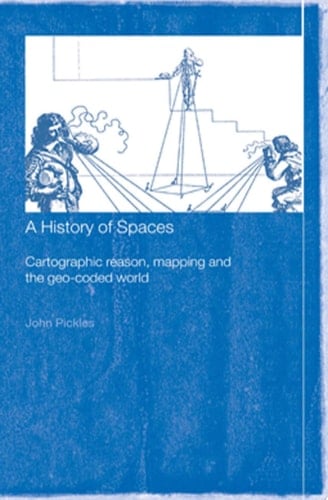
A History of Spaces Cartographic Reason, Mapping and the Geo-Coded World
John Pickles · 2012
This book provides an essential insight into the practices and ideas of maps and map-making. It draws on a wide range of social theorists, and theorists of maps and cartography, to show how maps and map-making have shaped the spaces in which we live. Going beyond the focus of traditional cartography, the book draws on examples of the use of maps from the sixteenth century to the present, including their role in projects of the national and colonial state, emergent capitalism and the planetary consciousness of the natural sciences. It also considers the use of maps for military purposes, maps that have coded modern conceptions of health, disease and social character, and maps of the transparent human body and the transparent earth.

Encountering Development The Making and Unmaking of the Third World
Arturo Escobar · 2012
<p>How did the industrialized nations of North America and Europe come to be seen as the appropriate models for post-World War II societies in Asia, Africa, and Latin America? How did the postwar discourse on development actually create the so-called Third World? And what will happen when development ideology collapses? To answer these questions, Arturo Escobar shows how development policies became mechanisms of control that were just as pervasive and effective as their colonial counterparts. The development apparatus generated categories powerful enough to shape the thinking even of its occasional critics while poverty and hunger became widespread. "Development" was not even partially "deconstructed" until the 1980s, when new tools for analyzing the representation of social reality were applied to specific "Third World" cases. Here Escobar deploys these new techniques in a provocative analysis of development discourse and practice in general, concluding with a discussion of alternative visions for a postdevelopment era.<br><br><br> Escobar emphasizes the role of economists in development discourse--his case study of Colombia demonstrates that the economization of food resulted in ambitious plans, and more hunger. To depict the production of knowledge and power in other development fields, the author shows how peasants, women, and nature became objects of knowledge and targets of power under the "gaze of experts."<br><br><br> In a substantial new introduction, Escobar reviews debates on globalization and postdevelopment since the book's original publication in 1995 and argues that the concept of postdevelopment needs to be redefined to meet today's significantly new conditions. He then calls for the development of a field of "pluriversal studies," which he illustrates with examples from recent Latin American movements.</p>

Mining Capitalism
Stuart Kirsch · 2014
Corporations are among the most powerful institutions of our time, but they are also responsible for a wide range of harmful social and environmental impacts. Consequently, political movements and nongovernmental organizations increasingly contest the risks that corporations pose to people and nature. <i>Mining Capitalism</i> examines the strategies through which corporations manage their relationships with these critics and adversaries. By focusing on the conflict over the Ok Tedi copper and gold mine in Papua New Guinea, Stuart Kirsch tells the story of a slow-moving environmental disaster and the international network of indigenous peoples, advocacy groups, and lawyers that sought to protect local rivers and rain forests. Along the way, he analyzes how corporations promote their interests by manipulating science and invoking the discourses of sustainability and social responsibility. Based on two decades of anthropological research, this book is comparative in scope, showing readers how similar dynamics operate in other industries around the world.
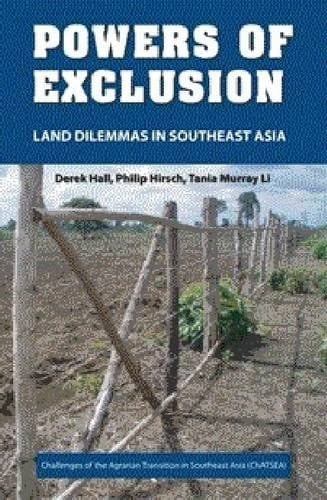
Powers of Exclusion Land Dilemmas in Southeast Asia
Derek Hall · 2011
Questions of who can access land and who is excluded from it underlie many recent social and political conflicts in Southeast Asia. Powers of Exclusion examines the key processes through which shifts in land relations are taking place, notably state land allocation and provision of property rights, the dramatic expansion of areas zoned for conservation, booms in the production of export-oriented crops, the conversion of farmland to post-agrarian uses, "intimate" exclusions involving kin and co-villagers, and mobilizations around land farmed in terms of identity and belonging. In case studies drawn from seven countries, the authors find that four "powers of exclusion" - regulation, market, force and legitimation - have combined to shape land relations in new and often surprising ways. Land debates are often presented as a conflict between market-oriented land use with full private property rights on one side, and equitable access, production for subsistence, and respect for custom on the other. The authors step back from these debates to point out that any productive use of land requires the exclusion of some potential users, and that most projects for transforming land relations are thus accompanied by painful dilemmas. Rather than counterposing "exclusion" to "inclusion", the book argues that attention must be paid to who is excluded, how, why, and with what consequences. <i>Powers of Exclusion</i> draws on insights from multiple disciplines to map out the new contours of struggles for land in Southeast Asia. The volume provides a framework for analyzing the dilemmas of land relations across the Global South and beyond.

Necropolitics
Achille Mbembe · 2019

State of Exception
Giorgio Agamben · 2005
Two months after the attacks of 9/11, the Bush administration, in the midst of what it perceived to be a state of emergency, authorized the indefinite detention of noncitizens suspected of terrorist activities and their subsequent trials by a military commission. Here, distinguished Italian philosopher Giorgio Agamben uses such circumstances to argue that this unusual extension of power, or "state of exception," has historically been an underexamined and powerful strategy that has the potential to transform democracies into totalitarian states.<br> <br> The sequel to Agamben's <i>Homo Sacer: Sovereign Power and Bare Life, State of Exception</i> is the first book to theorize the state of exception in historical and philosophical context. In Agamben's view, the majority of legal scholars and policymakers in Europe as well as the United States have wrongly rejected the necessity of such a theory, claiming instead that the state of exception is a pragmatic question. Agamben argues here that the state of exception, which was meant to be a provisional measure, became in the course of the twentieth century a normal paradigm of government. Writing nothing less than the history of the state of exception in its various national contexts throughout Western Europe and the United States, Agamben uses the work of Carl Schmitt as a foil for his reflections as well as that of Derrida, Benjamin, and Arendt.<br> <br> In this highly topical book, Agamben ultimately arrives at original ideas about the future of democracy and casts a new light on the hidden relationship that ties law to violence.
States of Imagination Ethnographic Explorations of the Postcolonial State
Thomas Blom Hansen · 2001
The state has recently been rediscovered as an object of inquiry by a broad range of scholars. Reflecting the new vitality of the field of political anthropology, <i>States of Imagination</i> draws together the best of this recent critical thinking to explore the postcolonial state. Contributors focus on a variety of locations from Guatemala, Pakistan, and Peru to India and Ecuador; they study what the state looks like to those seeing it from the vantage points of rural schools, police departments, small villages, and the inside of the Truth and Reconciliation Commission.<br>Focusing on the micropolitics of everyday state-making, the contributors examine the mythologies, paradoxes, and inconsistencies of the state through ethnographies of diverse postcolonial practices. They show how the authority of the state is constantly challenged from the local as well as the global and how growing demands to confer rights and recognition to ever more citizens, organizations, and institutions reveal a persistent myth of the state as a source of social order and an embodiment of popular sovereignty. Demonstrating the indispensable value of ethnographic work on the practices and the symbols of the state, <i>States of Imagination</i> showcases a range of studies and methods to provide insight into the diverse forms of the postcolonial state as an arena of both political and cultural struggle.<br>This collection will interest students and scholars of anthropology, cultural studies, sociology, political science, and history.<p><i>Contributors.</i> Lars Buur, Mitchell Dean, Akhil Gupta, Thomas Blom Hansen, Steffen Jensen, Aletta J. Norval, David Nugent, Sarah Radcliffe, Rachel Sieder, Finn Stepputat, Martijn van Beek, Oskar Verkaaik, Fiona Wilson<br></p>
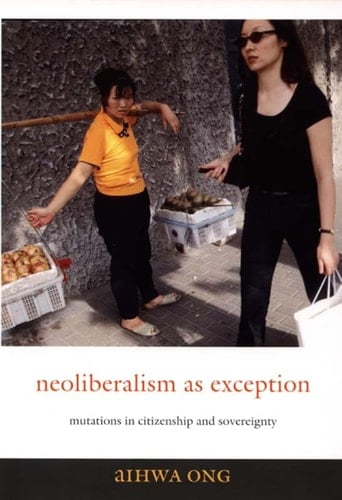
Neoliberalism as Exception Mutations in Citizenship and Sovereignty
Aihwa Ong · 2006
Neoliberalism is commonly viewed as an economic doctrine that seeks to limit the scope of government. Some consider it a form of predatory capitalism with adverse effects on the Global South. In this groundbreaking work, Aihwa Ong offers an alternative view of neoliberalism as an extraordinarily malleable technology of governing that is taken up in different ways by different regimes, be they authoritarian, democratic, or communist. Ong shows how East and Southeast Asian states are making exceptions to their usual practices of governing in order to position themselves to compete in the global economy. As she demonstrates, a variety of neoliberal strategies of governing are re-engineering political spaces and populations. Ong’s ethnographic case studies illuminate experiments and developments such as China’s creation of special market zones within its socialist economy; pro-capitalist Islam and women’s rights in Malaysia; Singapore’s repositioning as a hub of scientific expertise; and flexible labor and knowledge regimes that span the Pacific.<p>Ong traces how these and other neoliberal exceptions to business as usual are reconfiguring relationships between governing and the governed, power and knowledge, and sovereignty and territoriality. She argues that an interactive mode of citizenship is emerging, one that organizes people—and distributes rights and benefits to them—according to their marketable skills rather than according to their membership within nation-states. Those whose knowledge and skills are not assigned significant market value—such as migrant women working as domestic maids in many Asian cities—are denied citizenship. Nevertheless, Ong suggests that as the seam between sovereignty and citizenship is pried apart, a new space is emerging for NGOs to advocate for the human rights of those excluded by neoliberal measures of human worthiness.</p>
Coercion, Capital and European States AD 990 - 1992
Charles Tilly · 1993
In this pathbreaking work, now available in paperback, Charles Tilly challenges all previous formulations of state development in Europe. Specifically, Tilly charges that most available explanations fail because they do not account for the great variety of kinds of states which were viable at different stages of European history, and because they assume a unilinear path of state development resolving in today's national state.

The Art of Not Being Governed An Anarchist History of Upland Southeast Asia
James C. Scott · 2009
<p>For two thousand years the disparate groups that now reside in Zomia (a mountainous region the size of Europe that consists of portions of seven Asian countries) have fled the projects of the organized state societies that surround them—slavery, conscription, taxes, corvée labor, epidemics, and warfare. This book, essentially an “anarchist history,” is the first-ever examination of the huge literature on state-making whose author evaluates why people would deliberately and reactively remain stateless. Among the strategies employed by the people of Zomia to remain stateless are physical dispersion in rugged terrain; agricultural practices that enhance mobility; pliable ethnic identities; devotion to prophetic, millenarian leaders; and maintenance of a largely oral culture that allows them to reinvent their histories and genealogies as they move between and around states.</p><p>In accessible language, James Scott, recognized worldwide as an eminent authority in Southeast Asian, peasant, and agrarian studies, tells the story of the peoples of Zomia and their unlikely odyssey in search of self-determination. He redefines our views on Asian politics, history, demographics, and even our fundamental ideas about what constitutes civilization, and challenges us with a radically different approach to history that presents events from the perspective of stateless peoples and redefines state-making as a form of “internal colonialism.” This new perspective requires a radical reevaluation of the civilizational narratives of the lowland states. Scott's work on Zomia represents a new way to think of area studies that will be applicable to other runaway, fugitive, and marooned communities, be they Gypsies, Cossacks, tribes fleeing slave raiders, Marsh Arabs, or San-Bushmen.

Seeing like a State: How Certain Schemes to Improve the Human Condition Have Failed
James C. Scott · 1999
“Illuminating and beautifully written, this book calls into sharp relief the nature of the world we now inhabit.”—New Yorker<br/><br/>“A magisterial critique of top-down social planning.”—Jennifer Schuessler, New York Times<br/><br/>“One of the most profound and illuminating studies of this century to have been published in recent decades.”—John Gray, New York Times Book Review<br/><br/>Compulsory ujamaa villages in Tanzania, collectivization in Russia, Le Corbusier’s urban planning theory realized in Brasília, the Great Leap Forward in China, agricultural “modernization” in the Tropics—the twentieth century has been racked by grand utopian schemes that have inadvertently brought death and disruption to millions. Why do well-intentioned plans for improving the human condition go tragically awry?<br/><br/>In this wide-ranging and original book, James C. Scott analyzes failed cases of large-scale authoritarian plans in a variety of fields. Centrally managed social plans misfire, Scott argues, when they impose schematic visions that do violence to complex interdependencies that are not—and cannot—be fully understood. Further, the success of designs for social organization depends upon the recognition that local, practical knowledge is as important as formal, epistemic knowledge. The author builds a persuasive case against “development theory” and imperialistic state planning that disregards the values, desires, and objections of its subjects. He identifies and discusses four conditions common to all planning disasters: administrative ordering of nature and society by the state; a “high-modernist ideology” that places confidence in the ability of science to improve every aspect of human life; a willingness to use authoritarian state power to effect large- scale interventions; and a prostrate civil society that cannot effectively resist such plans.
Relational Infrastructure, Supply Chains, and Expulsion

Territory, Authority, Rights From Medieval to Global Assemblages
Saskia Sassen · 2008
<p>Where does the nation-state end and globalization begin? In <i>Territory, Authority, Rights</i>, one of the world's leading authorities on globalization shows how the national state made today's global era possible. Saskia Sassen argues that even while globalization is best understood as "denationalization," it continues to be shaped, channeled, and enabled by institutions and networks originally developed with nations in mind, such as the rule of law and respect for private authority. This process of state making produced some of the capabilities enabling the global era. The difference is that these capabilities have become part of new organizing logics: actors other than nation-states deploy them for new purposes. Sassen builds her case by examining how three components of any society in any age--territory, authority, and rights--have changed in themselves and in their interrelationships across three major historical "assemblages": the medieval, the national, and the global.</p><br><p> The book consists of three parts. The first, "Assembling the National," traces the emergence of territoriality in the Middle Ages and considers monarchical divinity as a precursor to sovereign secular authority. The second part, "Disassembling the National," analyzes economic, legal, technological, and political conditions and projects that are shaping new organizing logics. The third part, "Assemblages of a Global Digital Age," examines particular intersections of the new digital technologies with territory, authority, and rights.</p><br><p> Sweeping in scope, rich in detail, and highly readable, <i>Territory, Authority, Rights</i> is a definitive new statement on globalization that will resonate throughout the social sciences.</p>
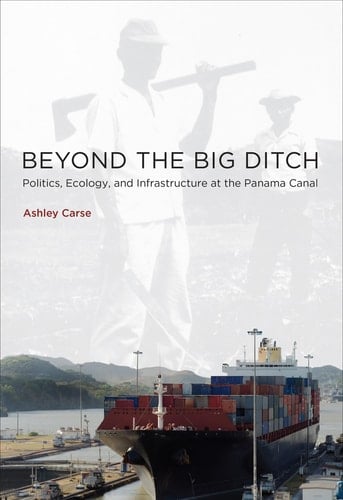
Beyond the Big Ditch Politics, Ecology, and Infrastructure at the Panama Canal
Ashley Carse · 2014
<b>A historical and ethnographic study of the conflict between global transportation and rural development as the two intersect at the Panama Canal. </b><p>In this innovative book, Ashley Carse traces the water that flows into and out from the Panama Canal to explain how global shipping is entangled with Panama's cultural and physical landscapes. By following container ships as they travel downstream along maritime routes and tracing rivers upstream across the populated watershed that feeds the canal, he explores the politics of environmental management around a waterway that links faraway ports and markets to nearby farms, forests, cities, and rural communities. </p><p>Carse draws on a wide range of ethnographic and archival material to show the social and ecological implications of transportation across Panama. The Canal moves ships over an aquatic staircase of locks that demand an enormous amount of fresh water from the surrounding region. Each passing ship drains 52 million gallons out to sea—a volume comparable to the daily water use of half a million Panamanians. </p><p>Infrastructures like the Panama Canal, Carse argues, do not simply conquer nature; they rework ecologies in ways that serve specific political and economic priorities. Interweaving histories that range from the depopulation of the U.S. Canal Zone a century ago to road construction conflicts and water hyacinth invasions in canal waters, the book illuminates the human and nonhuman actors that have come together at the margins of the famous trade route. 2014 marks the 100th anniversary of the Panama Canal. <i>Beyond the Big Ditch</i> calls us to consider how infrastructures are materially embedded in place, producing environments with winners and losers. </p>

The Deadly Life of Logistics Mapping Violence in Global Trade
Deborah Cowen · 2014
<p><br>In a world in which global trade is at risk, where warehouses and airports, shipping lanes and seaports try to guard against the likes of Al Qaeda and Somali pirates, and natural disaster can disrupt the flow of goods, even our “stuff” has a political life. The high stakes of logistics are not surprising, Deborah Cowen reveals, if we understand its genesis in war.</p><br><p>In <i>The Deadly Life of Logistics</i>, Cowen traces the art and science of logistics over the last sixty years, from the battlefield to the boardroom and back again. Focusing on choke points such as national borders, zones of piracy, blockades, and cities, she tracks contemporary efforts to keep goods circulating and brings to light the collective violence these efforts produce. She investigates how the old military art of logistics played a critical role in the making of the global economic order—not simply the globalization of production, but the invention of the supply chain and the reorganization of national economies into transnational systems. While reshaping the world of production and distribution, logistics is also actively reconfiguring global maps of security and citizenship, a phenomenon Cowen charts through the rise of supply chain security, with its challenge to long-standing notions of state sovereignty and border management.</p><br><p>Though the object of corporate and governmental logistical efforts is commodity supply, <i>The Deadly Life of Logistics</i> demonstrates that they are deeply political—and, considered in the context of the long history of logistics, deeply indebted to the practice of war.<br><br><br></p>
Democracy's Infrastructure Techno-Politics and Protest after Apartheid
Antina von Schnitzler · 2016
<p>In the past decade, South Africa's "miracle transition" has been interrupted by waves of protests in relation to basic services such as water and electricity. Less visibly, the post-apartheid period has witnessed widespread illicit acts involving infrastructure, including the nonpayment of service charges, the bypassing of metering devices, and illegal connections to services. <i>Democracy’s Infrastructure</i> shows how such administrative links to the state became a central political terrain during the antiapartheid struggle and how this terrain persists in the post-apartheid present. Focusing on conflicts surrounding prepaid water meters, Antina von Schnitzler examines the techno-political forms through which democracy takes shape.<br><br>Von Schnitzler explores a controversial project to install prepaid water meters in Soweto—one of many efforts to curb the nonpayment of service charges that began during the antiapartheid struggle—and she traces how infrastructure, payment, and technical procedures become sites where citizenship is mediated and contested. She follows engineers, utility officials, and local bureaucrats as they consider ways to prompt Sowetans to pay for water, and she shows how local residents and activists wrestle with the constraints imposed by meters. This investigation of democracy from the perspective of infrastructure reframes the conventional story of South Africa’s transition, foregrounding the less visible remainders of apartheid and challenging readers to think in more material terms about citizenship and activism in the postcolonial world.<br><br><i>Democracy’s Infrastructure</i> examines how seemingly mundane technological domains become charged territory for struggles over South Africa’s political transformation.</p>

Energopolitics Wind and Power in the Anthropocene
Dominic Boyer · 2019
Between 2009 and 2013 Cymene Howe and Dominic Boyer conducted fieldwork in Mexico's Isthmus of Tehuantepec to examine the political, social, and ecological dimensions of moving from fossil fuels to wind power. Their work manifested itself as a new ethnographic form: the duograph—a combination of two single-authored books that draw on shared fieldsites, archives, and encounters that can be productively read together, yet can also stand alone in their analytic ambitions.<br><br>In his volume, <i>Energopolitics</i>, Boyer examines the politics of wind power and how it is shaped by myriad factors, from the legacies of settler colonialism and indigenous resistance to state bureaucracy and corporate investment. Drawing on interviews with activists, campesinos, engineers, bureaucrats, politicians, and bankers, Boyer outlines the fundamental impact of energy and fuel on political power. Boyer also demonstrates how large conceptual frameworks cannot adequately explain the fraught and uniquely complicated conditions on the isthmus, illustrating the need to resist narratives of anthropocenic universalism and to attend to local particularities.
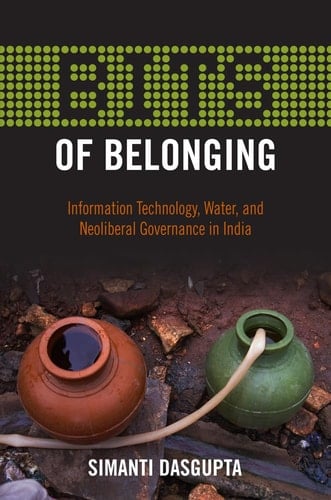
BITS of Belonging Information Technology, Water, and Neoliberal Governance in India
Simanti Dasgupta · 2015
<p>India’s global success in the Information Technology industry has also prompted the growth of neoliberalism and the re-emergence of the middle class in contemporary urban areas, such as Bangalore. In her significant study, <i>BITS of Belonging,</i> Simanti Dasgupta shows that this economic shift produces new forms of social inequality while reinforcing older ones. She investigates this economic disparity by looking at IT and water privatization to explain how these otherwise unrelated domains correspond to our thinking about citizenship, governance, and belonging. </p> <p>Dasgupta’s ethnographic study shows how work and human processes in the IT industry intertwine to meet the market stipulations of the global economy. Meanwhile, in the recasting of water from a public good to a commodity, the middle class insists on a governance and citizenship model based upon market participation. Dasgupta provides a critical analysis of the grassroots activism involved in a contested water project where different classes lay their divergent claims to the city.</p>

Captured at Sea Piracy and Protection in the Indian Ocean
Jatin Dua · 2019
How is it possible for six men to take a Liberian-flagged oil tanker hostage and negotiate a huge pay out for the return of its crew and 2.2 million barrels of crude oil? In his gripping new book, Jatin Dua answers this question by exploring the unprecedented upsurge in maritime piracy off the coast of Somalia in the twenty-first century. Taking the reader inside pirate communities in Somalia, onboard multinational container ships, and within insurance offices in London, Dua connects modern day pirates to longer histories of trade and disputes over protection. In our increasingly technological world, maritime piracy represents not only an interruption, but an attempt to insert oneself within the world of oceanic trade. <i>Captured at Sea</i> moves beyond the binaries of legal and illegal to illustrate how the seas continue to be key sites of global regulation, connectivity, and commerce today.<br>

Sinews of War and Trade Shipping and Capitalism in the Arabian Peninsula
Laleh Khalili · 2020
<b>How shipping is central to the very fabric of global capitalism</b><br><br>In our networked world, the realities governing the international movement of freight are easily forgotten. But maritime transport remains the bedrock of trade. Convoys perpetually crisscross the oceans, carrying gas, oil, ore – indeed, every type of consumable and commodity. These movements, though practically invisible, mean that control of the seas is vital in an age when no nation can survive on domestic products alone.<br><br>Professor and author Laleh Khalili travelled the Mediterranean, the Red Sea, and the Indian Ocean aboard gigantic container ships to investigate the secretive and sometimes dangerous world of maritime trade. What she discovered was strangely disturbing: brutally exploited seafarers enduring loneliness and risking injury to keep the cogs of trade turning. In the Arabian peninsula’s ports, forbidden places encircled by barbed wire and moats of highways, the dockers struggle for benefits and political rights, as they have for generations. Environmental catastrophes threaten with increasing intensity and frequency. Around the oil-trading nations of the Middle East, a history of British colonialism, modern US imperialism, and local autocracies combine to worsen the conditions of modern seafarers, and piracy persists near the Horn of Africa.<br><br>From her research riding the sea lanes and visiting the major Middle Eastern ports, Khalili has produced a book that exposes the frayed and tense sinews of modern capital, a physical network without which none of our more abstracted webs and systems could operate.
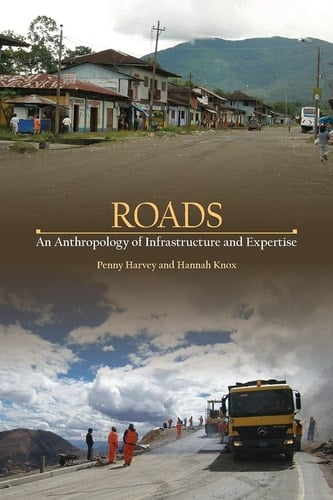
Roads An Anthropology of Infrastructure and Expertise
Penelope Harvey · 2015
<p>Roads matter to people. This claim is central to the work of Penny Harvey and Hannah Knox, who in this book use the example of highway building in South America to explore what large public infrastructural projects can tell us about contemporary state formation, social relations, and emerging political economies.</p><p>Roads focuses on two main sites: the interoceanic highway currently under construction between Brazil and Peru, a major public/private collaboration that is being realized within new, internationally ratified regulatory standards; and a recently completed one-hundred-kilometer stretch of highway between Iquitos, the largest city in the Peruvian Amazon, and a small town called Nauta, one of the earliest colonial settlements in the Amazon. The Iquitos-Nauta highway is one of the most expensive roads per kilometer on the planet.</p><p>Combining ethnographic and historical research, Harvey and Knox shed light on the work of engineers and scientists, bureaucrats and construction company officials. They describe how local populations anticipated each of the road projects, even getting deeply involved in questions of exact routing as worries arose that the road would benefit some more than others. Connectivity was a key recurring theme as people imagined the prosperity that will come by being connected to other parts of the country and with other parts of the world. Sweeping in scope and conceptually ambitious, Roads tells a story of global flows of money, goods, and people—and of attempts to stabilize inherently unstable physical and social environments.</p>

Rule of Experts Egypt, Techno-Politics, Modernity
Timothy Mitchell · 2002
Can one explain the power of global capitalism without attributing to capital a logic and coherence it does not have? Can one account for the powers of techno-science in terms that do not merely reproduce its own understanding of the world?<br><br><i>Rule of Experts </i>examines these questions through a series of interrelated essays focused on Egypt in the twentieth century. These explore the way malaria, sugar cane, war, and nationalism interacted to produce the techno-politics of the modern Egyptian state; the forms of debt, discipline, and violence that founded the institution of private property; the methods of measurement, circulation, and exchange that produced the novel idea of a national "economy," yet made its accurate representation impossible; the stereotypes and plagiarisms that created the scholarly image of the Egyptian peasant; and the interaction of social logics, horticultural imperatives, powers of desire, and political forces that turned programs of economic reform in unanticipated directions.<br><br>Mitchell is a widely known political theorist and one of the most innovative writers on the Middle East. He provides a rich examination of the forms of reason, power, and expertise that characterize contemporary politics. Together, these intellectually provocative essays will challenge a broad spectrum of readers to think harder, more critically, and more politically about history, power, and theory.

Extrastatecraft
Keller Easterling · 2014
Extrastatecraft is the operating system of the modern world: the skyline of Dubai, the subterranean pipes and cables sustaining urban life, free-trade zones, the standardized dimensions of credit cards, and hyper-consumerist shopping malls. It is all this and more. Infrastructure sets the invisible rules that govern the spaces of our everyday lives, making the city the key site of power and resistance in the twenty-first century. Keller Easterling reveals the nexus of emerging governmental and corporate forces buried within the concrete and fiber-optics of our modern habitat. Extrastatecraft will change how we think about cities—and, perhaps, how we live in them.
Expulsions Brutality and Complexity in the Global Economy
Saskia Sassen · 2014
<p>Soaring income inequality and unemployment, expanding populations of the displaced and imprisoned, accelerating destruction of land and water bodies: today’s socioeconomic and environmental dislocations cannot be fully understood in the usual terms of poverty and injustice, according to Saskia Sassen. They are more accurately understood as a type of expulsion—from professional livelihood, from living space, even from the very biosphere that makes life possible.<br><br>This hard-headed critique updates our understanding of economics for the twenty-first century, exposing a system with devastating consequences even for those who think they are not vulnerable. From finance to mining, the complex types of knowledge and technology we have come to admire are used too often in ways that produce elementary brutalities. These have evolved into predatory formations—assemblages of knowledge, interests, and outcomes that go beyond a firm’s or an individual’s or a government’s project.<br><br>Sassen draws surprising connections to illuminate the systemic logic of these expulsions. The sophisticated knowledge that created today’s financial “instruments” is paralleled by the engineering expertise that enables exploitation of the environment, and by the legal expertise that allows the world’s have-nations to acquire vast stretches of territory from the have-nots. <i>Expulsions</i> lays bare the extent to which the sheer complexity of the global economy makes it hard to trace lines of responsibility for the displacements, evictions, and eradications it produces—and equally hard for those who benefit from the system to feel responsible for its depredations.</p>
Post-Colonial Urban Peripherality and Datafied Erasure
Planet of Slums
Mike Davis · 2007
The “profound . . . brilliant” account of the rise of the world’s slums and the failures of modern urbanization—by the world’s leading urbanist (Arundhati Roy, activist and Booker Prize–winning author) According to the United Nations, more than one billion people now live in the slums of the cities of the South. In this brilliant and ambitious book, Mike Davis explores the future of a radically unequal and explosively unstable urban world. From the sprawling barricadas of Lima to the garbage hills of Manila, urbanization has been disconnected from industrialization, and even from economic growth. Davis portrays a vast humanity warehoused in shantytowns and exiled from the formal world economy. He argues that the rise of this informal urban proletariat is a wholly unforeseen development, and asks whether the great slums, as a terrified Victorian middle class once imagined, are volcanoes waiting to erupt.

In the Public's Interest Evictions, Citizenship, and Inequality in Contemporary Delhi
Gautam Bhan · 2016
<p>This book studies the recent legacy of basti "evictions" in Delhi—mass clearings of some of the city's poorest neighborhoods—as a way to understand how the urban poor are disenfranchised in the name of "public interest" and, in the case of Delhi, by the very courts meant to empower and protect them. Studying bastes, says Gautam Bhan, provokes six clear lines of inquiry applicable to studies of urbanism across the global south.<br></p><p>The first is the long-standing debate over urban informality and illegality: the debate's impact on conceptions and practices of urban planning, the production of space, and the regulation of value. The second is a set of debates on "good governance," read through their intersections with ideas of "planned development" within rapidly transforming cities. The third is the political field of urban citizenship and the possibilities of substantive rights and belonging in the city. The fourth is resistance and the ability of a city's subaltern residents to struggle against exclusion. The two remaining inquiries both cut across and unify the first four. One of these is the role of the judiciary and the relationships between law and urbanism in cities of the global south. The other is the relationship between democracy and inequality in the city.<br></p><p>What emerges about Delhi in particular are a set of new modes for the reproduction of inequality. When rights are lost, citizenship is unequal and differentiated, the promise of development is refused, and poverty and inequality are reproduced and deepened. The task at hand, says Bhan, is not just to explain evictions but also to listen to what they are telling us about "the city that is as well as the city that can be."<br></p>
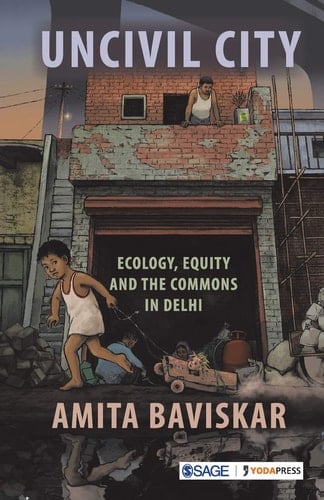
Uncivil City Ecology, Equity and the Commons in Delhi
Amita Baviskar · 2020
As cities become habitat for most of humanity, the question of their ecological capacity to sustain lives worth living becomes ever more critical. Yet, when we listen to debates about city planning and governance, and observe urban environmental campaigns on the ground, we notice that they have little to do with ecology or justice. To examine this contradiction, Uncivil City: Ecology, Equity and the Commons in Delhi looks at two decades of environmental politics in Delhi--across homes and workplaces, ordinary streets and extraordinary spectacles, and the river and the Ridge. It argues that the terms of the discourse--what is an environmental issue, who is authorised to speak, and which modes of action count as legitimate--are partial, particularistic and perverse. 'Bourgeois environmentalists', who claim to speak in the public interest, for nature and society, have made the city what it is: unfair and unliveable. Only citizenship and civility will save the commons--air, water, space and trees--upon which cities depend for survival.<br> <br>

Biometric State The Global Politics of Identification and Surveillance in South Africa, 1850 to the Present
Keith Breckenridge · 2016
A groundbreaking study of South Africa's role as a site for global experiments in biometric identification throughout the twentieth century.
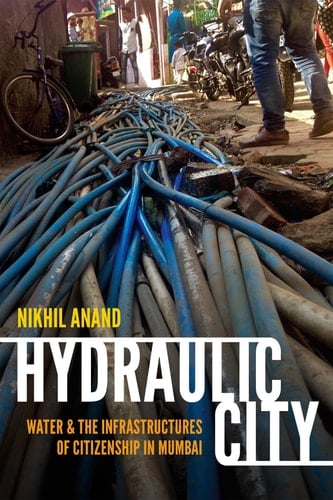
Hydraulic City Water and the Infrastructures of Citizenship in Mumbai
Nikhil Anand · 2017
In <i>Hydraulic City</i> Nikhil Anand explores the politics of Mumbai's water infrastructure to demonstrate how citizenship emerges through the continuous efforts to control, maintain, and manage the city's water. Through extensive ethnographic fieldwork in Mumbai's settlements, Anand found that Mumbai's water flows, not through a static collection of pipes and valves, but through a dynamic infrastructure built on the relations between residents, plumbers, politicians, engineers, and the 3,000 miles of pipe that bind them. In addition to distributing water, the public water network often reinforces social identities and the exclusion of marginalized groups, as only those actively recognized by city agencies receive legitimate water services. This form of recognition—what Anand calls "hydraulic citizenship"—is incremental, intermittent, and reversible. It provides residents an important access point through which they can make demands on the state for other public services such as sanitation and education. Tying the ways Mumbai's poorer residents are seen by the state to their historic, political, and material relations with water pipes, the book highlights the critical role infrastructures play in consolidating civic and social belonging in the city.

City of Walls Crime, Segregation, and Citizenship in São Paulo
Teresa P. R. Caldeira · 2000
"This is an extraordinary treatment of a difficult problem. . . . Much more than a conventional comparative study, <i>City of Walls</i> is a genuinely transcultural, transnational work—the first of its kind that I have read."—George E. Marcus, author of <i>Ethnography Through Thick & Thin</i><br><br>"Caldeira's work is wonderfully ambitious-theoretically bold, ethnographically rich, historically specific. Anyone who cares about the condition and future of cities, of democracy, of human rights should read this book."—Thomas Bender, Director of the Project on Cities and Urban Knowledges<br><br>"<i>City of Walls</i> is a brilliant analysis of the dynamics of urban fear. The sophistication of Caldeira's arguments should stimulate new discussion of cities and urban life. Its significance goes far beyond the borders of Brazil."—Margaret Crawford, Professor of Urban Planning and Design Theory, Graduate School of Design, Harvard University<br><br>"Caldeira's insight illuminates the geography of the city as well as the boundaries—or the lack of boundaries—of violence."—Paul Chevigny, author of <i>Edge of the Knife: Police Violence in the Americas</i><br><br>"An extraordinary account of violence in the city. . . . Caldeira brings to this task a rare depth of knowledge and understanding."—Saskia Sassen, author of <i>Globalization and Its Discontents</i><br><br>"An outstanding contribution to understanding authoritarian continuity under political reform. Caldeira has written a brilliant and bleak analysis on the many challenges and obstacles which government and civil society face in new democracies."—Paulo Sérgio Pinheiro, Director of the Center for the Study of Violence, University of São Paulo and Member of the United Nations Sub-Commission for the Promotion and Protection of Human Rights
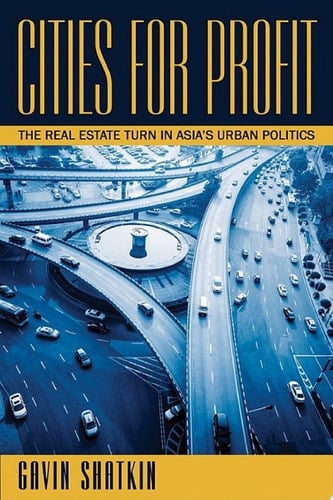
Cities for Profit
Gavin Shatkin · 2017
<p><b><i>Cities for Profit</i></b><b> examines the phenomenon of urban real estate megaprojects in Asia—massive, privately built planned urban developments that have captured the imagination of politicians, policymakers, and citizens across the region.</b> These controversial projects, embraced by elites, occasion massive displacement and have extensive social and economic impacts. Gavin Shatkin finds commonalities and similarities in dozens of such projects in Jakarta, Kolkata, and Chongqing. </p><p>Shatkin is at the vanguard of urban studies in his focus on real estate. Just as cities are increasingly defined and remapped according to the value of the land under their residents' feet, the lives of city dwellers are shaped and constrained by their ability to keep up with rising costs of urban life. Scholars and policy and planning professionals alike will benefit from Shatkin's comprehensive research. <i>Cities for Profit</i> contains insights from more than 150 interviews, site visits to projects, and data from government and nongovernmental organization reports and data, urban plans, architectural renderings, annual reports and promotional materials of developers, and newspaper and other media accounts.</p>

Entangled Urbanism Slum, Gated Community, and Shopping Mall in Delhi and Gurgaon
Sanjay Srivastava · 2015
What makes a city? Rather than a totality, a city is best understood through focusing upon different but interconnected spaces and processes that make for both dynamism and instability in human lives. Hence, the book ranges across a number of sites in order to explore their connections. How do the pleasures of the gated residential enclave encompass the pain of the demolished slum locality? How do localized rituals of suburban life incorporate the symbolic procedures of the nation-state? What processes link contemporary manifestations of consumerism, the middle-classes, and the urban poor? What kind of a city is produced by the relationship between "illegal" settlements such as "slums," the traffic in fake documents that seek to stave of slum-demolitions and representatives of the "legal" city such as Residents Welfare Associations (RWAs)? What can the increasing visibility of RWAs in the quotidian politics of the city tell us about new notions of citizenship and the emergent relationships between middle-classes, the state, and the market? And, what is shared between new forms of urban religiosity, the desire for a "global" city and new consumer cultures? Through these key themes, the book examines the city as a series of overlapping meanings rather than as identifiable urban essence.

The Illegal City Space, Law and Gender in a Delhi Squatter Settlement
Ayona Datta · 2012
The Illegal City explores the relationship between space, law and gendered subjectivity through a close look at an 'illegal' squatter settlement in Delhi. Since 2000, a series of judicial rulings in India have criminalised squatters as 'illegal' citizens, 'encroachers' and 'pickpockets' of urban land, and have led to a spate of slum demolitions across the country. This book argues that in this context, it has become vital to distinguish between illegality and informality since it is those 'illegal' slums which are at the receiving end of a 'force of law', where law is violently encountered within everyday spaces. This book uses a gendered intersectional lens to explore how a 'violence of law' shapes how 'public' subjectivities of gender, class, religion and caste are encountered and negotiated within the 'private' spaces of home, family and neighbourhood. This book suggests that resettlement is not a condition that squatters desire; rather something that is seen as the only way out of the 'illegal' city. The wait for resettlement is a temporal space of anxiety and uncertainty, where particular kinds of politics around law, space and gender takes shape, which transform squatters' relations with the state, urban development, civil society, and with each other. Through their everyday struggles around water, sanitation, social and political organisation and the transformation of their homes and families, this book shows that the desire for the 'legal city' is also the irony and utopia of home, which will remain an incomplete gendered project - both for the state and for squatters.
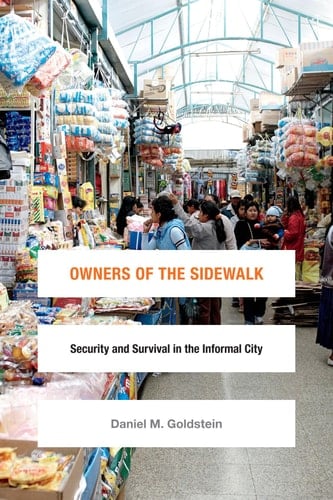
Owners of the Sidewalk Security and Survival in the Informal City
Daniel M. Goldstein · 2016
Many of Bolivia's poorest and most vulnerable citizens work as vendors in the Cancha mega-market in the city of Cochabamba, where they must navigate systems of informality and illegality in order to survive. In <i>Owners of the Sidewalk</i> Daniel M. Goldstein examines the ways these systems correlate in the marginal spaces of the Latin American city. Collaborating with the Cancha's legal and permanent stall vendors (<i>fijos</i>) and its illegal and itinerant street and sidewalk vendors (<i>ambulantes</i>), Goldstein shows how the state's deliberate neglect and criminalization of the Cancha's poor—a practice common to neoliberal modern cities—makes the poor exploitable, governable, and consigns them to an insecure existence. Goldstein's collaborative and engaged approach to ethnographic field research also opens up critical questions about what ethical scholarship entails.

The Politics of Slums in the Global South Urban Informality in Brazil, India, South Africa and Peru
Véronique Dupont · 2017
<p>Seeing urban politics from the perspective of those who reside in slums offers an important dimension to the study of urbanism in the global South. Many people living in sub-standard conditions do not have their rights as urban citizens recognised and realise that they cannot rely on formal democratic channels or governance structures.</p> <p>Through in-depth case studies and comparative research, <i>The Politics of Slums in the Global South: Urban Informality in Brazil, India, South Africa and Peru</i> integrates conceptual discussions on urban political dynamics with empirical material from research undertaken in Rio de Janeiro, Delhi, Chennai, Cape Town, Durban and Lima. The chapters engage with the relevant literature and present empirical material on urban governance and cities in the South, housing policy for the urban poor, the politics of knowledge and social mobilisation. Recent theories on urban informality and subaltern urbanism are explored, and the issue of popular participation in public interventions is critically assessed.</p> <p>The book is aimed at a scholarly readership of postgraduate students and researchers in development studies, urban geography, political science, urban sociology and political geography. It is also of great value to urban decision-makers and practitioners.</p>
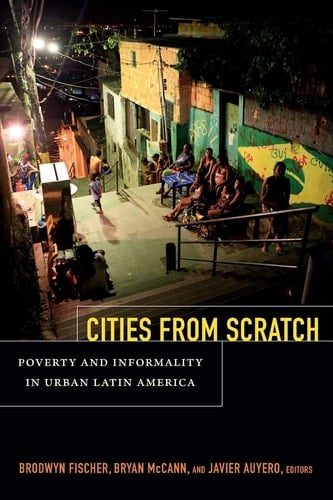
Cities From Scratch Poverty and Informality in Urban Latin America
Brodwyn Fischer · 2014
This collection of essays challenges long-entrenched ideas about the history, nature, and significance of the informal neighborhoods that house the vast majority of Latin America's urban poor. Until recently, scholars have mainly viewed these settlements through the prisms of crime and drug-related violence, modernization and development theories, populist or revolutionary politics, or debates about the cultures of poverty. Yet shantytowns have proven both more durable and more multifaceted than any of these perspectives foresaw. Far from being accidental offshoots of more dynamic economic and political developments, they are now a permanent and integral part of Latin America's urban societies, critical to struggles over democratization, economic transformation, identity politics, and the drug and arms trades. Integrating historical, cultural, and social scientific methodologies, this collection brings together recent research from across Latin America, from the informal neighborhoods of Rio de Janeiro and Mexico City, Managua and Buenos Aires. Amid alarmist exposés, Cities from Scratch intervenes by considering Latin American shantytowns at a new level of interdisciplinary complexity.<br><br>Contributors. Javier Auyero, Mariana Cavalcanti, Ratão Diniz, Emilio Duhau, Sujatha Fernandes, Brodwyn Fischer, Bryan McCann, Edward Murphy, Dennis Rodgers

Seeing Like a City
Ash Amin · 2016
<p>Seeing like a city means recognizing that cities are living things made up of a tangle of networks, built up from the agency of countless actors. Cities must not be considered as expressions of larger paradigms or sites of human effort and organization alone. Within their density, size and sprawl can be found a world of symbols, bodies, buildings, technologies and infrastructures. It is the machine-like combination, interaction and confrontation of these different elements that make a city.</p> <p>Such a view locates urban outcomes and influences in the character of these networks, which together power urban life, allocating resources, shaping social opportunities, maintaining order and simply enabling life. More than the silent stage on which other powers perform, such networks represent the essence of the city. They also form an important political project, a politics of small interventions with large effects. The increasing evidence for an Anthropocene bears out the way in which humanity has stamped its footprint on the planet by constructing urban forms that act as systems for directing life in ways that create both immense power and immense constraint.</p>
Collective Memory, Marginality, and Spatial Politics in Urban Indonesia.
Manneke Budiman · 2024
<p>This volume presents three important themes for the study of Indonesian politics, cultures, and urban space: 1) urban regeneration and collective memory, 2) marginality and the other archives, 3) mood, medium, and media. Readers will find in the collection elements of urban imaginary and practices as represented in essays on community archiving, heritage, spatial experiments, gangsters and hooligans, sex work and sexual violence, youth subcultures, marketplaces, museums, and elite subdivisions. With this, the book offers readers a way to look at how the contributors approach the ever- shifting urban space as a cultural and political arena: how space is represented, produced and contested and how they are implicated in identity formations today and in the past; how individual and collective memories are fixated, disrupted, or catapulted forward by mobility and spatial transformation; how people, landscapes, buildings, movements join forces in transforming self and space, resulting in significant reconfiguration of politics, culture, and memory.</p> <p>This is an open access book.</p>

Growth of a Megacity Planning Jakarta in the Post-Suburban Era
Deden Rukmana · 2026
<p>Jakarta, one of the largest metropolitan areas in Southeast Asia, has grown from 150,000 residents in the first half of the twentieth century to more than 31 million residents in 2024. This tremendous population growth and the expansion of the urbanized areas have created several challenges as well as exposed the role of planning in shaping and managing the Jakarta Metropolitan Area (JMA), also known as Jabodetabek.<br> <br> This edited volume argues that Jakarta exhibits several features of "post-suburban" development, but at the same time, the central area continues to attract population and urban growth. Thus, this metropolitan region is featuring a different type of post-suburban development that might also be considered as an "early stage" of post-suburbanization. The inner city and the suburbs (inner and outer suburbs) are all experiencing a massive physical, social, and economic transformation, albeit with different processes of attraction and rejection/eviction of different social groups. Suburban development and post-suburban development need to be considered from a multiperspective, looking at the changes in residential, industrial, and commercial development, as well as the impact of this growth. Impacts range from changes in employment and infrastructure, to impact on the environment, including disasters and land degradation, and the social fabric, such as segregation and gentrification.<br> <br> This is the first book that analyzes the challenges and practices of planning in the post-suburbanization of Jakarta from a wide thematic perspective, in a single volume. It examines spatial, environmental, economic, and social impacts of the post-suburbanization phenomenon and provides evidence to advance the discussion of policies tackling these adverse impacts and looking into the vision of the JMA for the next twenty years. Collective effort of twenty-two contributors, including academics, planners, urban designers, and architects, the chapters are organized into four parts: economic aspects; environmental concerns; housing and public space, and gentrification and displacement. <i>Growth of a Megacity</i> aims to contribute to the literature on urban planning in Indonesia, and Jakarta in particular, and provides an updated view of post-suburban development in Jakarta intending to help inform future policy-making.</p>

Ordinary Cities Between Modernity and Development
Jennifer Robinson · 2013

Segregation A Global History of Divided Cities
Carl H. Nightingale · 2016
<p>When we think of segregation, what often comes to mind is apartheid South Africa, or the American South in the age of Jim Crow—two societies fundamentally premised on the concept of the separation of the races. But as Carl H. Nightingale shows us in this magisterial history, segregation is everywhere, deforming cities and societies worldwide.<br> <br> Starting with segregation’s ancient roots, and what the archaeological evidence reveals about humanity’s long-standing use of urban divisions to reinforce political and economic inequality, Nightingale then moves to the world of European colonialism. It was there, he shows, segregation based on color—and eventually on race—took hold; the British East India Company, for example, split Calcutta into “White Town” and “Black Town.” As we follow Nightingale’s story around the globe, we see that division replicated from Hong Kong to Nairobi, Baltimore to San Francisco, and more. The turn of the twentieth century saw the most aggressive segregation movements yet, as white communities almost everywhere set to rearranging whole cities along racial lines. Nightingale focuses closely on two striking examples: Johannesburg, with its state-sponsored separation, and Chicago, in which the goal of segregation was advanced by the more subtle methods of real estate markets and housing policy.<br> <br> For the first time ever, the majority of humans live in cities, and nearly all those cities bear the scars of segregation. This unprecedented, ambitious history lays bare our troubled past, and sets us on the path to imagining the better, more equal cities of the future.</p>

Violence at the Urban Margins
Javier Auyero · 2015
In the Americas, debates around issues of citizen's public safety--from debates that erupt after highly publicized events, such as the shootings of Jordan Davis and Trayvon Martin, to those that recurrently dominate the airwaves in Latin America--are dominated by members of the middle and upper-middle classes. However, a cursory count of the victims of urban violence in the Americas reveals that the people suffering the most from violence live, and die, at the lowest of the socio-symbolic order, at the margins of urban societies.<br/><br/>The inhabitants of the urban margins are hardly ever heard in discussions about public safety. They live in danger but the discourse about violence and risk belongs to, is manufactured and manipulated by, others--others who are prone to view violence at the urban margins as evidence of a cultural, or racial, defect, rather than question violence's relationship to economic and political marginalization. As a result, the experience of interpersonal violence among the urban poor becomes something unspeakable, and the everyday fear and trauma lived in relegated territories is constantly muted and denied.<br/><br/>This edited volume seeks to counteract this pernicious tendency by putting under the ethnographic microscope--and making public--the way in which violence is lived and acted upon in the urban peripheries. It features cutting-edge ethnographic research on the role of violence in the lives of the urban poor in South, Central, and North America, and sheds light on the suffering that violence produces and perpetuates, as well as the individual and collective responses that violence generates, among those living at the urban margins of the Americas.

For the City Yet to Come Changing African Life in Four Cities
Abdou Maliqalim Simone · 2004
Among government officials, urban planners, and development workers, Africa’s burgeoning metropolises are frequently understood as failed cities, unable to provide even basic services. Whatever resourcefulness does exist is regarded as only temporary compensation for fundamental failure. In <i>For the City Yet to Come</i>, AbdouMaliq Simone argues that by overlooking all that does work in Africa’s cities, this perspective forecloses opportunities to capitalize on existing informal economies and structures in development efforts within Africa and to apply lessons drawn from them to rapidly growing urban areas around the world. Simone contends that Africa’s cities do work on some level and to the extent that they do, they function largely through fluid, makeshift collective actions running parallel to proliferating decentralized local authorities, small-scale enterprises, and community associations.<p>Drawing on his nearly fifteen years of work in African cities—as an activist, teacher, development worker, researcher, and advisor to ngos and local governments—Simone provides a series of case studies illuminating the provisional networks through which most of Africa’s urban dwellers procure basic goods and services. He examines informal economies and social networks in Pikine, a large suburb of Dakar, Senegal; in Winterveld, a neighborhood on the edge of Pretoria, South Africa; in Douala, Cameroon; and among Africans seeking work in Jeddah, Saudi Arabia. He contextualizes these particular cases through an analysis of the broad social, economic, and historical conditions that created present-day urban Africa. <i>For the City Yet to Come</i> is a powerful argument that any serious attempt to reinvent African urban centers must acknowledge the particular history of these cities and incorporate the local knowledge reflected in already existing informal urban economic and social systems.</p>

Automating Inequality How High-Tech Tools Profile, Police, and Punish the Poor
Virginia Eubanks · 2019

Poverty Capital: Microfinance and the Making of Development
Ananya Roy · 2010

Rule by Aesthetics World-class City Making in Delhi
D. Asher Ghertner · 2015
Rule by Aesthetics offers a powerful examination of the process and experience of mass demolition in the world's second largest city of Delhi, India. Using Delhi's millennial effort to become a 'world-class city, ' the book shows how aesthetic norms can replace the procedures of mapping and surveying typically considered necessary to administer space. This practice of evaluating territory based on its adherence to aesthetic norms - what Ghertner calls 'rule by aesthetics' - allowed the state in Delhi to intervene in the once ungovernable space of slums, overcoming its historical reliance on inaccurate maps and statistics. Slums hence were declared illegal because they looked illegal, an arrangement that led to the displacement of a million slum residents in the first decade of the 21st century. <p>Drawing on close ethnographic engagement with the slum residents targeted for removal, as well as the planners, judges, and politicians who targeted them, the book demonstrates how easily plans, laws, and democratic procedures can be subverted once the subjects of democracy are seen as visually out of place. Slum dwellers' creative appropriation of dominant aesthetic norms shows, however, that aesthetic rule does not mark the end of democratic claims making. Rather, it signals a new relationship between the mechanism of government and the practice of politics, one in which struggles for a more inclusive city rely more than ever on urban aesthetics, in Delhi as in aspiring world-class cities the world over.
Archipelagic Realities, Fiscal Flows, and Frontier Enclosure

Plantation Life Corporate Occupation in Indonesia's Oil Palm Zone
Tania Murray Li · 2021
In <i>Plantation Life</i> Tania Murray Li and Pujo Semedi examine the structure and governance of Indonesia's contemporary oil palm plantations in Indonesia, which supply 50 percent of the world's palm oil. They attend to the exploitative nature of plantation life, wherein villagers' well-being is sacrificed in the name of economic development. While plantations are often plagued by ruined ecologies, injury among workers, and a devastating loss of livelihoods for former landholders, small-scale independent farmers produce palm oil more efficiently and with far less damage to life and land. Li and Semedi theorize “corporate occupation” to underscore how massive forms of capitalist production and control over the palm oil industry replicate colonial-style relations that undermine citizenship. In so doing, they question the assumption that corporations are necessary for rural development, contending that the dominance of plantations stems from a political system that privileges corporations.
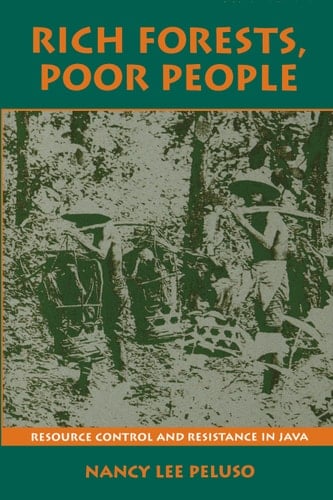
Rich Forests, Poor People Resource Control and Resistance in Java
Nancy Lee Peluso · 1992
Millions of Javanese peasants live alongside state-controlled forest lands in one of the world's most densely populated agricultural regions. Because their legal access and customary rights to the forest have been severely limited, these peasants have been pushed toward illegal use of forest resources. <i>Rich Forests, Poor People</i> untangles the complex of peasant and state politics that has developed in Java over three centuries.<br><br>Drawing on historical materials and intensive field research, including two contemporary case studies, Peluso presents the story of the forest and its people. Without major changes in forest policy, Peluso contends, the situation is portentous. Economic, social, and political costs to the government will increase. Development efforts will by stymied and forest destruction will continue. Mindful that a dramatic shift is unlikely, Peluso suggests how tension between foresters and villagers can be alleviated while giving peasants a greater stake in local forest management.

Violent Environments
Nancy Lee Peluso · 2001
<p>Do environmental problems and processes produce violence? Current U.S. policy about environmental conflict and scholarly work on environmental security assume direct causal links between population growth, resource scarcity, and violence. This belief, a staple of governmental decision-making during both Clinton administrations and widely held in the environmental security field, depends on particular assumptions about the nature of the state, the role of population growth, and the causes of environmental degradation.</p> <p>The conventional understanding of environmental security, and its assumptions about the relation between violence and the environment, are challenged and refuted in Violent Environments. Chapters by geographers, historians, anthropologists, and sociologists include accounts of ethnic war in Indonesia, petro-violence in Nigeria and Ecuador, wildlife conservation in Tanzania, and "friendly fire" at Russia's nuclear weapons sites.</p> <p>Violent Environments portrays violence as a site-specific phenomenon rooted in local histories and societies, yet connected to larger processes of material transformation and power relations. The authors argue that specific resource environments, including tropical forests and oil reserves, and environmental processes (such as deforestation, conservation, or resource abundance) are constituted by and in part constitute the political economy of access to and control over resources. Violent Environments demands new approaches to an international set of complex problems, powerfully arguing for deeper, more ethnographically informed analyses of the circumstances and processes that cause violence.</p>
The Banana Tree at the Gate A History of Marginal Peoples and Global Markets in Borneo
Michael Dove · 2011
<p>The “Hikayat Banjar,” a native court chronicle from Borneo, characterizes the irresistibility of natural resource wealth to outsiders as “the banana tree at the gate.” Michael R. Dove employs this phrase as a root metaphor to frame the history of resource relations between the indigenous peoples of Borneo and the world system. In analyzing production and trade in forest products, pepper, and especially natural rubber, Dove shows that the involvement of Borneo’s native peoples in commodity production for global markets is ancient and highly successful and that processes of globalization began millennia ago. Dove’s analysis replaces the image of the isolated tropical forest community that needs to be helped into the global system with the reality of communities that have been so successful and competitive that they have had to fight political elites to keep from being forced out.</p>

Friction: An Ethnography of Global Connection
Anna Lowenhaupt Tsing · 2011
A wheel turns because of its encounter with the surface of the road; spinning in the air it goes nowhere. Rubbing two sticks together produces heat and light; one stick alone is just a stick. In both cases, it is friction that produces movement, action, effect. Challenging the widespread view that globalization invariably signifies a "clash" of cultures, anthropologist Anna Tsing here develops friction in its place as a metaphor for the diverse and conflicting social interactions that make up our contemporary world. She focuses on one particular "zone of awkward engagement"--the rainforests of Indonesia--where in the 1980s and the 1990s capitalist interests increasingly reshaped the landscape not so much through corporate design as through awkward chains of legal and illegal entrepreneurs that wrested the land from previous claimants, creating resources for distant markets. In response, environmental movements arose to defend the rainforests and the communities of people who live in them. Not confined to a village, a province, or a nation, the social drama of the Indonesian rainforest includes local and national environmentalists, international science, North American investors, advocates for Brazilian rubber tappers, UN funding agencies, mountaineers, village elders, and urban students, among others--all combining in unpredictable, messy misunderstandings, but misunderstandings that sometimes work out. Providing a portfolio of methods to study global interconnections, Tsing shows how curious and creative cultural differences are in the grip of worldly encounter, and how much is overlooked in contemporary theories of the global.
The Making of Middle Indonesia Middle Classes in Kupang Town, 1930s-1980s
Geert Arend van Klinken · 2014
What holds Indonesia together? 'A strong leader' is the answer most often given. This book looks instead at a middle level of society. Middle classes in provincial towns around the vast archipelago mediate between the state and society and help to constitute state power. 'Middle Indonesia' is a social zone connecting extremes. <i>The Making of Middle Indonesia</i> examines the rise of an indigenous middle class in one provincial town far removed from the capital city. Spanning the late colonial to early New Order periods, it develops an unusual, associational notion of political power. 'Soft' modalities of power included non-elite provincial people in the emerging Indonesian state. At the same time, growing inequalities produced class tensions that exploded in violence in 1965-1966.<br>Full text (Open Access)

Nine-Tenths of the Law Enduring Dispossession in Indonesia
Christian Lund · 2021
<p>An exploration of the relationship between possession and legalization across Indonesia, and how people navigate dispossession</p><p>The old aphorism "possession is nine-tenths of the law" is particularly relevant in Indonesia, which has seen a string of regime changes and a shifting legal landscape for property claims. Ordinary people struggle to legalize their possessions and claim rights in competition with different branches of government, as well as police, army, and private gangs. This book explores the relationship between possession and legalization across Indonesia, examining the imaginative and improvisational interpretations of law by which Indonesians navigate dispossession.</p>

Natural Hazards, Risk and Vulnerability Floods and Slum Life in Indonesia
Roanne van Voorst · 2016
<p>Different people handle risk in different ways. The current lack of understanding about this heterogeneity in risk behaviour makes it difficult to intervene effectively in risk-prone communities.</p> <p><i>Natural Hazards, Risk and Vulnerability</i> offers a unique insight in the everyday life of a group of riverbank settlers in Jakarta - one of the most vulnerable areas worldwide in terms of exposure to natural hazards. Based on long-term fieldwork, the book portrays the often creative and innovative ways in which slum dwellers cope with recurrent floods. The book shows that behaviour that is often described as irrational or ineffective by outside experts can be highly pragmatic and often effective. This book argues that human risk behaviour cannot be explained by the risk itself, but instead by seemingly unrelated factors such as trust in authorities and aid-institutions and unequal power structures. By considering a risk as a lens that exposes these factors, a completely new type of analysis is proposed that offers useful insights for everyone concerned about how people cope with the currently increasing amount of natural hazard.</p> <p>This is a valuable resource for academics, researchers and policy makers in the areas of risk studies, disaster and natural hazard, urban studies, anthropology, development, Southeast Asian studies and Indonesia studies.</p>

Civilizing the Margins Southeast Asian Government Policies for the Development of Minorities
Christopher R. Duncan · 2008
Discusses the programs, policies, and laws that affect ethnic minorities in eight countries: Burma, Cambodia, Indonesia, Laos, Malaysia, the Philippines, Thailand, and Viet Nam. Once targeted for intervention, people such as the Orang Asli of Malaysia and the "hill tribes" of Thailand often become the subject of programs aimed at radically changing their lifestyles, which the government views as backward or primitive. Several chapters highlight the tragic consequences of forced resettlement, a common result of these programs.
Democracy for Sale Elections, Clientelism, and the State in Indonesia
Edward Aspinall · 2019
<p><b><i>Democracy for Sale</i></b> <b>is an on-the-ground account of Indonesian democracy, analyzing its election campaigns and behind-the-scenes machinations</b>. Edward Aspinall and Ward Berenschot assess the informal networks and political strategies that shape access to power and privilege in the messy political environment of contemporary Indonesia.</p> <p>In post-Suharto Indonesian politics the exchange of patronage for political support is commonplace. Clientelism, argue the authors, saturates the political system, and in <i>Democracy for Sale</i> they reveal the everyday practices of vote buying, influence peddling, manipulating government programs, and skimming money from government projects. In doing so, Aspinall and Berenschot advance three major arguments. The first argument points toward the role of religion, kinship, and other identities in Indonesian clientelism. The second explains how and why Indonesia's distinctive system of free-wheeling clientelism came into being. And the third argument addresses variation in the patterns and intensity of clientelism. Through these arguments and with comparative leverage from political practices in India and Argentina, <i>Democracy for Sale</i> provides compelling evidence of the importance of informal networks and relationships rather than formal parties and institutions in contemporary Indonesia.</p>

The Fourth Circle A Political Ecology of Sumatra’s Rainforest Frontier
John Fitzgerald McCarthy · 2006
This book addresses the politics of environmental change in one of the richest areas of tropical rainforest in Indonesia. Based on field studies conducted in three agricultural communities in rural Aceh, this work considers a number of questions: How do customary (<i>adat</i>) village and state institutions work? What roles do they play in managing local resources? How have they evolved over time? Are villagers, state policies, or corrupt local networks responsible for the loss of tropical rainforest? Will better outcomes emerge from revitalizing customary management, from changing state policies, or from transforming the way the state works? And why do projects designed by outsiders so often fail?<br> <br> The book describes how, as key actors interact, they create arrangements that effectively manage local resources, eclipsing <i>adat</i> and formal state management structures. While outside interventions try to work with <i>adat</i> and the state, they fail to engage fully with the main problem--that is, that district webs of power and interest, coalescing around local resources and reaching into the wider society, lead inexorably to environmental decline.<br> <br>
The Politics of Deforestation and REDD+ in Indonesia Global Climate Change Mitigation
Aled Williams · 2023
<p>This book reflects on Indonesia ́s recent experience with REDD+ (Reducing Emissions from Deforestation and forest Degradation), all set within a broader discussion of neoliberal environmentalism, hyper-capitalism and Indonesian carbon politics.</p> <p></p>
Building on Borrowed Time Rising Seas and Failing Infrastructure in Semarang
Lukas Ley · 2021
<p><b>A timely ethnography of how Indonesia's coastal dwellers inhabit the "chronic present" of a slow-motion natural disaster</b><br> <br> <br> <br> Ice caps are melting, seas are rising, and densely populated cities worldwide are threatened by floodwaters, especially in Southeast Asia. <i>Building on Borrowed Time</i> is a timely and powerful ethnography of how people in Semarang, Indonesia, on the north coast of Java, are dealing with this global warming-driven existential challenge. In addition to antiflooding infrastructure breaking down, vast areas of cities like Semarang and Jakarta are rapidly sinking, affecting the very foundations of urban life: toxic water oozes through the floors of houses, bridges are submerged, traffic is interrupted. </p> <p>As Lukas Ley shows, the residents of Semarang are constantly engaged in maintaining their homes and streets, trying to live through a slow-motion disaster shaped by the interacting temporalities of infrastructural failure, ecological deterioration, and urban development. He casts this predicament through the temporal lens of a "meantime," a managerial response that means a constant enduring of the present rather than progress toward a better future--a "chronic present." </p> <p><i>Building on Borrowed Time</i> takes us to a place where a flood crisis has already arrived--where everyday residents are not waiting for the effects of climate change but are in fact already living with it--and shows that life in coastal Southeast Asia is defined not by the temporality of climate science but by the lived experience of tidal flooding.</p>
The Politics of Citizenship in Indonesia
Eric Hiariej, Kristian Stokke · 2022
The State and Illegality in Indonesia
Gerry Van Klinken · 2011
The popular 1998 reformasi movement that brought down President Suharto's regime demanded an end to illegal practices by state officials, from human rights abuse to nepotistic investments. Yet today, such practices have proven more resistant to reform than people had hoped.<br>Many have said corruption in Indonesia is "entrenched". We argue it is precisely this entrenched character that requires attention. What is state illegality entrenched in and how does it become entrenched? This involves studying actual cases. Our observations led us to rethink fundamental ideas about the nature of the state in Indonesia, especially regarding its socially embedded character. We conclude that illegal practices by state officials are not just aberrations to the state, they are the state. Almost invariably, illegality occurs as part of collective, patterned, organized and collaborative acts, linked to the competition for political power and access to state resources. While obviously excluding many without connections, corrupt behaviour also plays integrative and stabilizing functions. Especially at the lower end of the social ladder, it gets a lot of things done and is often considered legitimate.<br>This book may be read as a defence of area studies approaches. Without the insights that grew from applying our area studies skills, we would still be constrained by highly stylised notions of the state, which bear little resemblance to the state's actual workings. The struggle against corruption is a long-term political process. Instead of trying to depoliticize it, we believe the key to progress is greater popular participation.<br>With contributions from Simon Butt, Robert Cribb, Howard Dick, Michele Ford, Jun Honna, Tim Lindsey, Lenore Lyons, John McCarthy, Ross McLeod, Marcus Mietzner, Jeremy Mulholland, Gerben Nooteboom, J Danang Widoyoko and Ian Wilson. This book is the result of a series of workshops supported, among others, by the Australian-Netherlands Research Collaboration (ANRC).

In the Realm of the Diamond Queen Marginality in an Out-of-the-way Place
Anna Lowenhaupt Tsing · 1993
<p>In this highly original and much-anticipated ethnography, Anna Tsing challenges not only anthropologists and feminists but all those who study culture to reconsider some of their dearest assumptions. By choosing to locate her study among Meratus Dayaks, a marginal and marginalized group in the deep rainforest of South Kalimantan, Indonesia, Tsing deliberately sets into motion the familiar and stubborn urban fantasies of self and other. Unusual encounters with her remarkably creative and unconventional Meratus friends and teachers, however, provide the opportunity to rethink notions of tradition, community, culture, power, and gender--and the doing of anthropology. Tsing's masterful weaving of ethnography and theory, as well as her humor and lucidity, allow for an extraordinary reading experience for students, scholars, and anyone interested in the complexities of culture.</p><p>Engaging Meratus in wider conversations involving Indonesian bureaucrats, family planners, experts in international development, Javanese soldiers, American and French feminists, Asian-Americans, right-to-life advocates, and Western intellectuals, Tsing looks not for consensus and coherence in Meratus culture but rather allows individual Meratus men and women to return our gaze. Bearing the fruit from the lively contemporary conversations between anthropology and cultural studies, <i>In the Realm of the Diamond Queen</i> will prove to be a model for thinking and writing about gender, power, and the politics of identity.</p>

Land's End Capitalist Relations on an Indigenous Frontier
Tania Murray Li · 2014
Drawing on two decades of ethnographic research in Sulawesi, Indonesia, Tania Murray Li offers an intimate account of the emergence of capitalist relations among indigenous highlanders who privatized their common land to plant a boom crop, cacao. Spurred by the hope of ending their poverty and isolation, some prospered, while others lost their land and struggled to sustain their families. Yet the winners and losers in this transition were not strangers—they were kin and neighbors. Li's richly peopled account takes the reader into the highlanders' world, exploring the dilemmas they faced as sharp inequalities emerged among them.<br><br>The book challenges complacent, modernization narratives promoted by development agencies that assume inefficient farmers who lose out in the shift to high-value export crops can find jobs elsewhere. Decades of uneven and often jobless growth in Indonesia meant that for newly landless highlanders, land's end was a dead end. The book also has implications for social movement activists, who seldom attend to instances where enclosure is initiated by farmers rather than coerced by the state or agribusiness corporations. Li's attention to the historical, cultural, and ecological dimensions of this conjuncture demonstrates the power of the ethnographic method and its relevance to theory and practice today.

The Will to Improve: Governmentality, Development, and the Practice of Politics
Tania Murray Li · 2007
The Will to Improve is a remarkable account of development in action. Focusing on attempts to improve landscapes and livelihoods in Indonesia, Tania Murray Li carefully exposes the practices that enable experts to diagnose problems and devise interventions, and the agency of people whose conduct is targeted for reform. Deftly integrating theory, ethnography, and history, she illuminates the work of colonial officials and missionaries; specialists in agriculture, hygiene, and credit; and political activists with their own schemes for guiding villagers toward better ways of life. She examines donor-funded initiatives that seek to integrate conservation with development through the participation of communities, and a one-billion-dollar program designed by the World Bank to optimize the social capital of villagers, inculcate new habits of competition and choice, and remake society from the bottom up.<br/>Demonstrating that the “will to improve” has a long and troubled history, Li identifies enduring continuities from the colonial period to the present. She explores the tools experts have used to set the conditions for reform—tools that combine the reshaping of desires with applications of force. Attending in detail to the highlands of Sulawesi, she shows how a series of interventions entangled with one another and tracks their results, ranging from wealth to famine, from compliance to political mobilization, and from new solidarities to oppositional identities and violent attack. The Will to Improve is an engaging read—conceptually innovative, empirically rich, and alive with the actions and reflections of the targets of improvement, people with their own critical analyses of the problems that beset them.
