
Philosophy

Items in this hypelist
To Read

Crime and Punishment (Everyman's Library)
Fyodor Dostoyevsky · 1993
A masterpiece of guilt and redemption that transforms the sordid story of an old woman’s murder into the nineteenth century’s profoundest and most compelling philosophical novel. • ONE OF TIME MAGAZINE'S 100 BEST MYSTERY AND THRILLER BOOKS OF ALL TIME<br/><br/>Raskolnikov, an impoverished student living in the St. Petersburg of the tsars, is determined to overreach his humanity and assert his untrammeled individual will. When he commits an act of murder and theft, he sets into motion a story that, for its excruciating suspense, its atmospheric vividness, and its depth of characterization and vision is almost unequaled in the literatures of the world. The best known of Dostoevsky’s masterpieces, Crime and Punishment can bear any amount of rereading without losing a drop of its power over our imaginations.<br/><br/>Award-winning translators Richard Pevear and Larissa Volokhonsky render this elusive and wildly innovative novel with an energy, suppleness, and range of voice that do full justice to the genius of its creator.<br/><br/>Everyman's Library pursues the highest production standards, printing on acid-free cream-colored paper, with full-cloth cases with two-color foil stamping, decorative endpapers, silk ribbon markers, European-style half-round spines, and a full-color illustrated jacket. Everyman’s Library Classics include an introduction, a select bibliography, and a chronology of the author's life and times.

The Master and Margarita: 50th-Anniversary Edition (Penguin Classics Deluxe Edition)
Mikhail Bulgakov · 2016
A 50th-anniversary Deluxe Edition of the incomparable 20th-century masterpiece of satire and fantasy, in a newly revised version of the acclaimed Pevear and Volokhonsky translation<br/><br/>Nothing in the whole of literature compares with The Master and Margarita. One spring afternoon, the Devil, trailing fire and chaos in his wake, weaves himself out of the shadows and into Moscow. Mikhail Bulgakov’s fantastical, funny, and devastating satire of Soviet life combines two distinct yet interwoven parts, one set in contemporary Moscow, the other in ancient Jerusalem, each brimming with historical, imaginary, frightful, and wonderful characters. Written during the darkest days of Stalin’s reign, and finally published in 1966 and 1967, The Master and Margarita became a literary phenomenon, signaling artistic and spiritual freedom for Russians everywhere.<br/><br/>This newly revised translation, by the award-winning team of Pevear and Volokhonsky, is made from the complete and unabridged Russian text.<br/><br/>For more than seventy years, Penguin has been the leading publisher of classic literature in the English-speaking world. With more than 1,700 titles, Penguin Classics represents a global bookshelf of the best works throughout history and across genres and disciplines. Readers trust the series to provide authoritative texts enhanced by introductions and notes by distinguished scholars and contemporary authors, as well as up-to-date translations by award-winning translators.

The Book of Disquiet (Penguin Classics)
Fernando Pessoa · 2002
The prizewinning, complete and unabridged translation—“the best English-language version we are likely to see for a long time, if ever” (The Guardian)—of a work of unclassifiable genius: the crowning achievement of Portugal’s modern master<br/><br/>Edited, Translated, and with an Introduction by Richard Zenith, the author of the Pulitzer Prize finalist Pessoa: A Biography<br/><br/>Winner of the Calouste Gulbenkian Translation Prize for Portuguese Translation<br/><br/>A Penguin Classic<br/><br/>Fernando Pessoa was many writers in one. He attributed his prolific writings to a wide range of alternate selves, each of which had a distinct biography, ideology, and horoscope. When he died in 1935, Pessoa left behind a trunk filled with unfinished and unpublished writings, among which were the remarkable pages that make up his posthumous masterpiece, The Book of Disquiet, an astonishing work that, in George Steiner's words, "gives to Lisbon the haunting spell of Joyce's Dublin or Kafka's Prague."<br/><br/>Published for the first time some fifty years after his death, this unique collection of short, aphoristic paragraphs comprises the "autobiography" of Bernardo Soares, one of Pessoa's alternate selves. Part intimate diary, part prose poetry, part descriptive narrative, captivatingly translated by Richard Zenith, The Book of Disquiet is one of the greatest works of the twentieth century.<br/><br/>“Pessoa is a genius.” —André Aciman

The Stranger
Albert Camus · 1989
With the intrigue of a psychological thriller, The Stranger—Camus's masterpiece—gives us the story of an ordinary man unwittingly drawn into a senseless murder on an Algerian beach. With an Introduction by Peter Dunwoodie; translated by Matthew Ward.<br/><br/>Behind the subterfuge, Camus explores what he termed "the nakedness of man faced with the absurd" and describes the condition of reckless alienation and spiritual exhaustion that characterized so much of twentieth-century life.<br/><br/>“The Stranger is a strikingly modern text and Matthew Ward’s translation will enable readers to appreciate why Camus’s stoical anti-hero and devious narrator remains one of the key expressions of a postwar Western malaise, and one of the cleverest exponents of a literature of ambiguity.” —from the Introduction by Peter Dunwoodie<br/><br/>First published in 1946; now in translation by Matthew Ward.

The Passion According to G.H. (New Directions Books)
Clarice Lispector · 2012
"A New Directions paperbook original"--Back cover.

Meditations on First Philosophy (Hackett Classics)
Rene Descartes · 1993
Descartes's Meditations on First Philosophy, the fundamental and originating work of the modern era in Western philosophy, is presented here in Donald Cress's completely revised edition of his well-established translation, bringing this version even closer to Descartes's original, while maintaining its clear and accessible style.
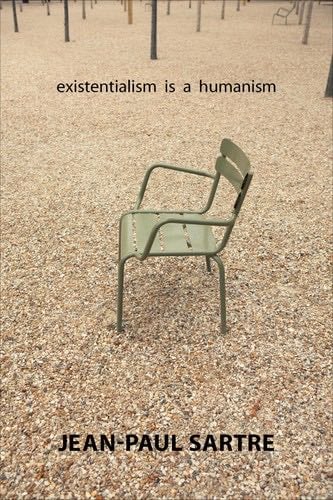
Existentialism Is a Humanism
Jean-Paul Sartre · 2007
<DIV><B>A new translation of two seminal works of existentialism</B><BR /><BR /> It was to correct common misconceptions about his thought that Jean-Paul Sartre, the most dominent European intellectual of the post-World War II decades, accepted an invitation to speak on October 29, 1945, at the Club Maintenant in Paris. The unstated objective of his lecture (“Existentialism Is a Humanism”) was to expound his philosophy as a form of “existentialism,” a term much bandied about at the time. Sartre asserted that existentialism was essentially a doctrine for philosophers, though, ironically, he was about to make it accessible to a general audience. The published text of his lecture quickly became one of the bibles of existentialism and made Sartre an international celebrity.<BR /><BR /> The idea of freedom occupies the center of Sartre’s doctrine. Man, born into an empty, godless universe, is nothing to begin with. He creates his essence—his self, his being—through the choices he freely makes (“existence precedes essence”). Were it not for the contingency of his death, he would never end. Choosing to be this or that is to affirm the value of what we choose. In choosing, therefore, we commit not only ourselves but all of mankind. This book presents a new English translation of Sartre’s 1945 lecture and his analysis of Camus’s <I>The Stranger</I>, along with a discussion of these works by acclaimed Sartre biographer Annie Cohen-Solal. This edition is a translation of the 1996 French edition, which includes Arlette Elkaïm-Sartre’s introduction and a Q&A with Sartre about his lecture.</DIV>

What Is Existentialism? (Penguin Great Ideas)
Simone De Beauvoir · 2021
The groundbreaking writings on the philosophy of the individual by iconic feminist and social thinker, Simone de Beauvoir<br/><br/>How should we think and act in the world? These writings on the human condition by one of the twentieth century's great philosophers explore the absurdity of our notions of good and evil, and show instead how we make our own destiny simply by being.<br/><br/>Throughout history, some books have changed the world. They have transformed the way we see ourselves - and each other. They have inspired debate, dissent, war and revolution. They have enlightened, outraged, provoked and comforted. They have enriched lives--and upended them. Now Penguin brings you a new set of the acclaimed Great Ideas, a curated library of selections from the works of the great thinkers, pioneers, radicals and visionaries whose ideas shook civilization and helped make us who we are.
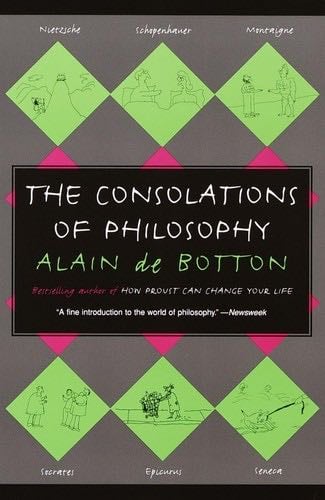
The Consolations of Philosophy
Alain De Botton · 2001
From the internationally heralded author of How Proust Can Change Your Life comes a remarkable book that presents the wisdom of some of the greatest thinkers of the ages as advice for our day to day struggles.<br/><br/>"A fine introduction the world of philosophy." —Newsweek<br/><br/>Solace for the broken heart can be found in the words of Schopenhauer. The ancient Greek Epicurus has the wisest, and most affordable, solution to cash flow problems. A remedy for impotence lies in Montaigne. Seneca offers advice upon losing a job. And Nietzsche has shrewd counsel for everything from loneliness to illness. The Consolations of Philosophy is a book as accessibly erudite as it is useful and entertaining.

The Myth of Sisyphus (Vintage International)
Albert Camus · 2018
A Nobel Prize-winning author delivers one of the most influential works of the twentieth century, showing a way out of despair and reaffirming the value of existence.<br/><br/>Influenced by works such as Don Juan and the novels of Kafka, these essays begin with a meditation on suicide—the question of living or not living in a universe devoid of order or meaning. With lyric eloquence, Albert Camus brilliantly presents a crucial exposition of existentialist thought.
