political ecology
A research log tracking the power dynamics, institutional mechanisms, and material circuits that govern the biophysical world. This folder bridges macro-political economy with grounded local realities, exploring how global capital accumulation and state apparatuses actively produce resource frontiers. The literature collected here traces how state-enforced resource rents, property regimes, and the enclosures of green capitalism impose environmental degradation and displacement upon peripheral territories. Beyond structural critiques of extraction and imperialism, this repository investigates the frontline frictions of the Anthropocene, examining how marginalized and Indigenous communities weaponize traditional ecological knowledge, organize grassroots resistance, and actively assert territorial sovereignty against corporate and state domination.
Items in this hypelist
Foundations & Core Theories

The Routledge Handbook of Political Ecology
Tom Perreault · 2020
<p>The Routledge Handbook of Political Ecology presents a comprehensive and authoritative examination of the rapidly growing field of political ecology. Located at the intersection of geography, anthropology, sociology, and environmental history, political ecology is one of the most vibrant and conceptually diverse fields of inquiry into nature-society relations within the social sciences. With contributions from over 50 leading scholars, the Handbook presents a systematic overview of political ecology's origins, practices, and core concerns, and aims to advance both ongoing and emerging debates. While there are numerous edited volumes, textbooks, and monographs under the heading "political ecology" these have tended to be either collections of empirically based (mostly case study) research on a given theme, or broad overviews of the field aimed at undergraduate audiences. The Routledge Handbook of Political Ecology is the first systematic, comprehensive overview of the field. With authors from North and South America, Europe, Australia, and elsewhere, the Handbook provides a state-of-the-art examination of political ecology; addresses ongoing and emerging debates in this rapidly evolving field; and charts new agendas for research, policy, and activism.<br> The Handbook opens with several chapters that critically reflect on political ecology and situate it within the broader scope of nature-society scholarship. These are followed by a section on the practice of political ecology: ethics, methods, activism, and policy. The remainder of the book comprises five sub-sections that examine fundamental concepts at the heart of political ecology: environmental knowledge, environmental change, environmental governance, environmental identities, and environmental politics.<br> The Routledge Handbook of Political Ecology introduces political ecology as an interdisciplinary academic field. It will serve as an excellent resource for graduate and advanced undergraduate teaching, and as a key reference text for geographers, anthropologists, sociologists, environmental historians, and others working in and around the fields of political ecology, environmental politics, and the political economy of environmental change.</p>
Critical Political Ecology The Politics of Environmental Science
Tim Forsyth · 2003
<p>Critical Political Ecology brings political debate to the science of ecology. As political controversies multiply over the science underlying environmental debates, there is an increasing need to understand the relationship between environmental science and politics. In this timely and wide-ranging volume, Tim Forsyth uses an innovative approach to apply political analysis to ecology, and demonstrates how more politicised approaches to science can be used in environmental decision-making.<br> <br> Critical Political Ecology examines:<br> *how social and political factors frame environmental science, and how science in turn shapes politics<br> *how new thinking in philosophy and sociology of science can provide fresh insights into the biophysical causes and impacts of environmental problems<br> *how policy and decision-makers can acknowledge the political influences on science and achieve more effective public participation and governance.</p>

Political Ecology A Critical Introduction
Paul Robbins · 2019
<p><b>An accessible, focused exploration of the field of political ecology</b></p> <p>The third edition of <i>Political Ecology</i> spans this sprawling field, using grounded examples and careful readings of current literature. While the study of political ecology is sometimes difficult to fathom, owing to its breadth and diversity, this resource simplifies the discussion by reducing the field down into a few core questions and arguments. These points clearly demonstrate how critical theory can make pragmatic contributions to the fields of conservation, development, and environmental management.</p> <p>The latest edition of this seminal work is also more closely focused, with references to recent work from around the world. Further, <i>Political Ecology</i> raises critical questions about “traditional” approaches to environmental questions and problems. This new edition:</p> <ul> <li>Includes international work in the field coming out of Europe, Latin America, and Asia</li> <li>Explains political ecology and its tendency to disrupt the environmental research and practice by both advancing and undermining associated fields of study</li> <li>Contains contributions from a wide range of diverse backgrounds and expertise</li> <li>Offers a resource that is written in highly-accessible, straightforward language</li> <li>Outlines the frontiers of the field and frames climate change and the end of population growth with the framework of political ecology</li> </ul> <p>An excellent resource for undergraduates and academics, the third edition of <i>Political Ecology </i>offers an updated edition of the guide to this diverse, quickly growing field that is at the heart of how humans shape the world and, in turn, are shaped by it.</p>

Liberation Ecologies Environment, Development and Social Movements
Richard Peet · 2004
Liberating political ecology / Michael Watts and Richard Peet -- The political ecology of famine : the origins of the Third World / Mike Davis -- Invisible forests : the political ecology of forest resurgence in El Salvador / Susanna B. Hecht -- Environmental discourses on soil degradation in Bolivia : sustainability and the search for socioenvironmental "middle ground" / Karl S. Zimmerer -- Purity and pollution : racial degradation and environmental anxieties / Jake Kosek -- Eco-governmentality and other transnational practices of a "green" World Bank / Michael Goldman -- Nature-state-territory : toward a critical theorization of conversation enclosures / Roderick P. Neumann -- Water, markets, and embedded institutions in Western India / Navroz K. Dubash -- Transition environments : ecological and social challenges to post-socialist industrial development / Dara O'Rourke -- Violent environments : petroleum conflict and the political ecology of rule in the Niger Delta, Nigeria / Michael Watts -- Gender and class power in agroforestry systems : case studies from Indonesia and West Africa / Richard A. Schroeder and Krisnawati Suryanata -- Gender conflict in Gambian wetlands / Judith Carney -- Environment, indigeneity and transnationalism / Tania Murray Li -- From Chipko to Uttaranchal : the environment of protest and development in the Indian Himalaya / Haripriya Rangan -- Movements and modernizations, markets and municipalities : indigenous federations in rural Ecuador / Anthony Bebbington -- Industrial pollution and social movements in Thailand / Tim Forsyth.

Political Ecology Deconstructing Capital and Territorializing Life
Enrique Leff · 2022
<p>This book offers a conceptual framework for the critical understanding of the present socio-environmental conflicts. It reflects on the evolution of subject and thought, a shift in environmental thinking triggered by the development of eco-territorial conflicts and the social responses given to the environmental question. Bringing together 40 years of the authors writing and research, the book explores the transition from ecological economics and historical materialism to ecological Marxism. It unpacks the forging of political ecology from value theory in political economy, to ecological distribution and ecologies of difference; a transition to an environmental rationality grounded in the ontology of diversity, a politics of difference and an ethics of otherness. This evolution in thinking gives consistency to a theoretical discourse able to respond to the territorial conflicts generated by the radicalization of the environmental question as a key social issue of our times. The bookis a call to respond to the urgent challenge of reversing the tendency towards the entropic death of the planet and to building a sustainable world order.<br></p>

Reimagining Political Ecology
Aletta Biersack and James B. Greenberg · 2006
Reimagining Political Ecology is a state-of-the-art collection of ethnographies grounded in political ecology. When political ecology first emerged as a distinct field in the early 1970s, it was rooted in the neo-Marxism of world system theory. This collection showcases second-generation political ecology, which retains the Marxist interest in capitalism as a global structure but which is also heavily influenced by poststructuralism, feminism, practice theory, and cultural studies. As these essays illustrate, contemporary political ecology moves beyond binary thinking, focusing instead on the interchanges between nature and culture, the symbolic and the material, and the local and the global. Aletta Biersack’s introduction takes stock of where political ecology has been, assesses the field’s strengths, and sets forth a bold research agenda for the future. Two essays offer wide-ranging critiques of modernist ecology, with its artificial dichotomy between nature and culture, faith in the scientific management of nature, and related tendency to dismiss local knowledge. The remaining eight essays are case studies of particular constructions and appropriations of nature and the complex politics that come into play regionally, nationally, and internationally when nature is brought within the human sphere. Written by some of the leading thinkers in environmental anthropology, these rich ethnographies are based in locales around the world: in Belize, Papua New Guinea, the Gulf of California, Iceland, Finland, the Peruvian Amazon, Malaysia, and Indonesia. Collectively, they demonstrate that political ecology speaks to concerns shared by geographers, sociologists, political scientists, historians, and anthropologists alike. And they model the kind of work that this volume identifies as the future of political ecology: place-based “ethnographies of nature” keenly attuned to the conjunctural effects of globalization. Contributors. Eeva Berglund, Aletta Biersack, J. Peter Brosius, Michael R. Dove, James B. Greenberg, Søren Hvalkof, J. Stephen Lansing, Gísli Pálsson, Joel Robbins, Vernon L. Scarborough, John W. Schoenfelder, Richard Wilk
Global Political Ecology
Richard Peet · 2011
<p>The world is caught in the mesh of a series of environmental crises. So far attempts at resolving the deep basis of these have been superficial and disorganized. Global Political Ecology links the political economy of global capitalism with the political ecology of a series of environmental disasters and failed attempts at environmental policies.</p><p>This critical volume draws together contributions from twenty-five leading intellectuals in the field. It begins with an introductory chapter that introduces the readers to political ecology and summarizes the books main findings. The following seven sections cover topics on the political ecology of war and the disaster state; fuelling capitalism: energy scarcity and abundance; global governance of health, bodies, and genomics; the contradictions of global food; capitalâe(tm)s marginal product: effluents, waste, and garbage; water as a commodity, a human right, and power; the functions and dysfunctions of the global green economy; political ecology of the global climate, and carbon emissions. </p><p>This book contains accounts of the main currents of thought in each area that bring the topics completely up-to-date. The individual chapters contain a theoretical introduction linking in with the main themes of political ecology, as well as empirical information and case material. Global Political Ecology serves as a valuable reference for students interested in political ecology, environmental justice, and geography.</p>
Agrarian Change & Rural Frontiers

Regional Political Ecologies and Environmental Conflicts in India
Sarmistha Pattanaik · 2022
"This book focuses on the regional political ecologies (RPEs) of environmental conflicts in India. It explores broadly, landscape-based analyses of political, economic and social issues, which impact environmental changes, challenges and conflicts at local and micro-local levels. The chapters in this volume examine the intervention of different stakeholders in the management of various regional ecological landscapes in India, including forests, rivers, canals, creeks and wetlands. The volume is an interdisciplinary endeavour, weaving together contextual narratives through a combination of approaches from sociology, anthropology, geography, political studies and environmental history. Using such core approaches, the book studies the place-based dynamisms within the regional environmental conflicts in the selected conservation landscapes. It provides empirical reflections on transboundary issues, rural-urban transitions, middle-class environmentalism, identity conflicts, decentralized natural resource management and the role of political institutions. Regional Political Ecologies and Environmental Conflicts in India will be of great interest to students and scholars of Political Ecology and South Asian Environmental Studies"--

The Political Ecology of Climate Change Adaptation Livelihoods, Agrarian Change and the Conflicts of Development
Marcus Taylor · 2017
<p>This book provides the first systematic critique of the concept of climate change adaptation within the field of international development. Drawing on a reworked political ecology framework, it argues that climate is not something 'out there' that we adapt to. Instead, it is part of the social and biophysical forces through which our lived environments are actively yet unevenly produced. From this original foundation, the book challenges us to rethink the concepts of climate change, vulnerability, resilience and adaptive capacity in transformed ways. With case studies drawn from Pakistan, India and Mongolia, it demonstrates concretely how climatic change emerges as a dynamic force in the ongoing transformation of contested rural landscapes. In crafting this synthesis, the book recalibrates the frameworks we use to envisage climatic change in the context of contemporary debates over development, livelihoods and poverty.</p> <p>With its unique theoretical contribution and case study material, this book will appeal to researchers and students in environmental studies, sociology, geography, politics and development studies.</p>

Friction: An Ethnography of Global Connection
Anna Lowenhaupt Tsing · 2011
A wheel turns because of its encounter with the surface of the road; spinning in the air it goes nowhere. Rubbing two sticks together produces heat and light; one stick alone is just a stick. In both cases, it is friction that produces movement, action, effect. Challenging the widespread view that globalization invariably signifies a "clash" of cultures, anthropologist Anna Tsing here develops friction in its place as a metaphor for the diverse and conflicting social interactions that make up our contemporary world. She focuses on one particular "zone of awkward engagement"--the rainforests of Indonesia--where in the 1980s and the 1990s capitalist interests increasingly reshaped the landscape not so much through corporate design as through awkward chains of legal and illegal entrepreneurs that wrested the land from previous claimants, creating resources for distant markets. In response, environmental movements arose to defend the rainforests and the communities of people who live in them. Not confined to a village, a province, or a nation, the social drama of the Indonesian rainforest includes local and national environmentalists, international science, North American investors, advocates for Brazilian rubber tappers, UN funding agencies, mountaineers, village elders, and urban students, among others--all combining in unpredictable, messy misunderstandings, but misunderstandings that sometimes work out. Providing a portfolio of methods to study global interconnections, Tsing shows how curious and creative cultural differences are in the grip of worldly encounter, and how much is overlooked in contemporary theories of the global.

The Government of Beans Regulating Life in the Age of Monocrops
Kregg Hetherington · 2020
<i>The Government of Beans</i> is about the rough edges of environmental regulation, where tenuous state power and blunt governmental instruments encounter ecological destruction and social injustice. At the turn of the twenty-first century, Paraguay was undergoing dramatic economic, political, and environmental change due to a boom in the global demand for soybeans. Although the country's massive new soy monocrop brought wealth, it also brought deforestation, biodiversity loss, rising inequality, and violence. Kregg Hetherington traces well-meaning attempts by bureaucrats and activists to regulate the destructive force of monocrops that resulted in the discovery that the tools of modern government are at best inadequate to deal with the complex harms of modern agriculture and at worst exacerbate them. The book simultaneously tells a local story of people, plants, and government; a regional story of the rise and fall of Latin America's new left; and a story of the Anthropocene writ large, about the long-term, paradoxical consequences of destroying ecosystems in the name of human welfare.

Land, Capital and Extractive Frontiers Social Conflict and Ecological Crisis in the Senegal River Delta
Maura Benegiamo · 2025
<p>This book examines ‘land-grabbing’ - its colonial roots and the fraught relationship between capital and nature amidst the current global socio-ecological crisis.</p><p> Through ethnographic and archival research, Maura Benegiamo investigates an Italian company’s acquisition of 20,000 hectares in Senegal’s River Delta for agrofuel production and delves into the struggles of pastoral communities affected by the project. Through this landmark case, the book shows how European energy and global food security policies are reshaping rural spaces, expanding agrarian extractivism in sub-Saharan Africa.</p><p> By shedding light on how contemporary capital–nature relationships perpetuate socio-ecological crises and colonial models, the book highlights the enduring forms of opposition to these processes. At the heart of these struggles lies a crucial question: how can we understand today’s crises while reclaiming alternative ways of living, producing and inhabiting the land?</p>
Slow Disaster Political Ecology of Hazards and Everyday Life in the Brahmaputra Valley, Assam
Mitul Baruah · 2022
<p>This book presents a fascinating, ethnographic account of the challenges faced by communities living in Majuli, India, one of the largest river islands in the world, which has experienced immense socio-environmental transformations over the years, processes that are emblematic of the Brahmaputra Valley as a whole.</p> <p>Written in an engaging style, full of the author's insider perspectives, this insightful volume explores the processes of flooding and riverbank erosion in Majuli, including re-configuration of the island's geographies, loss of local livelihoods, and large-scale displacement of the population. The book begins with an examination of the physical geography of Majuli and its ecological complexities, leading to discussion on the role of the state in water governance and hazard management, as well as popular resistance by the rural communities on the island. The book focuses on livelihoods as a way of offering economic context to living in challenging environmental conditions and examines the interactions between the state and a whole host of non-state actors, and the everyday, arbitrary functioning of the bureaucracy in a hazardscape.</p> <p>This volume is an invaluable resource for scholars interested in political ecology of hazards and vulnerability, water and hydraulic infrastructure, rural livelihoods and agrarian questions, state theorizations, island studies, and resistance and social movements, as well as those with an interest in northeast India more generally across various disciplines.</p>
A Political Ecology of Forest Conservation in India Communities, Wildlife, and the State
Amrita Sen · 2021
<p>This book critically explores the political ecology of human marginalization, wildlife conservation and the role of the state in politicizing conservation frameworks, drawing on examples from forests in India.</p> <p>The book specifically demonstrates the nuances within human-environmental linkages, by showing how environmental concerns are not only ecological in content but also political. In India a large part of the forests and their surrounding areas were inhabited far before they were designated as protected areas and inviolate zones, with the local population reliant on forests for their survival and livelihoods. Thus, socioecological conflicts between the forest dependents and official state bodies have been widespread. This book uses a political ecology lens to explore the complex interplay between current norms of forest conservation and environmental subjectivities, illustrating contemporary articulation of forest rights and the complex mediations between forest dependents and different state and non-state bodies in designing and implementing regulatory standards for wildlife and forest protection. It foregrounds the issues of identity, migration and cultural politics while discussing the politics of conservation. Through a political ecology approach, the book not only is human-centric but also makes significant use of the role of non-humans in foregrounding the conservation discourse, with a particular focus on tigers.</p> <p>The book will be of great interest to students and academics studying forest conservation, human-wildlife interactions and political ecology.</p>

The Violence of the Green Revolution Third World Agriculture, Ecology, and Politics
Vandana Shiva · 2015
<p>The Green Revolution has been heralded as a political and technological achievement -- unprecedented in human history. Yet in the decades that have followed it, this supposedly nonviolent revolution has left lands ravaged by violence and ecological scarcity. A dedicated empiricist, Vandana Shiva takes a magnifying glass to the effects of the Green Revolution in India, examining the devastating effects of monoculture and commercial agriculture and revealing the nuanced relationship between ecological destruction and poverty. In this classic work, the influential activist and scholar also looks to the future as she examines new developments in gene technology.</p>

Human-environment Relations and Politics in Indonesia Conflicting Ecologies
Kristina Großmann · 2022
<p>This book analyses how people in Kalimantan, the Indonesian part of the island of Borneo, relate to their environment in different political and historical contexts.</p>
Forest Resources Management in Indonesia (1968-2004) A Political Ecology Approach
Herman Hidayat · 2018
<p>This book explores the forestry sector and its context, investigating the management of forest resources in Indonesia. It covers topics including forest fires, deforestation, water pollution, depletion of biodiversity, climate change and environmental damages. The book adopts a political economy approach, elaborating on the role of direct actors such as the central government, private companies and local governments, and the role of indirect actors. In addition, readers will discover anthropological and sociological perspectives through engagement with local communities such as the Kutai, Banjar and Rejang ethnic groups, Chinese trading communities, NGOs and Academics.<br> <br>Featuring interviews with 91 informants and participatory observations, the text draws on secondary literature to provide a comprehensive overview of the subject. This work is illustrated with figures, tables and maps and will be of particular interest to students and researchers of forest policies. It makes a valuable contribution to forest sciences and will also be useful to those in non-government organizations, politicians and business men with an interest in forest resources management, or a deeper interest in Indonesia.<br></p>
Urban Politics & Infrastructure

Living with Floods in a Mobile Southeast Asia A Political Ecology of Vulnerability, Migration and Environmental Change
Carl Middleton · 2019
<p>This book contributes to a better understanding of the relationship between migration, vulnerability, resilience and social justice associated with flooding across diverse environmental, social and policy contexts in Southeast Asia. It challenges simple analyses of flooding as a singular driver of migration, and instead considers the ways in which floods figure in migration-based livelihoods and amongst already mobile populations.</p> <p>The book develops a conceptual framework based on a 'mobile political ecology' in which particular attention is paid to the multidimensionality, temporalities and geographies of vulnerability. Rather than simply emphasising the capacities (or lack thereof) of individuals and households, the focus is on identifying factors that instigate, manage and perpetuate vulnerable populations and places: these include the sociopolitical dynamics of floods, flood hazards and risky environments, migration and migrant-based livelihoods and the policy environments through which all of these take shape.</p> <p>The book is organised around a series of eight empirical urban and rural case studies from countries in Southeast Asia, where lives are marked by mobility and by floods associated with the region's monsoonal climate. The concluding chapter synthesises the insights of the case studies, and suggests future policy directions. Together, the chapters highlight critical policy questions around the governance of migration, institutionalised disaster response strategies and broader development agendas.</p>

Everyday Environmentalism Creating an Urban Political Ecology
Alex Loftus · 2012
<p><i>Everyday Environmentalism</i> develops a conversation between marxist theories of everyday life and recent work in urban political ecology, arguing for a philosophy of praxis in relation to the politics of urban environments. Grounding its theoretical debate in empirical studies of struggles to obtain water in the informal settlements of Durban, South Africa, as well as in the creative acts of insurgent art activists in London, Alex Loftus builds on the work of key marxist thinkers to redefine “environmental politics.”</p><p>A marxist philosophy of praxis—that world-changing ideas emerge from the acts of everyday people—undergirds the book. Our daily reality, writes Loftus, is woven out of the entanglements of social and natural relations, and as such a kind of environmental politics is automatically incorporated into our lives. Nevertheless, one effect of the public recognition of global environmental change, asserts Loftus, has been a resurgence of dualistic understandings of the world: for example, that nature is inflicting revenge on arrogant human societies.</p><p>This ambitious work reformulates—with the assistance of such philosophers as Lukács, Gramsci, Lefebvre, and others—a politics of the environment in which everyday subjectivity is at the heart of a revolutionary politics.<br></p>
Divided Environments An International Political Ecology of Climate Change, Water and Security
Jan Selby · 2022
What are the implications of climate change for twenty-first-century conflict and security? Rising temperatures, it is often said, will bring increased drought, more famine, heightened social vulnerability, and large-scale political and violent conflict; indeed, many claim that this future is already with us. Divided Environments, however, shows that this is mistaken. Focusing especially on the links between climate change, water and security, and drawing on detailed evidence from Israel-Palestine, Syria, Sudan and elsewhere, it shows both that mainstream environmental security narratives are misleading, and that the actual security implications of climate change are very different from how they are often imagined. Addressing themes as wide-ranging as the politics of droughts, the contradictions of capitalist development and the role of racism in environmental change, while simultaneously articulating an original 'international political ecology' approach to the study of socio-environmental conflicts, Divided Environments offers a new and important interpretation of our planetary future.

Promises of the Political Insurgent Cities in a Post-Political Environment
Erik Swyngedouw · 2018
<p><b>The possibility of a new emancipatory and democratizing politics, explored through the lens of recent urban insurgencies<b>.</b></b></p><p>In <i>Promises of the Political</i>, Erik Swyngedouw explores whether progressive and emancipatory politics is still possible in a post-political era. Activists and scholars have developed the concept of post-politicization to describe the process by which “the political” is replaced by techno-managerial governance. If the political domain has been systematically narrowed into a managerial apparatus in which consensual governance prevails, where can we find any possibility of a new democratic politics? Swyngedouw examines this question through the lens of recent urban insurgencies. In Zuccotti Park, Paternoster Square, Taksim Square, Tahrir Square, Hong Kong, and elsewhere, he argues, insurgents have gathered to choreograph new configurations of the democratic. </p><p>Swyngedouw grounds his argument in urban and ecological processes, struggles, and conflicts through which post-politicization has become institutionally entrenched. He casts “the city” and “nature” as emblematic of the construction of post-democratic modes of governance. He describes the disappearance of the urban polis into the politics of neoliberal planetary urbanization; and he argues that the political-managerial framing of “nature” and the environment contributes to the formation of depoliticized governance—most notably in the impotent politics of climate change. Finally, he explores the possibilities for a reassertion of the political, considering whether—after the squares are cleared, the tents folded, and everyday life resumes—the urban uprisings of the last several years signal a return of the political.</p>

A Political Ecology of Women, Water and Global Environmental Change
Stephanie Buechler · 2016
<p>This edited volume explores how a feminist political ecology framework can bring fresh insights to the study of rural and urban livelihoods dependent on vulnerable rivers, lakes, watersheds, wetlands and coastal environments. Bringing together political ecologists and feminist scholars from multiple disciplines, the book develops solution-oriented advances to theory, policy and planning to tackle the complexity of these global environmental changes.</p> <p>Using applied research on the contemporary management of groundwater, springs, rivers, lakes, watersheds and coastal wetlands in Central and South Asia, Northern, Central and Southern Africa, and South and North America, the authors draw on a variety of methodological perspectives and new theoretical approaches to demonstrate the importance of considering multiple layers of social difference as produced by and central to the effective governance and local management of water resources.</p> <p>This unique collection employs a unifying feminist political ecology framework that emphasizes the ways that gender interacts with other social and geographical locations of water resource users. In doing so, the book further questions the normative gender discourses that underlie policies and practices surrounding rural and urban water management and climate change, water pollution, large-scale development and dams, water for crop and livestock production and processing, resource knowledge and expertise, and critical livelihood studies.</p> <p>This book will be of interest to students and scholars of environmental studies, development studies, feminist and environmental geography, anthropology, sociology, environmental philosophy, public policy, planning, media studies, Latin American and other area studies, as well as women's and gender studies.</p>
Where Rivers Meet the Sea: The Political Ecology of Water
Stephanie C. Kane · 2012
Where fresh water appears to be abundant and generally accessible, chronic pollution may be relatively ignored as a public issue. Yet there are those whose lives, livelihoods, and traditions are touched directly by the destructive albeit essential relationship between humans and water. In her passionate and persuasively argued Where Rivers Meet the Sea, Stephanie Kane compares two cities and nations—Salvador, Brazil and Buenos Aires, Argentina—as she tells the stories of those who organize in the streets, petition the courts, and challenge their governments to implement and enforce existing laws designed to protect springs, lakes, harbors, and rivers. Illuminating the complex and distinctive cultural forces in the South Atlantic that shape conflicts and collaborations pertaining to particular waterfront settings, Kane shows the dilemmas, inventiveness, and persistence that provide the foundation for environmental and social justice movements writ large.

Turning Up the Heat Urban Political Ecology for a Climate Emergency
Maria Kaika · 2023
<p>'Turning up the heat is an ambitious book that delivers what it promises, a bringing together of the proliferating field of urban political ecology, to take stock, but moreover, to move on. In a hotter world with increasing social inequality, it will function as inspiration for scholarship and political ecological action for many and for years to come.'<br>Henrik Ernstson, Associate Professor and Docent in Political Ecology at KTH Royal Institute of Technology and Lecturer in Human Geography at the University of Manchester <p>'Turning up the heat makes a brilliant contribution to critical scholarship. Here is a rich and much-needed collection of cases and critiques that pushes us to theorise the urban from its margins. It demands creative modes of political thought and action to confront a world of environmental destruction, authoritarianism, and economic inequality.'<br> Malini Ranganathan, Associate Professor, American University, and co-author of Corruption Plots: Stories, Ethics, and Publics of the Late Capitalist City <p> Since its emergence in the 1990s, the field of Urban Political Ecology (UPE) has focused on unsettling traditional understandings of the 'city' as entirely distinct from nature, showing instead how cities are metabolically linked with ecological processes and the flow of resources. More recently, a new generation of scholars has turned the focus towards the climate emergency. Turning up the heat seeks to turn UPE's critical energies towards a politically engaged debate over the role of extensive urbanisation in addressing socio-environmental equality in the context of climate change. <p> The collection brings together theoretical discussions and rigorous empirical analysis by key scholars spanning three generations, engaging UPE in current debates about urbanisation and climate change. Engaging with cutting edge approaches including feminist political ecology, circular economies, and the Anthropocene, case studies in the book range from Singapore and Amsterdam to Nairobi and Vancouver. Contributors make the case for a UPE better informed by situated knowledges: an embodied UPE that pays equal attention to the role of postcolonial processes and more-than-human ontologies of capital accumulation within the context of the climate emergency. Acknowledging UPE's rich intellectual history and aiming to enrich rather than split the field, Turning up the heat reveals how UPE is ideally positioned to address contemporary environmental issues in theory and practice.</p>
Fossil Capital, Extractivism, & The Green Frontier

Energopolitics Wind and Power in the Anthropocene
Dominic Boyer · 2019
Between 2009 and 2013 Cymene Howe and Dominic Boyer conducted fieldwork in Mexico's Isthmus of Tehuantepec to examine the political, social, and ecological dimensions of moving from fossil fuels to wind power. Their work manifested itself as a new ethnographic form: the duograph—a combination of two single-authored books that draw on shared fieldsites, archives, and encounters that can be productively read together, yet can also stand alone in their analytic ambitions.<br><br>In his volume, <i>Energopolitics</i>, Boyer examines the politics of wind power and how it is shaped by myriad factors, from the legacies of settler colonialism and indigenous resistance to state bureaucracy and corporate investment. Drawing on interviews with activists, campesinos, engineers, bureaucrats, politicians, and bankers, Boyer outlines the fundamental impact of energy and fuel on political power. Boyer also demonstrates how large conceptual frameworks cannot adequately explain the fraught and uniquely complicated conditions on the isthmus, illustrating the need to resist narratives of anthropocenic universalism and to attend to local particularities.
The Political Economy of the Energy Transition in Latin America - Between Extractivism and Sustainable Development
Hannes Warnecke-Berger · 2026
<p>The persistence of extractivism in Latin America is a central issue in contemporary debates on global sustainability and the curse of the energy transition. </p><p>This book explores these pressing concerns by analyzing the tensions between the energy transition, extractivism, and green development in Latin America. While important parts of the world economy are beginning to decarbonize and industrialized nations promote sustainability initiatives, resource extraction continues to play a fundamental role in the political, economic, and social landscapes of the Global South. The international expert contributors to this volume examine whether the emerging sustainability paradigm based on energy transition represents an alternative or merely a reconfiguration of historical extractivist structures. The first few chapters of the book critically examine the unsustainability of extractivism and therefore the historical and contemporary challenges of resource dependency. It presents case studies of countries such as Bolivia, Venezuela, and Argentina, illustrating how extractivist states have struggled with governance dilemmas, environmental degradation, and socio-political resistance. The following chapters focus on the challenges for the green economy, investigating the intersection between sustainability and structural economic constraints, addressing the risks of green extractivism, and exploring whether Latin America can escape the cycle of resource dependency. </p><p>Through an interdisciplinary approach that integrates political economy, sociology, environmental science, and development studies, this book provides a nuanced understanding of Latin America's resource dilemmas in the context of global energy transitions.</p>
Lifeblood Oil, Freedom, and the Forces of Capital
Matthew T. Huber · 2013
<p>If our oil addiction is so bad for us, why don't we kick the habit? Looking beyond the usual culprits--Big Oil, petro-states, and the strategists of empire--<i>Lifeblood</i> finds a deeper and more complex explanation in everyday practices of oil consumption in American culture. Those practices, Matthew T. Huber suggests, have in fact been instrumental in shaping the broader cultural politics of American capitalism.</p><p>How did gasoline and countless other petroleum products become so central to our notions of the American way of life? Huber traces the answer from the 1930s through the oil shocks of the 1970s to our present predicament, revealing that oil's role in defining popular culture extends far beyond material connections between oil, suburbia, and automobility. He shows how oil powered a cultural politics of entrepreneurial life--the very American idea that life itself is a product of individual entrepreneurial capacities. In so doing he uses oil to retell American political history from the triumph of New Deal liberalism to the rise of the New Right, from oil's celebration as the lifeblood of postwar capitalism to increasing anxieties over oil addiction.</p><p><i>Lifeblood</i> rethinks debates surrounding energy and capitalism, neoliberalism and nature, and the importance of suburbanization in the rightward shift in American politics. Today, Huber tells us, as crises attributable to oil intensify, a populist clamoring for cheap energy has less to do with American excess than with the eroding conditions of life under neoliberalism.<b></p>

White Skin, Black Fuel On the Danger of Fossil Fascism
Andreas Malm · 2021
<b>Rising temperatures and the rise of the far right. What disasters happen when they meet?</b><br><br>In the first study of the far right’s role in the climate crisis, <i>White Skin, Black Fuel</i> presents an eye-opening sweep of a novel political constellation, revealing its deep historical roots. Fossil-fuelled technologies were born steeped in racism. No one loved them more passionately than the classical fascists. Now right-wing forces have risen to the surface, some professing to have the solution—closing borders to save the nation as the climate breaks down.<br><br> Epic and riveting, White Skin, Black Fuel traces a future of political fronts that can only heat up.
More and More and More An All-Consuming History of Energy
Jean-Baptiste Fressoz · 2025
<p>The radical, paradigm-shifting international bestseller that destroys our delusions about energy consumption and will change the way we talk about climate change.</p> <p>We have long been taught that humanity's relationship with energy is one of progress, with wood superseded by coal, coal by oil, oil by nuclear--until at some future point everything will be replaced by "green" energy. But the long-held belief in transition and sustainability is completely untrue, Jean-Baptiste Fressoz argues.</p> <p>More and More and More demolishes this disastrous fallacy, showing how our industrial age and beyond has in fact been powered by an ever-greater accumulation of each major energy source feeding off the others. Using a fascinating array of examples from past and present, from the whaling and candle-making industries of the nineteenth century to our post-nuclear age today, Fressoz describes how humanity has gorged on all forms of energy--with whole forests used to prop up coal mines, and fossil fuels remaining central to the creation of innumerable new products we rely on every day. While nations have signed climate agreements aimed at reducing fossil fuels, the sad truth is that the world today burns more wood, coal, and carbon than ever before.</p> <p>More and More and More forces readers to confront hard truths, including how "transition" was originally promoted by energy companies, not as a genuine plan, but as a way to put off any meaningful change. It offers a clear-eyed understanding of the modern world in all its voracious reality and shines a hard light on the true nature of the enormous challenges eight billion of us face, as we stand at the precipice of planetary crisis.</p>
Neoextractivism and Capitalist Development
Dennis C. Canterbury · 2018
The large-scale extraction of natural resources for sale in capitalist markets is not a new phenomenon, but in recent years global demand for resources has increased, leading to greater attention to the role of resource extraction in the development of the exporting countries. The term neoextractivism was coined to refer to the complex of state-private sector policies intended to utilize the income from natural resources sales for development objectives and for improving the lives of a country's citizens. However, this book argues that neoextractivism is merely another conduit for capitalist development, reinforcing the position of elites, with few benefits for working people. With particular reference to the role of neoextractivism within Latin America and the Caribbean, using Guyana as a case study, the book aims to provide readers with the tools they need to critically analyze neoextractivism as a development model, identifying alternative paths for improving the human condition. This book will be of interest to academics and students in the fields of international development, political economy, sociology, and globalization, as well as to policymakers and political activists engaged in social movements in the natural resources sector.
Fossil Capital The Rise of Steam Power and the Roots of Global Warming
Andreas Malm · 2016
<b>A sweeping study of how capitalism first promoted fossil fuels with the rise of steam power—and contributed to the worsening climate crisis</b><br><br> The more we know about the catastrophic implications of climate change, the more fossil fuels we burn. How did we end up in this mess? In this masterful new history, Andreas Malm claims it all began in Britain with the rise of steam power. But why did manufacturers turn from traditional sources of power, notably water mills, to an engine fired by coal? Contrary to established views, steam offered neither cheaper nor more abundant energy—but rather superior control of subordinate labor. Animated by fossil fuels, capital could concentrate production at the most profitable sites and during the most convenient hours, as it continues to do today.<br> <br> Sweeping from nineteenth-century Manchester to the emissions explosion in China, from the original triumph of coal to the stalled shift to renewables, this study hones in on the burning heart of capital and demonstrates, in unprecedented depth, that turning down the heat will mean a radical overthrow of the current economic order.<br><br><br>“The definitive deep history on how our economic system created the climate crisis. Superb, essential reading from one of the most original thinkers on the subject.”<br><b>—Naomi Klein, author of <i>This Changes Everything</i> and <i>The Shock Doctrine</i></b>
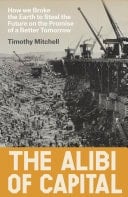
The Alibi of Capital How We Broke the Earth to Steal the Future on the Promise of a Better Tomorrow
Timothy Mitchell · 2026
<b>The author of the acclaimed <i>Carbon Democracy</i> argues that capitalism has always operated by consuming the future—and concealing its theft.</b><br><br>We live in an age in which extraordinary wealth seems to arrive from unfathomable sources, such as when tech firms that have never made a profit are valued at billions of dollars. While seeming extraordinary, this mode of acquiring unearned wealth is, in fact, commonplace. It is a key to understanding how capitalism came into being and a clue to grasping why the catastrophe of climate collapse has come upon us. The value is created by consuming the future.<br><br><i>The Alibi of Capital</i> asks how we came to organize collective life on the principle of capturing the future, explores the development of this principle in the imperial expansion of the West, and examines how lives today are encumbered by the repayment of earlier extractions. The book identifies the forms of capitalisation, credit, and coercion that turn prospective assets into present income. Rejecting the common idea that claims on the future create only financial or fictitious capital, it traces the terraforming projects—the destruction of rivers, the colonizing of territory, the expansion of infrastructures, and the burning of carbon—through which consuming the future has operated. Arguing that terms like finance, technology, the economy and its growth provide alibis that conceal this mode of extraction, it develops a new approach for understanding how the impoverishment operates.

The Licit Life of Capitalism US Oil in Equatorial Guinea
Hannah Appel · 2019
The <i>Licit Life of Capitalism</i> is both an account of a specific capitalist project—U.S. oil companies working off the shores of Equatorial Guinea—and a sweeping theorization of more general forms and processes that facilitate diverse capitalist projects around the world. Hannah Appel draws on extensive fieldwork with managers and rig workers, lawyers and bureaucrats, the expat wives of American oil executives and the Equatoguinean women who work in their homes, to turn conventional critiques of capitalism on their head, arguing that market practices do not merely exacerbate inequality; they are made by it. People and places differentially valued by gender, race, and colonial histories are the terrain on which the rules of capitalist economy are built. Appel shows how the corporate form and the contract, offshore rigs and economic theory are the assemblages of liberalism and race, expertise and gender, technology and domesticity that enable the <i>licit life of capitalism</i>—practices that are legally sanctioned, widely replicated, and ordinary, at the same time as they are messy, contested, and, arguably, indefensible.

Planetary Mine Territories of Extraction under Late Capitalism
Martin Arboleda · 2020
<b>A clarion call to rethink natural resource extraction beyond the extractive industries</b><p><i>Planetary Mine</i> rethinks the politics and territoriality of resource extraction, especially as the mining industry becomes reorganized in the form of logistical networks, and East Asian economies emerge as the new pivot of the capitalist world-system. Through an exploration of the ways in which mines in the Atacama Desert of Chile—the driest in the world—have become intermingled with an expanding constellation of megacities, ports, banks, and factories across East Asia, the book rethinks uneven geographical development in the era of supply chain capitalism. Arguing that extraction entails much more than the mere spatiality of mine shafts and pits, <i>Planetary Mine</i> points towards the expanding webs of infrastructure, of labor, of finance, and of struggle, that drive resource-based industries in the twenty-first century.</p>

The Price is Wrong Why Capitalism Won't Save the Planet
Brett Christophers · 2024

The Politics of Precarity Spaces of Extractivism, Violence and Suffering
Gediminas Lesutis · 2021
"Based on critical theory and ethnographic research, this book explores how intensifying geographies of extractive capitalism shapes human lives and transformative politics in marginal areas of the global economy. Engaging the work of Judith Butler, Henri Lefebvre, and Jacque Ranciáere with ethnographic research on socio-political effects of mining-induced dispossession in Mozambique, the bookLesutis demonstrates how explores how extractive capitalism affects (im)possibilities of a liveable life and theorising precarity unfolds as a spatially constituted condition of everyday life given over to the violence of capital. Going beyond labour relations, or governance of life in liberal democracies, it the book shows how dispossessed people are subjected to structural, symbolic, and direct modalities of violence; this simultaneously constitutes their suffering and ceaseless desire, however implausible, to be included into abstract space of extractivism. As a result, despite multifarious violence that it engenders, extractive capital accumulation is sustained even in the margins, historically excluded from contingently lived imaginaries of a "good life" promised by capital Presenting this theorisation of precarity as a framework on, and a critique of, the contemporary politics of (un)liveability, the book speaks to key debates about precarity, dispossession, resistance, extractivism, and development in several disciplines, especially political geography, IPE, global politics, and critical theory. It will also be of interest to scholars in development studies, critical political economy, and African politics"--
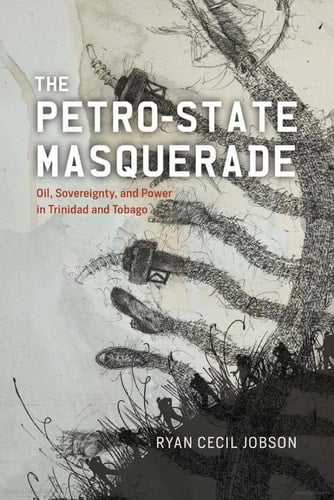
The Petro-State Masquerade Oil, Sovereignty, and Power in Trinidad and Tobago
Ryan Cecil Jobson · 2024
<b>A historical and ethnographic study of the fraught relationship between fossil fuels and political power in Trinidad and Tobago.</b><br> <br> <br> <br> Examining the past, present, and future of Trinidad and Tobago's oil and gas industries, anthropologist Ryan Cecil Jobson traces how a model of governance fashioned during prior oil booms is imperiled by declining fossil fuel production and a loss of state control. Despite the twin-island nation's increasingly volatile and vulnerable financial condition, however, government officials continue to promote it as a land of inexhaustible resources and potentially limitless profits.<br> <br> <br> <br> The result is what Jobson calls a "masquerade of permanence" whereby Trinbagonian state actors represent the nation as an interminable reserve of hydrocarbons primed for multinational investment. In <i>The Petro-state Masquerade</i>, Jobson examines the gulf between this narrative crafted by the postcolonial state and the vexed realities of its dwindling petroleum-fueled aspirations. After more than a century of commercial oil production, Trinidad and Tobago instructs us to regard the petro-state as less a permanent form than a fragile relation between fossil fuels and sovereign authority. Foregrounding the concurrent masquerades of oil workers, activists, and Carnival revelers, Jobson argues that the promise of decolonization lies in the disarticulation of natural resources, capital, and political power by ordinary people in the Caribbean.<br> <br>
The Political Economy of Extractivism Global Perspectives on the Seduction of Rent
Hannes Warnecke-Berger · 2024
"For many countries, primarily in the Global South, extractivism - the exploiting and exporting of natural resources - is big business. For those exporting countries, natural resource rents create hope and promise for development which can be a seductive force. This book explores the depth of extractivism in economies around the world. The contributions to this book investigate the connection between the political economy of extractivism and its impact on the socio-political fabric of natural resource exporting societies in Asia, Africa, Latin America, and Eastern Europe. The book engages with a comparative perspective on the persistence of extractivism in these four different world regions. The book focuses on the formative power of rents and argues that rents are seductive. The individual contributions flesh out this seductive force of rents on different political scales and how this seduction affects a variety of actors. The book investigates how these actors react to the prevalence of rent, how they align or break with specific political and economic strategies, and how myths of resource-driven development play out on the ground. The book, therefore, underlines that rent theory bridges current debates in different area communities and offers fresh insights into extractivist societies' social, economic, and political dynamics. This book will be of significant interest to readers in political economy, political science, development studies and area studies"--

Extractive Capitalism How Commodities and Cronyism Drive the Global Economy
Laleh Khalili · 2025
<b>An exposé of the extractive industries powering globalization —and a primer on fighting back</b><br><br>Laleh Khalili reflects on the hidden stories behind late capitalism, from seafarers abandoned on debt-ridden container ships to the nefarious reach of consultancy firms and the cronyism that drives record-breaking profits. Piercing, wry, and constantly revealing, <i>Extractive Capitalism </i>brings vividly to light the dark truths behind the world’s most voracious industries.<br><br>Whether it is pumping oil, mining resources, or shipping commodities across oceans, the global economy runs on extraction. Promises of frictionless trade and lucrative speculation are the hallmarks of our era, but the backbone of globalization is still low-cost labor and rapacious corporate control. Extractive capitalism is what made—and what maintains—our unequal world.

Crude Capitalism
Adam Hanieh · 2024
A groundbreaking history of oil and it's importance to US politics, finance, militarism and consumerism from an award-winning author and scholar This expansive history traces the hidden connections between oil and capitalism from the late 1800s to the current climate crisis. Beyond simplistic narratives that frame oil as 'prize' or 'curse', Crude Capitalism uncovers the surprising ways that oil is woven into the fabric of our modern world: the rise of an American-centered global order; the breakdown of Empire and anti-colonial rebellion; contemporary finance and US dollar hegemony; debt and militarism; and the emergence of new forms of synthetic consumption. Much more than an energy source or transport fuel, oil has a foundational place in all aspects of contemporary life - no challenge to the fossil fuel industry can be effective without taking this fact seriously. Crude Capitalism maps the varied geographies of oil, including the rise of OPEC, the importance of revolutionary and Post-Soviet Russia, the crucial role of African upstream reserves, and the new petrochemical circuits that link the Middle East, China, and East Asia. The book provides an original and fine-grained empirical analysis of corporate ownership and control, including refining and petrochemicals. By exposing these structures of power and placing oil in capitalism, the book makes an essential contribution to debates around oil-dependency and the struggle for climate justice.
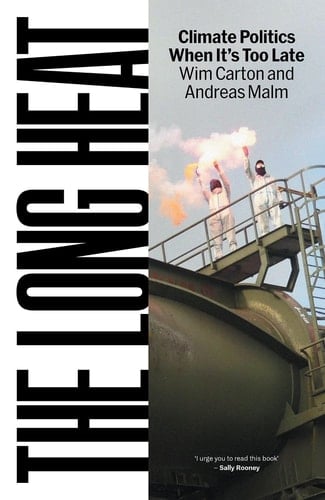
The Long Heat - Climate Politics When It’s Too Late
Andreas Malm · 2025
The world is crossing the 1.5C global warming limit, perhaps exceeding 2C soon after. What is to be done when these boundaries, set by the Paris Agreement, have been passed? In the overshoot era, schemes proliferate for muscular adaptation or for new technologies to turn the heat down at a later date by removing CO2 from the air or blocking sunlight. Such technologies are by no means safe; they come with immense risks and provide an excuse for those who would prefer to avoid limiting emissions in the present. But do they also hold out some potential? Can the catastrophe be reversed, masked or simply adapted to once it is a fact? Or will any such roundabout measures simply make things worse?<br><br><i>The Long Heat </i>maps the new front lines in the struggle for a liveable planet and insists on the climate revolution long overdue. In the end, no technology can absolve us of responsibility for our planet and each other.

Overshoot How the World Surrendered to Climate Breakdown
Andreas Malm · 2024
<b>A scathing critique of proposals to geoengineer our way out of climate disaster by the bestselling author of <i>How to Blow Up a Pipeline</i></b><br><br>It might soon be far too hot on this planet. What do we do then? In the era of "overshoot," schemes abound for turning down the heat–not now, but a few decades down the road. We’re being told that we can return to liveable temperatures by means of technologies for removing CO2 from the air or blocking incoming sunlight.If they even exist, such technologies are not safe.<br><br>They come with immense uncertainties and risks. Worse, like magical promises of future redemption, they might provide reasons for continuing to emit in the present. But do they also hold some potentials? In <i>Overshoot</i> two leading climate scholars subject the plans for saving the planet after it’s been wrecked to critical study. Carbon dioxide removal is already having effects, as an excuse for continuing business as usual, while geoengineering promises to bail out humanity if the heat reaches critical levels.<br><br>Both distract from the one urgent task: to slash emissions <i>now</i>. There can be no further delay. The climate revolution is long overdue, and in the end, no technology can absolve us of its tasks.
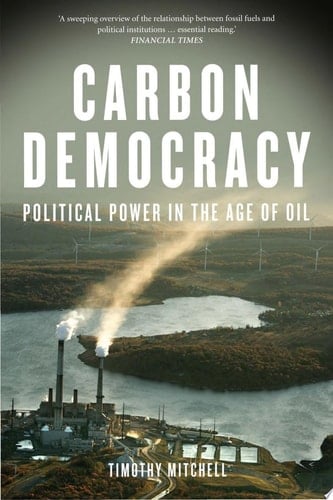
Carbon Democracy Political Power in the Age of Oil
Timothy Mitchell · 2013
<b>“A brilliant, revisionist argument that places oil companies at the heart of 20th-century history—and of the political and environmental crises we now face.” —<i>Guardian<br><br></i>“A sweeping overview of the relationship between fossil fuels and political institutions from the industrial revolution to the Arab Spring.” <i><b>—<i>Financial Times</i></b><br></i></b><br>Oil is a curse, it is often said, that condemns the countries producing it to an existence defined by war, corruption and enormous inequality. <i>Carbon Democracy</i> tells a more complex story, arguing that no nation escapes the political consequences of our collective dependence on oil. It shapes the body politic both in regions such as the Middle East, which rely upon revenues from oil production, and in the places that have the greatest demand for energy.<br><br>Timothy Mitchell begins with the history of coal power to tell a radical new story about the rise of democracy. Coal was a source of energy so open to disruption that oligarchies in the West became vulnerable for the first time to mass demands for democracy. In the mid-twentieth century, however, the development of cheap and abundant energy from oil, most notably from the Middle East, offered a means to reduce this vulnerability to democratic pressures. The abundance of oil made it possible for the first time in history to reorganize political life around the management of something now called “the economy” and the promise of its infinite growth. The politics of the West became dependent on an undemocratic Middle East.<br><br>In the twenty-first century, the oil-based forms of modern democratic politics have become unsustainable. Foreign intervention and military rule are faltering in the Middle East, while governments everywhere appear incapable of addressing the crises that threaten to end the age of carbon democracy—the disappearance of cheap energy and the carbon-fuelled collapse of the ecological order.<br><br>In making the production of energy the central force shaping the democratic age, <i>Carbon Democracy</i> rethinks the history of energy, the politics of nature, the theory of democracy, and the place of the Middle East in our common world.

Extraction - The Frontiers of Green Capitalism
Thea Riofrancos · 2026
<p>Lithium, a crucial input in the batteries powering electric vehicles, has the potential to save the world from climate change. But even green solutions come at a cost. Mining lithium is environmentally destructive. We therefore confront a dilemma: Is it possible to save the world by harming it in the process?</p> <p>Having spent over a decade researching mining and oil sectors in Latin America, Thea Riofrancos is a leading voice on resource extraction. In Extraction, she draws on groundbreaking fieldwork on the global race for lithium. Taking readers from the breathtaking salt flats of Chile's Atacama Desert, to Nevada's glorious Silver Peak Range, to the rolling hills of the Barroso Region of Portugal, she reveals the social and environmental costs of "critical minerals." In Washington, DC, and Brussels, she tracks the escalating geopolitics of green technology supply chains. And she takes stock of new policy paradigms in the Global South, where governments seek to leverage mineral assets to jumpstart green development. In the process, Riofrancos uncovers surprising links across history, from colonial conquest to the 1970s energy crisis, to our still uncertain green future.</p> <p>While unregulated mining could inflict irreversible harm, Riofrancos offers optimistic proposals to transform the governance of mining while also reducing the sheer volume of global extraction. A rigorous and hopeful call to action, Extraction shares how we can harmonize climate goals with social justice--and set the planet on a course to ecological flourishing.</p>
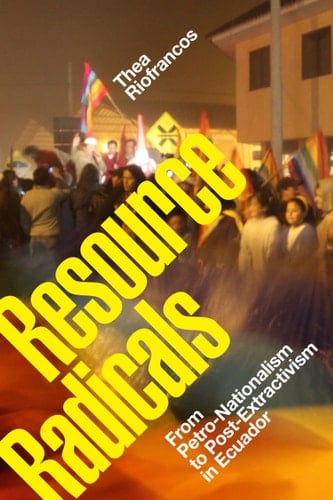
Resource Radicals From Petro-Nationalism to Post-Extractivism in Ecuador
Thea Riofrancos · 2020
In 2007, the left came to power in Ecuador. In the years that followed, the “twenty-first-century socialist” government and a coalition of grassroots activists came to blows over the extraction of natural resources. Each side declared the other a perversion of leftism and the principles of socioeconomic equality, popular empowerment, and anti-imperialism. In <i>Resource Radicals</i>, Thea Riofrancos unpacks the conflict between these two leftisms: on the one hand, the administration's resource nationalism and focus on economic development; and on the other, the anti-extractivism of grassroots activists who condemned the government's disregard for nature and indigenous communities. In this archival and ethnographic study, Riofrancos expands the study of resource politics by decentering state resource policy and locating it in a field of political struggle populated by actors with conflicting visions of resource extraction. She demonstrates how Ecuador's commodity-dependent economy and history of indigenous uprisings offer a unique opportunity to understand development, democracy, and the ecological foundations of global capitalism.
Decolonial Ecology & Resistance

A Political Ecology of Common People
Jacques Bidet · 2025
This book advances a counter-intuitive thesis: modern attacks on the global ecological balance are exclusively the result of processes of social domination, whether they are based on class, gender or nation. If this is the case, then it follows that ecological struggle and social struggle are one and the same thing. The approach is inspired by Marx's theory, as revisited through Bourdieu and Foucault, Rawls and Habermas, and Ostrom and Wallerstein. Based on a new concept, that of metastructure which defines the relationship between the structural and the symbolic, it confronts contemporary debates on class, gender andcoloniality, as well as on the state, the nation and the World-System. Global social-ecological destruction is thus analysed on three registers: that of capital, which produces for profit; that of (supposed) competent authority, which produces to produce; and that of the nation, which produces to conquer. Consumerism follows from productivism, not the other way around. The question of need takes precedence over that of desire. This metastructural configuration poses the imperative constantly renewed to counter the blind logic of capital with a rational logic of organisation, and, at the same time, to counter the logic of the organisers through a democratic discursive logic. This latter is the recourse of common people. The Global South is on the front line of this struggle; and women's struggle bears its own decisive ecological impulse.
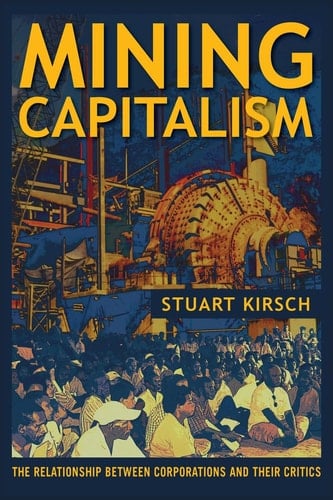
Mining Capitalism The Relationship Between Corporations and Their Critics
Stuart Kirsch · 2014
Corporations are among the most powerful institutions of our time, but they are also responsible for a wide range of harmful social and environmental impacts. Consequently, political movements and nongovernmental organizations increasingly contest the risks that corporations pose to people and nature. <i>Mining Capitalism</i> examines the strategies through which corporations manage their relationships with these critics and adversaries. By focusing on the conflict over the Ok Tedi copper and gold mine in Papua New Guinea, Stuart Kirsch tells the story of a slow-moving environmental disaster and the international network of indigenous peoples, advocacy groups, and lawyers that sought to protect local rivers and rain forests. Along the way, he analyzes how corporations promote their interests by manipulating science and invoking the discourses of sustainability and social responsibility. Based on two decades of anthropological research, this book is comparative in scope, showing readers how similar dynamics operate in other industries around the world.
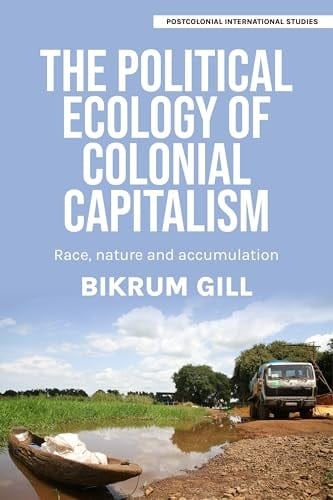
The Political Ecology of Colonial Capitalism Race, Nature, and Accumulation
Bikrum Gill · 2024
<p>This book articulates an analytical framework for understanding how race, nature, and capitalism are co-constituted on a planetary scale. The framework of the 'political ecology of colonial capitalism' elucidates how the co-production of race and the society/nature distinction operates as a foundational structure of capitalism. In order to express the relationship between global inequality and planetary ecological crises, the book applies this framework to a theoretical and historical analysis of the 'global land grab', which refers to the intensification, beginning in the 2010s and continuing into the 2020s, of large scale transnational agricultural land acquisitions in the global South. It orients analytical attention towards how capitalist development has proceeded, over its long history, through a succession of accumulation cycles that rise and fall in correspondence with the racialized construction, and ultimate exhaustion, of frontiers of "unused" natures. <br>At one level, the book foregrounds how colonialism materially opens, through violent dispossession of colonized peoples, frontiers provisioning the necessary cheap inputs for capitalist development. It then proceeds, on a second level, to reveal how the accompanying conceptualization of the frontier as an 'unused' nature distinct from human society is contingent upon a technology of race which re-presents Indigenous sovereign earth-worlds as unused and wasted virgin natures. The book thus demonstrates how the global land grab is driven by a systemic colonial-capitalist logic of racialized frontier re-generation attempting to overcome the crisis context marking the exhaustion of the neoliberal epoch of capitalism.</p>

The Extractive Zone Social Ecologies and Decolonial Perspectives
Macarena Gómez-Barris · 2017
In <i>The Extractive Zone</i> Macarena Gómez-Barris traces the political, aesthetic, and performative practices that emerge in opposition to the ruinous effects of extractive capital. The work of Indigenous activists, intellectuals, and artists in spaces Gómez-Barris labels extractive zones—majority indigenous regions in South America noted for their biodiversity and long history of exploitative natural resource extraction—resist and refuse the terms of racial capital and the continued legacies of colonialism. Extending decolonial theory with race, sexuality, and critical Indigenous studies, Gómez-Barris develops new vocabularies for alternative forms of social and political life. She shows how from Colombia to southern Chile artists like filmmaker Huichaqueo Perez and visual artist Carolina Caycedo formulate decolonial aesthetics. She also examines the decolonizing politics of a Bolivian anarcho-feminist collective and a coalition in eastern Ecuador that protects the region from oil drilling. In so doing, Gómez-Barris reveals the continued presence of colonial logics and locates emergent modes of living beyond the boundaries of destructive extractive capital.
Natural Resource Extraction and Indigenous Livelihoods: Development Challenges in an Era of Globalization
Gilberthorpe, Emma, Dr · 2014
<p>This book provides an extended analysis of how resource extraction projects stimulate social, cultural and economic change in indigenous communities. Through a range of case studies, including open cast mining, artisanal mining, logging, deforestation, oil extraction and industrial fishing, the contributors explore the challenges highlighted in global debates on sustainability, Corporate Social Responsibility (CSR), and climate change. The case studies are used to assess whether and how development processes might compete and conflict with the market objectives of multinational corporations and the organizational and moral principles of indigenous communities. Emphasizing the perspectives of directly-affected parties, the authors identify common patterns in the way in which extraction projects are conceptualized, implemented and perceived. The book provides a deeper understanding of the dynamics of the human environments where resource extraction takes place and its consequent impacts on local livelihoods. Its in-depth case studies underscore the need for increased social accountability in the planning and development of natural resource extraction projects.</p>

Earth Beings Ecologies of Practice across Andean Worlds
Marisol de la Cadena · 2015
<i>Earth Beings</i> is the fruit of Marisol de la Cadena's decade-long conversations with Mariano and Nazario Turpo, father and son, <i>runakuna</i> or Quechua people. Concerned with the mutual entanglements of indigenous and nonindigenous worlds, and the partial connections between them, de la Cadena presents how the Turpos' indigenous ways of knowing and being include and exceed modern and nonmodern practices. Her discussion of indigenous political strategies—a realm that need not abide by binary logics—reconfigures how to think about and question modern politics, while pushing her readers to think beyond "hybridity" and toward translation, communication that accepts incommensurability, and mutual difference as conditions for ethnography to work.
The Environmentalism of the Poor A Study of Ecological Conflicts and Valuation
Juan Martínez Alier · 2002
<i>The Environmentalism of the Poor</i>has the explicit intention of helping to establish two emerging fields of study - political ecology and ecological economics - whilst also investigating the relations between them. <p>The book analyses several manifestations of the growing 'environmental justice movement', and also of 'popular environmentalism' and the 'environmentalism of the poor', which will be seen in the coming decades as driving forces in the process to achieve an ecologically sustainable society. The author studies, in detail, many ecological distribution conflicts in history and at present, in urban and rural settings, showing how poor people often favour resource conservation. The environment is thus not so much a luxury of the rich as a necessity of the poor. It concludes with the fundamental questions: who has the right to impose a language of valuation and who has the power to simplify complexity?</p> <p>Joan Martinez-Alier combines the study of ecological conflicts and the study of environmental valuation in a totally original approach that will appeal to a wide cross-section of academics, ecologists and environmentalists.</p>

Sacred Ecology
Fikret Berkes · 2026
<p><i>Sacred Ecology </i>examines knowledge held by Indigenous peoples and local communities around the world and asks how we can learn from this body of knowledge and practice. Berkes explores the importance of Indigenous ways of knowing as a complement to ecology and environmental science, and its cultural and political significance for traditional peoples themselves. With updates of relevant web links and over 300 new references, the Fifth Edition provides increased voice for Indigenous authors and contains much new material, including a new chapter.</p>
ExtrACTION Impacts, Engagements, and Alternative Futures
Kirk Jalbert · 2017
Introduction: Confronting Extraction, Taking Action 1. The Great Crew Change? Structuring Work in the Oilfield 2. Mega-mining Sovereignty: Landscapes of Power and Protest in Uruguay's New Extractivist Frontier 3. Marcellus Shale as Golden Goose: The Discourse of Development and the Marginalization of Resistance in Northcentral Pennsylvania 4. Bounded Impacts, Boundless Promise: Environmental Impact Assessments of Oil Production in the Ecuadorian Amazon 5. The Power and Politics of Health Impact Assessment in the Pacific Northwest Coal Export Debate 6. Contingent Legal Futures: Does the Ability to Exercise Aboriginal Rights and Title Turn on the Price of Gold? 7. Corexit to Forget It: Transforming Coastal Louisiana into an Energy Sacrifice Zone 8. With or Without Railway? Post-catastrophe Perceptions of Risk and Development in Lac-Mégantic, Quebec 9. Bringing Country Back? Indigenous Aspirations and Ecological Values in Australian Mine-Site Rehabilitation 10. Harmonizing Grassroots Organizing and Legal Advocacy to Address Coal Mining and Shale Gas Drilling Issues in Southwestern Pennsylvania 11. Images of Harm, Imagining Justice: Gold Mining Contestation in Kyrgyzstan 12. El Salvador's Challenge to the Latin American Extractive Imperative 13. Unconventional Action and Community Control: Rerouting Dependencies Despite the Hydrocarbon Economy 14 .Toward Transition? Challenging Extractivism and the Politics of the Inevitable on the Navajo Nation Afterword: An Open letter to extrACTIVISTs.

Slow Violence and the Environmentalism of the Poor
Rob Nixon · 2011

Practising Feminist Political Ecologies Moving Beyond the 'Green Economy'
Wendy Harcourt · 2015
<p>Destined to transform its field, this volume features some of the most exciting feminist scholars and activists working within feminist political ecology, including Giovanna Di Chiro, Dianne Rocheleau, Catherine Walsh and Christa Wichterich. Offering a collective critique of the 'green economy', it features the latest analyses of the post-Rio+20 debates alongside a nuanced reading of the impact of the current ecological and economic crises on women as well as their communities and ecologies.<br><br>This new, politically timely and engaging text puts feminist political ecology back on the map.</p>
Sacred Forests of Asia Spiritual Ecology and the Politics of Nature Conservation
Chris Coggins · 2022
<p>Presenting a thorough examination of the sacred forests of Asia, this volume engages with dynamic new scholarly dialogues on the nature of sacred space, place, landscape, and ecology in the context of the sharply contested ideas of the Anthropocene.</p> <p>Given the vast geographic range of sacred groves in Asia, this volume discusses the diversity of associated cosmologies, ecologies, traditional local resource management practices, and environmental governance systems developed during the pre-colonial, colonial, and post-colonial periods. Adopting theoretical perspectives from political ecology, the book views ecology and polity as constitutive elements interacting within local, regional, and global networks. Readers will find the very first systematic comparative analysis of sacred forests that include the karchall mabhuy of the Katu people of Central Vietnam, the leuweng kolot of the Baduy people of West Java, the fengshui forests of southern China, the groves to the goddess Sarna Mata worshiped by the Oraon people of Jharkhand India, the mauelsoop and bibosoop of Korea, and many more. Comprising in-depth, field-based case studies, each chapter shows how the forest's sacrality must not be conceptually delinked from its roles in common property regimes, resource security, spiritual matters of ultimate concern, and cultural identity.</p> <p>This volume will be of great interest to students and scholars of indigenous studies, environmental anthropology, political ecology, geography, religion and heritage, nature conservation, environmental protection, and Asian studies.</p>
Social Ecology, State Power, & Geopolitics
Imperialism Without Colonies
Harry Magdoff · 2007
In The Decades After 1945, As Colonial Possessions Became Independent States, It Was Widely-Believed That Imperialism As A Historical Phenomenon Was Coming To An End. The Six Essays Collected In This Volume Demonstrate That A New Form Of Imperialism Was, In Fact, Taking Shape--An Imperialism Defined Not By Colonial Rulebut By The Golbal Capitalist Market. From The Outset, Teh Dominant Power In This Imperialism Without Colonies Was The United States.
Corruption, Natural Resources and Development From Resource Curse to Political Ecology
Philippe Le Billon · 2017
<i>Corruption, Natural Resources and Development</i> provides a fresh and extensive discussion of corruption issues in natural resources sectors. Reflecting on recent debates in corruption research and revisiting resource curse challenges in light of political ecology approaches, this volume provides a series of nuanced and policy-relevant case studies analyzing patterns of corruption around natural resources and options to reach anti-corruption goals. <p>Using corruption case studies across a wide spectrum of natural resource sectors from around the world, the expert contributions explore political ecology as a means of analysing resource curse challenges. The potential for new variations of the resource curse in the forest and urban land sectors and the effectiveness of anti-corruption policies in resource sectors are considered in depth. Corruption in oil, gas, mining, fisheries, biofuel, wildlife, forestry and urban land are all covered, and potential solutions discussed.</p> <p>This forward-thinking book is essential reading for students and academics in the fields of development studies, political ecology, corruption, development economics and international political economy. The evidence and policy solutions included will be of great appeal to policymakers and practitioners.</p> <p><b>Contributors include:</b> I. Amundsen, F. Boamah, C.J. Cavanagh, K.E. Dupuy, L. Epremian, B. Eriksen, O.-H. Fjeldstad, J. Jacquet, J. Johnsøn, P. Le Billon, P. Lujala, G. Mayo-Anda, J.P. Mrema, O. Remy, R. Sumaila, T. Søreide, A. Witter, T. Wyatt, D. Zinnbauer</p>

Politics of the Anthropocene and Climate Crisis in India Seeking Socio-Ecological Transformations
Purendra Prasad · 2025
<p>This book focuses on the complex and contested nature of transformation in India, from a social and political ecology perspective.</p> <p>Given that the age of Anthropocene is increasingly threatening to undermine the present world order, the countries in the Global South are at the forefront of debates on transformations. By examining issues pertaining to land, labour, and urbanisation from an interdisciplinary perspective, the chapters in this book break down the notion of the Anthropocene into useful analytical categories that represent both the disruptive and constructive natures of the transformation debate. Drawing on empirical research, each author focuses on a particular state or region in the East Coast, East, and Northeast of India to show how states and communities seek transformation sometimes in competition and/or contestation with each other. The authors in this volume illustrate that although all stakeholders seek transformation, their ideas and discourses nevertheless reflect their situated ethics and unique knowledges of their local, regional, and national contexts.</p> <p>Politics of the Anthropocene and Climate Crisis in India will be of interest to students of environmental politics, environmental sociology, political ecology, and South Asian studies more broadly.</p>
Climate Leviathan
Joel Wainwright · 2018
How climate change will affect our political theory—for better and worse Despite the science and the summits, leading capitalist states have not achieved anything close to an adequate level of carbon mitigation. There is now simply no way to prevent the planet breaching the threshold of two degrees Celsius set by the Intergovernmental Panel on Climate Change. What are the likely political and economic outcomes of this? Where is the overheating world heading? To further the struggle for climate justice, we need to have some idea how the existing global order is likely to adjust to a rapidly changing environment. Climate Leviathan provides a radical way of thinking about the intensifying challenges to the global order. Drawing on a wide range of political thought, Joel Wainwright and Geoff Mann argue that rapid climate change will transform the world’s political economy and the fundamental political arrangements most people take for granted. The result will be a capitalist planetary sovereignty, a terrifying eventuality that makes the construction of viable, radical alternatives truly imperative.
The Limits to Capital
David Harvey · 2018
A major rereading of Marx’s critique of political economy Now a classic of Marxian economics, The Limits to Capital provides one of the best theoretical guides to the history and geography of capitalist development. In this edition, Harvey updates his seminal text with a substantial discussion of the turmoil in world markets today. Delving into concepts such as “fictitious capital” and “uneven geographical development,” Harvey takes the reader step by step through layers of crisis formation, beginning with Marx’s controversial argument concerning the falling rate of profit and closing with a timely foray into the geopolitical and geographical implications of Marx’s work.
Ecology Against Capitalism
John Bellamy Foster · 2002
In recent years John Bellamy Foster has emerged as a leading theorist of the Marxist perspective on ecology. His seminal book Marx's Ecology (Monthly Review Press, 2000) discusses the place of ecological issues within the intellectual history of Marxism and on the philosophical foundations of a Marxist ecology, and has become a major point of reference in ecological debates. This historical and philosophical focus is now supplemented by more directly political engagement in his new book, Ecology against Capitalism. In a broad-ranging treatment of contemporary ecological politics, Foster deals with such issues as pollution, sustainable development, technological responses to environmental crisis, population growth, soil fertility, the preservation of ancient forests, and the "new economy" of the Internet age. Foster's introduction sets out the unifying themes of these essays enabling the reader to draw from them a consolidated approach to a rapidly-expanding field of debate which is of critical importance in our times. Within these debates on the politics of ecology, Foster's work develops an important and distinctive perspective. Where many of these debates assume a basic divergence of "red" and "green" issues, and are concerned with the exact terms of a trade-off between them, Foster argues that Marxismproperly understoodalready provides the framework within which ecological questions are best approached. This perspective is advanced here in accessible and concrete form, taking account of the major positions in contemporary ecological debate.
Or Something Worse Why We Need to Disrupt the Climate Transition
Nicholas Beuret · 2025
<i>Or Something Worse</i> exposes the bleak realities of the transition to a carbon-neutral economy. Greening the economy has become a one-sided war, as governments and businesses squeeze the living standards of ordinary people. We need to seize control of the transition in order to reshape it to equitable ends.<br><br>Existing policies won't limit global heating to anything close to a safe level. Claims of sustainability disguise a zero-sum battle where the powerful profit and everyone else foots the bill. Green growth was supposed to bring increased wealth for all. Instead, work has been degraded, energy bills have soared, and the most basic necessities have become expensive and scarce.<br><br>We need to disrupt green capitalism. Nicholas Beuret follows those already fighting back through 'don't pay' campaigns, blockades of fossil-fuel infrastructure, and community counter-planning. He shows we have the tools not only to stop climate change but to build a fairer future.
Eco-Socialism: From Deep Ecology to Social Justice
David Pepper · 2002

How to Blow Up a Pipeline
Andreas Malm · 2021
<b>Property will cost us the earth</b><br><br>The science on climate change has been clear for a very long time now. Yet despite decades of appeals, mass street protests, petition campaigns, and peaceful demonstrations, we are still facing a booming fossil fuel industry, rising seas, rising emission levels, and a rising temperature. With the stakes so high, why haven't we moved beyond peaceful protest?<br><br>In this lyrical manifesto, noted climate scholar (and saboteur of SUV tires and coal mines) Andreas Malm makes an impassioned call for the climate movement to escalate its tactics in the face of ecological collapse. We need, he argues, to force fossil fuel extraction to stop--with our actions, with our bodies, and by defusing and destroying its tools. We need, in short, to start blowing up some oil pipelines.<br><br>Offering a counter-history of how mass popular change has occurred, from the democratic revolutions overthrowing dictators to the movement against apartheid and for women's suffrage, Malm argues that the strategic acceptance of property destruction and violence has been the only route for revolutionary change. In a braided narrative that moves from the forests of Germany and the streets of London to the deserts of Iraq, Malm offers us an incisive discussion of the politics and ethics of pacifism and violence, democracy and social change, strategy and tactics, and a movement compelled by both the heart and the mind. Here is how we fight in a world on fire.

Globalization and Capitalist Geopolitics Sovereignty and State Power in a Multipolar World
Daniel Woodley · 2017
<p>Globalization and Capitalist Geopolitics is concerned with the nature of corporate power against the backdrop of the decline of the West and the struggle by non-western states to challenge and overcome domination of the rest of the world by the West. This book argues that although the US continues to preside over a quasi-imperial system of power based on global military preponderance and financial statecraft, and remains reluctant to recognize the realities global economic convergence, the age of imperial state hegemony is giving way to a new international order characterized by capitalist sovereignty and competition between regional and transnational concentrations of economic power.</p> <p>This title seeks to interrogate the structure of world order by examining leading approaches to globalization and political economy in international relations and international political economy. Breaking with the classical school, Woodley argues that geopolitics should be understood as a transnational strategic practice employed by powerful state actors, which mirrors predatory corporate rivalry for control over global resources and markets, reproducing the structural conditions for corporate power through the transnational state form of capital.</p> <p>In a period of increasing geopolitical insecurity and economic instability this title provides an authoritative yet accessible commentary on debates on capitalism and globalization in the wake of the financial crisis. It is valuable resource for students and scholars seeking to develop a deeper understanding of the historical determinants of the changing dynamics of neoliberal capitalism and their implications for world order.</p>

How the West Came to Rule The Geopolitical Origins of Capitalism
Alexander Anievas · 2015
<p>***Winner, International Studies Association International Political Sociology Best Book Prize 2017***<br> <br> ***Winner, British International Studies Association International Political Economy Working Group Book Prize 2016***</p> <p>Mainstream historical accounts of the development of capitalism describe a profess which is fundamentally European--a system that was born in the mills and factories of English and under the guillotines of the French Revolution. This groundbreaking book tells a very difference story.</p> <p>How the West Came to Rule offers a unique interdisciplinary and international historical account of the origins of capitalism. It argues that, contrary to dominant wisdom, capitalism's origins should not be understood as a development confined to the geographically and culturally sealed borders of Europe, but the outcome of a wider array of global processes in which non-European societies played a decisive role.</p> <p>Here is a provocative, incisive explanation of how capitalism emerged in England and Europe through a dialectical intersocietal and geopolitical process. The authors' aim to undermine a Eurocentric bias that has been prominent in the debate about capitalisms rise to supremacy, and their case is remarkably convincing. They provide a fundamental rethinking. Anievas and Nisancioglu contend that often cited assumptions are neither theoretically nor empirically tenable and deny the agency of non-Western societies to the emergence of capitalism. Topics covered include:</p> <p>*The Problem of Eurocentrism<br> <br> *The Problem of Historical Specificity<br> <br> *The Brenner Thesis: Explanation and Critique<br> <br> *The Geopolitical in the Making of Capitalism<br> <br> *The Political Marxist Conception of Capitalism<br> <br> *Rethinking the Origins of Capitalism<br> <br> *And much more!</p> <p>Through an outline of the uneven histories of Mongolian expansion, New World discoveries, Ottoman-Habsburg rivalry, the development of the colonies, and bourgeois revolutions, Alex Anievas and Kerem Nisancioglu offer an account of capitalism's origins that convincingly argues against the prevailing Eurocentric narratives. It will change minds and open the eyes of historians, economists, and political thinkers.</p>

Spaces of Global Capitalism A Theory of Uneven Geographical Development
David Harvey · 2019
Fiscal crises have cascaded across much of the developing world with devastating results, from Mexico to Indonesia, Russia and Argentina. The extreme volatility in contemporary political economic fortunes seems to mock our best efforts to understand the forces that drive development in the world economy.<br><br>David Harvey is the single most important geographer writing today and a leading social theorist of our age, offering a comprehensive critique of contemporary capitalism. In this fascinating book, he shows the way forward for just such an understanding, enlarging upon the key themes in his recent work: the development of neoliberalism, the spread of inequalities across the globe, and ‘space’ as a key theoretical concept.<br><br>Both a major declaration of a new research programme and a concise introduction to David Harvey’s central concerns, this book will be essential reading for scholars and students across the humanities and social sciences.
Undoing Human Supremacy Anarchist Political Ecology in the Face of Anthroparchy
Simon Springer · 2023
<p>The Earth is in crisis. We know this. We have known this for a long time. In the throes of the unfolding nightmare we call “capitalism” it is not hard to see and hear the violence that is being enacted against the planet. If we are to move beyond the idea that humanity is tasked with expressing our dominion over nature and towards a renewed integral understanding of humanity as firmly located within the biosphere, as an anarchist political ecology demands, then we have to start interrogating the privileges, hierarchies, and human-centric frames that guide our ways of knowing and being in the world. <br>This volume centers around the idea that anarchism, as a conceptual framework, encourages us to contend with the multiple lines of difference, the various iterations of privilege, and the manifold set of archies that undergird our understandings of the world, and crucially, our place within it.</p>
The Ecology of Freedom The Emergence and Dissolution of Hierarchy
Murray Bookchin · 2005
Uncategorized

Mobility Justice The Politics of Movement in an Age of Extremes
Mimi Sheller · 2018
<b>Mobility justice is one of the crucial political and ethical issues of our day</b><p>We are in the midst of a global climate crisis and experiencing the extreme challenges of urbanization. In <i>Mobility Justice</i>, Mimi Sheller makes a passionate argument for a new understanding of the contemporary crisis of movement.</p><p>Sheller shows how power and inequality inform the governance and control of movement. She connects the body, street, city, nation, and planet in one overarching theory of the modern, perpetually shifting world. Concepts of mobility are examined on a local level in the circulation of people, resources, and information, as well as on an urban scale, with questions of public transport and “the right to the city.” On the planetary level, she demands that we rethink the reality where tourists and other elites are able to roam freely, while migrants and those most in need are abandoned and imprisoned at the borders.</p><p><i>Mobility Justice</i> is a new way to understand the deep flows of inequality and uneven accessibility in a world in which the mobility commons have been enclosed. It is a call for a new understanding of the politics of movement and a demand for justice for all.</p>

For Space
Doreen Massey · 2005
Doreen Massey is one of the most profound thinkers in contemporary human geography, and her work addresses fundamental issues with great insight. This is a work of enormous ambition, breadth, and depth, and not a little complexity. - David M. Smith, Queen Mary, University of London "The reason for my enthusiasm for this book is that Doreen Massey manages to describe a certain way of perceiving movement in space which I have been - and still am - working with on different levels in my work: i.e. the idea that space is not something static and neutral, a frozen entity, but is something intertwined with time and thus ever changing . Doreen′s descriptions of her journey through England for example are clear and precise accounts of this idea, and she very sharply characterizes the attempts not to recognize this idea as utopian and nostalgic." - Olaffur Eliasson "Destined to be widely read by many who are not geographers... in a publishing market currently so driven by what publishers think students will read, its lack of fit into established genres is hugely refreshing... a great book to read in terms of its head-on engagement with the spatial." - Geographical Research In this book, Doreen Massey makes an impassioned argument for revitalising our imagination of space. She takes on some well-established assumptions from philosophy, and some familiar ways of characterising the 21st century world, and shows how they restrain our understanding of both the challenge and the potential of space. The way we think about space matters. It inflects our understandings of the world, our attitudes to others, our politics. It affects, for instance, the way we understand globalisation, the way we approach cities, the way we develop, and practice, a sense of place. If time is the dimension of change then space is the dimension of the social: the contemporaneous co-existence of others. That is its challenge, and one that has been persistently evaded. For Space pursues its argument through philosophical and theoretical engagement, and through telling personal and political reflection. Doreen Massey asks questions such as how best to characterise these so-called spatial times, how it is that implicit spatial assumptions inflect our politics, and how we might develop a responsibility for place beyond place. This book is ′for space′ in that it argues for a reinvigoration of the spatiality of our implicit cosmologies. For Space is essential reading for anyone interested in space and the spatial turn in the social sciences and humanities. Serious, and sometimes irreverent, it is a compelling manifesto: for re-imagining spaces for these times and facing up to their challenge.

Or Something Worse Why We Need to Disrupt the Climate Transition
Nicholas Beuret · 2025
<i>Or Something Worse</i> exposes the bleak realities of the transition to a carbon-neutral economy. Greening the economy has become a one-sided war, as governments and businesses squeeze the living standards of ordinary people. We need to seize control of the transition in order to reshape it to equitable ends.<br><br>Existing policies won't limit global heating to anything close to a safe level. Claims of sustainability disguise a zero-sum battle where the powerful profit and everyone else foots the bill. Green growth was supposed to bring increased wealth for all. Instead, work has been degraded, energy bills have soared, and the most basic necessities have become expensive and scarce.<br><br>We need to disrupt green capitalism. Nicholas Beuret follows those already fighting back through 'don't pay' campaigns, blockades of fossil-fuel infrastructure, and community counter-planning. He shows we have the tools not only to stop climate change but to build a fairer future.

The Long Heat - Climate Politics When It’s Too Late
Andreas Malm · 2025
The world is crossing the 1.5C global warming limit, perhaps exceeding 2C soon after. What is to be done when these boundaries, set by the Paris Agreement, have been passed? In the overshoot era, schemes proliferate for muscular adaptation or for new technologies to turn the heat down at a later date by removing CO2 from the air or blocking sunlight. Such technologies are by no means safe; they come with immense risks and provide an excuse for those who would prefer to avoid limiting emissions in the present. But do they also hold out some potential? Can the catastrophe be reversed, masked or simply adapted to once it is a fact? Or will any such roundabout measures simply make things worse?<br><br><i>The Long Heat </i>maps the new front lines in the struggle for a liveable planet and insists on the climate revolution long overdue. In the end, no technology can absolve us of responsibility for our planet and each other.

Valuing Development, Environment and Conservation Creating Values That Matter
Sarah Bracking, Aurora Fredriksen, Sullivan Sian, Philip Woodhouse · 2020

Planet Dialectics Explorations in Environment and Development
Wolfgang Sachs · 2015
<p>All effects of human action will inevitably be played out within our planet's limits; any hope of infinity is an illusion. And yet, as Wolfgang Sachs warned almost twenty years ago, environmental concerns have been assimilated into the rhetoric, dynamics and power structures of development.<br><br>This classic collection of trenchant and elegant explorations addresses the crisis of the Western world's relations with nature and social justice. Examining the notions of efficiency, speed, globalization and development, Sachs shows that sustainability, truly conceived, is incompatible with the worldwide rule of economism.<br><br><i>Planet Dialectics</i> reveals that the Western development model is fundamentally at odds with both the quest for justice among the world's people and the aspiration to reconcile humanity and nature.</p>
Global Development and Environment
Joe Williams · 2025
<p>Available open access digitally under CC-BY licence.</p><p> Development and environmental challenges are often framed at the global or planetary scale, but in a vague or apolitical manner. This book develops a theoretically rigorous and politicized concept of the planetary to intervene in contemporary debates on global development and to enhance our critical understanding of development as we approach the second quarter of the twenty-first century. </p><p> Chapters explore key themes and processes including urbanization, demographic change, health, financialization, and infrastructure development. Referencing diverse cases and examples drawn from across the world, the book argues that the futures of global development are inseparable from environmental challenges and transformations.</p>

Sustainable Development and the Environment in Southeast Asia
Pamela D. McElwee · 2025
The rapid economic development experienced by Southeast Asia has come at the cost of considerable environmental degradation, including deforestation and land degradation, biodiversity loss, water and ocean pollution, rising greenhouse gas emissions, and increasing vulnerability to climate change. While sustainable development as a concept recognizes the fundamental importance of nature to future human well-being, the Sustainable Development Goals (SDGs) as a set of policies falls far short of this ideal. The SDGs, particularly the environmental goals relating to life on land, life under water, and climate action, are essentially impossible to meet in Southeast Asia, as no country is on a sustainability trajectory, but these goals are superficial and modest at best anyway. Alternative approaches that recognize trade-offs and seek to integrate across solutions, that create spaces for inclusion, and which center equity and justice could help meet SDG goals, but face considerable challenges in implementation across Southeast Asia.