
social movements, resistance, & alternative futures
Items in this hypelist
Subaltern Theory, Ontological Refusal, & Hegemony
Provincializing Europe Postcolonial Thought and Historical Difference
Dipesh Chakrabarty · 2000
Can European thought be dislodged from the center of the practice of history in a non-European place? What problems arise when we translate cultural practices into the categories of social science? "Provincializing Europe" is one of the first book-length treatments on how postcolonial thinking impacts on the social sciences. This book explores, through a series of linked essays, the problems of thought that present themselves when we think of a place such as India through the categories of modern, European social science and, in particular, history.<p>"Provincializing Europe" is a sustained conversation between historical thinking and postcolonial perspectives. It addresses the mythical figure of Europe that is often taken to be the original site of the modern in many histories of capitalist transition in non-Western countries. This imaginary Europe, Chakrabarty argues, is built right into the social sciences. The very idea of historicizing carries with it some peculiarly European assumptions about disenchanted space, secular time, and human sovereignty. Measured against such mythical standards, capitalist transition in the third world has often seemed either incomplete or lacking. Chakrabarty finds that "Nativism," however, is no answer to Eurocentrism, because the universals propounded by European Enlightenment remain indispensable to any social critique that seeks to address issues of social justice and equity. "Provincializing Europe" proposes that every case of transition to capitalism is a case of translation as well--a translation of existing worlds and their thought-categories into the categories and self-understandings of capitalist modernity. Chakrabarty demonstrates, boththeoretically and with examples from colonial and contemporary India, how such translational histories may be thought and written. "Provincializing Europe" is not a project of shunning European thought. It is a project of globalizing such thought by exploring how it may be renewed both for and from the margins.
Wayward Lives, Beautiful Experiments Intimate Histories of Riotous Black Girls, Troublesome Women and Queer Radicals
Saidiya Hartman · 2021
"At the dawn of the twentieth century, the first generation of black women born after emancipation wanted real freedom. Refusing to labour like slaves, they leapt into the unknown, becoming pioneers of free love, common-law marriage, queer identities and single motherhood. They were an unrecognised avant-garde, and their pursuit of liberty forged the modern world. Wayward Lives, Beautiful Experiments pushes the boundaries of scholarship to reveal at last their defiant brilliance." -- back cover.

Mohawk Interruptus: Political Life Across the Borders of Settler States
Audra Simpson · 2022
Mohawk Interruptus is a bold challenge to dominant thinking in the fields of Native studies and anthropology. Combining political theory with ethnographic research among the Mohawks of Kahnawà:ke, a reserve community in what is now Southwestern Quebec, Audra Simpson examines their struggles to articulate and maintain political sovereignty through centuries of settler colonialism. The Kahnawà:ke Mohawks are part of the Haudenosaunee or Iroquois Confederacy. Like many Iroquois peoples, they insist on the integrity of Haudenosaunee governance and refuse American or Canadian citizenship. Audra Simpson thinks through this politics of refusal, which stands in stark contrast to the politics of cultural recognition. Tracing the implications of refusal, Simpson argues that one sovereign political order can exist nested within a sovereign state, albeit with enormous tension around issues of jurisdiction and legitimacy. Finally, Simpson critiques anthropologists and political scientists, whom, she argues, have too readily accepted the assumption that the colonial project is complete. Belying that notion, Mohawk Interruptus calls for and demonstrates more robust and evenhanded forms of inquiry into indigenous politics in the teeth of settler governance.

The Government of No One The Theory and Practice of Anarchism
Ruth Kinna · 2020
<b>'The standard book on anarchism for the twenty-first century. Written with brio, quiet insight and clarity' Carl Levy</b><br><br><b>A magisterial study of the history and theory of one of the most controversial political movements</b><br><br>Anarchism routinely gets a bad press. It's usually seen as meaning chaos and disorder -- or even nothing at all. And yet, from Occupy Wall Street to Pussy Riot, Noam Chomsky to David Graeber, this philosophical and political movement is as relevant as ever. Contrary to popular perception, different strands of anarchism -- from individualism to collectivism -- do follow certain structures and a shared sense of purpose: a belief in freedom and working towards collective good without the interference of the state. <br><br>In this masterful, sympathetic account, political theorist Ruth Kinna traces the tumultuous history of anarchism, starting with thinkers and activists such as Peter Kropotkin and Emma Goldman and through key events like the Paris Commune and the Haymarket affair. Skilfully introducing us to the nuanced theories of anarchist groups from Russia to Japan to the United States, <i>The Government of No One</i> reveals what makes a supposedly chaotic movement particularly adaptable and effective over centuries -- and what we can learn from it.

Designs for the Pluriverse Radical Interdependence, Autonomy, and the Making of Worlds
Arturo Escobar · 2018
In <i>Designs for the Pluriverse</i> Arturo Escobar presents a new vision of design theory and practice aimed at channeling design's world-making capacity toward ways of being and doing that are deeply attuned to justice and the Earth. Noting that most design—from consumer goods and digital technologies to built environments—currently serves capitalist ends, Escobar argues for the development of an “autonomous design” that eschews commercial and modernizing aims in favor of more collaborative and placed-based approaches. Such design attends to questions of environment, experience, and politics while focusing on the production of human experience based on the radical interdependence of all beings. Mapping autonomous design’s principles to the history of decolonial efforts of indigenous and Afro-descended people in Latin America, Escobar shows how refiguring current design practices could lead to the creation of more just and sustainable social orders.

Politics of Piety The Islamic Revival and the Feminist Subject
Saba Mahmood · 2004
<p><i>Politics of Piety</i> is a groundbreaking analysis of Islamist cultural politics through the ethnography of a thriving, grassroots women's piety movement in the mosques of Cairo, Egypt. Unlike those organized Islamist activities that seek to seize or transform the state, this is a moral reform movement whose orthodox practices are commonly viewed as inconsequential to Egypt's political landscape. Saba Mahmood's compelling exposition of these practices challenges this assumption by showing how the ethical and the political are indelibly linked within the context of such movements.</p><p>Not only is this book a sensitive ethnography of a critical but largely ignored dimension of the Islamic revival, it is also an unflinching critique of the secular-liberal principles by which some people hold such movements to account. The book addresses three central questions: How do movements of moral reform help us rethink the normative liberal account of politics? How does the adherence of women to the patriarchal norms at the core of such movements parochialize key assumptions within feminist theory about freedom, agency, authority, and the human subject? How does a consideration of debates about embodied religious rituals among Islamists and their secular critics help us understand the conceptual relationship between bodily form and political imaginaries? <i>Politics of Piety</i> is essential reading for anyone interested in issues at the nexus of ethics and politics, embodiment and gender, and liberalism and postcolonialism.</p>
A Critique of Postcolonial Reason Toward a History of the Vanishing Present
Gayatri Chakravorty Spivak · 1999
<p>Are the “culture wars” over? When did they begin? What is their relationship to gender struggle and the dynamics of class? In her first full treatment of postcolonial studies, a field that she helped define, Gayatri Chakravorty Spivak, one of the world’s foremost literary theorists, poses these questions from within the postcolonial enclave.<br><br>“We cannot merely continue to act out the part of Caliban,” Spivak writes; and her book is an attempt to understand and describe a more responsible role for the postcolonial critic. <i>A Critique of Postcolonial Reason</i> tracks the figure of the “native informant” through various cultural practices—philosophy, history, literature—to suggest that it emerges as the metropolitan hybrid. The book addresses feminists, philosophers, critics, and interventionist intellectuals, as they unite and divide. It ranges from Kant’s analytic of the sublime to child labor in Bangladesh. Throughout, the notion of a Third World interloper as the pure victim of a colonialist oppressor emerges as sharply suspect: the mud we sling at certain seemingly overbearing ancestors such as Marx and Kant may be the very ground we stand on.<br><br>A major critical work, Spivak’s book redefines and repositions the postcolonial critic, leading her through transnational cultural studies into considerations of globality.</p>
Elementary Aspects of Peasant Insurgency in Colonial India
Ranajit Guha · 1999
Foreword by James Scott <p>This classic work in subaltern studies explores the common elements present in rebel consciousness during the Indian colonial period. Ranajit Guha--intellectual founder of the groundbreaking and influential Subaltern Studies Group--describes from the peasants' viewpoint the relations of dominance and subordination in rural India from 1783 to 1900.<br> Challenging the idea that peasants were powerless agents who rebelled blindly against British imperialist oppression and local landlord exploitation, Guha emphasizes their awareness and will to effect political change. He suggests that the rebellions represented the birth of a theoretical consciousness and asserts that India's long subaltern tradition lent power to the landmark insurgence led by Mahatma Gandhi. Yet as long as landlord authority remains dominant in a ruling culture, Guha claims, all mass struggles will tend to model themselves after the unfinished projects documented in this book.<br> Students and scholars will welcome this paperback edition of Guha's 1983 original, which was distributed on a limited scale in the United States. It will influence new generations studying colonialism, postcolonialism, subaltern studies, historiography, anthropology, and Indian, Asian, and Latin American history.</p>

Epistemologies of the South Justice Against Epistemicide
Boaventura de Sousa Santos · 2014
In a world of appalling social inequalities people are becoming more aware of the multiple dimensions of injustice, whether social, political, cultural, sexual, ethnic, religious, historical, or ecological. Rarely acknowledged is another vital dimension: cognitive injustice, the failure to recognize the different ways of knowing by which people across the globe run their lives and provide meaning to their existence. This book shows why cognitive injustice underlies all the other dimensions; global social justice is not possible without global cognitive justice. Santos s argument unfolds in two inquiries. No matter how internally diverse, Western Modernity provided the knowledge underlying the long cycle of colonialism followed by global capitalism. These historical processes profoundly devalued and marginalized the knowledge and wisdom that had been in existence in the global South. Today, working against epistemicide is imperative in order to recover and valorize the epistemological diversity of the world. Such recovery and valorization is the book s second inquiry and is based on four key analytical tools: sociology of absences, sociology of emergences, ecology of knowledges, and intercultural translation. The transformation of the world s epistemological diversity into an empowering instrument against hegemonic globalization points to a new kind of bottom-up cosmopolitanism. It would promote a wide conversation of humankind, celebrating conviviality, solidarity, and life against the logic of market-ridden greed and individualism and the destruction of life to which world populations large and small are condemned by the dominant forces of globalization. --Provided by publisher.
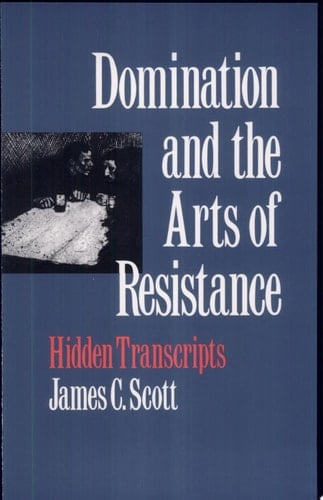
Domination and the Arts of Resistance Hidden Transcripts
James C. Scott · 1990
"Play fool, to catch wise."--proverb of Jamaican slaves Confrontations between the powerless and powerful are laden with deception--the powerless feign deference and the powerful subtly assert their mastery. Peasants, serfs, untouchables, slaves, laborers, and prisoners are not free to speak their minds in the presence of power. These subordinate groups instead create a secret discourse that represents a critique of power spoken behind the backs of the dominant. At the same time, the powerful also develop a private dialogue about practices and goals of their rule that cannot be openly avowed. In this book, renowned social scientist James C. Scott offers a penetrating discussion both of the public roles played by the powerful and powerless and the mocking, vengeful tone they display off stage--what he terms their public and hidden transcripts. Using examples from the literature, history, and politics of cultures around the world, Scott examines the many guises this interaction has taken throughout history and the tensions and contradictions it reflects. Scott describes the ideological resistance of subordinate groups--their gossip, folktales, songs, jokes, and theater--their use of anonymity and ambiguity. He also analyzes how ruling elites attempt to convey an impression of hegemony through such devices as parades, state ceremony, and rituals of subordination and apology. Finally, he identifies--with quotations that range from the recollections of American slaves to those of Russian citizens during the beginnings of Gorbachev's <i>glasnost </i>campaign--the political electricity generated among oppressed groups when, for the first time, the hidden transcript is spoken directly and publicly in the face of power. His landmark work will revise our understanding of subordination, resistance, hegemony, folk culture, and the ideas behind revolt.

Representation Cultural Representations and Signifying Practices
Stuart Hall · 2013
Since 1997 <b>Representation</b> has been the key go-to textbook for students learning the tools to question and critically analyze institutional and media texts and images. This long-awaited <b>Second Edition</b>:</p> <p></p> <p>• update and refreshes the approach to theories of representation by signalling key developments in the field</p> <p>• addresses the emergence of new technologies and formats of representation, from the internet and the digital revolution to reality TV</p> <p>• includes an entirely new chapter on celebrity culture and personalisation, to debates about representation and democracy, and involve illustrations of an intertextual nature, cutting across various technologies and formats in which 'the real' or the authentic makes an appearance</p> <p>• offers new exercises, new readings, new images and examples for a new generation of students</p> <p></p> <p>This book will once again prove an indispensible resource for students and teachers in cultural and media studies.
Spatial Tactics, Everyday Encroachment, & Resource Friction
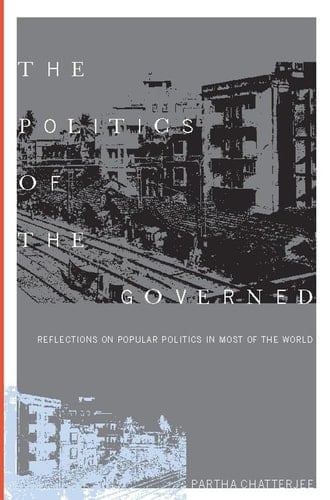
The Politics of the Governed Reflections on Popular Politics in Most of the World
Partha Chatterjee · 2004
<p>Often dismissed as the rumblings of "the street," popular politics is where political modernity is being formed today, according to Partha Chatterjee. The rise of mass politics all over the world in the twentieth century led to the development of new techniques of governing population groups. On the one hand, the idea of popular sovereignty has gained wide acceptance. On the other hand, the proliferation of security and welfare technologies has created modern governmental bodies that administer populations, but do not provide citizens with an arena for democratic deliberation. Under these conditions, democracy is no longer government of, by, and for the people. Rather, it has become a world of power whose startling dimensions and unwritten rules of engagement Chatterjee provocatively lays bare.</p><p>This book argues that the rise of ethnic or identity politics -- particularly in the postcolonial world -- is a consequence of new techniques of governmental administration. Using contemporary examples from India, the book examines the different forms taken by the politics of the governed. Many of these operate outside of the traditionally defined arena of civil society and the formal legal institutions of the state. This book considers the global conditions within which such local forms of popular politics have appeared and shows us how both community and global society have been transformed. Chatterjee's analysis explores the strategic as well as the ethical dimensions of the new democratic politics of rights, claims, and entitlements of population groups and permits a new understanding of the dynamics of world politics both before and after the events of September 11, 2001.</p><p> <i>The Politics of the Governed</i> consists of three essays, originally given as the Leonard Hastings Schoff Lectures at Columbia University in November 2001, and four additional essays that complement and extend the analyses presented there. By combining these essays between the covers of a single volume, Chatterjee has given us a major and urgent work that provides a full perspective on the possibilities and limits of democracy in the postcolonial world.</p>

Neoliberalism from Below Popular Pragmatics and Baroque Economies
Verónica Gago · 2017
In <i>Neoliberalism from Below</i>—first published in Argentina in 2014—Verónica Gago examines how Latin American neoliberalism is propelled not just from above by international finance, corporations, and government, but also by the activities of migrant workers, vendors, sweatshop workers, and other marginalized groups. Using the massive illegal market La Salada in Buenos Aires as a point of departure, Gago shows how alternative economic practices, such as the sale of counterfeit goods produced in illegal textile factories, resist neoliberalism while simultaneously succumbing to its models of exploitative labor and production. Gago demonstrates how La Salada's economic dynamics mirror those found throughout urban Latin America. In so doing, she provides a new theory of neoliberalism and a nuanced view of the tense mix of calculation and freedom, obedience and resistance, individualism and community, and legality and illegality that fuels the increasingly powerful popular economies of the global South's large cities.

Earth Beings Ecologies of Practice across Andean Worlds
Marisol de la Cadena · 2015
<i>Earth Beings</i> is the fruit of Marisol de la Cadena's decade-long conversations with Mariano and Nazario Turpo, father and son, <i>runakuna</i> or Quechua people. Concerned with the mutual entanglements of indigenous and nonindigenous worlds, and the partial connections between them, de la Cadena presents how the Turpos' indigenous ways of knowing and being include and exceed modern and nonmodern practices. Her discussion of indigenous political strategies—a realm that need not abide by binary logics—reconfigures how to think about and question modern politics, while pushing her readers to think beyond "hybridity" and toward translation, communication that accepts incommensurability, and mutual difference as conditions for ethnography to work.

The Democracy Project A History, a Crisis, a Movement
David Graeber · 2014
A bold rethinking of the most powerful political idea in the world--democracy--and the story of how radical democracy can yet transform America. Democracy has been the American religion since before the Revolution--from New England town halls to the multicultural democracy of Atlantic pirate ships. But can our current political system, one that seems responsive only to the wealthiest among us and leaves most Americans feeling disengaged, voiceless, and disenfranchised, really be called democratic? And if the tools of our democracy are not working to solve the rising crises we face, how can we--average citizens--make change happen? David Graeber, one of the most influential scholars and activists of his generation, takes readers on a journey through the idea of democracy, provocatively reorienting our understanding of pivotal historical moments, and extracts their lessons for today.--
Necropolitics
Achille Mbembe · 2019
In <i>Necropolitics</i> Achille Mbembe, a leader in the new wave of francophone critical theory, theorizes the genealogy of the contemporary world, a world plagued by ever-increasing inequality, militarization, enmity, and terror as well as by a resurgence of racist, fascist, and nationalist forces determined to exclude and kill. He outlines how democracy has begun to embrace its dark side---what he calls its “nocturnal body”---which is based on the desires, fears, affects, relations, and violence that drove colonialism. This shift has hollowed out democracy, thereby eroding the very values, rights, and freedoms liberal democracy routinely celebrates. As a result, war has become the sacrament of our times in a conception of sovereignty that operates by annihilating all those considered enemies of the state. Despite his dire diagnosis, Mbembe draws on post-Foucauldian debates on biopolitics, war, and race as well as Fanon's notion of care as a shared vulnerability to explore how new conceptions of the human that transcend humanism might come to pass. These new conceptions would allow us to encounter the Other not as a thing to exclude but as a person with whom to build a more just world.

Theory of the Border
Thomas Nail · 2016
Despite -- and perhaps because of -- increasing global mobility, there are more types of borders today than ever before in history. Borders of all kinds define every aspect of social life in the twenty-first century. From the biometric data that divides the smallest aspects of our bodies to the aerial drones that patrol the immense expanse of our domestic and international airspace, we are defined by borders. They can no longer simply be understood as the geographical divisions between nation-states. Today, their form and function has become too complex, too hybrid. What we need now is a theory of the border that can make sense of this hybridity across multiple domains of social life. Rather than viewing borders as the result or outcome of pre-established social entities like states, Thomas Nail reinterprets social history from the perspective of the continual and constitutive movement of the borders that organize and divide society in the first place. Societies and states are the products of bordering, Nail argues, not the other way around. Applying his original movement-oriented theoretical framework "kinopolitics" to several major historical border regimes (fences, walls, cells, and checkpoints), Theory of the Border pioneers a new methodology of "critical limology," that provides fresh tools for the analysis of contemporary border politics.
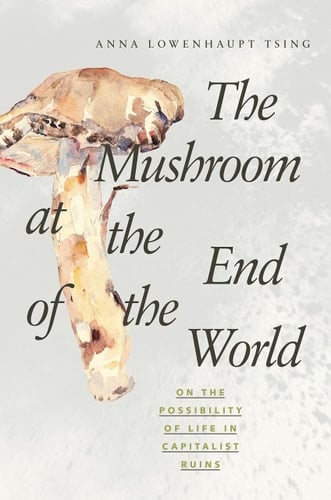
The Mushroom at the End of the World On the Possibility of Life in Capitalist Ruins
Anna Lowenhaupt Tsing · 2017

Friction: An Ethnography of Global Connection
Anna Lowenhaupt Tsing · 2011
A wheel turns because of its encounter with the surface of the road; spinning in the air it goes nowhere. Rubbing two sticks together produces heat and light; one stick alone is just a stick. In both cases, it is friction that produces movement, action, effect. Challenging the widespread view that globalization invariably signifies a "clash" of cultures, anthropologist Anna Tsing here develops friction in its place as a metaphor for the diverse and conflicting social interactions that make up our contemporary world. She focuses on one particular "zone of awkward engagement"--the rainforests of Indonesia--where in the 1980s and the 1990s capitalist interests increasingly reshaped the landscape not so much through corporate design as through awkward chains of legal and illegal entrepreneurs that wrested the land from previous claimants, creating resources for distant markets. In response, environmental movements arose to defend the rainforests and the communities of people who live in them. Not confined to a village, a province, or a nation, the social drama of the Indonesian rainforest includes local and national environmentalists, international science, North American investors, advocates for Brazilian rubber tappers, UN funding agencies, mountaineers, village elders, and urban students, among others--all combining in unpredictable, messy misunderstandings, but misunderstandings that sometimes work out. Providing a portfolio of methods to study global interconnections, Tsing shows how curious and creative cultural differences are in the grip of worldly encounter, and how much is overlooked in contemporary theories of the global.
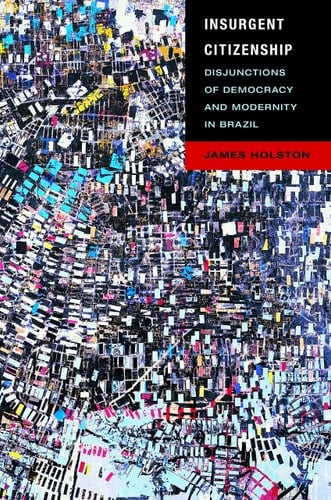
Insurgent Citizenship Disjunctions of Democracy and Modernity in Brazil
James Holston · 2008
<p>Insurgent citizenships have arisen in cities around the world. This book examines the insurgence of democratic citizenship in the urban peripheries of São Paulo, Brazil, its entanglement with entrenched systems of inequality, and its contradiction in violence.<br> <br> James Holston argues that for two centuries Brazilians have practiced a type of citizenship all too common among nation-states--one that is universally inclusive in national membership and massively inegalitarian in distributing rights and in its legalization of social differences. But since the 1970s, he shows, residents of Brazil's urban peripheries have formulated a new citizenship that is destabilizing the old. Their mobilizations have developed not primarily through struggles of labor but through those of the city--particularly illegal residence, house building, and land conflict. Yet precisely as Brazilians democratized urban space and achieved political democracy, violence, injustice, and impunity increased dramatically. Based on comparative, ethnographic, and historical research, <i>Insurgent Citizenship</i> reveals why the insurgent and the entrenched remain dangerously conjoined as new kinds of citizens expand democracy even as new forms of violence and exclusion erode it.<br> <br> Rather than view this paradox as evidence of democratic failure and urban chaos, <i>Insurgent Citizenship</i> argues that contradictory realizations of citizenship characterize all democracies--emerging and established. Focusing on processes of city- and citizen-making now prevalent globally, it develops new approaches for understanding the contemporary course of democratic citizenship in societies of vastly different cultures and histories.</p>
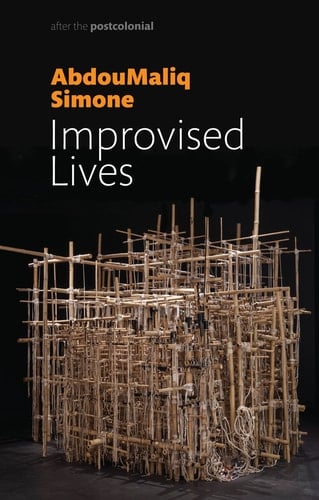
Improvised Lives
AbdouMaliq Simone · 2018
<p>The poor and working people in cities of the South find themselves in urban spaces that are conventionally construed as places to reside or inhabit. But what if we thought of popular districts in more expansive ways that capture what really goes on within them? In such cities, popular districts are the settings of more uncertain operations that take place under the cover of darkness, generating uncanny alliances among disparate bodies, materials and things and expanding the urban sensorium and its capacities for liveliness.</p> <p>In this important new book AbdouMaliq Simone explores the nature of these alliances, portraying urban districts as sites of enduring transformations through rhythms that mediate between the needs of residents not to draw too much attention to themselves and their aspirations to become a small niche of exception. Here we discover an urban South that exists as dense rhythms of endurance that turn out to be vital for survival, connectivity, and becoming.</p>

Life as Politics How Ordinary People Change the Middle East
Asef Bayat · 2009
In the popular imagination, the Muslim Middle East is frozen in its own traditions and history—a land of mosques and minarets, veiled women, despotic regimes, and desert sand. But this assumption fails to recognize that social and political change comes in many guises. In this eye-opening book, Asef Bayat reveals how under the shadow of the authoritarian rule, religious moral authorities, and economic elites, ordinary people can make meaningful change through the practices of everyday life. <br><br>Though not as visible on the world-stage as a mass protest or a full-scale revolution, millions of people across the Middle East are discovering or creating new social spaces within which to make their claims heard. The street vendor who sets up his business in the main square, squatters who take over public parks, Muslim youth who frequent public hangouts in blue jeans, and protestors who march in the streets, poor housewives who hang their wash in the alleyways, and educated women who pursue careers doing "men's work"—all these people challenge the state's control and implicity question the established public order through their daily activities. Though not coordinated in their activities, these "non-movements" offer a political response, not of protest but of practice and direct daily action. <br><br>Offering a window into the complex social processes in a too-often misunderstood part of the world, this unique book provides a much-needed Middle Eastern perspective on global debates over the meaning of social movements and the dynamics of social change.
The Indonesia Front
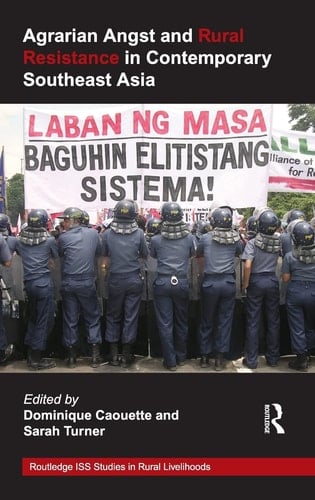
Agrarian Angst and Rural Resistance in Contemporary Southeast Asia
Dominique Caouette · 2009
<p>Agrarian transformations, market integration and globalization processes are impacting upon rural Southeast Asia with increasingly complex and diverse consequences. In response, local inhabitants are devising a broad range of resistance measures that they feel will best protect or improve their livelihoods, ensure greater social justice and equity, or allow them to just be left alone. This book develops a multi-scalar approach to examine such resistance occurring in relation to agrarian transformations in the Southeast Asian region.</p><p></p><p>The contributors take a fresh look at the diversity of sites of struggle and the combinations of resistance measures being utilized in contemporary Southeast Asia. They reveal that open public conflicts and debates are taking place between dominators and the oppressed, at the same time as covert critiques of power and everyday forms of resistance. The book shows how resistance measures are context contingent, shaped by different world views, and shift according to local circumstances, the opening and closing of political opportunity structures, and the historical peculiarities of resistance dynamics.</p><p></p><p>By providing new conceptual approaches and illustrative case studies that cut across scales and forms, this book will be of interest to academics and students in comparative politics, sociology, human geography, environmental studies, cultural anthropology and Southeast Asian studies. It will also help to further debate and action among academics, activists and policymakers.</p>
Capitalism and Agrarian Change Class, Production and Reproduction in Indonesia
Muchtar Habibi · 2022
"Small-scale agricultural producers in the peripheral world are often condescendingly assumed to be a single social class ('the peasantry') to be pitted against the state or corporation. This book challenges this rather idealistic view by demonstrating that under current capitalist social relations (competition, efficiency and productivity, and profit maximisation), these agricultural producers have been differentiated into different agrarian classes by exploitation. By comparing two different contexts of local agrarian change in Indonesia - rice cultivation. in Java and oil palm in Sumatra - this book exposes the different class location of the agrarian classes among petty agricultural producers and the class relations between them. These are often inextricably linked to gender, clanship and generational issues. The power of class dynamics crucially shapes how agricultural production in both rice and oil palm is organised. The share received by different agrarian classes from the production site then prominently shapes the different nature of class reproduction for each agrarian class. This analysis demonstrates that the different agrarian classes possess different capacities and responses in their relation to the state or corporations. Any real emancipation attempt in the Indonesian countryside (and beyond) must start from a proper understanding of these class dynamics. This book marks a significant contribution to the literature on agrarian change, the political economy of development, rural development and Marxist political economy"--

The Politics of Protection Rackets in Post-New Order Indonesia Coercive Capital, Authority and Street Politics
Ian Douglas Wilson · 2014
<p>Since the end of Suharto's New Order there have been significant positive changes in Indonesia, but there are also distinct and alarming continuities with the past that represent a major challenge to the development of stable democratic institutions and the rule of law. </p><p></p><p>Wilson investigates the increase of institutionalised political thuggery through detailed case studies of some of the paramilitary groups, vigilantes, gangs and other entrepreneurs in violence that have emerged.</p><p></p><p>A number of thematic questions will be explored in this book:</p><ul><p><li>What are the implications of the increasing prevalence of predatory coalitions between gangsters and political parties in setting political regime directions? </li><p></p><p><li>What are the implications of the emergence of a distinct class of entrepreneurs in violence, and the trading of violence as a market resource?</li><p></p><p><li>How have violent entrepreneurs reconfigured themselves in relation to new forms of social and political power? And what means have they deployed to legitimize racketeering and the use of coercive force?</li><p></p><p><li>What social, cultural and political forces are attempting to counter and resist this 'uncivil society' and the use of violence and coercion as a legitimate form of political communication and strategy?</li><p></p></ul><p></p><p>Wilson demonstrates that organised political violence may have collapsed as a centralised state strategy, but has re-emerged as a commodity used by non-state actors for the pursuit of particular social, economic and political agendas and the establishment and maintenance of localised monopolies.</p><p></p><p>This ground-breaking new work will be of interest to anyone studying Indonesia, Southeast Asian Politics and State violence.</p>

Countering Dispossession, Reclaiming Land A Social Movement Ethnography
David E. Gilbert · 2024
Two decades ago, a group of Indonesian agricultural workers began occupying the agribusiness plantation near their homes. In the years since, members of this remarkable movement have reclaimed collective control of their land and cultivated diverse agricultural forests on it, repairing the damage done over nearly a century of abuse. <i>Countering Dispossession, Reclaiming Land</i> is their story. David E. Gilbert offers an account of the ways these workers-turned-activists mobilized to move beyond industrial agriculture's exploitation of workers and the environment, illustrating how emancipatory and ecologically attuned ways of living with land are possible. At a time when capitalism has remade landscapes and reordered society, the Casiavera reclaiming movement stands as an inspiring example of what struggles for social and environmental justice can achieve.<br>

From Rebellion to Riots Collective Violence on Indonesian Borneo
Jamie Seth Davidson · 2008
<i>From Rebellion to Riots</i> is a critical analysis of the roots of contemporary violence in one of Indonesia's most ethnically heterogeneous provinces, West Kalimantan. Since the late 1960s, this province has suffered periodic outbreaks of ethnic violence among its Dayak, Malay, Madurese, and ethnic Chinese populations. Citing evidence from his research, internal military documents, and ethnographic accounts, Jamie S. Davidson refutes popular explanations for these flare-ups. The recurrent violence has less to do with a clash of cultures, the ills of New Order-led development, or indigenous marginalization than with the ongoing politicization of ethnic and indigenous identity in the region. Looking at key historical moments, markedly different in their particulars, Davidson reveals the important links between ethnic violence and subnational politics. In one case, army officers in Soeharto's recently established New Order regime encouraged anti-Chinese sentiments. To move against communist-inspired rebellion, they recruited indigenous Dayaks to expunge tens of thousands of ethnic Chinese from interior towns and villages. This counter-insurgent bloodshed inadvertently initiated a series of clashes between Dayaks and Madurese, another migrant community. Driven by an indigenous empowerment movement and efforts by local elites to control benefits provided by decentralization and democratization, these low-intensity riots rose to immense proportions in the late 1990s. <i>From Rebellion to Riots</i> demonstrates that the endemic violence in this vast region is not the inevitable outcome of its ethnic diversity, and reveals that the initial impetus for collective bloodshed is not necessarily the same as the forces that sustain it.<br> <br> "A comprehensive case study . . . . Essential reading for students of the West Kalimantan violence."--Dave McRae, <i>Indonesia</i>

The Revival of Tradition in Indonesian Politics The Deployment of Adat from Colonialism to Indigenism
Jamie Davidson · 2012
<p>The Indonesian term adatmeans ‘custom’ or ‘tradition’, and carries connotations of sedate order and harmony. Yet in recent years it has suddenly become associated with activism, protest and violence. This book investigates the revival of adatin Indonesian politics, identifying its origins, the historical factors that have conditioned it and the reasons behind its recent blossoming. </p><p>It considers whether the adatrevival is a constructive contribution to Indonesia’s new political pluralism or a divisive, dangerous and reactionary force, and examines the implications for the development of democracy, human rights, civility and political stability. </p><p>The Revival of Tradition in Indonesian Politicsprovides detailed coverage of the growing significance of adatin Indonesian politics. It is an important resource for anyone seeking to understand the contemporary Indonesian political landscape.</p>

Rich Forests, Poor People Resource Control and Resistance in Java
Nancy Lee Peluso · 1992
Millions of Javanese peasants live alongside state-controlled forest lands in one of the world's most densely populated agricultural regions. Because their legal access and customary rights to the forest have been severely limited, these peasants have been pushed toward illegal use of forest resources. <i>Rich Forests, Poor People</i> untangles the complex of peasant and state politics that has developed in Java over three centuries.<br><br>Drawing on historical materials and intensive field research, including two contemporary case studies, Peluso presents the story of the forest and its people. Without major changes in forest policy, Peluso contends, the situation is portentous. Economic, social, and political costs to the government will increase. Development efforts will by stymied and forest destruction will continue. Mindful that a dramatic shift is unlikely, Peluso suggests how tension between foresters and villagers can be alleviated while giving peasants a greater stake in local forest management.

Activist Archives Youth Culture and the Political Past in Indonesia
Doreen Lee · 2016
In <i>Activist Archives</i> Doreen Lee tells the origins, experiences, and legacy of the radical Indonesian student movement that helped end the thirty-two-year dictatorship in May 1998. Lee situates the revolt as the most recent manifestation of student activists claiming a political and historical inheritance passed down by earlier generations of politicized youth. Combining historical and ethnographic analysis of "Generation 98," Lee offers rich depictions of the generational structures, nationalist sentiments, and organizational and private spaces that bound these activists together. She examines the ways the movement shaped new and youthful ways of looking, seeing, and being—found in archival documents from the 1980s and 1990s; the connections between politics and place; narratives of state violence; activists' experimental lifestyles; and the uneven development of democratic politics on and off the street. Lee illuminates how the interaction between official history, collective memory, and performance came to define youth citizenship and resistance in Indonesia’s transition to the post-Suharto present.

Opposing Suharto: Compromise, Resistance, And Regime Change In Indonesia
Edward Aspinall · 2005
Opposing Suharto presents an account of democratization in the world's fourth most populous country, Indonesia. It describes how opposition groups challenged the long-time ruler, President Suharto, and his military-based regime, forcing him to resign in 1998. The book's main purpose is to explain how ordinary people can bring about political change in a repressive authoritarian regime. It does this by telling the story of an array of dissident groups, nongovernmental organizations, student activists, and political party workers as they tried to expand democratic space in the last decade of Suharto's rule. This book is an important study not only for readers interested in contemporary Indonesia and political change in Asia, but also for all those interested in democratization processes elsewhere in the world. Unlike most other books on Indonesia, and unlike many books on democratization, it provides an account from the perspective of those who were struggling to bring about change.
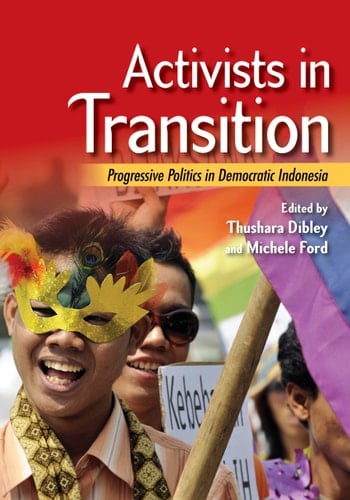
Activists in Transition Progressive Politics in Democratic Indonesia
Thushara Dibley · 2019
<p><b><i>Activists in Transition</i></b><b> examines the relationship between social movements and democratization in Indonesia.</b> Collectively, progressive social movements have played a critical role over in ensuring that different groups of citizens can engage directly in--and benefit from--the political process in a way that was not possible under authoritarianism. However, their individual roles have been different, with some playing a decisive role in the destabilization of the regime and others serving as bell-weathers of the advancement, or otherwise, of Indonesia's democracy in the decades since. Equally important, democratization has affected social movements differently depending on the form taken by each movement during the New Order period. The book assesses the contribution that nine progressive social movements have made to the democratization of Indonesia since the late 1980s, and how, in turn, each of those movements has been influenced by democratization.</p>
