
social policy, welfare states, & marginalization
Items in this hypelist
The Politics of Distribution, Precarity, & Structural Debt
Deindustrialization, Distribution, and Development Structural Change in the Global South
Andy Sumner · 2021
The term rust belt has rarely been associated with developing countries. In fact, it is commonly used to discuss deindustrialization in advanced nations, particularly the US. However, this book argues that such a belt is now threatening the middle-income developing world, spreading across Brazil and other countries in Latin America, running down across South Africa, and then upwards to Malaysia, Indonesia, Thailand, and the Philippines in South East Asia.<br> <br> Deindustrialization, Distribution, and Development: Structural Change in the Global South explores the emergent processes of stalled industrialization and the spectre of deindustrialization in these developing countries. Building upon the author's previous work on economic development, structural change, and income inequality, this book examines the causes and consequences of these new issues, focusing on inequality both between and within countries since the Cold War.<br> <br> Providing a comparative, in-depth analysis of the varieties of contemporary structural change in the Global South and challenging many long-standing myths, this work explains why late development remains a crucial concept in understanding contemporary development and explores what deindustrialization means for the future of global development.

The Wolf at the Door The Menace of Economic Insecurity and How to Fight It
Michael J. Graetz · 2021
<p><b>“Deep, informed, and reeks of common sense.”<br>—Norman Ornstein</b><br><br><b>“It is now beyond debate that rising inequality is not only leaving millions of Americans living on a sharp edge but also is threatening our democracy...For activists and scholars alike who are struggling to create a more equitable society, this is an essential read.”<br>—David Gergen</b><br><br>We are in an age of crisis. That much we can agree on. But a crisis of what, exactly? And how do we get out of it?<br><br>In a follow up to their influential and much debated <i>Death by a Thousand Cuts</i>, Michael Graetz and Ian Shapiro focus on what really worries people: not what the rich are making or the government is taking from them but their own insecurity. Americans are worried about losing their jobs, their status, and the safety of their communities. They fear the wolf at the door. The solution is not protectionism or class warfare but better jobs, higher wages, greater protection for families suffering from unemployment, better health insurance, and higher quality childcare. And it turns out those goals are more achievable than you might think. <i>The Wolf at the Door</i> is one of those rare books that doesn’t just diagnose our problems, it shows how to address them.<br><br>“This is a terrific book, original, erudite, and superbly well-informed, and full of new wisdom about what might and what might not help the majority of Americans who have not shared in our growing prosperity, but are left facing the wolf at the door...Everyone interested in public policy should read this book.”<br>—Angus Deaton, Princeton University<br><br>“Graetz and Shapiro wrestle with a fundamental question of our day: How do we address a system that makes too many Americans anxious that economic security is slipping out of reach? Their cogent call for sensible and achievable policies...should be read by progressives and conservatives alike.”<br>—Jacob J. Lew, former Secretary of the Treasury</p>
Navigating Austerity Currents of Debt along a South Asian River
Laura Bear · 2015
<i>Navigating Austerity</i> addresses a key policy question of our era: what happens to society and the environment when austerity dominates political and economic life? To get to the heart of this issue, Laura Bear tells the stories of boatmen, shipyard workers, hydrographers, port bureaucrats and river pilots on the Hooghly River, a tributary of the Ganges that flows into the Bay of Bengal and Indian Ocean. Through their accounts, Bear traces the hidden currents of state debt crises and their often devastating effects.<br> <br> Taking the reader on a voyage along the river, Bear reveals how bureaucrats, entrepreneurs and workers navigate austerity policies. Their attempts to reverse the decline of ruined public infrastructures, environments and urban spaces lead Bear to argue for a radical rethinking of economics according to a social calculus. This is a critical measure derived from the ethical concerns of people affected by national policies. It places issues of redistribution and inequality at the fore of public and environmental plans. Concluding with proposals for restoring more just long term social obligations, Bear suggests new practices of state financing and ways to democratize fiscal policy. Her aim is to transform sovereign debt from a financial problem into a widely debated ethical and political issue. <i>Navigating Austerity</i> contributes to policy studies as well as to the understanding of today's global injustices. It also develops new theories about the significance of state debt, speculation and time for contemporary capitalism. Sited on a single body of water flowing with rhythms of circulation, renewal and transformation, this ambitious and accessible book will be of interest to specialists and general readers.

Life in Debt Times of Care and Violence in Neoliberal Chile
Clara Han · 2012
“<i>Life in Debt</i> will become, I predict, one of the classic ethnographies in the anthropological study of state violence, community responses, and the moral life of the global poor. Relating economic and political debt, financial and psychological depression, and caregiving by ordinary people and by social institutions, Clara Han maps our brave new world just about as illuminatingly as it has been done. A remarkable achievement.” -Arthur Kleinman, Harvard University<br><br>“In this highly sophisticated take on the ironies of neoliberal social reforms, the corporate sector, consumer culture, and chronic underemployment, nothing can be read literally. Han transforms underclass urban ethnography in Latin America by bringing readers directly into the intimate flow of relationships, experiences, and emotions in family life on the margins of Santiago, Chile." -Kay Warren, Director, Pembroke Center, Brown University. <br><br>"People-centered, movingly written, and analytically probing, <i>Life in Debt</i> deals with both the human costs and the changing structures of power driven by contemporary dynamics of neoliberalism. Combining a deep and nuanced understanding of Chile's history with a longitudinal and heart-wrenching field-based knowledge of the everyday travails of the urban poor, Clara Han has crafted an exceptional analysis of human transformations in the face of political violence and economic insecurity." -João Biehl, author of <i>Vita: Life in a Zone of Social Abandonment</i><br><br>"During ten years, Clara Han has gathered fragments of biographies and moments of lives to recreate the experience of Chileans after Pinochet’s dictatorship. Her vivid ethnography plunges into the moral economy of a society entangled between memory and pardon, revealing the ethical work undertaken by those who accept the present without disclaiming the past." -Didier Fassin, Institute for Advanced Study, Princeton, author of <i>Humanitarian Reason</i>

Redistribution Or Recognition? A Political-Philosophical Exchange
Nancy Fraser · 2003
“Recognition” has become a veritable keyword of our time, but its relation to “redistribution” remains undertheorized. This volume remedies the lacuna by staging a sustained debate between two philosophers, one North American, the other European, who hold different views of the matter. Highly attuned to contemporary politics, the exchange between Nancy Fraser and Axel Honneth constitutes a rigorous dialogue on moral philosophy, social theory, and the best way to conceptualize capitalist society.

Social Policy
Hartley Dean · 2019

The Great Transformation The Political and Economic Origins of Our Time
Karl Polanyi · 2025
<b>One of the twentieth century’s most important pieces of social and economic theory, highlighting the rise and reality of capitalism as it shaped our world <br><br>A limited Beacon Classics edition</b><br><br>In this classic work of economic history and social theory, Karl Polanyi tracks the economic and social changes brought about by the “great transformation” of the Industrial Revolution. He pays particular attention to capitalism’s rise and its role in fundamentally altering life after the Industrial Revolution. While previous economic arrangements were embedded within social relations, capitalism reverses this: social relations are defined by economic relations. This seminal analysis explains not only the deficiencies of the self-regulating market, but the potentially dire social consequences of untempered market capitalism.<br><br>In an era of ever-increasing globalization and free trade, Polanyi’s cogent historical, social, and economic analysis offers grounded insight into the inner workings of the modern world. Polanyi suggests that capitalism is a historical anomaly. The rules of reciprocity, redistribution and communal obligations were far more consistent as guiding principles of exchange than market relations throughout human history. Capitalism, however, does not exhibit these obligations, and in fact its rise irreversibly destroyed them. The true "great transformation" of the industrial revolution was to completely replace all modes of interaction with capitalism and market relations, forever altering the function, and result, of human relations.<br><br>Now with a new hardcover package, this treatise from one of the greatest thinkers of the 20th century will illuminate seminal economic and social theory for fans old and new.

The Precariat The New Dangerous Class
Guy Standing · 2016
<p>First published in 2011 <i>The Precariat </i>is the hugely influential first account of an emerging class of people facing insecurity, moving in and out of precarious work that gives little meaning to their lives. Standing warns that the growth of the precariat is producing instabilities in society. Its internal divisions have led to the villainization of migrants and other vulnerable groups and some are susceptible to the dangers of political extremism. Standing argues for a new politics which puts the fears and aspirations of the precariat at the heart of a progressive strategy of redistribution and income security.<br><br>The precariat is an increasingly global phenomenon, highly visible in the ongoing migrant crisis and protest movements around the world. In a new preface for the <i>Revelations</i> edition Guy Standing discusses recent political developments and their effect on the precariat.</p>

Give a Man a Fish Reflections on the New Politics of Distribution
James Ferguson · 2015
Conditional Welfare, Marketization, & Targeted Assistance

Social Protection for the Poor and Poorest Concepts, Policies and Politics
A. Barrientos · 2008
Social protection is fast becoming an important theme in development policy. This book examines the political processes shaping social protection policies; compares the key conceptual frameworks available for analyzing social protection; and provides a comparative discussion on social protection policies focused on the poor and the poorest.

Social Policy A Critical and Intersectional Analysis
Fiona Williams · 2021
<p>Welfare states face profound challenges. Widening economic and social inequalities have been intensified by austerity politics, sharpened by the rise in ethno-nationalism and exposed by the COVID-19 pandemic. At the same time, recent decades have seen a resurgence of social justice activism at both the local and the transnational level. Yet the transformative power of feminist, anti-racist and postcolonial/decolonial thinking has become relatively marginal to core social policy theory, while other critical approaches – around disability, sexuality, migration, age and the environment – have found recognition only selectively.</p> <p>This book provides a much needed new analysis of this complex landscape, drawing together critical approaches in social policy with intersectionality and political economy. Fiona Williams contextualizes contemporary social policies not only in the global crisis of finance capitalism but also in the interconnected global crises of care, ecology and racialized borders. These shape and are shaped at national scale by the intersecting dynamics of family, nation, work and nature. Through critical assessment of these realities, the book probes the ethical, prefigurative and transformative possibilities for a future welfare commons.</p> <p>This significant intervention will animate social policy thinking, teaching and research. It will be essential reading for anyone wanting to understand the complexities of social policy for the years ahead.</p>
The Politics of Welfare in the Global South
Sattwick Dey Biswas, Cleopas Gabriel Sambo, Sony Pellissery · 2024
This book serves as a comprehensive reference for conducting political analyses of emerging welfare systems in the Global South. These countries have adopted a development-oriented approach, distinct from the social policy trajectory observed in industrialized capitalist states. However, the pervasive influence of globalization since the 1990s has significantly reshaped policy priorities in these regions. Notably, political discourse surrounding social policy concepts developed in the Northern capitalist states has gained prominence.Irrespective of the geographical focus of the chapters, the book delves into fundamental social policy concepts and debates. These include the ongoing discourse between "universalism" and "selectivity," the challenges posed by the welfare residuum, the intricate role of institutional norms and apparatuses in achieving justice or engendering feelings of shame among social assistance recipients, and the examination of "absolute" and "relative" poverty. Additionally, the book investigates the pendulum shift within social welfare policies, the complex politics surrounding the portrayal of welfare recipients, and the newly established link between poverty and shame.Comprising 12 chapters, the book employs a case study-based approach to test the applicability and universality of social policy theories and concepts. The central focus lies in assessing the adaptability of concepts and theories developed in the Global North to comprehend the intricacies of welfare politics in the Global South. These case studies contribute to theoretical generalizations capable of explaining universal principles that are relevant to both the Global South and North.
The Takeover of Social Policy by Financialization The Brazilian Paradox
Lena Lavinas · 2017
This book critically addresses the model of social inclusion that prevailed in Brazil under the rule of the Workers Party from the early 2000s until 2015. It examines how the emergence of a mass consumer society proved insufficient, not only to overcome underdevelopment, but also to consolidate the comprehensive social protection system inherited from Brazil’s 1988 Constitution. By juxtaposing different theoretical frameworks, this book scrutinizes how the current finance-dominated capitalism has reshaped the role of social policy, away from rights-based decommodified benefits and towards further commodification. This constitutes the Brazilian paradox: how a center-left government has promoted and boosted financialization through a market incorporation strategy using credit as a lever for expanding financial inclusion. In so doing, it has pushed the subjection of social policy further into the logic of financial markets.

Poverty and Social Protection in Indonesia
Joan Hardjono, Nuning Akhmadi, Sudarno Sumarto · 2010

The Paradox of Agrarian Change Food Security and the Politics of Social Protection in Indonesia
John Fitzgerald McCarthy · 2023
<b>A detailed study of agrarian change, the persistence of food insecurity, and the most significant policy to address poverty in rural Indonesia.</b><br> <br> <br> <br> Economic growth in the middle-income countries of Southeast Asia over the past few decades has been widely praised for reducing poverty in both absolute and relative terms. Indonesia is a prime example. But while poverty has declined in Indonesia, patterns of food poverty persist across Indonesia. What explains this troubling paradox? How does it relate to Indonesia's enthusiastic embrace of the "entitlements revolution," the use of direct cash transfers as a tool for reducing poverty and building social inclusion?<br> <br> <br> <br> This book analyzes the nature and social consequences of economic development and agrarian change processes in rural Indonesia in relation to the scope and effectiveness of Indonesia's social protection programs. The findings are based on a series of extensive ground-up case studies in Indonesian communities in a variety of eco-agrarian settings that seek to understand the drivers of food insecurity and vulnerability at a household level. The results show that while high-value farming, diversification, and migration may offer a means of economic progress for poor households, opportunities for accumulation are limited. This, the authors show, is due to the way class, gender, and power work in remote local contexts, and the fact that much surplus income is used for enhanced consumption and changing lifestyles. There are few signs of the classical structural transformation of the countryside which has historically been considered the most decisive pathway out of rural poverty. The authors conclude that social assistance is unlikely to counter the persistence of rural poverty, food insecurity, and precarity in the absence of other redistributive strategies that shift the structural drivers of inequality.<br> <br>
The Bureaucratic Management & Policing of Marginal Populations
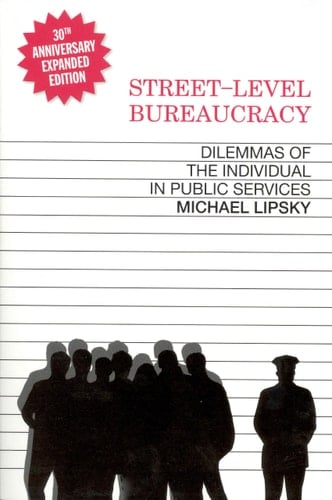
Street-Level Bureaucracy: Dilemmas of the Individual in Public Service, 30th Anniversary Expanded Edition
Michael Lipsky · 2010
First published in 1980, Street-Level Bureaucracy received critical acclaim for its insightful study of how public service workers, in effect, function as policy decision makers, as they wield their considerable discretion in the day-to-day implementation of public programs. Three decades later, the need to bolster the availability and effectiveness of healthcare, social services, education, and law enforcement is as urgent as ever. In this thirtieth anniversary expanded edition, Michael Lipsky revisits the territory he mapped out in the first edition to reflect on significant policy developments over the last several decades. Despite the difficulties of managing these front-line workers, he shows how street-level bureaucracies can be and regularly are brought into line with public purposes. Street-level bureaucrats―from teachers and police officers to social workers and legal-aid lawyers―interact directly with the public and so represent the frontlines of government policy. In Street-Level Bureaucracy, Lipsky argues that these relatively low-level public service employees labor under huge caseloads, ambiguous agency goals, and inadequate resources. When combined with substantial discretionary authority and the requirement to interpret policy on a case-by-case basis, the difference between government policy in theory and policy in practice can be substantial and troubling. The core dilemma of street-level bureaucrats is that they are supposed to help people or make decisions about them on the basis of individual cases, yet the structure of their jobs makes this impossible. Instead, they are forced to adopt practices such as rationing resources, screening applicants for qualities their organizations favor, "rubberstamping" applications, and routinizing client interactions by imposing the uniformities of mass processing on situations requiring human responsiveness. Occasionally, such strategies work out in favor of the client. But the cumulative effect of street-level decisions made on the basis of routines and simplifications about clients can reroute the intended direction of policy, undermining citizens' expectations of evenhanded treatment. This seminal, award-winning study tells a cautionary tale of how decisions made by overburdened workers translate into ad-hoc policy adaptations that impact peoples' lives and life opportunities. Lipsky maintains, however, that these problems are not insurmountable. Over the years, public managers have developed ways to bring street-level performance more in line with agency goals. This expanded edition of Street-Level Bureaucracy underscores that, despite its challenging nature, street-level work can be made to conform to higher expectations of public service.

Punishing the Poor The Neoliberal Government of Social Insecurity
Loïc Wacquant · 2009
The punitive turn of penal policy in the United States after the acme of the Civil Rights movement responds not to rising <i>criminal</i> insecurity but to the <i>social</i> insecurity spawned by the fragmentation of wage labor and the shakeup of the ethnoracial hierarchy. It partakes of a broader reconstruction of the state wedding restrictive “workfare” and expansive “prisonfare” under a philosophy of moral behaviorism. This paternalist program of penalization of poverty aims to curb the urban disorders wrought by economic deregulation and to impose precarious employment on the postindustrial proletariat. It also erects a garish theater of civic morality on whose stage political elites can orchestrate the public vituperation of deviant figures—the teenage “welfare mother,” the ghetto “street thug,” and the roaming “sex predator”—and close the legitimacy deficit they suffer when they discard the established government mission of social and economic protection. By bringing developments in welfare and criminal justice into a single analytic framework attentive to both the instrumental and communicative moments of public policy, <i>Punishing the Poor</i> shows that the prison is not a mere technical implement for law enforcement but a core political institution. And it reveals that the capitalist revolution from above called neoliberalism entails not the advent of “small government” but the building of an overgrown and intrusive penal state deeply injurious to the ideals of democratic citizenship.<p>Visit the author’s website.</p>

Neoliberalism as Exception Mutations in Citizenship and Sovereignty
Aihwa Ong · 2006
Neoliberalism is commonly viewed as an economic doctrine that seeks to limit the scope of government. Some consider it a form of predatory capitalism with adverse effects on the Global South. In this groundbreaking work, Aihwa Ong offers an alternative view of neoliberalism as an extraordinarily malleable technology of governing that is taken up in different ways by different regimes, be they authoritarian, democratic, or communist. Ong shows how East and Southeast Asian states are making exceptions to their usual practices of governing in order to position themselves to compete in the global economy. As she demonstrates, a variety of neoliberal strategies of governing are re-engineering political spaces and populations. Ong’s ethnographic case studies illuminate experiments and developments such as China’s creation of special market zones within its socialist economy; pro-capitalist Islam and women’s rights in Malaysia; Singapore’s repositioning as a hub of scientific expertise; and flexible labor and knowledge regimes that span the Pacific.<p>Ong traces how these and other neoliberal exceptions to business as usual are reconfiguring relationships between governing and the governed, power and knowledge, and sovereignty and territoriality. She argues that an interactive mode of citizenship is emerging, one that organizes people—and distributes rights and benefits to them—according to their marketable skills rather than according to their membership within nation-states. Those whose knowledge and skills are not assigned significant market value—such as migrant women working as domestic maids in many Asian cities—are denied citizenship. Nevertheless, Ong suggests that as the seam between sovereignty and citizenship is pried apart, a new space is emerging for NGOs to advocate for the human rights of those excluded by neoliberal measures of human worthiness.</p>

The Anti-politics Machine "development," Depoliticization, and Bureaucratic Power in Lesotho
James Ferguson · 1994
Development, it is generally assumed, is good and necessary, and in its name the West has intervened, implementing all manner of projects in the impoverished regions of the world. When these projects fail, as they do with astonishing regularity, they nonetheless produce a host of regular and unacknowledged effects, including the expansion of bureaucratic state power and the translation of the political realities of poverty and powerlessness into "technical" problems awaiting solution by "development" agencies and experts. It is the political intelligibility of these effects, along with the process that produces them, that this book seeks to illuminate through a detailed case study of the workings of the "development" industry in one country, Lesotho, and in one "development" project. Using an anthropological approach grounded in the work of Foucault, James Ferguson analyzes the institutional framework within which such projects are crafted and the nature of "development discourse," revealing how it is that, despite all the "expertise" that goes into formulating development projects, they nonetheless often demonstrate a startling ignorance of the historical and political realities of the locale they are intended to help. In a close examination of the attempted implementation of the Thaba-Tseka project in Lesotho, Ferguson shows how such a misguided approach plays out, how, in fact, the "development" apparatus in Lesotho acts as an "anti-politics machine," everywhere whisking political realities out of sight and all the while performing, almost unnoticed, its own pre-eminently political operation of strengthening the state presence in the local region.James Ferguson is an associate professor of anthropology at the University of California at Irvine.

The Will to Empower Democratic Citizens and Other Subjects
Barbara Cruikshank · 1999
<p>How do liberal democracies produce citizens who are capable of governing themselves? In considering this question, Barbara Cruikshank rethinks central topics in political theory, including the relationship between welfare and citizenship, democracy and despotism, and subjectivity and subjection.</p> <p>Drawing on theories of power and the creation of subjects, Cruikshank argues that individuals in a democracy are made into self-governing citizens through the small-scale and everyday practices of voluntary associations, reform movements, and social service programs. She argues that our empowerment is a measure of our subjection rather than of our autonomy from power. </p> <p>Through a close examination of several contemporary American "technologies of citizenship"--from welfare rights struggles to philanthropic self-help schemes to the organized promotion of self-esteem awareness--she demonstrates how social mobilization reshapes the political in ways largely unrecognized in democratic theory. Although the impact of a given reform movement may be minor, the techniques it develops for creating citizens far extend the reach of govermental authority. </p> <p>Combining a detailed knowledge of social policy and practice with insights from poststructural and feminist theory, <i><b>The Will to Empower</b></i> shows how democratic citizens and the political are continually recreated.</p>
Logics of Empowerment Development, Gender, and Governance in Neoliberal India
Aradhana Sharma · 2008
<b><p> A critical look at the globally dominant development strategy of "empowerment"<p></p></p></b><p></p><p> Celebratory news features about India's thriving middle class tell only part of the story of the country's recent economic rise, frequently glossing over the 300 million Indians who live on the margins and struggle to survive under economic liberalization. How do those cast out of their country's successes perceive and respond to their position and mobilize against disempowerment? <p></p><p></p>In <i>Logics of Empowerment, </i> Aradhana Sharma takes up these questions, focusing on the work of an innovative women's program called Mahila Samakhya that is part governmental and part nongovernmental and strives to empower those rural Indian women who have been pushed aside. She details the awkward ideological articulations and paradoxical outcomes of this unique activist-cum-government organizational structure and usage of empowerment. <p></p><p></p>Bringing much-needed specificity to the study of neoliberalism, <i>Logics of Empowerment</i> fosters a deeper understanding of development and politics in contemporary India. </p>
