sociology of development and underdevelopment
A research log exploring the structural production of global inequality, the institutional mechanics of state planning, and the lived realities of peripheral spaces. This folder moves beyond technical GDP metrics to analyze development as a site of active political contestation, bureaucratic social engineering, and post-colonial dependency. The literature collected here traces how macro-level dynamics, including historic colonial extractions, structural adjustment programs, and the expansion of transnational market frameworks, generate deep patterns of uneven spatial and regional development across the Global South. Special analytical weight is given to the institutional architecture of aid. This includes a critical, ethnographically grounded look at how state ministries, international development agencies, and the NGO industry manage marginalized populations, process files, and often depoliticize localized struggles through bureaucratic paperwork. Finally, the repository centers the qualitative frictions of the resource and urban frontier. By pairing macro-dependency models with granular field studies, particularly within Southeast Asia, this collection charts how peripheral, urban slum, and Indigenous communities navigate state-led modernization schemes, resist displacement, and carve out autonomous livelihoods against the historical violence of underdevelopment.
Items in this hypelist
Core Theories & Global Frameworks
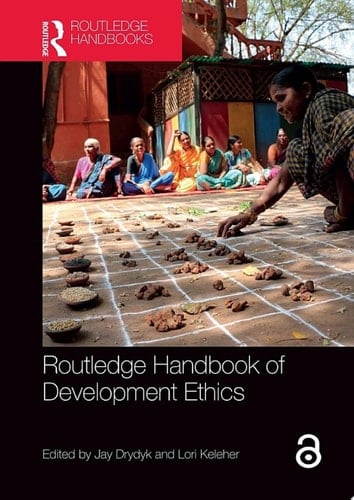
Routledge Handbook of Development Ethics
Jay Drydyk · 2018
<p>The <i>Routledge Handbook of Development Ethics</i> provides readers with insight into the central questions of development ethics, the main approaches to answering them, and areas for future research. Over the past seventy years, it has been argued and increasingly accepted that worthwhile development cannot be reduced to economic growth. Rather, a number of other goals must be realised:</p><ul> <li>Enhancement of people's well-being</li> <li>Equitable sharing in benefits of development</li> <li>Empowerment to participate freely in development</li> <li>Environmental sustainability</li> <li>Promotion of human rights</li> <li>Promotion of cultural freedom, consistent with human rights</li> <li>Responsible conduct, including integrity over corruption</li> </ul><p>Agreement that these are essential goals has also been accompanied by disagreements about how to conceptualize or apply them in different cases or contexts. Using these seven goals as an organizing principle, this handbook presents different approaches to achieving each one, drawing on academic literature, policy documents and practitioner experience.</p><p>This international and multi-disciplinary handbook will be of great interest to development policy makers and program workers, students and scholars in development studies, public policy, international studies, applied ethics and other related disciplines.</p>

On Economic Inequality
Amartya Sen · 1997
In this classic text, first published in 1973, Amartya Sen relates the theory of welfare economics to the study of economic inequality. He presents a systematic treatment of the conceptual framework as well as the practical problems of measurement of inequality. In his masterful analysis, Sen assesses various approaches to measuring inequality and delineates the causes and effects of economic disparities. Containing the four lectures from the original edition as well as a new introduction, this timeless study is essential reading for economists, philosophers, and social scientists. <br>In a substantial new annexe, Amartya Sen, jointly with James Foster, critically surveys the literature that followed the publication of this book, and also evaluates the main analytical issues in the appraisal of economic inequality and poverty.
Wellbeing, Freedom and Social Justice The Capability Approach Re-examined
Ingrid Robeyns · 2017
<p>Notions such as wellbeing, freedom, and social justice are integral to evaluating social progress and developing policies. One increasingly influential way to think about these concepts is the capability approach, a theoretical framework which was pioneered by the philosopher and economist Amartya Sen in the 1980s.<br> In this book Ingrid Robeyns orientates readers new to the capability approach through offering an explanation of this framework. Wellbeing, Freedom and Social Justice also endeavors to resolve historical disputes in the literature and thus will be equally engaging to those familiar with the field. The author offers a novel and illuminating account of how the capability approach can be understood in a variety of academic disciplines and fields of policymaking. Special attention is paid to clarifying misunderstandings that have been caused by different disciplinary assumptions and the interpretive consequences they have for our consideration of the capability approach.<br> Robeyns argues that respecting the distinction between the general capability approach, and more specific capability theories or applications, helps to clear up confusion and misinterpretation. In addition, the author presents detailed analyses of well-known objections to the capability approach, and also discusses how it relates to other schools of analysis such as theories of justice, human rights, basic needs, and the human development approach.<br> Wellbeing, Freedom and Social Justice offers an original and comprehensive account of the field. The book will appeal to scholars of the capability approach as well as new readers looking for an interdisciplinary introduction.</p>
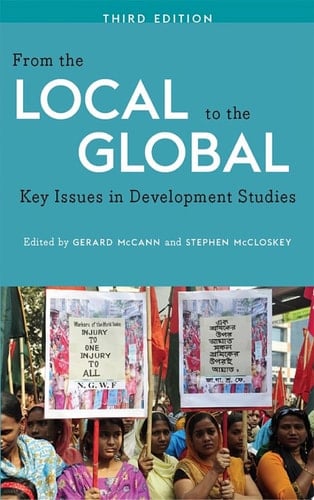
From the Local to the Global
Gerard McCann and Stephen McCloskey · 2015
The international development sector has found itself confronting new challenges to poverty eradication and the promotion of human rights. Climate change has loomed large as a crisis for development practitioners and environmentalists, affecting the most vulnerable in the Global South. The ongoing financial crisis has created recurrent recessions in the global North, while causing budget lines to be reduced for development aid.<br /><br />This textbook highlights the extent to which the local and global are interconnected in today's globalised economy. It questions the legitimacy of the neoliberal model of development which propelled us into the crisis. <br /><br />Including chapters on Latin America, China and sub-Saharan Africa, and topics such as debt injustice, gender and migration, this completely revised third edition takes stock of the international development environment as it embarks on new policy frameworks to confront new challenges.

Before the UN Sustainable Development Goals A Historical Companion
Martin Gutmann · 2022
Chapter 14 from this book is published open access and free to read or download from Oxford Scholarship Online, https: //oxford.universitypressscholarship.com/ <p>Before the UN Sustainable Development Goals enables professionals, scholars, and students engaged with the Sustainable Development Goals (SDGs) to develop a richer understanding of the legacies and historical complexities of the policy fields behind each goal. <p>Each of the seventeen chapters tells the decades- or centuries-old backstory of one SDG and reveals the global human connections, governance tools and frameworks, and the actors involved in past efforts to address sustainable development challenges. Collectively, the seventeen chapters build a historical latticework that reveals the multiple and often interwoven sources that have shaped the challenges later encompassed in the SDGs. Engaging and insightfully written, the book's chapters are authored by international experts from multiple disciplines. The book is an indispensable resource and a vital foundation for understanding the past's indelible footprint on our contemporary sustainable development challenges.

Creating Capabilities The Human Development Approach
Martha C. Nussbaum · 2013
If a country’s Gross Domestic Product increases each year, but so does the percentage of its people deprived of basic education, health care, and other opportunities, is that country really making progress? If we rely on conventional economic indicators, can we ever grasp how the world’s billions of individuals are really managing? In this powerful critique, <b>Martha Nussbaum</b> argues that our dominant theories of development have given us policies that ignore our most basic human needs for dignity and self-respect. For the past twenty-five years, Nussbaum has been working on an alternate model to assess human development: the Capabilities Approach. She and her colleagues begin with the simplest of questions: What is each person actually able to do and to be? What real opportunities are available to them? The Capabilities Approach to human progress has until now been expounded only in specialized works. <i>Creating Capabilities</i>, however, affords anyone interested in issues of human development a wonderfully lucid account of the structure and practical implications of an alternate model. It demonstrates a path to justice for both humans and nonhumans, weighs its relevance against other philosophical stances, and reveals the value of its universal guidelines even as it acknowledges cultural difference. In our era of unjustifiable inequity, Nussbaum shows how—by attending to the narratives of individuals and grasping the daily impact of policy—we can enable people everywhere to live full and creative lives.
Development as Freedom
Amartya Sen · 2011
By the winner of the 1988 Nobel Prize in Economics, an essential and paradigm-altering framework for understanding economic development--for both rich and poor--in the twenty-first century. Freedom, Sen argues, is both the end and most efficient means of sustaining economic life and the key to securing the general welfare of the world's entire population. Releasing the idea of individual freedom from association with any particular historical, intellectual, political, or religious tradition, Sen clearly demonstrates its current applicability and possibilities. In the new global economy, where, despite unprecedented increases in overall opulence, the contemporary world denies elementary freedoms to vast numbers--perhaps even the majority of people--he concludes, it is still possible to practically and optimistically restain a sense of social accountability. Development as Freedom is essential reading.
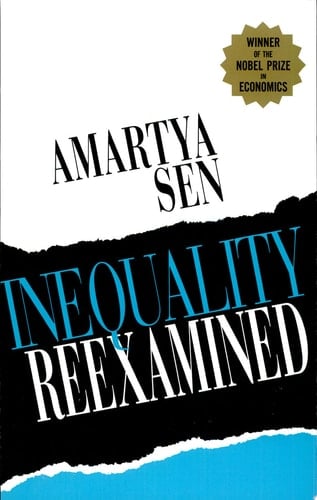
Inequality Reexamined
Amartya Sen · 1995
The noted economist and philosopher Amartya Sen argues that the dictum “all people are created equal” serves largely to deflect attention from the fact that we differ in age, gender, talents, and physical abilities as well as in material advantages and social background. He argues for concentrating on higher and more basic values: individual capabilities and freedom to achieve objectives. By concentrating on the equity and efficiency of social arrangements in promoting freedoms and capabilities of individuals, Sen adds an important new angle to arguments about such vital issues as gender inequalities, welfare policies, affirmative action, and public provision of health care and education.
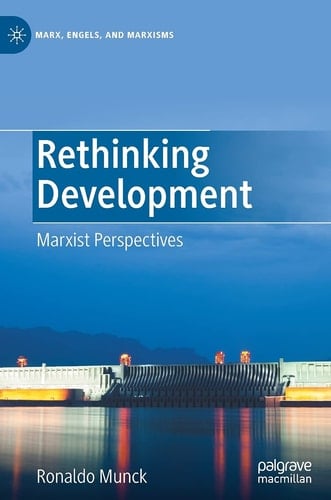
Rethinking Development Marxist Perspectives
Ronaldo Munck · 2021
Whatever Happened to the Third World?
Peter de Haan · 2020
How can the successful development of some former Third World countries be explained, while other developing countries have remained stagnant or worse, have deteriorated into failed states? This book offers a history of the economics of development. De Haan examines how the right mix of policies and evolving insights in development economics have impacted certain countries with the progression from low-income to middle-income, and even high-income status. In particular middle-income countries encounter hindrances to transit into high-income countries. The challenges of low-income countries and those of fragile and failed states is elaborated as well. Due attention is given to successive generations of development economists, economic growth models and international trade theories to provide academic background to the evolution or stagnation of developing countries. The author’s own experience in development aid is woven into the text, making this book important and entertaining reading for researchers, students of development economics, international trade and international aid.

The Myth of Development
Oswaldo De Rivero · 2019
<i>The Myth of Development</i> boldly states that the benefits of development, so long promised over the past sixty years, have not come about for most people. Nor are they going to.<br/><br/>State-driven and market-led development models have both failed. Many countries, and their cities in particular, are collapsing into ungovernable chaotic entities. De Rivero shows that the root of this chaos is not simply economic, but stems from a much more profound crisis of our way of life and of our unsustainable global urban civilization. Arguing that the 'wealth of nations' agenda must be replaced by a 'survival of nations' agenda in order to prevent increasing human misery and political disorder, De Riviero explains why many countries must abandon dreams of development and adopt instead a policy of national survival based on providing basic water, food, renewable energy, and stabilizing their populations.<br/><br/>Featuring a new introduction by the author, this edition engages with the latest findings on climate change and assesses the prospects for our species in the decades ahead.

The End of Development A Global History of Poverty and Prosperity
Andrew Brooks · 2017
<p>Why did some countries grow rich while others remained poor?<br><br>Human history unfolded differently across the globe. The world is separated in to places of poverty and prosperity. Tracing the long arc of human history from hunter gatherer societies to the early twenty first century in an argument grounded in a deep understanding of geography, Andrew Brooks rejects popular explanations for the divergence of nations. This accessible and illuminating volume shows how the wealth of 'the West' and poverty of 'the rest' stem not from environmental factors or some unique European cultural, social or technological qualities, but from the expansion of colonialism and the rise of America. Brooks puts the case that international inequality was moulded by capitalist development over the last 500 years.<br><br>After the Second World War, international aid projects failed to close the gap between 'developed' and 'developing' nations and millions remain impoverished. Rather than address the root causes of inequality, overseas development assistance exacerbate the problems of an uneven world by imposing crippling debts and destructive neoliberal policies on poor countries. But this flawed form of development is now coming to an end, as the emerging economies of Asia and Africa begin to assert themselves on the world stage.<br><br><i>The End of Development</i> provides a compelling account of how human history unfolded differently in varied regions of the world. Brooks argues that we must now seize the opportunity afforded by today's changing economic geography to transform attitudes towards inequality and to develop radical new approaches to addressing global poverty, as the alternative is to accept that impoverishment is somehow part of the natural order of things.</p>

The Sociology of Globalization
Luke Martell · 2016
<p>The new edition of this accessible and wide-ranging book demonstrates the distinctive insights that sociology has to bring to the study of globalization. Taking in the cultural, political and economic dimensions of globalization, the book provides a thorough introduction to key debates and critically evaluates the causes and consequences of a globalizing world.<br><br> Bringing the discussion right up to date, the new edition includes an increased emphasis on the rise of China, the aftermath of the financial crisis and austerity, the benefits of migration and open borders, and the changing structure of global inequality. Data and literature have been updated throughout the book, with new sections on global cities, the environment and international protests, and expanded discussion of gender. Martell argues that globalization offers many opportunities for greater interaction and participation in societies throughout the world, for instance through the media and migration, but also has dark sides such as conflict, global poverty, climate change and economic insecurity.<br><br> This book will continue to be an ideal companion to students across the social sciences taking courses that cover globalization, and the sociology of globalization in particular. </p>
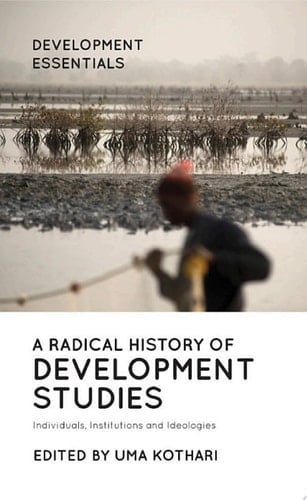
A Radical History of Development Studies
Uma Kothari · 2019
<i>A Radical History of Development Studies</i> traces the history of the subject from the late colonial period all the way through to contemporary focus on poverty reduction.<br/><br/>In this now classic genealogy of development, the authors look at the contested evolution and roles of development institutions and explore changes in development discourses. Combining personal and institutional reflections with an examination of key themes, including gender and development, NGOs, and natural resource management, <i>A Radical History of Development Studies</i> challenges mainstream development theory and practice and highlights concealed, critical discourses that have been written out of conventional stories of development.<br/><br/>The volume is intended to stimulate thinking on future directions for the discipline. It also provides an indispensable resource for students coming to grips with the historical continuities and divergences in the theory and practice of development.
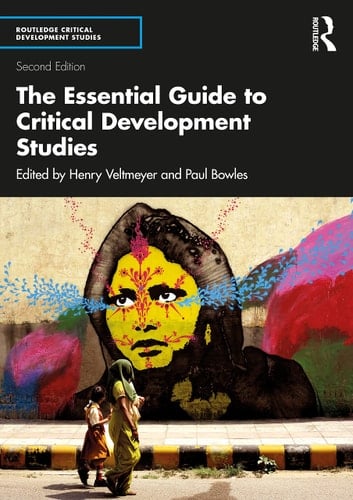
The Essential Guide to Critical Development Studies
Henry Veltmeyer, Paul Bowles · 2021
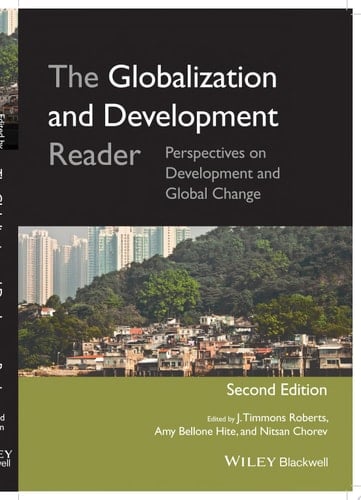
The Globalization and Development Reader Perspectives on Development and Global Change
J. Timmons Roberts · 2014
<p>This revised and updated second edition of <i>The Globalization and Development Reader</i> builds on the considerable success of a first edition that has been used around the world. It combines selected readings and editorial material to provide a coherent text with global coverage, reflecting new theoretical and empirical developments.</p> <ul> <li>Main text and core reference for students and professionals studying the processes of social change and development in “third world” countries. Carefully excerpted materials facilitate the understanding of classic and contemporary writings</li> <li>Second edition includes 33 essential readings, including 21 new selections</li> <li>New pieces cover the impact of the recession in the global North, global inequality and uneven development, gender, international migration, the role of cities, agriculture and on the governance of pharmaceuticals and climate change politics</li> <li>Increased coverage of China and India help to provide genuinely global coverage, and for a student readership the materials have been subject to a higher degree of editing in the new edition</li> <li>Includes a general introduction to the field, and short, insightful section introductions to each reading</li> <li>New readings include selections by Alexander Gershenkron, Alice Amsden, Amartya Sen, Anne-Marie Slaughter, Cecile Jackson, Dani Rodrik, David Harvey, Greta Krippner, Kathryn Sikkink, Leslie Sklair, Margaret E. Keck, Michael Burawoy, Nitsan Chorev, Oscar Lewis, Patrick Bond, Peter Evans, Philip McMichael, Pranab Bardhan, Ruth Pearson, Sarah Babb, Saskia Sassen, and Steve Radelet</li> </ul>

Encountering Development The Making and Unmaking of the Third World
Arturo Escobar · 2012
<p>How did the industrialized nations of North America and Europe come to be seen as the appropriate models for post-World War II societies in Asia, Africa, and Latin America? How did the postwar discourse on development actually create the so-called Third World? And what will happen when development ideology collapses? To answer these questions, Arturo Escobar shows how development policies became mechanisms of control that were just as pervasive and effective as their colonial counterparts. The development apparatus generated categories powerful enough to shape the thinking even of its occasional critics while poverty and hunger became widespread. "Development" was not even partially "deconstructed" until the 1980s, when new tools for analyzing the representation of social reality were applied to specific "Third World" cases. Here Escobar deploys these new techniques in a provocative analysis of development discourse and practice in general, concluding with a discussion of alternative visions for a postdevelopment era.<br><br><br> Escobar emphasizes the role of economists in development discourse--his case study of Colombia demonstrates that the economization of food resulted in ambitious plans, and more hunger. To depict the production of knowledge and power in other development fields, the author shows how peasants, women, and nature became objects of knowledge and targets of power under the "gaze of experts."<br><br><br> In a substantial new introduction, Escobar reviews debates on globalization and postdevelopment since the book's original publication in 1995 and argues that the concept of postdevelopment needs to be redefined to meet today's significantly new conditions. He then calls for the development of a field of "pluriversal studies," which he illustrates with examples from recent Latin American movements.</p>

Development and Underdevelopment The Political Economy of Global Inequality
Mitchell A. Seligson · 2014
The fifth edition of this classic reader retains many of the articles that have made the book a must-assign for classes on development and political economy, but has been updated with 14 new chapters that look even more deeply at long-term factors that help to explain the origins and current trends in the gap between rich and poor. An entirely new section focuses on natural resource and environmental issues, and the appendix of wealth and inequality indicators has been fully revised. The editors' short introduction to each selection, highlighting its significance, remains a key feature of the book.
Development and Underdevelopment
Celso Furtado · 2022
This title is part of UC Press's Voices Revived program, which commemorates University of California Press’s mission to seek out and cultivate the brightest minds and give them voice, reach, and impact. Drawing on a backlist dating to 1893, Voices Revived makes high-quality, peer-reviewed scholarship accessible once again using print-on-demand technology. This title was originally published in 1964.
State-Led Growth & Authoritarian Development
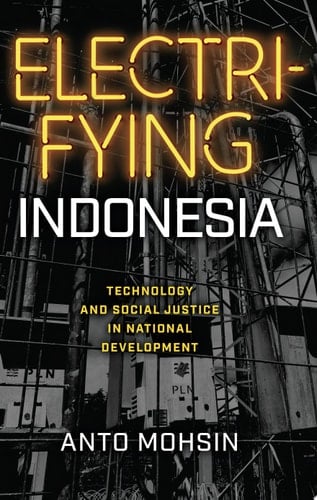
Electrifying Indonesia Technology and Social Justice in National Development
Anto Mohsin · 2023
"Electrifying Indonesia tells the story of the entanglement of politics and technology during Indonesia's rapid post-World War II development. As a central part of its nation-building project, the Indonesian state sought to supply electricity to the entire country, bringing transformative socioeconomic benefits across its heterogeneous territories and populations. While this project was driven by nationalistic impulses, it was also motivated by a genuine interest in social justice. The entanglement of these two ideologies "nation-building and equity" shaped how electrification was carried out, including how the state chose the technologies it did. Private companies and electric cooperatives vied with the hegemonic state power company to participate in a monumental undertaking that would transform daily life for all Indonesians, especially rural citizens. In this innovative volume, Anto Mohsin brings Indonesian studies together with science and technology studies to understand a crucial period in modern Indonesian history. He shows that attempts to illuminate the country were inseparable from the effort to maintain the new nation-state, chart its path to independence, and legitimize ruling regimes. In exchange for an often dramatically improved standard of living, people gave their votes, and their acquiescence, to the ruling government." --

Development and Poverty Reduction A Global Comparative Perspective
Yongnian Zheng · 2019
<p>Although the absolute number of poor people in the world has declined significantly in recent decades, poverty reduction continues to be a very important issue. There still are very large numbers of poor people, relative poverty is an increasingly concerning problem, and progress on poverty reduction varies enormously from one part of the world to another. Factors contributing to poverty reduction include economic growth, economic integration, and specific poverty-reduction programs, which are often initiated by Western countries. This book considers poverty reduction from a global perspective. Development and Poverty Reduction looks at a wide range of specific subjects, across all continents. It highlights in particular how the issues are perceived from a non-Western perspective and especially how the rise of China is both having a profound impact on poverty reduction globally and also changing the overall way in which development and poverty reduction are approached.</p><p>Chapter 4 of this book is freely available as a downloadable Open Access PDF at http://www.taylorfrancis.com under a Creative Commons Attribution-Non Commercial-No Derivatives (CC-BY-NC-ND) 4.0 license. </p>
State-Directed Development Political Power and Industrialization in the Global Periphery
Atul Kohli · 2004
Why have some developing country states been more successful at facilitating industrialization than others? An answer to this question is developed by focusing both on patterns of state construction and intervention aimed at promoting industrialization. Four countries are analyzed in detail - South Korea, Brazil, India, and Nigeria - over the twentieth century. The states in these countries varied from cohesive-capitalist (mainly in Korea), through fragmented-multiclass (mainly in India), to neo-patrimonial (mainly in Nigeria). It is argued that cohesive-capitalist states have been most effective at promoting industrialization and neo-patrimonial states the least. The performance of fragmented-multiclass states falls somewhere in the middle. After explaining in detail as to why this should be so, the study traces the origins of these different state types historically, emphasizing the role of different types of colonialisms in the process of state construction in the developing world.

Rural Life in Late Socialism Politics of Development and Imaginaries of the Future
Phill Wilcox · 2023
China, Laos, and Vietnam are three of a handful of late socialist countries where capitalist economics rubs up against party-state politics. In these countries, sweeping processes of change open up new vistas of opportunity and imaginaries of the future alongside much uncertainty and anxiety, especially for their large rural populations.<br> <br> Contributors to this edited volume demonstrate the diverse ways in which rural people build futures in this unique policy landscape and how their aspirations and desires are articulated as projects involving both citizens and the state. This produces a politics of development that happens through and around the state as people navigate discourses of betterment to imagine and make new futures at individual and collective levels.
The Price of China's Economic Development Power, Capital, and the Poverty of Rights
Zhaohui Hong · 2015
<p>The People's Republic of China has experienced significant transformations since Deng Xiaoping instituted economic reforms in 1978. Subsequent leaders continued and often broadened Deng's policies, shifting the nation from agrarianism to industrialism, from isolation to internationalism, and from centralized planning to market-based economics. As the world strives to understand the nation's rapid development, few observers have comprehensively examined the social and cultural price of the economic boom for the majority of the Chinese people. </p><p>Zhaohui Hong assesses the sociocultural consequences of these reforms in this provocative study. He contends that modern China functions as an oligarchy or plutocracy ruled by an alliance of political power and private capital where the boundaries between the private and public sectors are constantly shifting. This "power-capital institution" based on three millennia of Confucian ideology and decades of Maoist communism exercises monopolistic control of public resources at the expense of civil society and social justice for the majority of citizens.</p><p> <i>The Price of China's Economic Development</i> urges policymakers to alter their analytic lens. While industrial and commercial development is quantitatively measured, Hong argues that social progress should be assessed qualitatively, with justice its ultimate goal and fair allocation of resources and opportunity as the main index of success. This sophisticated analysis introduces English speakers to the varied and significant work of contemporary Chinese scholars and substantially enriches the international dialogue.</p>
Dictators, Democrats, and Development in Southeast Asia Implications for the Rest
Michael T. Rock · 2017
Getting growth going has been rare in the developing world-since 1960 only nine developing countries have succeeded in sustaining high growth. The aim of Dictators, Democrats and Development in Southeast Asia is to examine how dictators and democrats in three of the nine fast growers -Indonesia, Malaysia and Thailand, hereafter IMT-built and sustained pro-growth political coalitions that enabled them to adopt policies that ushered in sustained high growth.<br> <br> The focus is on IMT because circa 1960 few thought the three were candidates for high growth and because the three have factor endowments, ethnic heterogeneity, and forms of governance that resemble the Rest. These similarities suggest the Rest may have much to learn from IMT. The focus is unabashedly on the politics of development in IMT because dictators and democrats in IMT built and sustained pro-growth political coalitions that enabled them to link their long term political survival with delivering development. How and why they did so should be of keen interest to the Rest.<br> <br> Because dictators and democrats in IMT were committed to capitalist, industrial and open economy development strategies but deeply suspicious of a laissez faire approach to development, none of the three ever adopted a Washington Consensus style growth strategy. While all three toyed with a Northeast style capitalist developmental state approach to growth, because governments in IMT lacked the political requisites to make this strategy work, none really stuck to this approach to growth either.<br> <br> Instead dictators and democrats in IMT implemented highly pragmatic growth and development strategies. When markets worked, governments used them. When interventions worked governments relied on them. When either failed to deliver expected results, governments weeded out bad investments to sustain high growth. Such a pragmatic, trial and error approach to development should also be of keen interest to the Rest.
Paths to Development in Asia South Korea, Vietnam, China, and Indonesia
Tuong Vu · 2014
Why have some states in the developing world been more successful at facilitating industrialization than others? Challenging theories that privilege industrial policy and colonial legacies, this book focuses on state structure and the politics of state formation, arguing that a cohesive state structure is as important to developmental success as effective industrial policy. Based on a comparison of six Asian cases, including both capitalist and socialist states with varying structural cohesion, Tuong Vu proves that it is state formation politics rather than colonial legacies that have had decisive and lasting impacts on the structures of emerging states. His cross-national comparison of South Korea, Vietnam, Republican and Maoist China, and Sukarno's and Suharto's Indonesia, which is augmented by in-depth analyses of state formation processes in Vietnam and Indonesia, is an important contribution to understanding the dynamics of state formation and economic development in Asia.
China's State Ideology and the Three Gorges Dam The Political Theodicy of Development
Yuen-ching Bellette Lee · 2025
<p>This book uses the case of the Three Gorges Dam project to explore the Chinese state's use of ideology, namely the political theodicy of development, as a governing tactic in the reform era.</p>
The Developmental State
Meredith Woo-Cumings · 1999
<p>Developmental state, n.: the government, motivated by desire for economic advancement, intervenes in industrial affairs.</p> <p>The notion of the developmental state has come under attack in recent years. Critics charge that Japan's success in putting this notion into practice has not been replicated elsewhere, that the concept threatens the purity of freemarket economics, and that its shortcomings have led to financial turmoil in Asia. In this informative and thought-provoking book, a team of distinguished scholars revisits this notion to assess its continuing utility and establish a common vocabulary for debates on these issues. Drawing on new political and economic theories and emphasizing recent events, the authors examine the East Asian experience to show how the developmental state involves a combination of political, bureaucratic, and moneyed influences that shape economic life in the region.</p> <p>Taking as its point of departure Chalmers Johnson's account of the Japanese developmental state, the book explores the interplay of forces that have determined the structure of opportunity in the region. The authors critically address the argument for centralized political involvement in industrial development (with a new contribution by Johnson), describe the historical impact of colonialism and the Cold War, consider new ideas in economics, and compare the experiences of East Asian countries with those of France, Brazil, Mexico, and India.</p>
Seeing Like a State: How Certain Schemes to Improve the Human Condition Have Failed
James C. Scott · 2018
Compulsory ujamaa villages in Tanzania, collectivization in Russia, Le Corbusier's urban planning theory realized in Brasilia, the Great Leap Forward in China, agricultural "modernization" in the Tropics-the twentieth century has been racked by grand utopian schemes that have inadvertently brought death and disruption to millions. Why do well-intentioned plans for improving the human condition go tragically awry?In this wide-ranging and original book, James C. Scott analyzes failed cases of large-scale authoritarian plans in a variety of fields. Centrally managed social plans misfire, Scott argues, when they impose schematic visions that do violence to complex interdependencies that are not-and cannot-be fully understood. Further, the success of designs for social organization depends upon the recognition that local, practical knowledge is as important as formal, epistemic knowledge. The author builds a persuasive case against "development theory" and imperialistic state planning that disregards the values, desires, and objections of its subjects. He identifies and discusses four conditions common to all planning disasters: administrative ordering of nature and society by the state; a "high-modernist ideology" that places confidence in the ability of science to improve every aspect of human life; a willingness to use authoritarian state power to effect large- scale interventions; and a prostrate civil society that cannot effectively resist such plans.
Seeing like a State: How Certain Schemes to Improve the Human Condition Have Failed
James C. Scott • 1999
Neoliberalism, Inequality, & Welfare Regimes
Handbook on Social Protection and Social Development in the Global South
Leila Patel · 2023
This cutting-edge Handbook argues for social protection to be situated in a wider system of social welfare and development programmes for low- and middle-income countries. Focusing on the role of citizens and communities in enhancing human development, it explores how welfare systems are unfolding in diverse contexts across the global South.<p><br><br>Tracing the evolution and theory of social protection, the Handbook examines the nature, design, scope, goals and linkages of social protection and social development programmes. Case studies examine responses to the COVID-19 pandemic; the entrepreneurial character of modern social protection schemes; cash transfer schemes and the move towards cash-plus policies; and the fluidity between progression and regression of social protection. With global and regional reviews of social protection from in-country experts, the Handbook provides innovative solutions to key challenges.<p><br><br>Bridging theoretical and empirical approaches, the <i>Handbook on Social Protection and Social Development in the Global South</i> will prove an invaluable resource for academics and graduate students of development, social policy and sociology. Its comprehensive overview of the field will also be useful for policymakers and practitioners working on social welfare and development in the global South.<p>
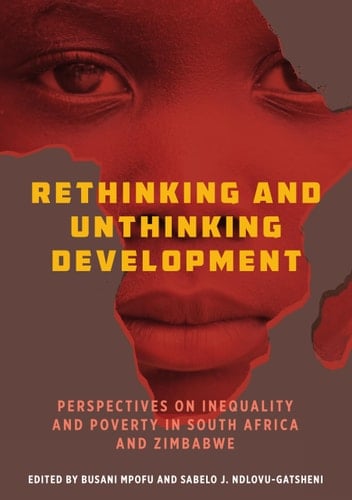
Rethinking and Unthinking Development Perspectives on Inequality and Poverty in South Africa and Zimbabwe
Busani Mpofu · 2023
<p> Development has remained elusive in Africa. Through theoretical contributions and case studies focusing on Southern Africa’s former white settler states, South Africa and Zimbabwe, this volume responds to the current need to rethink (and unthink) development in the region. The authors explore how Africa can adapt Western development models suited to its political, economic, social and cultural circumstances, while rejecting development practices and discourses based on exploitative capitalist and colonial tendencies. Beyond the legacies of colonialism, the volume also explores other factors impacting development, including regional politics, corruption, poor policies on empowerment and indigenization, and socio-economic and cultural barriers.</p>
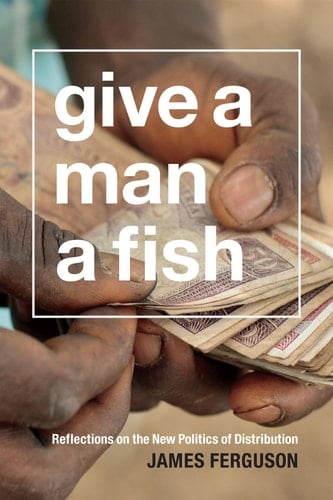
Give a Man a Fish Reflections on the New Politics of Distribution
James Ferguson · 2015
In <i>Give a Man a Fish</i> James Ferguson examines the rise of social welfare programs in southern Africa, in which states make cash payments to their low income citizens. More than thirty percent of South Africa's population receive such payments, even as pundits elsewhere proclaim the neoliberal death of the welfare state. These programs' successes at reducing poverty under conditions of mass unemployment, Ferguson argues, provide an opportunity for rethinking contemporary capitalism and for developing new forms of political mobilization. Interested in an emerging "politics of distribution," Ferguson shows how new demands for direct income payments (including so-called "basic income") require us to reexamine the relation between production and distribution, and to ask new questions about markets, livelihoods, labor, and the future of progressive politics.
Disrupted Development and the Future of Inequality in the Age of Automation
Lukas Schlogl · 2020
This open access book examines the future of inequality, work and wages in the age of automation with a focus on developing countries. The authors argue that the rise of a global ‘robot reserve army’ has profound effects on labor markets and economic development, but, rather than causing mass unemployment, new technologies are more likely to lead to stagnant wages and premature deindustrialization. The book illuminates the debate on the impact of automation upon economic development, in particular issues of poverty, inequality and work. It highlights public policy responses and strategies–ranging from containment to coping mechanisms—to confront the effects of automation. <br>
Social Policy in Post-apartheid South Africa Social Re-engineering for Inclusive Development
Ndangwa Noyoo · 2020
<p>This book critically examines the current social policy in post-apartheid South Africa and proposes an alternative social policy agenda to create a new development pathway for the country. </p> <p>Taking social policy as a vehicle that will facilitate the creation of a new society altogether, namely the "Good Society," the author argues for the adoption of policy that will socially re-engineer South Africa. The author shows how the policy tools and development interventions which were undertaken by the post-apartheid state in driving South Africa's transformation agenda failed to emancipate many individuals, families, and communities from the cycle of intergenerational poverty and underdevelopment. He contends that social policy interventions that foster the social re-engineering of South African society must take place to untangle the inherited colonial-apartheid social order. This book includes comparative analyses on the Global South and Global North to present the ways in which countries such as post-Second World War Great Britain and Sweden, and post-independence Zambia of the 1960s and 1970s, were able to use social policy to create new societies altogether or places similar to the "Good Society." </p> <p>The conceptual and methodological issues that form the basis for this book reside in public policy-making and the public good and will be of interest to scholars of social policy, social development, and South African society.</p>

Life in Debt Times of Care and Violence in Neoliberal Chile
Clara Han · 2012
“<i>Life in Debt</i> will become, I predict, one of the classic ethnographies in the anthropological study of state violence, community responses, and the moral life of the global poor. Relating economic and political debt, financial and psychological depression, and caregiving by ordinary people and by social institutions, Clara Han maps our brave new world just about as illuminatingly as it has been done. A remarkable achievement.” -Arthur Kleinman, Harvard University<br><br>“In this highly sophisticated take on the ironies of neoliberal social reforms, the corporate sector, consumer culture, and chronic underemployment, nothing can be read literally. Han transforms underclass urban ethnography in Latin America by bringing readers directly into the intimate flow of relationships, experiences, and emotions in family life on the margins of Santiago, Chile." -Kay Warren, Director, Pembroke Center, Brown University. <br><br>"People-centered, movingly written, and analytically probing, <i>Life in Debt</i> deals with both the human costs and the changing structures of power driven by contemporary dynamics of neoliberalism. Combining a deep and nuanced understanding of Chile's history with a longitudinal and heart-wrenching field-based knowledge of the everyday travails of the urban poor, Clara Han has crafted an exceptional analysis of human transformations in the face of political violence and economic insecurity." -João Biehl, author of <i>Vita: Life in a Zone of Social Abandonment</i><br><br>"During ten years, Clara Han has gathered fragments of biographies and moments of lives to recreate the experience of Chileans after Pinochet’s dictatorship. Her vivid ethnography plunges into the moral economy of a society entangled between memory and pardon, revealing the ethical work undertaken by those who accept the present without disclaiming the past." -Didier Fassin, Institute for Advanced Study, Princeton, author of <i>Humanitarian Reason</i>

The Lie of Global Prosperity How Neoliberals Distort Data to Mask Poverty and Exploitation
Seth Donnelly · 2019
<p><b>A deconstruction of the neoliberal placations about global capitalism, exposing the inequalities of global poverty</b><br><br>“We’re making headway on global poverty,” trills Bill Gates. “Decline of Global Extreme Poverty Continues,” reports the World Bank. “How did the global poverty rate halve in 20 years?” inquires The Economist. <br><br>Seth Donnelly answers: “It didn’t!” In fact, according to Donnelly, virtually nothing about these glad tidings proclaiming plummeting global poverty rates is true. It’s just that trend-setting neoliberal experts and institutions need us to believe that global capitalism, now unfettered in the wake of the Cold War and bolstered by Information Technology, has ushered in a new phase of international human prosperity.<br><br>This short book deconstructs the assumption that global poverty has fallen dramatically, and lays bare the spurious methods of poverty measurement and data on which the dominant prosperity narrative depends. Here is carefully researched documentation that global poverty—and the inequalities and misery that flourish within it—remains massive, afflicting the majority of the world’s population. Donnelly goes further to analyze just how global poverty, rather than being reduced, is actually reproduced by the imperatives of capital accumulation on a global scale. Just as the global, environmental catastrophe cannot be resolved within capitalism, rooted as it is in contemporary mechanisms of exploitation and plunder, neither can human poverty be effectively eliminated by neoliberal “advances.”</p>

The Economics of Inequality
Thomas Piketty · 2015
<p>Thomas Piketty—whose <i>Capital in the Twenty-First Century</i> pushed inequality to the forefront of public debate—wrote <i>The Economics of Inequality</i> as an introduction to the conceptual and factual background necessary for interpreting changes in economic inequality over time. This concise text has established itself as an indispensable guide for students and general readers in France, where it has been regularly updated and revised. Translated by Arthur Goldhammer, <i>The Economics of Inequality</i> now appears in English for the first time.<br><br>Piketty begins by explaining how inequality evolves and how economists measure it. In subsequent chapters, he explores variances in income and ownership of capital and the variety of policies used to reduce these gaps. Along the way, with characteristic clarity and precision, he introduces key ideas about the relationship between labor and capital, the effects of different systems of taxation, the distinction between “historical” and “political” time, the impact of education and technological change, the nature of capital markets, the role of unions, and apparent tensions between the pursuit of efficiency and the pursuit of fairness.<br><br>Succinct, accessible, and authoritative, this is the ideal place to start for those who want to understand the fundamental issues at the heart of one of the most pressing concerns in contemporary economics and politics.</p>
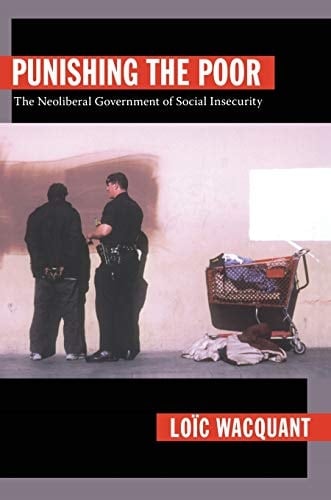
Punishing the Poor The Neoliberal Government of Social Insecurity
Loïc Wacquant · 2009
The punitive turn of penal policy in the United States after the acme of the Civil Rights movement responds not to rising <i>criminal</i> insecurity but to the <i>social</i> insecurity spawned by the fragmentation of wage labor and the shakeup of the ethnoracial hierarchy. It partakes of a broader reconstruction of the state wedding restrictive “workfare” and expansive “prisonfare” under a philosophy of moral behaviorism. This paternalist program of penalization of poverty aims to curb the urban disorders wrought by economic deregulation and to impose precarious employment on the postindustrial proletariat. It also erects a garish theater of civic morality on whose stage political elites can orchestrate the public vituperation of deviant figures—the teenage “welfare mother,” the ghetto “street thug,” and the roaming “sex predator”—and close the legitimacy deficit they suffer when they discard the established government mission of social and economic protection. By bringing developments in welfare and criminal justice into a single analytic framework attentive to both the instrumental and communicative moments of public policy, <i>Punishing the Poor</i> shows that the prison is not a mere technical implement for law enforcement but a core political institution. And it reveals that the capitalist revolution from above called neoliberalism entails not the advent of “small government” but the building of an overgrown and intrusive penal state deeply injurious to the ideals of democratic citizenship.<p>Visit the author’s website.</p>

Reclaiming the State A Progressive Vision of Sovereignty for a Post-neoliberal World
William Mitchell · 2017
Trump. Brexit. The alt-right. It's increasingly apparent that old political notions--believed to be consigned to the dustbin of history--are now resurrected. The neonationalist, anti-globalization, and anti-establishment attitude engulfing the United States and United Kingdom hints suspiciously at a yearning for national sovereignty. <i>Reclaiming the State </i>offers an urgent and prescient political analysis and economic program for the Left who are strategizing for these uncertain times.<br> <br> Many of our assumptions--about ideology, democracy, trade, and globalization--are being thrown into doubt, deposed by populism, nationalism, and racism. In response to these challenging times, economist Bill Mitchell and political theorist Thomas Fazi propose a reconceptualization of the sovereign state as a vehicle for change. They offer a progressive view of sovereignty based not on the demonization of the other, but as a way to bring the economy back under democratic control. With nationalism gaining support across the United States with each passing week, <i>Reclaiaming the State </i>provides innovative ideas to mobilize and reenergize a tired, divided Left.

Invisible Doctrine The Secret History of Neoliberalism
George Monbiot · 2024
<b>#1 <i>SUNDAY TIMES </i>BESTSELLER • A <b>“fantastic” (Mark Ruffalo),</b> fiercely argued takedown of neoliberalism that not only defines this slippery concept but connects it to the climate crisis, poverty, and fascism—and shows us how to fight back.</b><br><br><b>“Incisive, illuminating, eye-opening—an unsparing anatomy of the great ideological beast stalking our times, often whispered about and yet never so clearly in view.”—David Wallace-Wells, author of <i>The Uninhabitable Earth</i></b><br><br>Neoliberalism is the dominant ideology of our time. It shapes us in countless ways, yet most of us struggle to articulate what it is. Worse, we have been persuaded to accept this extreme creed as a kind of natural law. In <i>Invisible Doctrine, </i>journalist George Monbiot and filmmaker Peter Hutchison shatter this myth. They show how a fringe philosophy in the 1930s—championing competition as the defining feature of humankind—was systematically hijacked by a group of wealthy elites, determined to guard their fortunes and power. Think tanks, corporations, the media, university departments and politicians were all deployed to promote the idea that people are consumers, rather than citizens.<br><br>One of the most pernicious effects has been to make our various crises—from climate disasters to economic crashes, from the degradation of public services to rampant child poverty—seem unrelated. In fact, they have all been exacerbated by the “invisible doctrine,” which subordinates democracy to the power of money. Monbiot and Hutchison connect the dots—and trace a direct line from neoliberalism to fascism, which preys on people’s hopelessness and desperation.<br><br>Speaking out against the fairy tale of capitalism and populist conspiracy theories, Monbiot and Hutchison lay the groundwork for a new politics, one based on truly participatory democracy and “private sufficiency, public luxury”: an inspiring vision that could help bring the neoliberal era to an end.

The Capital Order How Economists Invented Austerity and Paved the Way to Fascism
Clara E. Mattei · 2025
<b>A <i>Financial Times</i> Best Book of the Year<br> <br> "A must-read, with key lessons for the future."—Thomas Piketty<br> <br> A groundbreaking examination of austerity’s dark intellectual origins. </b><br> <br> For more than a century, governments facing financial crisis have resorted to the economic policies of austerity—cuts to wages, fiscal spending, and public benefits—as a path to solvency. While these policies have been successful in appeasing creditors, they’ve had devastating effects on social and economic welfare in countries all over the world. Today, as austerity remains a favored policy among troubled states, an important question remains: What if solvency was never really the goal? <br> <br> In <i>The Capital Order</i>, political economist Clara E. Mattei explores the intellectual origins of austerity to uncover its originating motives: the protection of capital—and indeed capitalism—in times of social upheaval from below. <br> <br> Mattei traces modern austerity to its origins in interwar Britain and Italy, revealing how the threat of working-class power in the years after World War I animated a set of top-down economic policies that elevated owners, smothered workers, and imposed a rigid economic hierarchy across their societies. Where these policies “succeeded,” relatively speaking, was in their enrichment of certain parties, including employers and foreign trade interests, who accumulated power and capital at the expense of labor. Here, Mattei argues, is where the true value of austerity can be observed: its insulation of entrenched privilege and its elimination of all alternatives to capitalism. <br> <br> Drawing on newly uncovered archival material from Britain and Italy, much of it translated for the first time, <i>The Capital Order</i> offers a damning and essential new account of the rise of austerity—and of modern economics—at the levers of contemporary political power.
Bureaucracy, Foreign Aid, & The NGO Industry

How Development Projects Persist Everyday Negotiations with Guatemalan NGOs
Erin Beck · 2017
In <i>How Development Projects Persist</i> Erin Beck examines microfinance NGOs working in Guatemala and problematizes the accepted wisdom of how NGOs function. Drawing on twenty months of ethnographic fieldwork, she shows how development models and plans become entangled in the relationships among local actors in ways that alter what they are, how they are valued, and the conditions of their persistence. Beck focuses on two NGOs that use drastically different methods in working with poor rural women in Guatemala. She highlights how each program's beneficiaries—diverse groups of savvy women—exercise their agency by creatively appropriating, resisting, and reinterpreting the lessons of the NGOs to match their personal needs. Beck uses this dynamic—in which the goals of the developers and women do not often overlap—to theorize development projects as social interactions in which policymakers, workers, and beneficiaries critically shape what happens on the ground. This book displaces the notion that development projects are top-down northern interventions into a passive global south by offering a provocative account of how local conditions, ongoing interactions, and even fundamental tensions inherent in development work allow such projects to persist, but in new and unexpected ways.
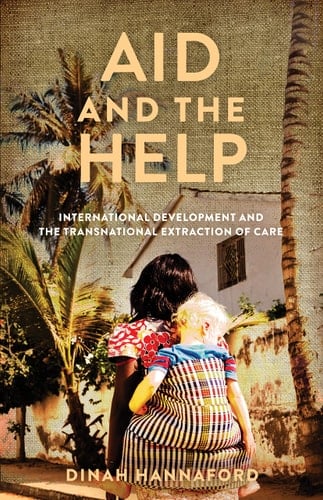
Aid and the Help International Development and the Transnational Extraction of Care
Dinah Hannaford · 2023
<p>Hiring domestic workers is a routine part of the expat development lifestyle. Whether working for the United Nations, governmental aid agencies, or NGOs such as Oxfam, Save the Children, or World Vision, expatriate aid workers in the developing world employ maids, nannies, security guards, gardeners and chauffeurs. Though nearly every expat aid worker in the developing world has local people working within the intimate sphere of their homes, these relationships are seldom, if ever, discussed in analyses of the development paradigm and its praxis. <i>Aid and the Help</i> addresses this major lacuna through an ethnographic analysis of the intersection of development work and domestic work. Examining the reproductive labor cheaply purchased by aid workers posted overseas opens the opportunity to assess the multiple ways that the ostensibly "giving" industry of development can be an extractive industry as well.</p>

Why We Lie About Aid Development and the Messy Politics of Change
Pablo Yanguas · 2018
<p>Foreign aid is about charity. International development is about technical fixes. At least that is what we, as donor publics, are constantly told. The result is a highly dysfunctional aid system which mistakes short-term results for long-term transformation and gets attacked across the political spectrum, with the right claiming we spend too much, and the left that we don't spend enough.<br><br>The reality, as Yanguas argues in this highly provocative book, is that aid isn't – or at least shouldn't be – about levels of spending, nor interventions shackled to vague notions of 'accountability' and 'ownership'. Instead, a different approach is possible, one that acknowledges aid as being about struggle, about taking sides, about politics. It is an approach that has been quietly applied by innovative development practitioners around the world, providing political coverage for local reformers to open up spaces for change. Drawing on a variety of convention-defying stories from a variety of countries – from Britain to the US, Sierra Leone to Honduras – Yanguas provides an eye-opening account of what we really mean when we talk about aid.</p>

Against NGOs A Critical Perspective on Civil Society, Management and Development
Nidhi Srinivas · 2022
What would development look like if its practitioners and scholars were 'against NGOs,' challenging common sense about them? This book presents a critical perspective on NGOs, describing how they emerged as key agents of development over time. Through an interpretative history based on Gramscian concepts it shows how civil society organizations were gradually enlisted in development as non-state technocratic actors. The book argues that management studies and development studies emerged as commonsensical explanations for capitalist crises. Each offered complementary solutions to balance the needs of capital and society, in particular historical circumstances. These solutions also situated civil society as agents of development and vectors of management. Against NGOs fills a gap within the literature of management and development studies through its original discussion of their historical interconnections and shared themes. The book raises provocative questions on what forms of knowledge-politics can respond productively to the crises of our contemporary moment.
Cultivating Development An Ethnography of Aid Policy and Practice
David Mosse · 2005
By focusing in detail on the activities of a development project in tribal western India over more than ten years as it falls under different policy regimes, this book takes a close look at the relationship between policy and practice in development.
Anti-Politics Machine Development, Depoliticization, and Bureaucratic Power in Lesotho
James Ferguson · 1994
Development, it is generally assumed, is good and necessary, and in its name the West has intervened, implementing all manner of projects in the impoverished regions of the world. When these projects fail, as they do with astonishing regularity, they nonetheless produce a host of regular and unacknowledged effects, including the expansion of bureaucratic state power and the translation of the political realities of poverty and powerlessness into "technical" problems awaiting solution by "development" agencies and experts. It is the political intelligibility of these effects, along with the process that produces them, that this book seeks to illuminate through a detailed case study of the workings of the "development" industry in one country, Lesotho, and in one "development" project. Using an anthropological approach grounded in the work of Foucault, James Ferguson analyzes the institutional framework within which such projects are crafted and the nature of "development discourse," revealing how it is that, despite all the "expertise" that goes into formulating development projects, they nonetheless often demonstrate a startling ignorance of the historical and political realities of the locale they are intended to help. In a close examination of the attempted implementation of the Thaba-Tseka project in Lesotho, Ferguson shows how such a misguided approach plays out, how, in fact, the "development" apparatus in Lesotho acts as an "anti-politics machine," everywhere whisking political realities out of sight and all the while performing, almost unnoticed, its own pre-eminently political operation of strengthening the state presence in the local region.James Ferguson is an associate professor of anthropology at the University of California at Irvine.

Local Space, Global Life The Everyday Operation of International Law and Development
Luis Eslava · 2016
Local Space, Global Life engages with the expansive, ground-level and intertwined operations of international law and the development project by discussing the current international focus on local jurisdictions. Since the mid-1980s, and through the discourse of decentralization, municipalities and cities in emerging nations have become the preferred spaces in which to promote global ideals of human, economic and environmental development. Through an ethnographic study of Bogotá's recent development experience and the city's changing relation to its illegal neighbourhoods, Luis Eslava interrogates this rationale and exposes the contradictions involved in the international turn to the local. Attentive to historical and current transformations, norms and praxis, and both ideology and materiality, he provides an innovative reading of the nature of international law and the development project, and reveals their impact on local spaces and lives at the urban periphery of today's world order.
Susceptibility in Development Micropolitics of Local Development in India and Indonesia
Tanya Jakimow · 2020
Susceptibility in Development offers a novel approach to understanding power in development through theories of affect and emotion. Development agents - people tasked with designing or delivering development - are susceptible to being affected in ways that may derail or threaten their 'sense of self'. This susceptibility is in direct relation to the capacity of others to engender feelings in development agents: an overlooked form of power. Susceptibility in Development proposes a new analytical framework to enable new readings of power relations and their consequences for development. Susceptibility in Development offers a comparative ethnography of two types of local development agents: volunteers in a community development program in Medan, Indonesia, and women municipal councillors in Dehradun, India. Ethnographic accounts that are attentive to the emotions and affects engendered in encounters between individuals provide a fresh reading of the relations shaping local development. Local development agents may be more 'susceptible' than workers and volunteers from the global North, yet the capacity/susceptibility to affect/be affected orders relations and shapes outcomes of development more broadly. In theorising from the local, Susceptibility in Development offers fresh insights into power dynamics in development.

The Aid Effect: Ethnographies of Development Practice and Neo-liberal Reform (Anthropology, Culture and Society)
David Moss · 2005
Today international development policy is converging around ideas of neoliberal reform, democratisation and poverty reduction. What does this mean for the local and international dimensions of aid relationships?The Aid Effect demonstrates the fruitfulness of an ethnographic approach to aid, policy reform and global governance. The contributors provide powerful commentary on hidden processes, multiple perspectives or regional interests behind official aid policy discourses. The book raises important questions concerning the systematic social effects of aid relationships, the nature of sovereignty and the state, and the working of power inequalities built through the standardisations of a neoliberal framework. The contributors take on new challenges to anthropology presented by a ‘global aid architecture’ which no longer operates through discrete projects but has moved on to sector wide approaches, budgetary support and other macro-level instruments of development; but they remain faithful to the fieldwork methodology that is anthropology’s strength and the source of rare insight.

Foreign Aid and Emerging Powers Asian Perspectives on Official Development Assistance
Iain Watson · 2015
"Current debates on emerging powers as foreign aid donors often fail to examine the myriad geopolitical, geoeconomic and geocultural tensions that influence policies of Official Development Assistance (ODA). This book advocates a regional geopolitical approach to explaining donor-donor relationships and provides a multidisciplinary critical assessment of the contemporary debates on emerging powers and foreign aid, bringing together economic and geopolitical approaches in the light of the 2015 completion of the Millennium Development Goals (MDGs). Moving away from established debates assessing the advantages and disadvantages of foreign aid, this book challenges the current geopolitical assumptions of the emerging powers concerning issues such as 'south-south' solidarity, shared development experience and 'multipolarity'. It analyses how donor governments 'sell' aid to recipients through enabling different cultural assumptions and soft power narratives of national identity and provides empirical evidence on agendas such as aid effectiveness, aid for trade, public-private partnerships, and green growth aid. The book examines the role of, and relationships between, the leading traditional and emerging power Asian donors specifically, and explores the different and contested perspectives and patterns of ODA policy through an alternative account of emerging power foreign aid to leading African and Asian recipients.This book provides a valuable resource for postgraduate students and practitioners across disciplines such as development economics and geopolitics of development, uniquely approaching the debate from the perspective of emerging powers and donors. "--
Development as a Battlefield
Béatrice Hibou · 2017
<i>Development as a Battlefield</i> is an innovative exploration of the multidimensional meanings of - and interactions between - conflict and development. The two phenomena are all too often regarded as ostensibly antagonistic. This was exemplified again in the context of the Arab Spring that erupted in December 2010 and was eventually short-lived in several countries of the Middle-East and North-Africa (MENA) region. This volume - the 8th thematic issue of <i>International Development Policy</i> - is an invitation to reconsider and renew the way social scientists usually seek to make sense of socio-political and economic developments in the MENA region and beyond.<br> <br> Contributors include: Fariba Adelkhah, Yasmine Berriane, Irene Bono, Ayşe Buğra, Raphaëlle Chevrillon-Guibert, Anouck Gabriela Côrte réal-Pinto, Nadia Hachimi Alaoui, Béatrice Hibou, Adriana Kemp, Nora Lafi. Talia Margalit, Marie Vannetzel, Elena Vezzadini, and Merieme Yafout.

An Ethnography of NGO Practice in India Utopias of Development
Stewart Allen · 2018
Through an ethnographic study of the 'Barefoot College', an internationally renowned non- governmental development organisation (NGO) situated in Rajasthan, India, this book investigates the methods and practices by which a development organisation materialises and manages a construction of success. Paying particular attention to the material processes by which success is achieved and the different meanings and discourses that they act to perform, this book offers a timely and novel approach to how the world of development NGOs and development ideologies work. The author argues that the College, as a prolific producer of various forms of development media, achieves its success through materially mediated heterotopic spectacles: enacted and imperfect utopias that constitute the desires, imaginings and Otherness of its society. The chapters that follow consider the different scenarios through which success was realised at the College.

Implementing Inequality The Invisible Labor of International Development
Rebecca Warne Peters · 2020
"Implementing Inequality argues that the international development industry's internal dynamics--between international and national staff, and among policy makers, administrators, and implementers--shape interventions and their outcomes as much as do the external dynamics of global political economy. Through an ethnographic study in postwar Angola, the book demonstrates how the industry's internal social pressures guide development's methods and goals, introducing the innovative concept of the development implementariat: those in-country workers, largely but not exclusively "local" staff members, charged with carrying out development's policy prescriptions. The implementariat is central to the development endeavor but remains overlooked and under-supported as most of its work is deeply social, interactive, and relational, the kind of work that receives less recognition and support than it deserves at every echelon of the industry. If international development is to meet its larger purpose, it must first address its internal inequalities of work and professional class."--
Government of Paper The Materiality of Bureaucracy in Urban Pakistan
Matthew S. Hull · 2012
“Drawing inspiration from actor-network theory, science studies, and semiotics, this brilliant book makes us completely rethink the workings of bureaucracy as analyzed by Max Weber and James Scott. Matthew Hull demonstrates convincingly how the materiality of signs truly matters for understanding the projects of ‘the state.’” - Katherine Verdery, author of <i>What was Socialism, and What Comes Next?</i><br><br>“We are used to studies of roads and rails as central material infrastructure for the making of modern states. But what of records, the reams and reams of paper that inscribe the state-in-making? This brilliant book inquires into the materiality of information in colonial and postcolonial Pakistan. This is a work of signal importance for our understanding of the everyday graphic artifacts of authority.” - Bill Maurer, author of <i>Mutual Life, Limited: Islamic Banking, Alternative Currencies, Lateral Reason</i><br><br>"This is an excellent and truly exceptional ethnography. Hull presents a theoretically sophisticated and empirically rich reading that will be an invaluable resource to scholars in the field of Anthropology and South Asian studies. The author’s focus on bureaucracy, “corruption," writing systems and urban studies (Islamabad) in a post-colonial context makes for a unique ethnographic engagement with contemporary Pakistan. In addition, Hull’s study is a refreshing voice that breaks the mold of current representation of Pakistan through the security studies paradigm." - Kamran Asdar Ali, Director, South Asia Institute, University of Texas<br><br><br><br>

Red Tape Bureaucracy, Structural Violence, and Poverty in India
Akhil Gupta · 2012
<i>Red Tape</i> presents a major new theory of the state developed by the renowned anthropologist Akhil Gupta. Seeking to understand the chronic and widespread poverty in India, the world's fourth largest economy, Gupta conceives of the relation between the state in India and the poor as one of structural violence. Every year this violence kills between two and three million people, especially women and girls, and lower-caste and indigenous peoples. Yet India's poor are not disenfranchised; they actively participate in the democratic project. Nor is the state indifferent to the plight of the poor; it sponsors many poverty amelioration programs.<p>Gupta conducted ethnographic research among officials charged with coordinating development programs in rural Uttar Pradesh. Drawing on that research, he offers insightful analyses of corruption; the significance of writing and written records; and governmentality, or the expansion of bureaucracies. Those analyses underlie his argument that care is arbitrary in its consequences, and that arbitrariness is systematically produced by the very mechanisms that are meant to ameliorate social suffering. What must be explained is not only why government programs aimed at providing nutrition, employment, housing, healthcare, and education to poor people do not succeed in their objectives, but also why, when they do succeed, they do so unevenly and erratically.</p>
Frontiers, Indigenous Resurgence, & Marginality
Politics, Power and Community Development
Rosie Meade, Mae Shaw, Sarah Banks · 2016

Reimagining Development in Southeast Asia Alternative Practices from the Grassroots and Social Movements
Jose Monfred C. Sy · 2025
<p>This volume consolidates chapters from across Southeast Asia as a means of discussing alternative development pathways. It presents radical re-imaginings of how development might look, considered alongside the growing disillusionment over mainstream development models. In suggesting alternative models of development, it reframes participatory processes from the developing world, discussing practices of decolonization, anti-capitalism, plurality, anti-racism, effacing patriarchy, and ecological sustainability, designed and executed by grassroot communities and civil society organisations (CSOs). The grassroots and social movement paradigms highlighted in this collection seek to challenge and change the dominant model of development instituted in ASEAN, which have largely failed in meaningfully addressing the issues faced by different sectors. That the book project springs from an engagement between scholars and on-the-ground practitioners means that several chapters combine reflective, case-based viewpoints. To this end, the book is relevant to scholars, students, and practitioners working in areas related to Southeast Asian politics, economy, and culture.</p>
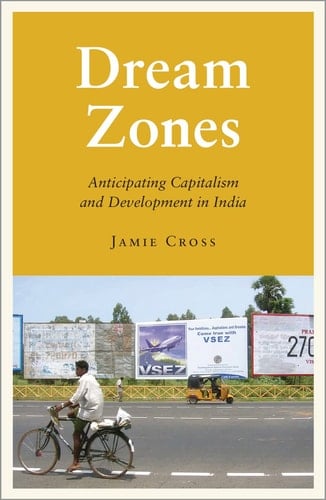
Dream Zones Capitalism and Development in India
Jamie Cross · 2014
Drawing on five years of research in and around India's special economic zones (SEZs) Dream Zones follows the stories of regional politicians, corporate executives, rural farmers, industrial workers and social activists to show how the pursuit of growth, profit and development shapes the politics of industrialisation and liberalisation. <br><br>This book offers a timely reminder that global political economy is shaped by sentiments as much as reason and that un-realised expectations are the grounds on which new hopes for the future are sown.<br></p>

The Democracy Development Machine Neoliberalism, Radical Pessimism, and Authoritarian Populism in Mayan Guatemala
Nicholas Copeland · 2019
<p><b>Nicholas Copeland sheds new light on rural politics in Guatemala and across neoliberal and post-conflict settings in</b> <b><i>The Democracy Development Machin</i></b><b>e.</b> This historical ethnography examines how governmentalized spaces of democracy and development fell short, enabling and disfiguring an ethnic Mayan resurgence.</p> <p>In a passionate and politically engaged book, Copeland argues that the transition to democracy in Guatemalan Mayan communities has led to a troubling paradox. He finds that while liberal democracy is celebrated in most of the world as the ideal, it can subvert political desires and channel them into illiberal spaces. As a result, Copeland explores alternative ways of imagining liberal democracy and economic and social amelioration in a traumatized and highly unequal society as it strives to transition from war and authoritarian rule to open elections and free-market democracy.<i>The Democracy Development Machine</i> follows Guatemala's transition, reflects on Mayan involvement in politics during and after the conflict, and provides novel ways to link democratic development with economic and political development.</p> <p>Thanks to generous funding from Virginia Tech and its participation in TOME (Toward an Open Monograph Ecosystem), the ebook editions of this book are available as Open Access (OA) volumes from Cornell Open (cornellpress.cornell.edu/cornell-open) and other Open Access repositories.</p>

Dilemmas of Difference Indigenous Women and the Limits of Postcolonial Development Policy
Sarah A. Radcliffe · 2015
In <i>Dilemmas of Difference</i> Sarah A. Radcliffe explores the relationship of rural indigenous women in Ecuador to the development policies and actors that are ostensibly there to help ameliorate social and economic inequality. Radcliffe finds that development policies’s inability to recognize and reckon with the legacies of colonialism reinforces long-standing social hierarchies, thereby reproducing the very poverty and disempowerment they are there to solve. This ineffectiveness results from failures to acknowledge the local population's diversity and a lack of accounting for the complex intersections of gender, race, ethnicity, class, and geography. As a result, projects often fail to match beneficiaries' needs, certain groups are made invisible, and indigenous women become excluded from positions of authority. Drawing from a mix of ethnographic fieldwork and postcolonial and social theory, Radcliffe centers the perspectives of indigenous women to show how they craft practices and epistemologies that critique ineffective development methods, inform their political agendas, and shape their strategic interventions in public policy debates.

In the Shadow of the Palms
Sophie Chao · 2022
With In the Shadow of the Palms, Sophie Chao examines the multispecies entanglements of oil palm plantations in West Papua, Indonesia, showing how Indigenous Marind communities understand and navigate the social, political, and environmental demands of the oil palm plant. As Chao notes, it is no secret that the palm oil sector has destructive environmental impacts: it greatly contributes to tropical deforestation and is a major driver of global warming. Situating the plant and the transformations it has brought within the context of West Papua’s volatile history of colonization, ethnic domination, and capitalist incursion, Chao traces how Marind attribute environmental destruction not just to humans, technologies, and capitalism but also to the volition and actions of the oil palm plant itself. By approaching cash crops as both drivers of destruction and subjects of human exploitation, Chao rethinks capitalist violence as a multispecies act. In the process, Chao centers how Marind fashion their own changing worlds and foreground Indigenous creativity and decolonial approaches to anthropology.

Anthropology and Development Challenges for the Twenty-First Century
Colin Cremin · 2015
Western aid is in decline. Non-traditional development actors from the developing countries and elsewhere are in the ascendant. A new set of global economic and political processes are shaping the twenty-first century. <br><br>Anthropology and Development is a completely rewritten new edition of the best-selling Anthropology, Development and the Post-Modern Challenge (1996). Published to a set of excellent reviews and strong sales, it, along with the new book, serves as both an innovative reformulation of the field, and as a textbook for many undergraduate and graduate courses at leading universities in Europe and North America. <br><br>For the new book, the authors Katy Gardner and David Lewis engage with nearly two decades of continuity and change in the development industry. In particular, they argue that while the world of international development has expanded since the 1990s, it has become more rigidly technocratic. Anthropology and Development therefore insists on a focus upon the core anthropological issues surrounding poverty and inequality, and thus sharply criticises the contemporary perceived problems in the field. <br></p>
Handbook of Rural Development
Gary Paul Green · 2013
Although most countries in the world are rapidly urbanizing, the majority of the global population - particularly the poor - continue to live in rural areas. This Handbook rejects the popular notion that urbanization should be universally encouraged and presents clear evidence of the vital importance of rural people and places, particularly in terms of environmental conservation. Expert contributors from around the world explore how global trends, state policies and grassroots movements affect contemporary rural areas in both developed and developing countries. Rural development policies have historically focused primarily on increasing agricultural productivity, but this volume demonstrates the need for a much broader approach as rural producers become increasingly integrated into the global economy. Following a comprehensive discussion of rural development theory and policy, the contributors tackle a number of diverse topics, including resource dependence, migration, entrepreneurship and microfinance, tourism and gender issues. The book concludes with detailed explorations of rural development in different areas of the world, including Africa, China and Latin America. Professors and students of development studies, agricultural economics, environmental studies and sociology will find this Handbook an indispensable resource, as will practitioners and policymakers working in rural areas around the world.
Constructing a new framework for rural development
Pierluigi Milone · 2015
"This volume seeks to answer modern questions and concerns regarding peasants, their production techniques, and their links to wider society. In the past, peasants and their seemingly simple production models have been criticized for being unable to fully meet the needs of modern society, especially when it comes to world hunger, food quality, and sustainability. However, often neglected is the myriad of new initiatives that alter the way food is produced and marketed. New 'peasant markets' are created everywhere and new products and services abound. This volume argues that these initiatives represent "seeds of transition"; they are the "sprouts" out of which new socio-technical modes for organizing production and marketing emerge - "sprouts" that, taken together, can be summarized as "rural development". This book critically discusses these new practices and the actors engaged in them. In doing so, it deals with several countries in three different continents (Asia, South America and Europe). It proposes new concepts and approaches for a better understanding of the re-emergence of peasants as indispensable part of modern societies."
Women in Politics Gender, Power and Development
Mariz Tadros · 2014
<p>Women the world over are being prevented from engaging in politics. Women's political leadership of any sort is a rarity and a career in politics rarer still. We have, however, begun to understand what it takes to create an enabling environment for women's political participation.<br><br>In this exciting and pioneering collection, writers from Africa, Latin America, and the Middle East are brought together for the first time to talk explicitly about women's participation in the political scene across the global South. Answering such questions as how women can get political apprenticeship opportunities, how these opportunities translate into the pursuit of a political career, and how these pursuits then influence the kind of political platform women advocate once in power, Women in Politics is essential reading for anyone interested in what it means to engage politically.</p>

Engendering Development Capitalism and Inequality in the Global Economy
Amy Trauger, Jennifer L. Fluri · 2019

Masculinities and Femininities in Latin America's Uneven Development
Susan Paulson · 2020
<p>This book forges a new approach to historical and geographical change by asking how gender arrangements and dynamics influence the evolution of institutions and environments. This new theoretical approach is applied via mixed methods and a multi-scale framework to bring together unusually diverse phenomena. Regional trends demonstrated with quantitative data include the massive incorporation of women into paid work, demographic masculinization of the countryside and feminization of cities, rapidly increasing gaps that favor women over men in education and life expectancy, and extraordinarily high levels of violence against men. Case studies in Mexico, Chile and Bolivia explore changes influenced by gender practices and expectations that involve men in different ways than women; they also highlight dissimilarities and power relations between differently positioned masculine groups. Ethnographic studies of culturally diverse arrangements, together with particular attention to subordinate versus dominant masculinities, complicate the gender binaries that circumscribe so much research and policy. Drawing attention to imbalances and conflicts generated by inappropriate models and uneven developments, the book points to opportunities for experimenting with and adapting the sociocultural institutions that govern relations among humans and between humans and their environment.</p>

Conundrums of Care Feminist Entanglements in Critical Development Studies
Wendy Harcourt · 2025
<p><b>Renowned feminist development scholar Wendy Harcourt offers the first incisive open access overview of how the lively feminist debates on care, in both minority and majority worlds, are crucial for critical development studies.</b><br><br>Adopting an intentionally open and readable style to ensure its technical terms are understood, each chapter starts by narrating nonfictional, on-the-ground stories-stories selected from different places, peoples, and histories-in order to show how care is understood in feminist economic debates on key subjects such as social reproduction analysis; interspecies relations in posthumanism; environmental justice in feminist political ecology; and reciprocity and accountability in postdevelopment and decolonialism. In each chapter, these sketches are then fleshed out through a critical survey of influential thinkers and activists who adopt ecofeminist, feminist political ecology, critical indigenous studies, transition studies, postdevelopment, and decolonial approaches to development. <br><br>This book-alongside the illustrations, vlogs, and social-media messaging that accompany it online- provides researchers, students, practitioners, and activists with the tools to explain why care is such a crucial concept for critical development discourse.<br><br><i>The ebook editions of this book are available open access under a CC BY-NC-ND 4.0 licence on bloomsburycollections.com. Open access was funded by Erasmus University Rotterdam.</i></p>

Anthropology and Development: Understanding Contemporary Social Change
Jean-Pierre Olivier de Sardan · 2018

Demanding Development The Politics of Public Goods Provision in India's Urban Slums
Adam Michael Auerbach · 2019
India's urban slums exhibit dramatic variation in their access to local public goods and services - paved roads, piped water, trash removal, sewers, and streetlights. Why are some vulnerable communities able to demand and secure development from the state while others fail? Drawing on more than two years of fieldwork in the north Indian cities of Bhopal and Jaipur, Demanding Development accounts for the uneven success of India's slum residents in securing local public goods and services. Auerbach's theory centers on the political organization of slum settlements and the informal slum leaders who spearhead resident efforts to make claims on the state - in particular, those slum leaders who are party workers. He finds striking variation in the extent to which networks of party workers have spread across slum settlements. Demanding Development shows how this variation in the density and partisan distribution of party workers across settlements has powerful consequences for the ability of residents to politically mobilize to improve local conditions.
Planet of Slums
Mike Davis · 2017
<b>The “profound . . . brilliant” account of the rise of the world’s slums and the failures of modern urbanization—by the world’s leading urbanist (Arundhati Roy, activist and Booker Prize–winning author)</b><br><br> According to the United Nations, more than one billion people now live in the slums of the cities of the South. In this brilliant and ambitious book, Mike Davis explores the future of a radically unequal and explosively unstable urban world.<br> <br> From the sprawling <i>barricadas</i> of Lima to the garbage hills of Manila, urbanization has been disconnected from industrialization, and even from economic growth. Davis portrays a vast humanity warehoused in shantytowns and exiled from the formal world economy. He argues that the rise of this informal urban proletariat is a wholly unforeseen development, and asks whether the great slums, as a terrified Victorian middle class once imagined, are volcanoes waiting to erupt.
Indigenous Invisibility in the City Successful Resurgence and Community Development Hidden in Plain Sight
Deirdre Howard-Wagner · 2020
<p>Indigenous Invisibility in the City contextualises the significant social change in Indigenous life circumstances and resurgence that came out of social movements in cities. It is about Indigenous resurgence and community development by First Nations people for First Nations people in cities.</p>

Oaxaca Resurgent Indigeneity, Development, and Inequality in Twentieth-century Mexico
Alan Shane Dillingham · 2021
<p><i>Oaxaca Resurgent</i> examines how Indigenous people in one of Mexico's most rebellious states shaped local and national politics during the twentieth century. Drawing on declassified surveillance documents and original ethnographic research, A. S. Dillingham traces the contested history of indigenous development and the trajectory of the Mexican government's Instituto Nacional Indigenista, the most ambitious agency of its kind in the Americas. This book shows how generations of Indigenous actors, operating from within the Mexican government while also challenging its authority, proved instrumental in democratizing the local teachers' trade union and implementing bilingual education. Focusing on the experiences of anthropologists, government bureaucrats, trade unionists, and activists, Dillingham explores the relationship between indigeneity, rural education and development, and the political radicalism of the Global Sixties.</p> <p>By centering Indigenous expressions of anticolonialism, <i>Oaxaca Resurgent</i> offers key insights into the entangled histories of Indigenous resurgence movements and the rise of state-sponsored multiculturalism in the Americas. This revelatory book provides crucial context for understanding post-1968 Mexican history and the rise of the 2006 Oaxacan social movement.</p>
Dreams Made Small The Education of Papuan Highlanders in Indonesia
Jenny Munro · 2018
<p> For the last five decades, the Dani of the central highlands of West Papua, along with other Papuans, have struggled with the oppressive conditions of Indonesian rule. Formal education holds the promise of escape from stigmatization and violence. Dreams Made Small offers an in-depth, ethnographic look at journeys of education among young Dani men and women, asking us to think differently about education as a trajectory for transformation and belonging, and ultimately revealing how dreams of equality are shaped and reshaped in the face of multiple constraints.</p>
Civilizing the Margins Southeast Asian Government Policies for the Development of Minorities
Christopher R. Duncan · 2008
Discusses the programs, policies, and laws that affect ethnic minorities in eight countries: Burma, Cambodia, Indonesia, Laos, Malaysia, the Philippines, Thailand, and Viet Nam. Once targeted for intervention, people such as the Orang Asli of Malaysia and the "hill tribes" of Thailand often become the subject of programs aimed at radically changing their lifestyles, which the government views as backward or primitive. Several chapters highlight the tragic consequences of forced resettlement, a common result of these programs.
Centering the Margin Agency and Narrative in Southeast Asian Borderlands
Alexander Horstmann · 2006
<p> In a completely new approach to borders and border crossing, this volume suggests a re-conceptualization of the nation in Southeast Asia. Choosing an actor approach, the individual chapters in this volume capture the narratives of minorities, migrants and refugees who inhabit and cross borders as part of their everyday life. They show that people are not only constrained by borders; the crossing of borders also opens up new options of agency. Making active use of these, border-crossing actors construct their own live projects on the border in multiple ways against the original intention of the nation-state. Based on their intimate knowledge of the interaction of communities, anthropologists from Europe, the USA, Japan and Southeast Asia provide a vivid picture of the effects of state policies at the borders on these communities.</p>

Along the Integral Margin Uneven Development in a Myanmar Squatter Settlement
Stephen Campbell · 2022
<p><b>In recent years anthropologists have focused on informal, unfree, and other nonnormative labor arrangements and labeled them as "noncapitalist."</b> In <i>Along the Integral Margin</i>, Stephen Campbell pushes back against this idea and shows that these labor arrangements are, in fact, important aspects of capitalist development and that the erroneous "noncapitalist" label contributes to obscuring current capitalist relations.</p> <p>Through powerful, intimate ethnographic narratives of the lives and struggles of residents of a squatter settlement in Myanmar, Campbell challenges narrow conceptions of capitalism and asserts that nonnormative labor is not marginal but rather centrally important to Myanmar's economic development. Campbell's narrative approach brings individuals who are often marginalized in accounts of contemporary Myanmar to the forefront and raises questions about the diversity of work in capitalism.</p>
Challenging Southeast Asian Development The Shadows of Success
Jonathan Rigg · 2016
<p>Over the course of the last half century, the growth economies of Southeast Asia - Indonesia, Malaysia, the Philippines, Singapore, Thailand and Vietnam - have transformed themselves into middle income countries. This book looks at how the very success of these economies has bred new challenges, novel problems, and fresh tensions, including the fact that particular individuals, sectors and regions have been marginalised by these processes.</p> <p>Contributing to discussions of policy implications, the book melds endogenous and exogenous approaches to thinking about development paths, re-frames Asia's model(s) of growth and draws out the social, environmental, political and economic side-effects that have arisen from growth. An interesting analysis of the problems that come alongside development's achievements, this book is an important contribution to Southeast Asian Studies, Development Studies and Environmental Studies.</p>
Land and Development in Indonesia Searching for the People's Sovereignty
John F. McCarthy · 2016
<p>Indonesia was founded on the ideal of the “Sovereignty of the People”, which suggests the pre-eminence of people’s rights to access, use and control land to support their livelihoods. Yet, many questions remain unresolved. How can the state ensure access to land for agriculture and housing while also supporting land acquisition for investment in industry and infrastructure? What is to be done about indigenous rights? Do registration and titling provide solutions? Is the land reform agenda — legislated but never implemented — still relevant? How should the land questions affecting Indonesia’s disappearing forests be resolved?</p><p></p><p> </p><p>The contributors to this volume assess progress on these issues through case studies from across the archipelago: from large-scale land acquisitions in Papua, to asset ownership in the villages of Sulawesi and Java, to tenure conflicts associated with the oil palm and mining booms in Kalimantan, Sulawesi and Sumatra. What are the prospects for the “people’s sovereignty” in regard to land?</p>
The Art of Not Being Governed An Anarchist History of Upland Southeast Asia
James C. Scott · 2009
The Moral Economy of the Peasant Rebellion and Subsistence in Southeast Asia
James C. Scott · 1977
<p>James C. Scott places the critical problem of the peasant household—subsistence—at the center of this study. The fear of food shortages, he argues persuasively, explains many otherwise puzzling technical, social, and moral arrangements in peasant society, such as resistance to innovation, the desire to own land even at some cost in terms of income, relationships with other people, and relationships with institutions, including the state.<br>Once the centrality of the subsistence problem is recognized, its effects on notions of economic and political justice can also be seen. Scott draws from the history of agrarian society in lower Burma and Vietnam to show how the transformations of the colonial era systematically violated the peasants’ “moral economy” and created a situation of potential rebellion and revolution.</p><p><br>Demonstrating keen insights into the behavior of people in other cultures and a rare ability to generalize soundly from case studies, Scott offers a different perspective on peasant behavior that will be of interest particularly to political scientists, anthropologists, sociologists, and Southeast Asianists.</p><p><br>“The book is extraordinarily original and valuable and will have a very broad appeal. I think the central thesis is correct and compelling.”—Clifford Geertz</p><p><br> “In this major work, … Scott views peasants as political and moral actors defending their values as well as their individual security, making his book vital to an understanding of peasant politics.”—Library Journal </p>

Plantation Life Corporate Occupation in Indonesia's Oil Palm Zone
Tania Murray Li · 2021
In <i>Plantation Life</i> Tania Murray Li and Pujo Semedi examine the structure and governance of Indonesia's contemporary oil palm plantations in Indonesia, which supply 50 percent of the world's palm oil. They attend to the exploitative nature of plantation life, wherein villagers' well-being is sacrificed in the name of economic development. While plantations are often plagued by ruined ecologies, injury among workers, and a devastating loss of livelihoods for former landholders, small-scale independent farmers produce palm oil more efficiently and with far less damage to life and land. Li and Semedi theorize “corporate occupation” to underscore how massive forms of capitalist production and control over the palm oil industry replicate colonial-style relations that undermine citizenship. In so doing, they question the assumption that corporations are necessary for rural development, contending that the dominance of plantations stems from a political system that privileges corporations.
Land's End Capitalist Relations on an Indigenous Frontier
Tania Murray Li · 2014
Drawing on two decades of ethnographic research in Sulawesi, Indonesia, Tania Murray Li offers an intimate account of the emergence of capitalist relations among indigenous highlanders who privatized their common land to plant a boom crop, cacao. Spurred by the hope of ending their poverty and isolation, some prospered, while others lost their land and struggled to sustain their families. Yet the winners and losers in this transition were not strangers—they were kin and neighbors. Li's richly peopled account takes the reader into the highlanders' world, exploring the dilemmas they faced as sharp inequalities emerged among them.<br><br>The book challenges complacent, modernization narratives promoted by development agencies that assume inefficient farmers who lose out in the shift to high-value export crops can find jobs elsewhere. Decades of uneven and often jobless growth in Indonesia meant that for newly landless highlanders, land's end was a dead end. The book also has implications for social movement activists, who seldom attend to instances where enclosure is initiated by farmers rather than coerced by the state or agribusiness corporations. Li's attention to the historical, cultural, and ecological dimensions of this conjuncture demonstrates the power of the ethnographic method and its relevance to theory and practice today.
Transforming the Indonesian Uplands Marginality, Power and Production
Tania Li · 1999
Drawing upon current theoretical debates in social anthropology, development studies and political ecology, and presenting original research from across the Archipelago, this book addresses the changing histories and identities of upland people as they relate in new ways to the natural resource base, to markets and to the state. It is an engaged study, which fills important analytical gaps and addresses real-world concerns, exploring the uplands as components of national and global systems of meaning, power, and production. It offers a significant re-assessment of concepts, processes, histories, relationships and discourses, many of which are not unique to either the uplands or Indonesia, making the book essential and compelling reading for both scholars and practitioners.

The Will to Improve: Governmentality, Development, and the Practice of Politics
Tania Murray Li · 2007
The Will to Improve is a remarkable account of development in action. Focusing on attempts to improve landscapes and livelihoods in Indonesia, Tania Murray Li carefully exposes the practices that enable experts to diagnose problems and devise interventions, and the agency of people whose conduct is targeted for reform. Deftly integrating theory, ethnography, and history, she illuminates the work of colonial officials and missionaries; specialists in agriculture, hygiene, and credit; and political activists with their own schemes for guiding villagers toward better ways of life. She examines donor-funded initiatives that seek to integrate conservation with development through the participation of communities, and a one-billion-dollar program designed by the World Bank to optimize the social capital of villagers, inculcate new habits of competition and choice, and remake society from the bottom up.<br/>Demonstrating that the “will to improve” has a long and troubled history, Li identifies enduring continuities from the colonial period to the present. She explores the tools experts have used to set the conditions for reform—tools that combine the reshaping of desires with applications of force. Attending in detail to the highlands of Sulawesi, she shows how a series of interventions entangled with one another and tracks their results, ranging from wealth to famine, from compliance to political mobilization, and from new solidarities to oppositional identities and violent attack. The Will to Improve is an engaging read—conceptually innovative, empirically rich, and alive with the actions and reflections of the targets of improvement, people with their own critical analyses of the problems that beset them.
Imperialism, Geopolitics, & The Global Economy
Development Disrupted The Global South in the Twenty-First Century
Ruth Elizabeth Gordon · 2022
Beyond Colonialism, Development and Globalization
Dominique Caouette · 2015
Development studies is in a state of flux. A new generation of scholars has come to reject what was once regarded as accepted wisdom, and increasingly regard development and globalization as part of a continuum with colonialism, premised on the same reductionist assumption that progress and growth are objective facts that can be fostered, measured, assessed and controlled. Drawing on a variety of theoretical perspectives and approaches, this book explores the ways in which social movements in the Global South are rejecting Western-centric notions of development and modernization, as well as creating their own alternatives.<br/><br/>By assessing development theories from the perspective of subaltern groups and movements, the contributors posit a new notion of development 'from below', one in which these movements provide new ways of imagining social transformation, and a way out of the 'developmental dead end' that has so far characterized post-development approaches. <i>Beyond Colonialism, Development and Globalization</i> therefore represents a radical break with the prevailing narrative of modernization, and points to a bold new direction for development studies.
Globalization Development and Social Justice A Propositional Political Approach
Ann El Khoury · 2016
<p>Are there existing alternatives to corporate globalization? What are the prospects for and commonalities between communities and movements such as Occupy, the World Social Forum and alternative economies?</p> <p>Globalization Development and Social Justice advances the proposition that another globalization is not only possible, but already exists. It demonstrates that there are multiple pathways towards development with social justice and argues that enabling propositional agency, rather than oppositional agency such as resistance, is a more effective alternative to neoliberal globalization. El Khoury develops a theory of infraglobalization that emphasizes creative constitution, not just contestation, of global and local processes. The book features case studies and examples of diverse economic practice and innovative emergent political forms from the Global South and North. These case studies are located in the informal social economy and community development, as well as everyday practices, from prefigurative politics to community cooperatives and participatory planning.</p> <p>This book makes an important contribution to debates about the prospects for, and practices of, a transformative grassroots globalization, and to critical debates about globalization and development strategies. It will be of interest to students and scholars of international relations, globalization, social movement studies, political and economic geography, sociology, anthropology and development studies.</p>

Modernity at Large Cultural Dimensions of Globalization
Arjun Appadurai · 1996
Offering a new framework for the cultural study of globalization, Modernity at Large shows how the imagination works as a social force in today's world, providing new resources for identity and energies for creating alternatives to the nation-state, whose era some see as coming to an end. Appadurai examines the current epoch of globalization, which is characterized by the win forces of mass migration and electronic mediation, and provides fresh ways of looking at popular consumption patters, debates about multiculturalism, and ethnic violence. He considers the way images--of lifestyles, popular culture, and self-representation--circulate internationally through the media and are often borrowed in surprising (to their originators) and inventive fashions.
The Global Development Crisis
Benjamin Selwyn · 2014
The central paradox of the contemporary world is the simultaneous presence of wealth on an unprecedented scale, and mass poverty. Liberal theory explains the relationship between capitalism and poverty as one based around the dichotomy of inclusion (into capitalism) vs exclusion (from capitalism). Within this discourse, the global capitalist system is portrayed as a sphere of economic dynamism and as a source of developmental opportunities for less developed countries and their populations. Development policy should, therefore, seek to integrate the poor into the global capitalist system. <br> <br> <i>The Global Development Crisis</i> challenges this way of thinking. Through an interrogation of some of the most important political economists of the last two centuries Friedrich List, Karl Marx, Leon Trotsky, Joseph Schumpeter, Alexander Gerschenkron, Karl Polanyi and Amarta Sen, Selwyn argues that class relations are the central cause of poverty and inequality, within and between countries. In contrast to much development thinking, which portrays ‘the poor’ as reliant upon benign assistance, this book advocates the concept of labour-centred development. Here ‘the poor’ are the global labouring classes, and their own collective actions and struggles constitute the basis of an alternative form of non-elitist, bottom-up human development.

The Struggle for Development
Benjamin Selwyn · 2017
<p> The world economy is expanding rapidly despite chronic economic crises. Yet the majority of the world's population live in poverty. Why are wealth and poverty two sides of the coin of capitalist development? What can be done to overcome this destructive dynamic? </p> <p> In this hard-hitting analysis Benjamin Selwyn shows how capitalism generates widespread poverty, gender discrimination and environmental destruction. He debunks the World Bank's dollar-a-day methodology for calculating poverty, arguing that the proliferation of global supply chains is based on the labour of impoverished women workers and environmental ruin. Development theories - from neoliberal to statist and Marxist - are revealed as justifying and promoting labouring class exploitation despite their pro-poor rhetoric. Selwyn also offers an alternative in the form of labour-led development, which shows how collective actions by labouring classes - whether South African shack-dwellers and miners, East Asian and Indian Industrial workers, or Latin American landless labourers and unemployed workers - can and do generate new forms of human development. This labour-led struggle for development can empower even the poorest nations to overcome many of the obstacles that block their way to more prosperous and equitable lives.</p>
China in Africa Between Imperialism and Partnership in Humanitarian Development
Sabella O. Abidde · 2021
This book examines Sino-African relations and their impact on Africa. It argues that Africa’s relationship with China has had a profound impact on key sectors in Africa—economic and political development, the media, infrastructural development, foreign direct investments, loans, debt peonage, and international relations. The authors also analyze the imperialist and neo-colonialist implications of this relationship and discuss the degree to which the relationship is beneficial to Africa.

Imperialism and the Developing World How Britain and the United States Shaped the Global Periphery
Atul Kohli · 2021
How did Western imperialism shape the developing world? Atul Kohli tackles that question by analyzing British and American influence on Asia, Africa, the Middle East and Latin America from the age of the British East India Company to the most recent U.S. war in Iraq.<br> <br> How did Western imperialism shape the developing world? In Imperialism and the Developing World, Atul Kohli tackles this question by analyzing British and American influence on Asia, Africa, the Middle East, and Latin America from the age of the British East India Company to the most recent U.S. war in Iraq. He argues that both Britain and the U.S. expanded to enhance their national economic prosperity, and shows how Anglo-American expansionism hurt economic development in poor parts of the world.<br> <br> To clarify the causes and consequences of modern imperialism, Kohli first explains that there are two kinds of empires and analyzes the dynamics of both. Imperialism can refer to a formal, colonial empire such as Britain in the 19th century or an informal empire, wielding significant influence but not territorial control, such as the U.S. in the 20th century. Kohli contends that both have repeatedly undermined the prospects of steady economic progress in the global periphery, though to different degrees.<br> <br> Time and again, the pursuit of their own national economic prosperity led Britain and the U.S. to expand into peripheral areas of the world. Limiting the sovereignty of other states-and poor and weak states on the periphery in particular-was the main method of imperialism. For the British and American empires, this tactic ensured that peripheral economies would stay open and accessible to Anglo-American economic interests. Loss of sovereignty, however, greatly hurt the life chances of people living in Asia, the Middle East, Africa, and Latin America. As Kohli lays bare, sovereignty is an economic asset; it is a precondition for the emergence of states that can foster prosperous and inclusive industrial societies.
Imperialism and the Development Myth How Rich Countries Dominate in the Twenty-first Century
Sam King · 2021
<p>China and other Third World societies cannot 'catch up' with the rich countries. The contemporary world system is permanently dominated by a small group of rich countries who maintain a vice-like grip over the key parts of the labour process - over the most technologically sophisticated and complex labour. Globalisation of production since the 1980s means much more of the world's work is now carried out in the poor countries, yet it is the rich, imperialist countries - through their domination of the labour process - that monopolise most of the benefits. Income levels in the First World remain five and ten times higher than Third World countries. The huge gulf between rich and poor worlds is getting bigger not smaller. Under capitalist imperialism, it is permanent.<br> <br> China has moved from being one of the poorest societies to a level now similar with other relatively developed Third World societies - like Mexico and Brazil. The dominant idea that it somehow threatens to 'catch up' economically, or overtake the rich countries paves the way for imperialist military and economic aggression against China. King's meticulous study punctures the rising-China myth. His empirical and theoretical analysis shows that, as long as the world economy continues to be run for private profit, it can no longer produce new imperialist powers. Rather it will continue to reproduce the monopoly of the same rich countries generation after generation. The giant social divide between rich and poor countries cannot be overcome.</p>
Polarizing Development Alternatives to Neoliberalism and the Crisis
Lucia Pradella · 2014
The global economic crisis has exposed the limits of neoliberalism and intensified social polarization. Amid increasing social resistance and opposition, however, neoliberalism prevails globally. <br><br>Within political economic debates, however, radical alternatives are rarely debated or are reduced to new Keynesian and new developmental agendas, which fail to address existing class divisions and imperialist relations of domination. <br><br>This unique collection of essays polarizes the debate between radical and reformist alternatives by exploring head-on the antagonistic structure of capitalist development in Latin America, Southern Asia, Europe, the US and the Middle East. The contributors ground the question of alternatives in an international, non-Eurocentric and avowedly Marxian analysis of the capitalist system and its crises. The collection's approach is also distinctive in arguing that social and labour movements are core determinants of development outcomes and progressive change.<br><br>This new generation of scholars has written accessible yet theoretically informed and empirically rich chapters elaborating radically different worldwide strategies for moving beyond neoliberalism, and beyond capitalism. The intent is to provoke critical reflection and positive action towards substantive change.<br><br></p>
The Political Economy of Emerging Markets and Alternative Development Paths
Judit Ricz · 2024
<p>This volume is the continuation of our research on economic and developmental policy-making in the global semi-periphery in the post-crisis cycle (see our two recently published volumes titled ‘Market-Liberalism and Economic Patriotism in Capitalist Systems’ edited by Gerőcs and Szanyi, 2019, Palgrave Macmillan and ‘The Post-Crisis Developmental State – Perspectives from the Global Periphery’ edited by Gerőcs and Ricz, 2021). Our new volume aims to be a contribution to the analysis of emerging market economies’ alternative development trajectories, as we explore the new perspectives on semi-peripheral dependent development since the Global Financial Crisis and especially amidst the new global pandemic, the COVID-19.</p> <p>The scope of comparative capitalism research has also been altered accordingly to include the analysis of emerging economies outside the core of the world system, and to make intertemporal comparisons possible (such as to define and characterise historical wavesof state capitalism). Still, we are convinced that to better understand the current wave of state capitalism and to explore its national varieties there is a need to critically reconsider existing theoretical approaches and methodologies, and to search for new ones, if necessary.</p> <p>This book aims to be a contribution to the analysis of emerging market economies' alternative development trajectories and explores new perspectives on semi-peripheral dependent development, especially amidst COVID-19.</p><br>
Regional Inequality and Development Measurement and Applications in Indonesia
Takahiro Akita · 2023
This book addresses three main issues in regional income inequality and development: meaning of regional inequality, measurement of regional inequality and the relationship between national economic development and regional income inequality. It provides analytical methods useful in exploring the determinants of regional inequality in income and productivity. Some software commands in Stata (statistical software package) available for the measurement and analysis of income inequality are also introduced. Some researchers have argued that spatial concentration of population in and around major cities and the concurrent increase in regional inequality do not hinder national economic development, and may stimulate it. Nevertheless, many national governments seek to promote balanced regional economic development and reduce regional income inequality, because unbalanced development and higher levels of regional inequality may cause political or ethnic conflicts between different regions of the country. As the applications of the analytical methods introduced in the first part of the book, the second part presents four independent empirical studies on regional inequality and development in Indonesia. They offer very interesting case studies for the formulation of policies and programs to reduce regional inequalities, because as the world’s largest archipelagic country with more than 13 thousand islands and 300 ethnic groups, Indonesia is spatially diverse in terms of its ecology, natural resource endowments, economy, ethnicity and culture.This book can be used as a textbook for undergraduate and graduate students who are interested in national economic development and regional income inequality. It is also beneficial for practitioners and policy makers who are in charge of the formulation, implementation and evaluation of development policies and programs.<br>

The Political Economy of Southeast Asia Politics and Uneven Development under Hyperglobalisation
Toby Carroll · 2020
<p>"This is not only the best collection of essays on the political economy of Southeast Asia, but also, as a singular achievement of the “Murdoch School”, one of the rarest of books that demonstrates how knowledge production travels across generations, institutions and time periods, thereby continually enriching itself. No course on Southeast Asia can afford to miss it as its core text." (Professor Amitav Acharya, American University, USA)<br> <br> "This book – the fourth in a path-breaking series – demonstrates why a critical political economy approach is more crucial than ever for understanding Southeast Asia's transformation. Across a wide range of topics, the book explains how capitalist development and globalisation are reshaping the societies, economies and politics of a diverse group of countries, casting light on the deep sources of economic and social power in the region. This is a book that every student of Southeast Asia needs to read." (Professor Edward Aspinall, Australian National University, Australia)<br> <br> "This book does what a work on political economy should do: challenge existing paradigms in order to gain a deeper understanding of the processes of social transformation. This volume is distinctive in three ways. First, it eschews methodological nationalism and focuses on how the interaction of national, regional, and global forces are shaping and reshaping systems of governance, mass politics, economies, labor-capital relations, migration, and gender relations across the region. Second, it is a bold effort to show how the “Murdoch School,” which focuses on the dynamic synergy of internal class relations and global capitalism, provides a better explanatory framework for understanding social change in Southeast Asia than the rival “developmental state” and “historical institutionalist” approaches. Third, alongside established luminaries in the field, it showcases the younger generation of political economists doing pathbreaking work on different dimensions of the political economy of the region." (Walden Bello, State University of New York at Binghamton, USA, and Former Member of the Philippines’ House of Representatives)<br> <br> "This very timely fourth edition explores Southeast Asia’s political economy within the context of hyperglobalisation and China’s pronounced social-structural impacts on international politics, finance and economics over the past decade and a half. The volume successfully adopts a cross-cutting thematic approach, while also conveying the diversity and divergences among the Southeast Asian states and economies. This will be an important resource for scholars of International Relations and Comparative Politics, who need to take an interest in a dynamic and increasingly significant part of Asia." (Professor Evelyn Goh, Australian National University, Australia)<br> <br> “This ambitious collection takes a consistent theoretical approach and applies it to a thematic, comparative analysis across Southeast Asia. The yield is impressive: the social, political and economic forces constituting the current conjuncture are not simply invoked, they are thoroughly identified and explained. By posing the deceptively simple questions of what is happening and why, the authors demonstrate the reciprocal relation between theory-building and empirical inquiry, providing a model of engaged scholarship with global resonance. Bravo!" (Professor Tania Li, University of Toronto, Canada)<br> <br> "Counteracting the spaceless and flattened geography of much literature on uneven development, this book delivers a forensic examination of the unevenness of geographical development in Southeast Asia and the relations of force shaping capital, state, nature and civil society. This is the most compelling theoretical and empirical political economy book available on Southeast Asia." (Professor Adam David Morton, University of Sydney, Australia)<br> <br> "A vital book for all scholars, students and practitionersconcerned with political economy and development, this volume combines cutting-edge theory with rich and wide-ranging empirical analysis. It is terrific to see the continued success of this book with this fully revised fourth edition." (Professor Nicola Philips, Kings College London, UK)<br> <br> "The Political Economy of Southeast Asia has become a leading reference for students of the region. With its breadth of geographic scope, timely themes, clarity of prose and rigour of analysis, Carroll, Hameiri and Jones have ensured that with this fourth edition the volume will continue its landmark status. The book, which brings together prominent experts in the field, will not only be of immense interest to scholars studying Southeast Asia, but also those seeking to understand the multifaceted nature of the political economy of uneven development in contemporary capitalism." (Professor Susanne Soederberg, Queen’s University, Canada)<br> <br> "The Asia Research Centre at Murdoch University has long produced leading analyses of the social, economic and political developments in Southeast Asia. This volume carries on that wonderful tradition. It brings together top-class scholars to challenge our assumptions about one of the most dynamic parts of the world. This collection is a crucial read for anyone interested in understanding trends in Southeast Asia’s development today and into the future." (Professor Richard Stubbs, McMaster University, Canada)<br> <br> "This fourth volume in a distinguished series provides a welcome and timely update of the Murdoch School’s distinctive approach to understanding the evolving political economy of Southeast Asia. Its theoretical depth and wide empirical scope will be of great value to scholars, students and practitioners seeking a systematic understanding of the political economy dynamics in the Asian region and, more broadly, of states and regions embedded in a complex, unstable global political economy." (Professor Andrew Walter,University of Melbourne)<br> <br> <br> This all-new fourth edition of The Political Economy of Southeast Asia constitutes a state-of-the-art, comprehensive analysis of the political, economic, social and ecological development of one of the world’s most dynamic regions. With contributions from world-leading experts, the volume is unified by a single theoretical approach: the Murdoch School of political economy, which foregrounds struggles over power and resources and the evolving global context of hyperglobalisation. Themes considered include gender, populism, the transformation of the state, regional governance, aid and the environment. The volume will be of interest to scholars and students across multiple disciplines, including political economy, development studies, international relations and area studies. The findings of contributors will also be of value to civil society, policymakers and anyone interested in Southeast Asia and its development.</p>
Capitalism, Development and Empowerment of Labour A Heterodox Political Economy
Hartmut Elsenhans · 2023
<p>The neoliberal approach presents politics and political economy as nuisances which disturb the smooth operation of self-regulating markets. But political economy is not merely an academic issue - it is a class issue. This book forcefully argues that political economy should return to a central position in the study of the social sciences.</p>

The Tragedy of Human Development A Genealogy of Capital as Power
Tim Di Muzio · 2018
<p>How might an objective observer conceive of what humans have accomplished as a species over its brief history? Benjamin argues that history can be judged as one giant catastrophe. Liberals suggest that this is to sombre an assessment and that human history can be read as a story of greater and greater progress in human rights, prosperity and the decrease of arbitrary and extra-judicial violence. But is there a third reading of history, one that neither interprets human history as a giant catastrophe or endless progress? Could we not say that human development has been a tragedy? <br><br>This book explores the idea of human development as a tragedy from the perspective of capitalist power. Although the argument of this book draws heavily on critical political economy, the analysis considers interdisciplinary literature in an effort to explore how major revolutions have transformed human social relations of power and created certain path dependencies that may ultimately lead to our downfall as a species. Intellectually sophisticated and readable, this book offers a provocative genealogy of capitalist power and the tragedy of human development.</p>
Limits to Globalization Disruptive Geographies of Capitalist Development
Eric S. Sheppard · 2016
This book summarizes how globalizing capitalism - the economic system now presumed to dominate the global economy - can be understood from a geographical perspective. This is in contrast to mainstream economic analysis, which theorizes globalizing capitalism as a system that is capable of enabling everyone to prosper and every place to achieve economic development. From this perspective, the globalizing capitalism perspective has the capacity to reduce poverty. Poverty's persistence is explained in terms of the dysfunctional attributes of poor people and places. A geographical perspective has two principal aspects: Taking seriously how the spatial organization of capitalism is altered by economic processes and the reciprocal effects of that spatial arrangement on economic development, and examining how economic processes co-evolve with cultural, political, and biophysical processes. From this, globalizing capitalism tends to reproduce social and spatial inequality; poverty's persistence is due to the ways in which wealth creation in some places results in impoverishment elsewhere.
China and Latin America Development, Agency and Geopolitics
Chris Alden · 2023
<p>Since the turn of the century bilateral trade between China and Latin America has increased by more than a factor of ten. In 2000, two-way trade stood at £12.17 billion; by 2019, it had reached $307.94 billion. Coupled with this commercial element of China-Latin America relations is a growing assertiveness in diplomatic and military affairs. Yet Beijing is showing caution in its diplomatic engagement, especially with the more left leaning countries of Venezuela and Ecuador. However, Latin America's enthusiasm in this regard has taken even the Chinese by surprise.<br><br>What are we to make of these shifting dynamics? In this detailed and up-to-the-minute investigation, Chris Alden, author of the critically acclaimed <i>China in Africa</i>, and Alvaro Mendez, leading expert in the international relations of Latin America, look at the interests, strategies and practices of China's incoming power. What can be learned by comparing Latin America with other developing regions in which China has had significant economic ties and a growing diplomatic stake? Does Beijing's approach to Latin America really differ, as is often claimed by Chinese leaders, from its approach to Africa? And more broadly, how should we read the curious and uneven decline of both the US and Europe as actors in the region?</p>
Necropolitics
Achille Mbembe · 2019
In <i>Necropolitics</i> Achille Mbembe, a leader in the new wave of francophone critical theory, theorizes the genealogy of the contemporary world, a world plagued by ever-increasing inequality, militarization, enmity, and terror as well as by a resurgence of racist, fascist, and nationalist forces determined to exclude and kill. He outlines how democracy has begun to embrace its dark side---what he calls its “nocturnal body”---which is based on the desires, fears, affects, relations, and violence that drove colonialism. This shift has hollowed out democracy, thereby eroding the very values, rights, and freedoms liberal democracy routinely celebrates. As a result, war has become the sacrament of our times in a conception of sovereignty that operates by annihilating all those considered enemies of the state. Despite his dire diagnosis, Mbembe draws on post-Foucauldian debates on biopolitics, war, and race as well as Fanon's notion of care as a shared vulnerability to explore how new conceptions of the human that transcend humanism might come to pass. These new conceptions would allow us to encounter the Other not as a thing to exclude but as a person with whom to build a more just world.

Globalists: The End of Empire and the Birth of Neoliberalism
Quinn Slobodian · 2021
Neoliberals hate the state. Or do they? In the first intellectual history of neoliberal globalism, Quinn Slobodian follows a group of thinkers from the ashes of the Habsburg Empire to the creation of the World Trade Organization to show that neoliberalism emerged less to shrink government and abolish regulations than to redeploy them at a global level.<br/><br/>Slobodian begins in Austria in the 1920s. Empires were dissolving and nationalism, socialism, and democratic self-determination threatened the stability of the global capitalist system. In response, Austrian intellectuals called for a new way of organizing the world. But they and their successors in academia and government, from such famous economists as Friedrich Hayek and Ludwig von Mises to influential but lesser-known figures such as Wilhelm Röpke and Michael Heilperin, did not propose a regime of laissez-faire. Rather they used states and global institutions—the League of Nations, the European Court of Justice, the World Trade Organization, and international investment law—to insulate the markets against sovereign states, political change, and turbulent democratic demands for greater equality and social justice.<br/><br/>Far from discarding the regulatory state, neoliberals wanted to harness it to their grand project of protecting capitalism on a global scale. It was a project, Slobodian shows, that changed the world, but that was also undermined time and again by the inequality, relentless change, and social injustice that accompanied it.
Uncategorized
The Poorer Nations A Possible History of the Global South
Vijay Prashad · 2014
In <i>The Darker Nations</i>, Vijay Prashad provided an intellectual history of the Third World and traced the rise and fall of the Non-Aligned Movement. With <i>The Poorer Nations</i>, Prashad takes up the story where he left off.<br><br>Since the ’70s, the countries of the Global South have struggled to build political movements. Prashad analyzes the failures of neoliberalism, as well as the rise of the BRICS countries, the World Social Forum, issuebased movements like Via Campesina, the Latin American revolutionary revival – in short, efforts to create alternatives to the neoliberal project advanced militarily by the US and its allies and economically by the IMF, the World Bank, the WTO, and other instruments of the powerful. Just as <i>The Darker Nations</i> asserted that the Third World was a project, not a place, <i>The Poorer Nations</i> sees the Global South as a term that properly refers not to geographical space but to a concatenation of protests against neoliberalism.<br><br>In his foreword to the book, former Secretary-General of the United Nations Boutros Boutros-Ghali writes that Prashad “has helped open the vista on complex events that preceded today’s global situation and standoff.” <i>The Poorer Nations</i> looks to the future while revising our sense of the past.
Spaces of Work: Global Capitalism and Geographies of Labour
Noel Castree · 2004
Spaces of Work is an accessible examination of the role of labour in the modern world. The authors critically assess the present condition and future prospects for workers through the geographies of place, space and scale, and in conjunction with other more commonly studied components of the globalisation such as production, trade and finance.<br/><br/>Each chapter presents examples of labour practice from around the world, and across multiple sectors of work, not just Western manufacturing. In addition, the book features:<br/><br/>· further reading section with key questions<br/>· glossary of key terms<br/>· short summaries of the main theoretical approaches<br/>· guide to further learning resouces<br/><br/>Spaces of Work is a key book for all social scientists interested in the contemporary state of labour, and the scope for progressive change within the capitalist system. Students of human geography, sociology, international political economy, economics and cultural studies will all find this an invaluable text.

Myth Of Development: Non-viable Economies And The Crisis Of Civilization
Oswaldo De Rivero · 2011
This much-anticipated new edition features both updated statistics and fresh material, including an essential new argument that the present global crisis is not simply economic but a much more profound crisis of the California Model : a crisis of our way of life and of our unsustainable global urban civilization. State-driven and market led development models have both failed. Many countries and their cities in particular, are collapsing into ungovernable chaotic entries under the controls of warlords and mafias. Oswaldo de Rivero argues that the wealth of nations agenda must be replaced by survival of nations agenda. In order to prevent increasing human misery and political disorder, many countries must abandon dreams of development and adopt instead a policy of national survival based on providing basic water, food and energy, and stabilizing their populations.
How Rich Countries Got Rich ... and Why Poor Countries Stay Poor
Erik S. Reinert · 2019
<b>A maverick economist explains how protectionism makes nations rich, free trade keeps them poor---and how rich countries make sure to keep it that way.</b><br>Throughout history, some combination of government intervention, protectionism, and strategic investment has driven successful development everywhere from Renaissance Italy to the modern Far East. Yet despite the demonstrable success of this approach, development economists largely ignore it and insist instead on the importance of free trade. Somehow, the thing that made rich nations rich supposedly won't work on poor countries anymore. <br>Leading heterodox economist Erik Reinert's invigorating history of economic development shows how Western economies were founded on protectionism and state activism and only later promoted free trade, when it worked to their advantage. In the tug-of-war between the gospel of government intervention and free-market purists, the issue is not that one is more correct, but that the winning nation tends to favor whatever benefits them most. <br>As Western countries begin to sense that the rules of the game they set were rigged, Reinert's classic book gains new urgency. His unique and edifying approach to the history of economic development is critical reading for anyone who wants to understand how we got here and what to do next, especially now that we aren't so sure we'll be the winners anymore.
The Tyranny of Experts Economists, Dictators, and the Forgotten Rights of the Poor
William Easterly · 2014
Over the last century, global poverty has largely been viewed as a technical problem that merely requires the right “expert” solutions. Yet all too often, experts recommend solutions that fix immediate problems without addressing the systemic political factors that created them in the first place. Further, they produce an accidental collusion with “benevolent autocrats,” leaving dictators with yet more power to violate the rights of the poor.<br><br>In <i>The Tyranny of Experts</i>, economist William Easterly, bestselling author of <i>The White Man's Burden</i>, traces the history of the fight against global poverty, showing not only how these tactics have trampled the individual freedom of the world's poor, but how in doing so have suppressed a vital debate about an alternative approach to solving poverty: freedom. Presenting a wealth of cutting-edge economic research, Easterly argues that only a new model of development—one predicated on respect for the individual rights of people in developing countries, that understands that unchecked state power is the problem and not the solution —will be capable of ending global poverty once and for all.<br>

The History of Development From Western Origins to Global Faith
Gilbert Rist · 2019
<p>In this landmark text, Gilbert Rist provides a comprehensive and compelling overview of what the idea of development has meant throughout history. He traces it from its origins in the Western view of history, through the early stages of the world system, the rise of US hegemony, and the supposed triumph of third-worldism, through to new concerns about the environment and globalization.<br><br>Assessing possible postdevelopment models and considering the ecological dimensions of development, Rist contemplates the ways forward. Throughout, he argues persuasively that development has been no more than a collective delusion, which in reality has resulted only in widening market relations, whatever the intentions of its advocates.<br><br>A classic development text written by one of the leaders of postdevelopment theory.</p>

Divide and Deal The Politics of Distribution in Democracies
Ian Shapiro · 2010
<p>Why are democracies so unequal? Despite the widespread expectation that democracy, via expansion of the franchise, would lead to redistribution in favor of the masses, in reality majorities regularly lose out in democracies. Taking a broad view of inequality as encompassing the distribution of wealth, risk, status, and well-being, this volume explores how institutions, individuals, and coalitions contribute to the often surprising twists and turns of distributive politics.<br>The contributors hail from a range of disciplines and employ an array of methodologies to illuminate the central questions of democratic distributive politics: What explains the variety of welfare state systems, and what are their prospects for survival and change? How do religious beliefs influence people’s demand for redistribution? When does redistributive politics reflect public opinion? How can different and seemingly opposed groups successfully coalesce to push through policy changes that produce new winners and losers?<br>The authors identify a variety of psychological and institutional factors that influence distributive outcomes. Taken together, the chapters highlight a common theme: politics matters. In seeking to understand the often puzzling contours of distribution and redistribution, we cannot ignore the processes of competition, bargaining, building, and destroying the political alliances that serve as bridges between individual preferences, institutions, and policy outcomes.</p>

How China Escaped the Poverty Trap
Yuen Yuen Ang · 2016
<p><b>WINNER OF THE 2017 PETER KATZENSTEIN BOOK PRIZE<br />"BEST OF BOOKS IN 2017" BY FOREIGN AFFAIRS<br />WINNER OF THE 2018 VIVIAN ZELIZER PRIZE BEST BOOK AWARD IN ECONOMIC SOCIOLOGY</b><br /><br />"<i><b>How China Escaped the Poverty Trap</b></i> truly offers game-changing ideas for the analysis and implementation of socio-economic development and should have a major impact across many social sciences."<br />― Zelizer Best Book in Economic Sociology Prize Committee</p><p>Acclaimed as "game changing" and "field shifting," <b><i>How China Escaped the Poverty Trap</i> </b>advances a new paradigm in the political economy of development and sheds new light on China's rise.</p><p>How can poor and weak societies escape poverty traps? Political economists have traditionally offered three answers: "stimulate growth first," "build good institutions first," or "some fortunate nations inherited good institutions that led to growth."</p><p>Yuen Yuen Ang rejects all three schools of thought and their underlying assumptions: linear causation, a mechanistic worldview, and historical determinism. Instead, she launches a new paradigm grounded in complex adaptive systems, which embraces the reality of interdependence and humanity's capacity to innovate.</p><p>Combining this original lens with more than 400 interviews with Chinese bureaucrats and entrepreneurs, Ang systematically reenacts the complex process that turned China from a communist backwater into a global juggernaut in just 35 years. Contrary to popular misconceptions, she shows that what drove China's great transformation was not centralized authoritarian control, but "directed improvisation"—top-down directions from Beijing paired with bottom-up improvisation among local officials.</p><p>Her analysis reveals two broad lessons on development. First, transformative change requires an adaptive governing system that empowers ground-level actors to create new solutions for evolving problems. Second, the first step out of the poverty trap is to "use what you have"—harnessing existing resources to kick-start new markets, even if that means defying first-world norms.</p><p>Bold and meticulously researched, <b><i>How China Escaped the Poverty Trap</i> </b>opens up a whole new avenue of thinking for scholars, practitioners, and anyone seeking to build adaptive systems.</p>

Poor Economics: A Radical Rethinking of the Way to Fight Global Poverty
Abhijit V. Banerjee · 2012
Billions of government dollars, and thousands of charitable organizations and NGOs, are dedicated to helping the world’s poor. But much of their work is based on assumptions that are untested generalizations at best, harmful misperceptions at worst. Abhijit Banerjee and Esther Duflo have pioneered the use of randomized control trials in development economics. Work based on these principles, supervised by the Poverty Action Lab, is being carried out in dozens of countries. Drawing on this and their 15 years of research from Chile to India, Kenya to Indonesia, they have identified wholly new aspects of the behavior of poor people, their needs, and the way that aid or financial investment can affect their lives. Their work defies certain presumptions: that microfinance is a cure-all, that schooling equals learning, that poverty at the level of 99 cents a day is just a more extreme version of the experience any of us have when our income falls uncomfortably low. This important book illuminates how the poor live, and offers all of us an opportunity to think of a world beyond poverty.
Neo-Colonialism: The Last Stage of Imperialism
Kwame Nkrumah · 2026
THE neo-colonialism of today represents imperialism in its final and perhaps its most dangerous stage. In the past it was possible to convert a country upon which a neo-colonial regime had been imposed - Egypt in the nineteenth century is an example - into a colonial territory. Today this process is no longer feasible. Old-fashioned colonialism is by no means entirely abolished. It still constitutes an African problem, but it is everywhere on the retreat. Once a territory has become nominally independent it is no longer possible, as it was in the last century, to reverse the process. Existing colonies may linger on, but no new colonies will be created. In place of colonialism as the main instrument of imperialism we have today neo-colonialism.The essence of neo-colonialism is that the State which is subject to it is, in theory, independent and has all the outward trappings of international sovereignty. In reality its economic system and thus its political policy is directed from outside.The methods and form of this direction can take various shapes. For example, in an extreme case the troops of the imperial power may garrison the territory of the neo-colonial State and control the government of it. More often, however, neo-colonialist control is exercised through economic or monetary means. The neo-colonial State may be obliged to take the manufactured products of the imperialist power to the exclusion of competing products from elsewhere. Control over government policy in the neo-colonial State may be secured by payments towards the cost of running the State, by the provision of civil servants in positions where they can dictate policy, and by monetary control over foreign exchange through the imposition of a banking system controlled by the imperial power.Where neo-colonialism exists the power exercising control is often the State which formerly ruled the territory in question, but this is not necessarily so. For example, in the case of South Vietnam the former imperial power was France, but neo-colonial control of the State has now gone to the United States. It is possible that neo-colonial control may be exercised by a consortium of financial interests which are not specifically identifiable with any particular State. The control of the Congo by great international financial concerns is a case in point.The result of neo-colonialism is that foreign capital is used for the exploitation rather than for the development of the less developed parts of the world. Investment under neo-colonialism increases rather than decreases the gap between the rich and the poor countries of the world.<br/>From the introduction

How Europe Underdeveloped Africa
Walter Rodney · 2018
<b>The classic work of political, economic, and historical analysis, powerfully introduced by Angela Davis</b><br><br>In his short life, the Guyanese intellectual Walter Rodney emerged as one of the leading thinkers and activists of the anticolonial revolution, leading movements in North America, South America, the African continent, and the Caribbean. In each locale, Rodney found himself a lightning rod for working class Black Power. His deportation catalyzed 20th century Jamaica's most significant rebellion, the 1968 Rodney riots, and his scholarship trained a generation how to think politics at an international scale. In 1980, shortly after founding of the Working People's Alliance in Guyana, the 38-year-old Rodney would be assassinated.<br><br>In his magnum opus, <i>How Europe Underdeveloped Africa</i>, Rodney incisively argues that grasping "the great divergence" between the west and the rest can only be explained as the exploitation of the latter by the former. This meticulously researched analysis of the abiding repercussions of European colonialism on the continent of Africa has not only informed decades of scholarship and activism, it remains an indispensable study for grasping global inequality today.
