
to read: classics

german and russian literature
Items in this hypelist
Books

Letters to Milena (The Schocken Kafka Library)
Franz Kafka · 2015
The passionate but doomed epistolary love affair between a Czech translator and one of the greatest writers of the twentieth century, the author of The Metamorphosis and The Trial.<br/><br/>"Extraordinary…touching, horrifying, brilliant, sickly, [and] heartbreaking…. The most significant key we have for a reading of the author's novels and short stories." —The New York Times<br/><br/>In no other work does Franz Kafka reveal himself as in Letters to Milena, which begins as a business correspondence but soon develops into an epistolary love affair. Kafka's Czech translator, Milena Jesenská, was a gifted and charismatic twenty-three-year-old who was uniquely able to recognize Kafka's complex genius and his even more complex character. For thirty-six-year-old Kafka, she was "a living fire, such as I have never seen." It was to Milena that he revealed his most intimate self and, eventually, entrusted his diaries for safekeeping.

Crime and Punishment
Fyodor Dostoevsky · 1993
<b>Hailed by <i>Washington Post Book World</i> as “the best [translation] currently available" when it was first published, this second edition of <i>Crime and Punishment </i>has been updated in honor of the 200th anniversary of Dostoevsky’s birth. • <b>ONE OF <i>TIME MAGAZINE</i>'S 100 BEST MYSTERY AND THRILLER BOOKS OF ALL TIME</b></b><br><br>With the same suppleness, energy, and range of voices that won their translation of <i>The Brothers Karamazov</i> the PEN/Book-of-the-Month Club Prize, Richard Pevear and Larissa Volokhonsky offer a brilliant translation of <i>Crime and Punishment, </i>Dostoevsky's astounding pyschological thriller, newly revised for his bicentenniel. <br><br>In <i>Crime and Punishment</i>, when Raskolnikov, an impoverished student living in the St. Petersburg of the tsars, commits an act of murder and theft, he sets into motion a story that is almost unequalled in world literature for its excruciating suspense, its atmospheric vividness, and its depth of characterization and vision. Dostoevsky’s drama of sin, guilt, and redemption transforms the sordid story of an old woman’s murder into the nineteenth century’s profoundest and most compelling philosophical novel.
The Idiot
Fyodor Dostoevsky · 2003
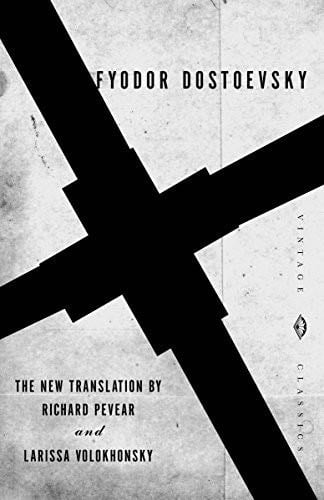
<p>Richard Pevear and Larissa Volokhonsky’s masterful translation of <b>The Idiot</b> is destined to stand with their versions of <b>Crime and Punishment, The Brothers Karamazov</b><i>, </i>and <b>Demons</b> as the definitive Dostoevsky in English.<br><br>After his great portrayal of a guilty man in <b>Crime and Punishment</b><i>,</i> Dostoevsky set out in <b>The Idiot</b> to portray a man of pure innocence. The twenty-six-year-old Prince Myshkin, following a stay of several years in a Swiss sanatorium, returns to Russia to collect an inheritance and “be among people.” Even before he reaches home he meets the dark Rogozhin, a rich merchant’s son whose obsession with the beautiful Nastasya Filippovna eventually draws all three of them into a tragic denouement. In Petersburg the prince finds himself a stranger in a society obsessed with money, power, and manipulation. Scandal escalates to murder as Dostoevsky traces the surprising effect of this “positively beautiful man” on the people around him, leading to a final scene that is one of the most powerful in all of world literature.</p>
