beautiful philosophy

Items in this hypelist
Books

What Is It Like to Be a Bat?
Thomas Nagel · 2024
<strong>A 50th anniversary edition of one of the most widely influential articles of 20th Century philosophy</strong>?Consciousness is what makes the mind-body problem really intractable.? So begins Thomas Nagel's classic 1974 essay ?What is it Like to be a Bat?? Nagel's essay initiated the now widespread attention to consciousness as a central problem for philosophy, psychology, and neuroscience; it also influenced the recognition of the consciousness of nonhuman creatures as an important subject of study. Nagel argued that the essential subjectivity of conscious experience--what it is like for the creature undergoing it--means that reductionist theories of mind, which attempt to analyze it in physical terms, can never succeed. It follows that the physical sciences cannot provide a complete description of reality, and that the physical conception of objective reality must be transcended if science is going to comprehend the mind. This edition reissues this classic and widely influential article on its 50th anniversary, along with a new preface discussing the origins and influence of the essay, as well as ?Further Thoughts: The Psychophysical Nexus,? a supplementary essay which describes Nagel's later thoughts about how to respond to the problem posed by ?What Is It Like to Be a Bat?? This second essay suggests that the most promising path forward for the mind-body problem, if one accepts the irreducible subjectivity of consciousness, is to seek a necessary connection between mental and neurophysiogical states through a more fundamental type of state which is neither mental nor physical but necessitates them both as essential aspects. In other words, a state that is physical from the outside and mental from the inside, just as we are. This would be a form of monism, requiring the formation of new concepts, since our present concepts of the mental and the physical do not entail such a necessary connection. The essay explains why the relation between the mental and the physical may be necessary, even though our present concepts make it appear contingent.

Beyond Good and Evil
Friedrich Nietzsche · 2018

The Myth of Sisyphus
Albert Camus · 2018
A Nobel Prize-winning author delivers one of the most influential works of the twentieth century, showing a way out of despair and reaffirming the value of existence.<br/><br/>Influenced by works such as Don Juan and the novels of Kafka, these essays begin with a meditation on suicide—the question of living or not living in a universe devoid of order or meaning. With lyric eloquence, Albert Camus brilliantly presents a crucial exposition of existentialist thought.

Nausea
Jean-Paul Sartre · 1969
The diary of Antoine Roquentin follows his thoughts as he gradually sinks into a metaphysical crisis of despair, in this the first novel by the leader of French Existentialism

Meditations
Marcus Aurelius · 2006
A clear and eloquent leading translation of the Roman emperor’s reflections of human life and death, timeless Stoic philosophy that inspires countless others including The Daily Stoic author Ryan Holiday to use philosophy as a tool for self-improvement and resilience to live a better life<br/><br/>Written in Greek by an intellectual Roman emperor without any intention of publication, the Meditations of Marcus Aurelius offer a wide range of fascinating spiritual reflections and exercises developed as the leader struggled to understand himself and make sense of the universe. Spanning from doubt and despair to conviction and exaltation, they cover such diverse topics as the question of virtue, human rationality, the nature of the gods and the values of leadership. But while the Meditations were composed to provide personal consolation, in developing his beliefs Marcus also created one of the greatest of all works of philosophy: a series of wise and practical aphorisms that have been consulted and admired by statesmen, thinkers and ordinary readers for almost two thousand years.<br/><br/>To provide a full understanding of Aurelius's seminal work, this edition includes explanatory notes, a general index, an index of quotations, an index of names, and an introduction by Diskin Clay putting the work in its biographical, historical, and literary context, a chronology of Marcus Aurelius's life and career.<br/><br/>Penguin Classics is the leading publisher of classic literature in the English-speaking world, representing a global bookshelf of the best works throughout history and across genres and disciplines. Readers trust the series to provide authoritative texts enhanced by introductions and notes by distinguished scholars and contemporary authors, as well as up-to-date translations by award-winning translators.
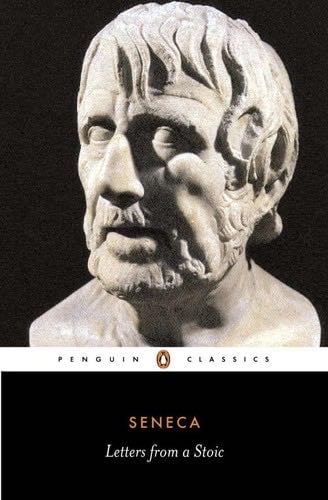
Letters from a Stoic
Lucius Annaeus Seneca · 1969
"It is philosophy that has the duty of protecting us...without it no one can lead a life free of fear or worry."<br/><br/>For several years of his turbulent life, Seneca was the guiding hand of the Roman Empire. His inspired reasoning derived mainly from the Stoic principles, which had originally been developed some centuries earlier in Athens. This selection of Seneca's letters shows him upholding the austere ethical ideals of Stoicism—the wisdom of the self-possessed person immune to overmastering emotions and life’s setbacks—while valuing friendship and the courage of ordinary men, and criticizing the harsh treatment of slaves and the cruelties in the gladiatorial arena. The humanity and wit revealed in Seneca’s interpretation of Stoicism is a moving and inspiring declaration of the dignity of the individual mind.<br/><br/>For more than seventy years, Penguin has been the leading publisher of classic literature in the English-speaking world. With more than 1,700 titles, Penguin Classics represents a global bookshelf of the best works throughout history and across genres and disciplines. Readers trust the series to provide authoritative texts enhanced by introductions and notes by distinguished scholars and contemporary authors, as well as up-to-date translations by award-winning translators.

A Happy Death
Albert Camus · 1995
The first novel from the Nobel Prize-winning author lays the foundation for The Stranger, telling the story of an Algerian clerk who kills a man in cold blood.<br/><br/>In A Happy Death, written when Albert Camus was in his early twenties and retrieved from his private papers following his death in 1960, revealed himself to an extent that he never would in his later fiction. For if A Happy Death is the study of a rule-bound being shattering the fetters of his existence, it is also a remarkably candid portrait of its author as a young man.<br/><br/>As the novel follows the protagonist, Patrice Mersault, to his victim's house -- and then, fleeing, in a journey that takes him through stages of exile, hedonism, privation, and death -it gives us a glimpse into the imagination of one of the great writers of the twentieth century. For here is the young Camus himself, in love with the sea and sun, enraptured by women yet disdainful of romantic love, and already formulating the philosophy of action and moral responsibility that would make him central to the thought of our time.<br/><br/>Translated from the French by Richard Howard

The Stranger
Albert Camus · 1989
With the intrigue of a psychological thriller, The Stranger—Camus's masterpiece—gives us the story of an ordinary man unwittingly drawn into a senseless murder on an Algerian beach. With an Introduction by Peter Dunwoodie; translated by Matthew Ward.<br/><br/>Behind the subterfuge, Camus explores what he termed "the nakedness of man faced with the absurd" and describes the condition of reckless alienation and spiritual exhaustion that characterized so much of twentieth-century life.<br/><br/>“The Stranger is a strikingly modern text and Matthew Ward’s translation will enable readers to appreciate why Camus’s stoical anti-hero and devious narrator remains one of the key expressions of a postwar Western malaise, and one of the cleverest exponents of a literature of ambiguity.” —from the Introduction by Peter Dunwoodie<br/><br/>First published in 1946; now in translation by Matthew Ward.