Libros para entender el siglo 21

Items in this hypelist
Finished

The Narrow Corridor: States, Societies, and the Fate of Liberty
Daron Acemoglu, James A. Robinson · 2019
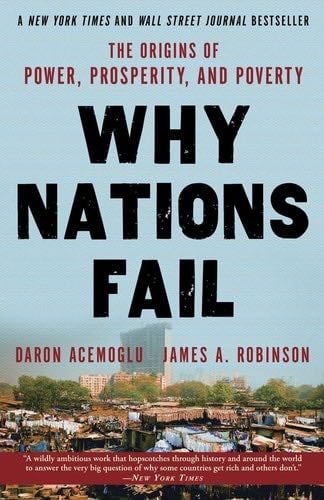
Why Nations Fail: The Origins of Power, Prosperity, and Poverty
Daron Acemoglu, James A. Robinson · 2013
Brilliant and engagingly written, Why Nations Fail answers the question that has stumped the experts for centuries: Why are some nations rich and others poor, divided by wealth and poverty, health and sickness, food and famine?<br/><br/>Is it culture, the weather, geography? Perhaps ignorance of what the right policies are?<br/><br/>Simply, no. None of these factors is either definitive or destiny. Otherwise, how to explain why Botswana has become one of the fastest growing countries in the world, while other African nations, such as Zimbabwe, the Congo, and Sierra Leone, are mired in poverty and violence?<br/><br/>Daron Acemoglu and James Robinson conclusively show that it is man-made political and economic institutions that underlie economic success (or lack of it). Korea, to take just one of their fascinating examples, is a remarkably homogeneous nation, yet the people of North Korea are among the poorest on earth while their brothers and sisters in South Korea are among the richest. The south forged a society that created incentives, rewarded innovation, and allowed everyone to participate in economic opportunities.<br/><br/>The economic success thus spurred was sustained because the government became accountable and responsive to citizens and the great mass of people. Sadly, the people of the north have endured decades of famine, political repression, and very different economic institutions—with no end in sight. The differences between the Koreas is due to the politics that created these completely different institutional trajectories.<br/><br/>Based on fifteen years of original research Acemoglu and Robinson marshall extraordinary historical evidence from the Roman Empire, the Mayan city-states, medieval Venice, the Soviet Union, Latin America, England, Europe, the United States, and Africa to build a new theory of political economy with great relevance for the big questions of today, including:<br/><br/>- China has built an authoritarian growth machine. Will it continue to grow at such high speed and overwhelm the West?<br/><br/>- Are America’s best days behind it? Are we moving from a virtuous circle in which efforts by elites to aggrandize power are resisted to a vicious one that enriches and empowers a small minority?<br/><br/>- What is the most effective way to help move billions of people from the rut of poverty to prosperity? More philanthropy from the wealthy nations of the West? Or learning the hard-won lessons of Acemoglu and Robinson’s breakthrough ideas on the interplay between inclusive political and economic institutions?<br/><br/>Why Nations Fail will change the way you look at—and understand—the world.
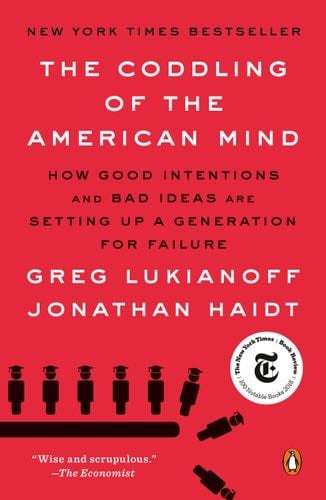
The Coddling of the American Mind: How Good Intentions and Bad Ideas Are Setting Up a Generation for Failure
Greg Lukianoff, Jonathan Haidt · 2019
New York Times Bestseller • Finalist for the 2018 National Book Critics Circle Award in Nonfiction • A New York Times Notable Book • Bloomberg Best Book of 2018 • One of Bill Gates’s Top Five Books of All Time<br/><br/>“Their distinctive contribution to the higher-education debate is to meet safetyism on its own, psychological turf . . . Lukianoff and Haidt tell us that safetyism undermines the freedom of inquiry and speech that are indispensable to universities.” —Jonathan Marks, Commentary<br/><br/>“The remedies the book outlines should be considered on college campuses, among parents of current and future students, and by anyone longing for a more sane society.” —Pittsburgh Post-Gazette<br/><br/>Something has been going wrong on many college campuses in the last few years. Speakers are shouted down. Students and professors say they are walking on eggshells and are afraid to speak honestly. Rates of anxiety, depression, and suicide are rising—on campus as well as nationally. How did this happen?<br/><br/>First Amendment expert Greg Lukianoff and social psychologist Jonathan Haidt, author of The Anxious Generation, show how the new problems on campus have their origins in three terrible ideas that have become increasingly woven into American childhood and education: What doesn’t kill you makes you weaker; always trust your feelings; and life is a battle between good people and evil people. These three Great Untruths contradict basic psychological principles about well-being and ancient wisdom from many cultures. Embracing these untruths—and the resulting culture of safetyism—interferes with young people’s social, emotional, and intellectual development. It makes it harder for them to become autonomous adults who are able to navigate the bumpy road of life.<br/><br/>Lukianoff and Haidt investigate the many social trends that have intersected to promote the spread of these untruths. They explore changes in childhood such as the rise of fearful parenting, the decline of unsupervised, child-directed play, and the new world of social media that has engulfed teenagers in the last decade. They examine changes on campus, including the corporatization of universities and the emergence of new ideas about identity and justice. They situate the conflicts on campus within the context of America’s rapidly rising political polarization and dysfunction.<br/><br/>This is a book for anyone who is confused by what is happening on college campuses today, or has children, or is concerned about the growing inability of Americans to live, work, and cooperate across party lines.

The Anxious Generation
Jonathan Haidt · 2024

The Righteous Mind: Why Good People Are Divided by Politics and Religion
Jonathan Haidt · 2013

Mago Del Kremlin (biblioteca Formentor) - Da Empoli Giulian
Da Empoli, Giuliano
To Read

Los Ingenieros del Caos
Giuliano da Empoli · 2020
Reading

The Revolt of The Public and the Crisis of Authority in the New Millenium
Martin Gurri · 2018