história da arte

Items in this hypelist
Livros
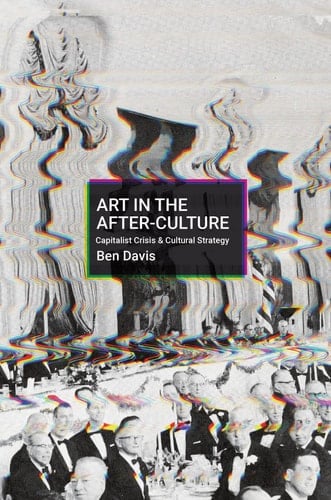
Art in the After-Culture: Capitalist Crisis and Cultural Strategy
Ben Davis · 2022
“This kaleidoscopic collection will help you see and comprehend the world anew—which is, in my book, what good art should do.”<br/>—Astra Taylor<br/><br/>It is a scary and disorienting time for art, as it is a scary and disorienting time in general. Aesthetic experience is both overshadowed by the spectacle of current events and pressed into new connection with them. The self-image of art as a social good is collapsing under the weight of capitalism’s dysfunction.<br/>In these incisive essays, art critic Ben Davis makes sense of our extreme present as an emerging "after-culture"—a culture whose forms and functions are being radically reshaped by cataclysmic events. In the face of catastrophe, he holds out hope that reckoning with the new realities of art, technology, activism, and the media, can help us weather the super-storms of the future.

Against Charity (Counterpunch)
Julie Wark, Daniel Raventós · 2018

Wages Against Artwork
Leigh Claire La Berge · 2019

Artificial Hells: Participatory Art and the Politics of Spectatorship
Claire Bishop · 2012
<b>This searing critique of participatory art—from its development to its political ambitions—is “an essential title for contemporary art history scholars and students as well as anyone who has . . . thought, ‘Now that’s art!’ or ‘That’s art?’” (</b><i><b>Library Journal</b></i><b>)</b><br> <br> Since the 1990s, critics and curators have broadly accepted the notion that participatory art is the ultimate political art: that by encouraging an audience to take part an artist can promote new emancipatory social relations. Around the world, the champions of this form of expression are numerous, ranging from art historians such as Grant Kester, curators such as Nicolas Bourriaud and Nato Thompson, to performance theorists such as Shannon Jackson.<br><br> <i>Artificial Hells</i> is the first historical and theoretical overview of socially engaged participatory art, known in the US as “social practice.” Claire Bishop follows the trajectory of twentieth-century art and examines key moments in the development of a participatory aesthetic. This itinerary takes in Futurism and Dada; the Situationist International; Happenings in Eastern Europe, Argentina and Paris; the 1970s Community Arts Movement; and the Artists Placement Group. It concludes with a discussion of long-term educational projects by contemporary artists such as Thomas Hirschhorn, Tania Bruguera, Pawel Althamer and Paul Chan.<br><br> Since her controversial essay in <i>Artforum</i> in 2006, Claire Bishop has been one of the few to challenge the political and aesthetic ambitions of participatory art. In <i>Artificial Hells</i>, she not only scrutinizes the emancipatory claims made for these projects, but also provides an alternative to the ethical (rather than artistic) criteria invited by such artworks. Artificial Hells calls for a less prescriptive approach to art and politics, and for more compelling, troubling, and bolder forms of participatory art and criticism.

Keep Walking Intently: The Ambulatory Art of the Surrealists, the Situationist International, and Fluxus (Sternberg Press)
Lori Waxman · 2017

Leaving The Twentieth Century
McKenzie Wark · 2024

Diante da Imagem (Em Portuguese do Brasil)
Georges Didi-Huberman · 2013
Historiadores

Erwin Panofsky
Art

Accion del Encierro, Graciela Carnevale
A arte como ação da realidade, não como representação da realidade. A arte não está nos museus e sim nas ruas.