
philosophy books i want to read

Items in this hypelist
Books

The Pig That Wants to Be Eaten: 100 Experiments for the Armchair Philosopher
Julian Baggini · 2006
Perfect for gifting to lovers of philosophy or mining intelligent ice-breaker topics for your next party, The Pig That Wants to Be Eaten offers one hundred philosophical puzzles that stimulate thought on a host of moral, social, and personal dilemmas. Taking examples from sources as diverse as Plato and Steven Spielberg, author Julian Baggini presents abstract philosophical issues in concrete terms, suggesting possible solutions while encouraging readers to draw their own conclusions:<br/>Lively, clever, and thought-provoking, The Pig That Wants to Be Eaten is a portable feast for the mind that is sure to satisfy any intellectual appetite.

Beloved
Toni Morrison · 2004
PULITZER PRIZE WINNER • NEW YORK TIMES BESTSELLER • A spellbinding novel that transforms history into a story as powerful as Exodus and as intimate as a lullaby. With a new afterword by the author.<br/><br/>This "brutally powerful, mesmerizing story” (People) is an unflinchingly look into the abyss of slavery, from the acclaimed Nobel Prize winner.<br/><br/>Sethe was born a slave and escaped to Ohio, but eighteen years later she is still not free. Sethe has too many memories of Sweet Home, the beautiful farm where so many hideous things happened. And Sethe’s new home is haunted by the ghost of her baby, who died nameless and whose tombstone is engraved with a single word: Beloved.<br/><br/>“A masterwork.... Wonderful.... I can’t imagine American literature without it.” —John Leonard, Los Angeles Times

Existentialism From Dostoevsky To Sartre
Walter Arnold Kaufmann · 2016
What is Existentialism? It is perhaps the most misunderstood of modern philosophic positions—misunderstood by reason of its broad popularity and general unfamiliarity with its origins, representatives, and principles. Existential thinking does not originate with Jean Paul Sartre. It has prior religious, literary, and philosophic origins. In its narrowest formulation it is a metaphysical doctrine, arguing as it does that any definition of man's essence must follow, not precede, an estimation of his existence. In Heidegger, it affords a view of Being in its totality; in Kierkegaard an approach to that inwardness indispensable to authentic religious experience; for Dostoevsky, Kafka, and Rilke the existential situation bears the stamp of modern man's alienation, uprootedness, and absurdity; to Sartre it has vast ethical and political implications. Walter Kaufmann, author of Nietzsche, is eminently qualified to present and interpret the insights of existentialism as they occur and are deepened by the major thinkers who express them. In every case complete selections or entire works have been employed: The Wall, Existentialism, and the complete chapter on "Self-Deception" from L'être et le Néant by Sartre; two lectures from Jaspers' book Reason and Existenz; original translations of On My Philosophy by Jaspers and The Way Back into the Ground of Metaphysics by Heidegger. There is, as well, material from Dostoevsky, Kierkegaard, Nietzsche, Rilke, and Camus.

The Stranger
Albert Camus · 1989
With the intrigue of a psychological thriller, The Stranger—Camus's masterpiece—gives us the story of an ordinary man unwittingly drawn into a senseless murder on an Algerian beach. With an Introduction by Peter Dunwoodie; translated by Matthew Ward.<br/><br/>Behind the subterfuge, Camus explores what he termed "the nakedness of man faced with the absurd" and describes the condition of reckless alienation and spiritual exhaustion that characterized so much of twentieth-century life.<br/><br/>“The Stranger is a strikingly modern text and Matthew Ward’s translation will enable readers to appreciate why Camus’s stoical anti-hero and devious narrator remains one of the key expressions of a postwar Western malaise, and one of the cleverest exponents of a literature of ambiguity.” —from the Introduction by Peter Dunwoodie<br/><br/>First published in 1946; now in translation by Matthew Ward.

Euthyphro: Plato (Classic Plato)
Plato · 2018

You're Not Listening
Kate Murphy · 2021
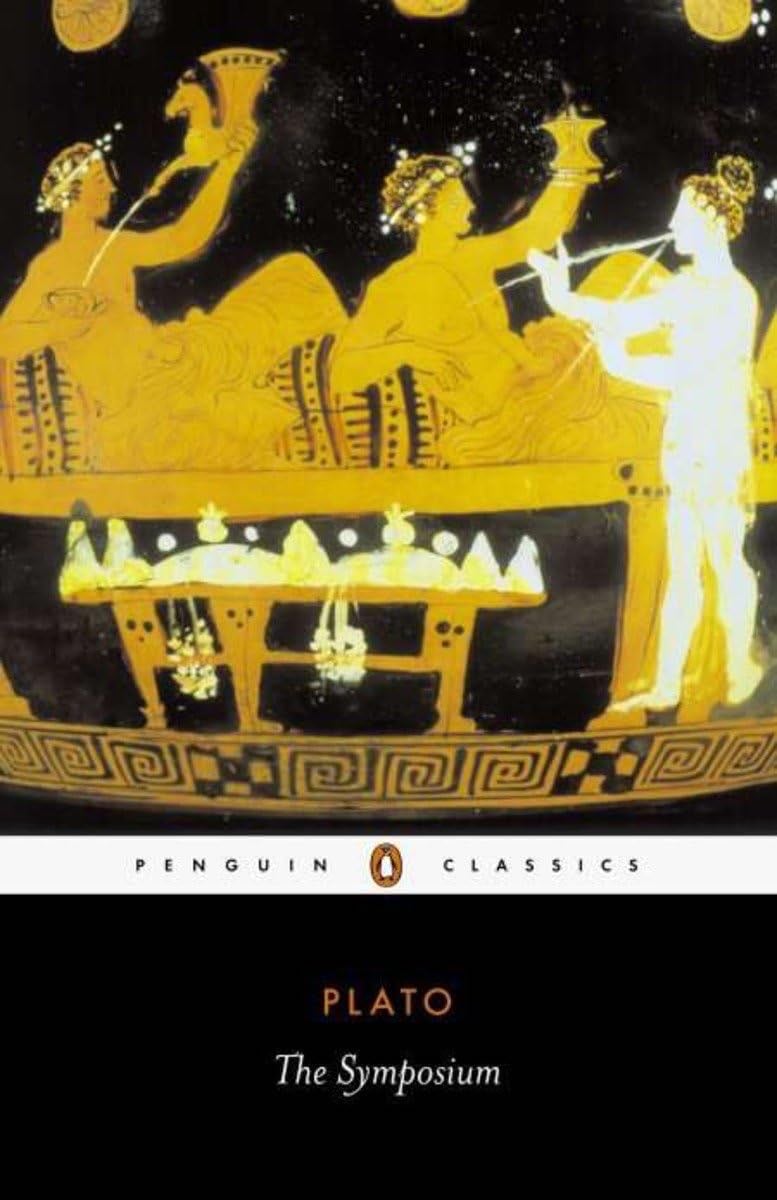
The Symposium (Penguin Classics)
Plato · 2003
A fascinating discussion on sex, gender, and human instincts, as relevant today as ever<br/><br/>In the course of a lively drinking party, a group of Athenian intellectuals exchange views on eros, or desire. From their conversation emerges a series of subtle reflections on gender roles, sex in society and the sublimation of basic human instincts. The discussion culminates in a radical challenge to conventional views by Plato's mentor, Socrates, who advocates transcendence through spiritual love. The Symposium is a deft interweaving of different viewpoints and ideas about the nature of love—as a response to beauty, a cosmic force, a motive for social action and as a means of ethical education.<br/><br/>For more than seventy years, Penguin has been the leading publisher of classic literature in the English-speaking world. With more than 1,700 titles, Penguin Classics represents a global bookshelf of the best works throughout history and across genres and disciplines. Readers trust the series to provide authoritative texts enhanced by introductions and notes by distinguished scholars and contemporary authors, as well as up-to-date translations by award-winning translators.